

中华护理杂志 ›› 2026, Vol. 61 ›› Issue (1): 30-37.DOI: 10.3761/j.issn.0254-1769.2026.01.004
高维杰*( ), 孙玉梅
收稿日期:2025-08-05
出版日期:2026-01-10
发布日期:2026-01-04
*通讯作者:
高维杰,女,硕士,讲师,E-mail:xiaoxiao1kaixin@sina.com作者简介:本文作者:高维杰
基金资助:
GAO Weijie*(), SUN Yumei
Received:2025-08-05
Online:2026-01-10
Published:2026-01-04
* Corresponding author:
GAO Weijie,E-mail:xiaoxiao1kaixin@sina.comFunding program:摘要:
目的 系统识别失智老年人及其照顾者使用喘息服务的障碍因素,为优化喘息服务供给策略提供参考。 方法 检索国内外8个中英文数据库,筛选2011年1月—2025年9月发表的关于失智老年人及照顾者使用喘息服务障碍因素的质性研究及混合研究。采用混合方法评价工具进行文献质量评价,并以Levesque服务可及性理论为框架,对结果进行整合。 结果 共纳入34篇文献,提取出150个研究结果,归纳形成25个障碍因素,被归纳至可接近性与感知能力(5个因素)、可接受性与寻找能力(6个因素)、可获得性与到达能力(5个因素)、可负担性与支付能力(3个因素)、适宜性与参与能力(6个因素)5个维度中。 结论 喘息服务的使用受多重障碍因素的制约,建议相关部门从信息传播、知识普及、文化适配、观念更新、资源优化、经济支持与服务品质提升等多方面综合施策,进而提高目标人群的生活质量。
高维杰, 孙玉梅. 失智老年人及其照顾者使用喘息服务障碍因素的Meta整合[J]. 中华护理杂志, 2026, 61(1): 30-37.
GAO Weijie, SUN Yumei. Barriers to the use of respite care by home-dwelling older adults with dementia and family caregivers:a meta-synthesis[J]. Chinese Journal of Nursing, 2026, 61(1): 30-37.
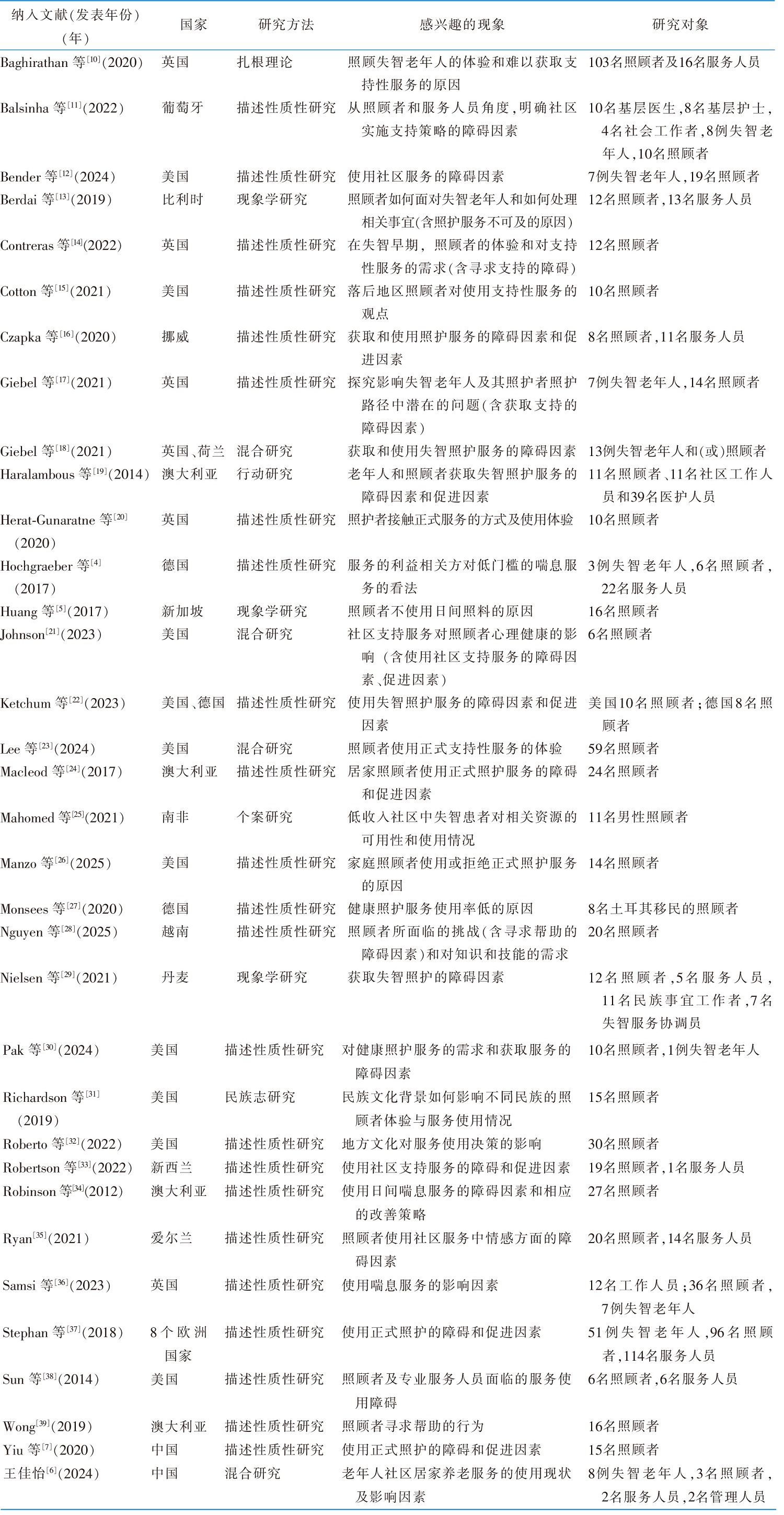 |
表1 纳入文献的基本特征(n=34)
Table 1 The basic characteristics of the included literature(n=34)
| |
| [1] |
Yin YH, Tam HL, Quint J, et al. Epidemiology of dementia in China in 2010-2020:a systematic review and meta-analysis[J]. Healthcare, 2024, 12(3):334.
DOI URL |
| [2] |
王洋, 顾艳荭, 龙德超, 等. 老年痴呆患者家庭照顾者创伤后成长现状及影响因素的混合研究[J]. 中华护理杂志, 2025, 60(17):2087-2094.
DOI |
| Wang Y, Gu YH, Long DC, et al. Posttraumatic growth status and influencing factors among family caregivers of patients with dementia:a mixed-methods study[J]. Chin J Nurs, 2025, 60(17):2087-2094. | |
| [3] | Zhang HY, Yin M, Nan X, et al. In-home respite care in dementia:an evolutionary concept analysis[J]. Int J Nurs Sci, 2025, 12(4):352-360. |
| [4] |
Hochgraeber I, von Kutzleben M, Bartholomeyczik S, et al. Low-threshold support services for people with dementia within the scope of respite care in Germany:a qualitative study on different stakeholders’ perspective[J]. Dementia, 2017, 16(5):576-590.
DOI URL |
| [5] |
Huang S, Griva K, Bryant CA, et al. Non-use of day care services for dementia in Singapore:a dilemma for caregivers[J]. Int Psychogeriatr, 2017, 29(3):455-466.
DOI PMID |
| [6] | 王佳怡. 上海市认知障碍老人社区居家养老服务利用及影响因素研究:以长宁区为例[D]. 上海: 上海师范大学, 2024. |
| Wang JY. Study on the utilization and influencing factors of community home care services for the elderly with cognitive impairment in Shanghai:taking Changning district as an example[D]. Shanghai: Shanghai Normal University, 2024. | |
| [7] |
Yiu HC, Zang YL, Chau JPC. Barriers and facilitators in the use of formal dementia care for dementia sufferers:a qualitative study with Chinese family caregivers in Hong Kong[J]. Geriatr Nurs, 2020, 41(6):885-890.
DOI URL |
| [8] | Levesque JF, Harris MF, Russell G. Patient-centred access to health care:conceptualising access at the interface of health systems and populations[J]. Int J Equity Health, 2013,12:18. |
| [9] |
廖星, 胡瑞学, 李博, 等. 混合方法研究评价工具的介绍:MMAT[J]. 中国全科医学, 2021, 24(31):4015-4020.
DOI |
| Liao X, Hu RX, Li B, et al. An introduction to mixed methods appraisal tool[J]. Chin Gen Pract, 2021, 24(31):4015-4020. | |
| [10] |
Baghirathan S, Cheston R, Hui R, et al. A grounded theory analysis of the experiences of carers for people living with dementia from three BAME communities:balancing the need for support against fears of being diminished[J]. Dementia, 2020, 19(5):1672-1691.
DOI URL |
| [11] | Balsinha C, Iliffe S, Dias S, et al. Dementia and primary care teams:obstacles to the implementation of Portugal’s dementia strategy[J]. Prim Health Care Res Dev, 2022,23:e10. |
| [12] |
Bender AA, Pier E, Moore M, et al. Barriers to community service use among persons with dementia and their care partners:a focus on consumers of a novel statewide dementia care program[J]. J Appl Gerontol, 2024, 43(5):612-622.
DOI URL |
| [13] |
Berdai Chaouni S, De Donder L. Invisible realities:caring for older Moroccan migrants with dementia in Belgium[J]. Dementia, 2019, 18(7/8):3113-3129.
DOI URL |
| [14] |
Contreras M, Mioshi E, Kishita N. What are the educational and support needs of family carers looking after someone in the early stages of Alzheimer’s disease? A qualitative retrospective approach[J]. Health Soc Care Community, 2022, 30(5):1726-1734.
DOI URL |
| [15] |
Cotton QD, Kind AJH, Kim AJ, et al. Dementia caregivers’ experiences engaging supportive services while residing in under-resourced areas[J]. J Alzheimers Dis, 2021, 84(1):169-177.
DOI URL |
| [16] |
Czapka EA, Sagbakken M. “It is always me against the Norwegian system.”Barriers and facilitators in accessing and using dementia care by minority ethnic groups in Norway:a qualitative study[J]. BMC Health Serv Res, 2020, 20(1):954.
DOI |
| [17] |
Giebel C, Sutcliffe C, Darlington-Pollock F, et al. Health inequities in the care pathways for people living with young- and late-onset dementia:from pre-COVID-19 to early pandemic[J]. Int J Environ Res Public Health, 2021, 18(2):686.
DOI URL |
| [18] |
Giebel C, Robertson S, Beaulen A, et al. “Nobody seems to know where to even turn to”:barriers in accessing and utilising dementia care services in England and the Netherlands[J]. Int J Environ Res Public Health, 2021, 18(22):12233.
DOI URL |
| [19] |
Haralambous B, Dow B, Tinney J, et al. Help seeking in older Asian people with dementia in Melbourne:using the Cultural Exchange Model to explore barriers and enablers[J]. J Cross Cult Gerontol, 2014, 29(1):69-86.
DOI PMID |
| [20] |
Herat-Gunaratne R, Cooper C, Mukadam N, et al. “In the Bengali vocabulary,there is No such word as care home”:caring experiences of UK Bangladeshi and Indian family carers of people living with dementia at home[J]. Gerontologist, 2020, 60(2):331-339.
DOI PMID |
| [21] | Johnson FU. Examining the relationship between community-based support services use and mental health in black family caregivers of persons living with dementia[D]. Michigan: University of Michigan, 2023. |
| [22] |
Ketchum FB, Monsees J, Kim AJ, et al. Pathways of care:a qualitative study of barriers and facilitators to engaging dementia care among underserved and minority populations in the US and Germany[J]. Aging Ment Health, 2023, 27(2):389-398.
DOI URL |
| [23] | Lee K, Cassidy J, Lee JH, et al. Examining utilization of formal supports and related impacts on overall well-being among east Asian American family caregivers of persons with dementia:a mixed-methods study[J]. Gerontologist, 2024, 64(2):gnad086. |
| [24] |
MacLeod A, Tatangelo G, McCabe M, et al. “There isn’t an easy way of finding the help that’s available.” Barriers and facilitators of service use among dementia family caregivers:a qualitative study[J]. Int Psychogeriatr, 2017, 29(5):765-776.
DOI URL |
| [25] |
Mahomed A, Pretorius C. Availability and utilization of support services for South African male caregivers of people with Alzheimer’s disease in low-income communities[J]. Dementia, 2021, 20(2):633-652.
DOI URL |
| [26] | Manzo AA, Segundo J, Britton M, et al. Equitable formal care access:examining processes for Hispanic/Latino family dementia caregivers’ decision-making[J]. Gerontologist, 2025, 65(8):gnaf168. |
| [27] |
Monsees J, Schmachtenberg T, Hoffmann W, et al. Dementia in people with a Turkish migration background:experiences and utilization of healthcare services[J]. J Alzheimers Dis, 2020, 77(2):865-875.
DOI URL |
| [28] |
Nguyen TTT, Than THN, Nguyen TC, et al. Challenges,knowledge,and skills required for family caregivers of older adults with dementia:a qualitative study in Vietnam[J]. Glob Health Action, 2025, 18(1):2526929.
DOI URL |
| [29] |
Nielsen TR, Nielsen DS, Waldemar G. Barriers in access to dementia care in minority ethnic groups in Denmark:a qualitative study[J]. Aging Ment Health, 2021, 25(8):1424-1432.
DOI URL |
| [30] |
Pak A, Demanes A, Wu S, et al. Informing dementia support programs that serve low-income,multilingual communities in a safety net health system:use of focus groups to identify specific needs[J]. Geriatrics, 2024, 9(2):33.
DOI URL |
| [31] |
Richardson VE, Fields N, Won S, et al. At the intersection of culture:ethnically diverse dementia caregivers’ service use[J]. Dementia, 2019, 18(5):1790-1809.
DOI URL |
| [32] |
Roberto KA, Savla J, McCann BR, et al. Dementia family caregiving in rural Appalachia:a sociocultural model of care decisions and service use[J]. J Gerontol B Psychol Sci Soc Sci, 2022, 77(6):1094-1104.
DOI URL |
| [33] |
Robertson KJ, Thyne M, Matheson I. Barriers and facilitators of using dementia community support services provided by an Alzheimers organisation:perceptions of informal caregivers receiving services[J]. Health Soc Care Community, 2022, 30(6):2353-2361.
DOI PMID |
| [34] |
Robinson A, Lea E, Hemmings L, et al. Seeking respite:issues around the use of day respite care for the carers of people with dementia[J]. Ageing Soc, 2012, 32(2):196-218.
DOI URL |
| [35] | Ryan L. Accessing community dementia care services in Ireland:emotional barriers for caregivers[J]. Health Soc Care Com-munity, 2021, 29(6):1980-1989. |
| [36] |
Samsi K, Orellana K, Cole L, et al. Understanding factors influencing residential respite service use by carers of people living with dementia using Andersen’s behavioural model of health services use:a qualitative study[J]. Aging Ment Health, 2023, 27(10):1946-1955.
DOI URL |
| [37] |
Stephan A, Bieber A, Hopper L, et al. Barriers and facilitators to the access to and use of formal dementia care:findings of a focus group study with people with dementia,informal carers and health and social care professionals in eight European countries[J]. BMC Geriatr, 2018, 18(1):131.
DOI PMID |
| [38] |
Sun F, Mutlu A, Coon D. Service barriers faced by Chinese American families with a dementia relative:perspectives from family caregivers and service professionals[J]. Clin Gerontol, 2014, 37(2):120-138.
DOI URL |
| [39] | Wong SL. Help-seeking behaviour of Chinese carers of people living with dementia[D]. Sydney: University of Technology Sydney, 2019. |
| [40] |
尹晓彤, 朱蓝玉, 李春映. 四元联动整合照护在老年失智症患者中的应用进展[J]. 中华护理杂志, 2020, 55(12):1890-1896.
DOI |
| Yin XT, Zhu LY, Li CY. Application progress of quaternary linkage integrated care in elderly patients with dementia[J]. Chin J Nurs, 2020, 55(12):1890-1896. | |
| [41] |
左顺利, 吴建炜, 郭军, 等. 中国澳门地区失智症照护管理师的培养及启示[J]. 中华护理杂志, 2024, 59(6):764-769.
DOI |
| Zuo SL, Wu JW, Guo J, et al. Training and implications of dementia care managers in Macao,China[J]. Chin J Nurs, 2024, 59(6):764-769. | |
| [42] |
邓艺帆, 王建宁, 彭梦婷, 等. 决策辅助工具在失智症患者照护中应用的范围综述[J]. 中华护理杂志, 2024, 59(6):758-763.
DOI |
| Deng YF, Wang JN, Peng MT, et al. Decision aids for care deci-sion making in dementia patients:a scoping review[J]. Chin J Nurs, 2024, 59(6):758-763. |
| [1] | 中华护理学会静脉输液治疗专业委员会, 北京护理学会, (执笔:李佳, 李旭英, 覃惠英, 陈利芬, 吴珍明, 胡泽吟, 罗梦娜, 范育英, 吴嘉慧, 林宇萍, 王蕾, 孙文彦, 冯毕龙, 高伟, 李亚南, 侯罗娅, 李春燕. 中心静脉通路装置拔除护理专家共识[J]. 中华护理杂志, 2026, 61(9): 1157-1162. |
| [2] | 周霞, 马艳艳, 师正坤, 于海霞, 周艳, 胡红玲, 李莜, 陈思思, 张京慧. 隧道式经股静脉PICC置入术在困难静脉通路婴幼儿中的应用研究[J]. 中华护理杂志, 2026, 61(9): 1163-1170. |
| [3] | 黄萍, 李黎, 郭骊莉, 徐莹, 叶赟, 江淑芳. 与无针输液接头相关的导管相关性血流感染风险评估工具的构建与初步应用[J]. 中华护理杂志, 2026, 61(9): 1171-1179. |
| [4] | 李佳, 张玉玲, 邢乐, 张利峰, 牛秀峰, 许莉. 早产儿经上肢置入PICC尖端继发性异位风险预测模型的建立与验证[J]. 中华护理杂志, 2026, 61(9): 1180-1186. |
| [5] | 何娟, 赵蕾蕾, 叶冠军, 余艳芬, 傅晓君, 周琴. 1例双侧无名静脉及上腔静脉人工血管置换术后患者经上肢置入PICC的护理[J]. 中华护理杂志, 2026, 61(9): 1187-1191. |
| [6] | 梁江淑渊, 曾妃, 何鹏, 谢梦珊, 江悦, 蒋宗恒, 王建茗. 静脉-静脉体外膜肺氧合患者早期活动风险等级评估系统的构建及应用研究[J]. 中华护理杂志, 2026, 61(9): 1192-1199. |
| [7] | 陈晨, 顾肖, 郭凡, 王敏, 倪兴梅, 黄琴, 程念开. 3种衰弱评估工具对急诊老年创伤患者不良结局的预测价值[J]. 中华护理杂志, 2026, 61(9): 1200-1207. |
| [8] | 郑煜琳, 刘晋宁, 张静, 郭会敏, 谷艳梅, 张莉莉. 酒精性肝病患者肝移植术后再饮酒现状及其影响因素分析[J]. 中华护理杂志, 2026, 61(9): 1208-1214. |
| [9] | 叶俊霜, 沈丽佳, 孟霞靓, 张玉姣, 蔡根莲, 邵碧云, 周亚辉, 张柳倩, 应金萍. 维持性血液透析患者对口腔衰弱认知和体验的质性研究[J]. 中华护理杂志, 2026, 61(9): 1215-1220. |
| [10] | 王芸姣, 杨玉金, 郑春艳, 彭菲津, 王淑贞, 蒋喜露, 周为民, 王薇, 张娜. 糖尿病下肢动脉硬化闭塞症患者介入术后康复护理方案的构建及应用研究[J]. 中华护理杂志, 2026, 61(9): 1221-1229. |
| [11] | 杨明霞, 安冉, 臧金凤, 李春梅. 老年慢性病共病患者及照护者老老照护能力与自我忽视的相关性分析[J]. 中华护理杂志, 2026, 61(9): 1230-1236. |
| [12] | 梁和静, 许鹊, 史云霞, 祖金美, 黄文静, 杨春旭, 郭明华, 王磊. 颈动脉内膜剥脱术围手术期护理质量评价指标的构建[J]. 中华护理杂志, 2026, 61(9): 1237-1244. |
| [13] | 韩媛媛, 石玉竹, 尚文涵, 么莉. 870所三级甲等医院老年住院患者跌倒伤害发生现状与影响因素分析[J]. 中华护理杂志, 2026, 61(9): 1245-1252. |
| [14] | 夏云芳, 王洪, 崔岱, 付真真, 朱敏. 1例弥漫性毒性甲状腺肿合并超敏反应综合征青少年患者的护理[J]. 中华护理杂志, 2026, 61(9): 1253-1256. |
| [15] | 周益飞, 王海苹, 胡益环, 应莉, 罗松娜. 1例氢氟酸中毒并发呼吸心搏骤停患者的急救护理[J]. 中华护理杂志, 2026, 61(9): 1257-1260. |
| 阅读次数 | ||||||
|
全文 |
|
|||||
|
摘要 |
|
|||||
