

Chinese Journal of Nursing ›› 2025, Vol. 60 ›› Issue (13): 1595-1602.DOI: 10.3761/j.issn.0254-1769.2025.13.010
• Specialist Nursing Practice and Research • Previous Articles Next Articles
LI Hua( ), ZHOU Jing, ZU Baifa, WU Fuchen, YAO Ensheng()
Received:2025-01-16
Online:2025-07-10
Published:2025-07-03
Contact:
YAO Ensheng
李华(), 周静, 祖百法, 吴复琛, 姚恩生()
通讯作者:
姚恩生
作者简介:李华:女,本科(硕士在读),E-mail:2371020637@qq.com
基金资助:LI Hua, ZHOU Jing, ZU Baifa, WU Fuchen, YAO Ensheng. Potential profiling analysis and influencing factors of apathy among stroke patients[J]. Chinese Journal of Nursing, 2025, 60(13): 1595-1602.
李华, 周静, 祖百法, 吴复琛, 姚恩生. 脑卒中患者淡漠症状的潜在剖面及影响因素研究[J]. 中华护理杂志, 2025, 60(13): 1595-1602.
Add to citation manager EndNote|Ris|BibTeX
URL: https://zh.zhhlzzs.com/EN/10.3761/j.issn.0254-1769.2025.13.010
 |
Table 1 Potential profiles of apathy symptoms in stroke patients
| |
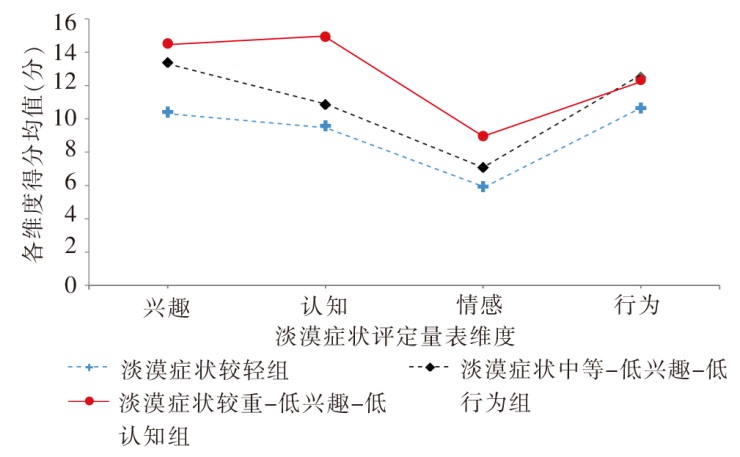
Figure 1 Characteristic distribution of 3 potential profiles of apathy symptoms in stroke patients
 |
Table 2 Univariate analysis of the potential profile of apathy symptoms in stroke patients
|
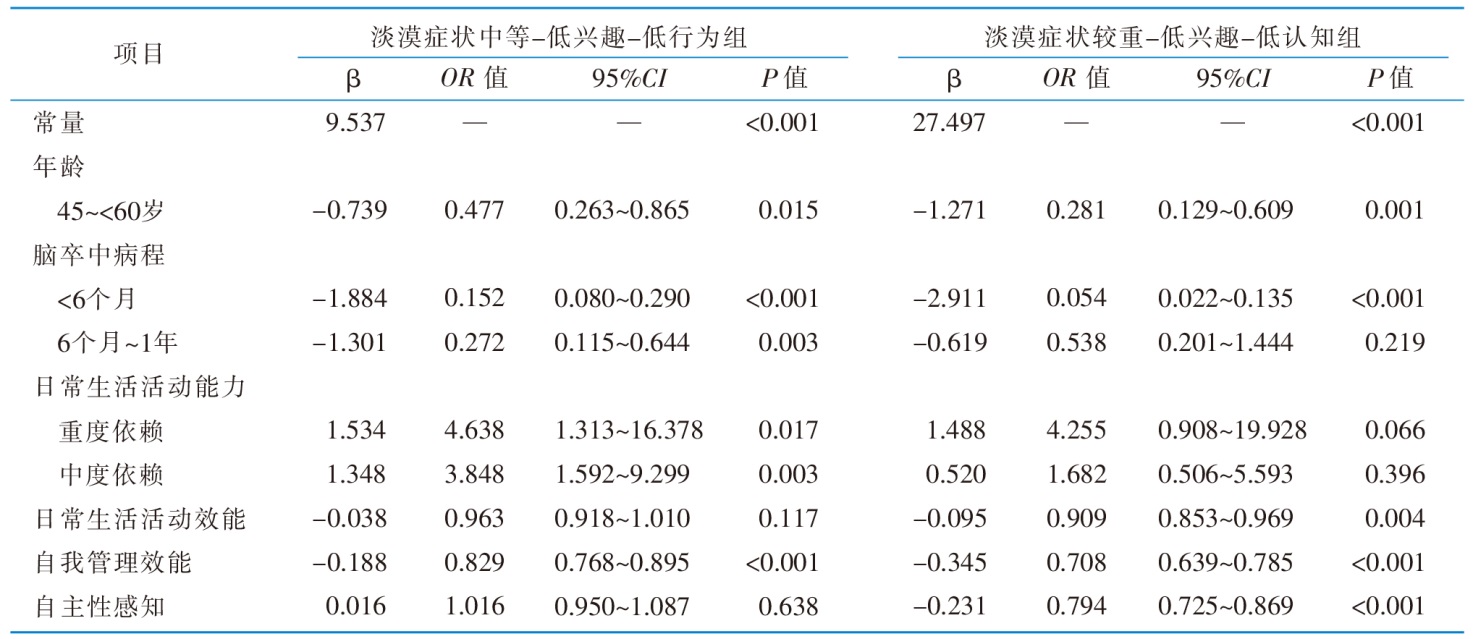 |
Table 3 Logistic regression analysis of the latent categories of apathy symptoms in stroke patients
| |
| [1] | Van Dalen JW, Moll Van Charante EP, Nederkoorn PJ, et al. Post-stroke apathy[J]. Stroke, 2013, 44(3):851-860. |
| [2] | Sagen-Vik U, Finset A, Moum T, et al. The longitudinal course of anxiety,depression and apathy through two years after stroke[J]. J Psychosom Res, 2022, 162:111016. |
| [3] | 谭绍英, 林晓丽, 刘赞, 等. 重复经颅磁刺激联合认知训练对缺血性脑卒中患者淡漠的效果研究[J]. 中华护理杂志, 2023, 58(3):282-288. |
| Tan SY, Lin XL, Liu Z, et al. Effects of repetitive transcranial magnetic stimulation combined with cognitive training in pa-tients with apathy after ischemic stroke[J]. Chin J Nurs, 2023, 58(3):282-288. | |
| [4] | Zhou J, Fangma Y, Chen Z, et al. Post-stroke neuropsychiatric complications:types,pathogenesis,and therapeutic intervention[J]. Aging and Dis, 2023, 14(6):2127-2152. |
| [5] | Horne KS, Gibson EC, Byrne J, et al. Post-stroke apathy:a case series investigation of neuropsychological and lesion characteristics[J]. Neuropsychologia, 2022, 171:108244. |
| [6] | Tay J, Morris RG, Markus HS. Apathy after stroke:diagnosis,mechanisms,consequences,and treatment[J]. Int J Stroke, 2021, 16(5):510-518. |
| [7] | Myhre P, Radakovic R, Ford C. Validation of the self-rated Dimensional Apathy Scale in community stroke survivors[J]. J Neurol Sci, 2022, 434:120103. |
| [8] | 中华医学会神经病学分会, 中华医学会神经病学分会脑血管病学组. 中国各类主要脑血管病诊断要点2019[J]. 中华神经科杂志, 2019, 52(9):710-715. |
| Cerebrovascular Disease Group of the Neurological Branch of the Chinese Medical Association,Chinese Medical Association, Neurological Branch of the Chinese Medical Association. Diagnostic criteria of cerebrovascular diseases in China(version 2019)[J]. Chin J Contemp Neurol Neurosurg, 2019, 52(9):710-715. | |
| [9] | 李树亚, 李峥. 两种淡漠评定量表知情者版的汉化及效度信度检验[J]. 中国心理卫生杂志, 2018, 32(8):656-661. |
| Li SY, Li Z. Validity and reliability of the Chinese version of the Lille Apathy Rating Scale-Informant and the Apathy Evaluation Scale-Informant[J]. Chin Ment Heal J, 2018, 32(8):656-661. | |
| [10] | 倪平, 陈京立, 刘娜. 护理研究中量性研究的样本量估计[J]. 中华护理杂志, 2010, 45(4):378-380. |
| Ni P, Chen JL, Liu N. The sample size estimation hi quantitative nursing research[J]. Chin J Nurs, 2010, 45(4):378-380. | |
| [11] | Marin RS, Biedrzycki RC, Firinciogullari S. Reliability and validity of the Apathy Evaluation Scale[J]. Psychiatry Res, 1991, 38(2):143-162. |
| [12] | Hertz J. The Perceived Enactment of Autonomy Scale:measur-ing the potential forself-care action in the elderly[J]. Diss Abstr Int, 1991(52):1953B. |
| [13] | 王博. 老年患者自主性感知现状及影响因素研究[D]. 山西医科大学, 2018. |
| Wang B. The level and influencing factors of perceived enactment of autonomy among elderly patients[D]. Shanxi Medical University, 2018. | |
| [14] | Jones F, Partridge C, Reid F. The Stroke Self-Efficacy Ques-tionnaire:measuring individual confidence in functional performance after stroke[J]. J Clin Nurs, 2008, 17(7B):244-252. |
| [15] | 李鸿艳, 方亮, 毕瑞雪, 等. 中文版脑卒中康复自我效能量表的信效度研究[J]. 中华护理杂志, 2015, 50(7):790-794. |
| Li HY, Fang L, Bi RX, et al. The reliability and validity of the Chinese version of Stroke Self-Efficacy Questionnaire[J]. Chin J Nurs, 2015, 50(7):790-794. | |
| [16] | 李小峰, 陈敏. 改良Barthel指数评定量表的设计与应用[J]. 护理研究, 2015, 29(13):1657-1658. |
| Li XF, Chen M. Design and application of the Modified Barthel Index Rating Scale[J]. Chin Nurs Res, 2015, 29(13):1657-1658. | |
| [17] | 温璞. 缺血性脑卒中患者急性期情感淡漠的影响因素[J]. 中国健康心理学杂志, 2019, 27(2):199-203. |
| Wen P. The influencing factors of acute apathy in patients with ischemic stroke[J]. Chin J Health Psychol, 2019, 27(2):199-203. | |
| [18] | Li H, Jacob MA, Cai M, et al. Meso-cortical pathway damage in cognition,apathy and gait in cerebral small vessel disease[J]. Brain, 2024, 147(11):3804-3816. |
| [19] | 何福培, 林蓓蕾, 刘雪婷, 等. 缺血性脑卒中患者健康行为决策现状及其影响因素分析[J]. 中华护理杂志, 2024, 59(18):2222-2229. |
| He FP, Lin BL, Liu XT, et al. Current situation of the health behavioral decision making in ischemic stroke patients and its influencing factors analysis[J]. Chin J Nurs, 2024, 59(18):2222-2229. | |
| [20] | Quang H, McDonald S, Huynh-Le P, et al. Apathy in a high prevalence population of moderate to severe traumatic brain injury:an investigation in Vietnam[J]. Neuropsychology, 2021, 36(1):94-102. |
| [21] | Green SL, Gignac GE, Watson PA, et al. Apathy and depression as predictors of activities of daily living following stroke and traumatic brain injuries in adults:a meta-analysis[J]. Neu-ropsychol Rev, 2022, 32(1):51-69. |
| [22] | Tay J, Tuladhar AM, Hollocks MJ, et al. Apathy is associated with large-scale white matter network disruption in small vessel disease[J]. Neurology, 2019, 92(11):e1157-e1167. |
| [23] | 王冬华, 罗艳, 周通, 等. 农村老年慢性病病人老化态度、自主性感知现状及其影响因素研究[J]. 护理研究, 2020, 34(14):2563-2566. |
| Wang DH, Luo Y, Zhou T, et al. Study on attitudes to aging perception status of autonomy and influencing factors of rural elderly patients with chronic diseases[J]. Chin Nurs Res, 2020, 34(14):2563-2566. |
| [1] | HUANG Panpan, LI Liling, HU Xiaojing. Research progress of early exercise rehabilitation in infants with congenital heart disease [J]. Chinese Journal of Nursing, 2025, 60(9): 1050-1055. |
| [2] | CHEN Liou, ZHANG Wenting, LIU Junqi, WANG Yuncong, WANG Zhenlin, QI Sai, YANG Na. Study on the effect of pulmonary lobes surface projection localization combined with pulmonary segment drainage and sputum expectoration technique on airway clearance in patients with aspiration pneumonia [J]. Chinese Journal of Nursing, 2025, 60(9): 1056-1061. |
| [3] | YANG Nana, CHENG Chuanli, ZENG Hui, FU Dandan, WANG Yan, CHEN Yue, RAN Hongmin, FAN Hongjing, LONG Xia. Evaluation of the effect of graded exercise rehabilitation on patients with acute exacerbation of chronic obstructive pulmonary disease [J]. Chinese Journal of Nursing, 2025, 60(9): 1062-1067. |
| [4] | CAO Yun, SUN Guozhen, CHEN Feng, JI Xueli, YAN Mengwan, JING Lei, QIAN Kun. A study of modified ankle pump exercise in stroke patients [J]. Chinese Journal of Nursing, 2025, 60(9): 1068-1074. |
| [5] | XIE Min, QI Wenkai, YIN Ling, ZHANG Xuan, ZHAO Ruqin. Potential profile analysis and influencing factors of kinesiophobia in patients with peritoneal dialysis [J]. Chinese Journal of Nursing, 2025, 60(9): 1080-1086. |
| [6] | CHEN Bingqian, ZHAO Bin, SUN Jiarong, HAO Sifang, HOU Xiaoli. Oral health management dilemmas of chronic periodontitis patients with implant dentures:a qualitative study [J]. Chinese Journal of Nursing, 2025, 60(9): 1087-1092. |
| [7] | QIN Chunlan, WU Zhenyun, QIAN Hongying, ZHAO Qian, SUN Jinting. Experiences of disease self-control among patients with chronic obstructive pulmonary disease:a qualitative study [J]. Chinese Journal of Nursing, 2025, 60(9): 1093-1098. |
| [8] | LI Ziwei, FENG Lijuan, CHEN Xusheng, HUANG Yi, YANG Jie. Development and application of a Fear of Movement Assessment Scale for patients with peripherally inserted central catheters [J]. Chinese Journal of Nursing, 2025, 60(9): 1099-1106. |
| [9] | CHENG Zhiqiang, ZHANG Baozhen, TANG Liping, LI Jing, XIA Jiaoyun, WEI Xueyan, GONG Zhixian, ZHANG Meizhen, LI Lusi. Reliability and validity test of the Chinese version of the Urinary Incontinence Awareness and Attitude Scale [J]. Chinese Journal of Nursing, 2025, 60(9): 1107-1112. |
| [10] | YANG Jing, WANG Huafen, LU Fangyan, BAO Ruijie, ZHU Li. Analysis influencing factors of nutritional status changes in pediatric liver transplant patients and nursing revelation [J]. Chinese Journal of Nursing, 2025, 60(9): 1113-1119. |
| [11] | SHI Meiqin, WU Jianfang, ZHANG Duo, WU Chunping, CHEN Ling, TAO Lei. Nursing care for postoperative laryngeal function rehabilitation in a patient undergoing primary voice prosthesis implantation after total laryngectomy [J]. Chinese Journal of Nursing, 2025, 60(9): 1120-1123. |
| [12] | GU Qian, HUANG Xi, SHI Weixiong, WU Jing, TAN Ruoming, WANG Feng. Nursing care for a patient with cytokine release syndrome following T-cell immunotherapy [J]. Chinese Journal of Nursing, 2025, 60(9): 1124-1127. |
| [13] | ZHOU Miao, CHEN Xing, PENG Fei, SUN Shangxue, LI Yangyang. Systematic review of risk prediction instruments for central line associated bloodstream infections in ICU patients [J]. Chinese Journal of Nursing, 2025, 60(9): 1132-1139. |
| [14] | PENG Yingjie, LIU Aihong, ZHU Wenli, MEI Yuxin, ZHOU Meng, GUAN Wenjing. Systematic review of readiness assessment tools for advance care planning in older adults [J]. Chinese Journal of Nursing, 2025, 60(9): 1146-1153. |
| [15] | RAN Lingxiao, WANG Dongmin, XU Ke, WANG Cong, CAO Hua, CUN Wei, JIANG Yan. Application of biomechanical simulation based on three-dimensional human body model in preventing pressure ulcers:a scoping review [J]. Chinese Journal of Nursing, 2025, 60(8): 1012-1018. |
| Viewed | ||||||
|
Full text |
|
|||||
|
Abstract |
|
|||||
