

Chinese Journal of Nursing ›› 2025, Vol. 60 ›› Issue (12): 1517-1523.DOI: 10.3761/j.issn.0254-1769.2025.12.018
• Review • Previous Articles Next Articles
YUAN Jiayan( ), ZHONG Songmei, ZHENG Xinyi, WU Meiqian, XIAO Jin, JIANG Biyan, LIU Caixia()
Received:2025-01-06
Online:2025-06-20
Published:2025-06-17
袁佳燕(), 钟松梅, 郑心怡, 吴美倩, 肖进, 江碧艳, 刘彩霞()
通讯作者:
刘彩霞,E-mail:zjyylcx@126.com
作者简介:袁佳燕:女,本科(硕士在读),E-mail:18167189108@163.com
YUAN Jiayan, ZHONG Songmei, ZHENG Xinyi, WU Meiqian, XIAO Jin, JIANG Biyan, LIU Caixia. The relationship between 24-hour movement behaviors and cognitive function in the elderly:a scoping review[J]. Chinese Journal of Nursing, 2025, 60(12): 1517-1523.
袁佳燕, 钟松梅, 郑心怡, 吴美倩, 肖进, 江碧艳, 刘彩霞. 老年人24 h活动行为与认知功能关系的范围综述[J]. 中华护理杂志, 2025, 60(12): 1517-1523.
Add to citation manager EndNote|Ris|BibTeX
URL: https://zh.zhhlzzs.com/EN/10.3761/j.issn.0254-1769.2025.12.018
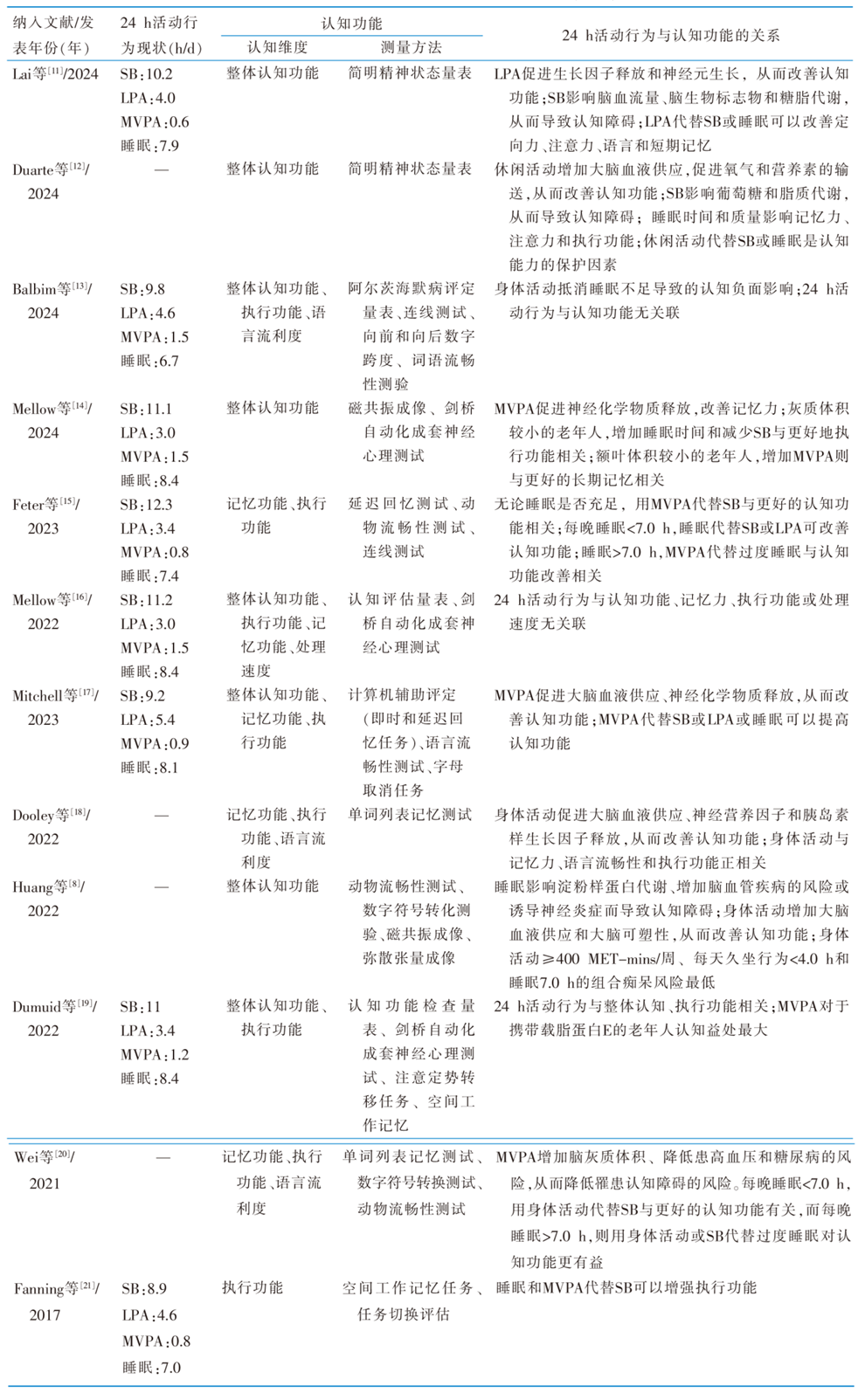 |
Table 1 Basic information of included studies(n=12)
| |
| [1] | 王鼎凯, 耿瑜, 杨晶晶, 等. 基于数字化技术的认知障碍患者认知训练干预的范围综述[J]. 中华护理杂志, 2023, 58(15):1907-1912. |
| Wang DK, Geng Y, Yang JJ, et al. Digital technology-based cog-nitive training intervention for patients with cognitive impair-ment:a scoping review[J]. Chin J Nurs, 2023, 58(15):1907-1912. | |
| [2] |
Livingston G, Huntley J, Liu KY, et al. Dementia prevention,intervention,and care:2024 report of the lancet standing commission[J]. Lancet, 2024, 404(10452):572-628.
DOI PMID |
| [3] | Alanazi MA. The role of physical activity in adjunctive nursing management of neuro-degenerative diseases among older adults:a systematic review of interventional studies[J]. Life, 2024, 14(5):597. |
| [4] | Cai XY, Qian GP, Wang F, et al. Association between sedentary behavior and risk of cognitive decline or mild cognitive impairment among the elderly:a systematic review and meta-analysis[J]. Front Neurosci, 2023,17:1221990. |
| [5] | Gonzales PNG, Villaraza SG, Rosa JCD. The association between sleep and Alzheimer's disease:a systematic review[J]. Dement Neuropsychol, 2024,18:e20230049. |
| [6] | Tremblay MS, Duncan MJ, Kuzik N, et al. Towards precision 24-hour movement behavior recommendations:the next new paradigm?[J]. J Sport Health Sci, 2024, 13(6):743-748. |
| [7] | Migueles JH, Aadland E, Andersen LB, et al. GRANADA con-sensus on analytical approaches to assess associations with accelerometer-determined physical behaviours(physical activity,sedentary behaviour and sleep) in epidemiological studies[J]. Br J Sports Med, 2022, 56(7):376-384. |
| [8] | Huang SY, Li YZ, Zhang YR, et al. Sleep,physical activity,se-dentary behavior,and risk of incident dementia:a prospective cohort study of 431,924 UK Biobank participants[J]. Mol Psy-chiatry, 2022, 27(10):4343-4354. |
| [9] | Mellow ML, Crozier AJ, Dumuid D, et al. How are combinations of physical activity,sedentary behaviour and sleep related to cognitive function in older adults? A systematic review[J]. Exp Gerontol, 2022,159:111698. |
| [10] |
王喜益, 叶志弘, 汤磊雯. 范围综述在护理领域的应用进展[J]. 中华护理杂志, 2019, 54(8):1259-1263.
DOI URL |
| Wang XY, Ye ZH, Tang LW. An integrative review of scoping review applied in nursing literature[J]. Chin J Nurs, 2019, 54(8):1259-1263. | |
| [11] | Lai TF, Chang CC, Hsueh MC, et al. Association of 24-hour movement behavior and cognitive function in older Taiwanese adults[J]. Geriatr Nurs, 2024,59:60-66. |
| [12] | Duarte FR, Galvão LL, Rocha-Silva R, et al. Leisure-time phy-sical activity as a key protective factor against cognitive decline in older adults:an isotemporal substitution analysis[J]. Cad Saude Publica, 2024, 40(6):e00046523. |
| [13] | Balbim GM, Falck RS, Boa Sorte Silva NC, et al. The associa-tion of the 24-hour activity cycle profiles with cognition in older adults with mild cognitive impairment:a cross-sectional study[J]. J Gerontol A Biol Sci Med Sci, 2024,79(7):glae099. |
| [14] | Mellow ML, Dumuid D, Olds T, et al. Cross-sectional associa-tions between 24-hour time-use composition,grey matter volume and cognitive function in healthy older adults[J]. Int J Behav Nutr Phys Act, 2024, 21(1):11. |
| [15] | Feter N, de Paula D, Dos Reis RCP, et al. Association between 24-hour movement behavior and cognitive function in Brazilian middle-aged and older adults:findings from the ELSA-Brasil[J]. Innov Aging, 2023, 7(3):igad030. |
| [16] | Mellow ML, Dumuid D, Wade AT, et al. Twenty-four-hour time-use composition and cognitive function in older adults:cross-sectional findings of the ACTIVate study[J]. Front Hum Neuro-sci, 2022,16:1051793. |
| [17] | Mitchell JJ, Blodgett JM, Chastin SF, et al. Exploring the asso-ciations of daily movement behaviours and mid-life cognition:a compositional analysis of the 1970 British cohort study[J]. J Epidemiol Community Health, 2023, 77(3):189-195. |
| [18] | Dooley EE, Palta P, Wolff-Hughes DL, et al. Higher 24-h total movement activity percentile is associated with better cognitive performance in U.S. older adults[J]. Med Sci Sports Exerc, 2022, 54(8):1317-1325. |
| [19] | Dumuid D, Mellow ML, Olds T, et al. Does APOE ε4 status change how 24-hour time-use composition is associated with cognitive function? An exploratory analysis among middle-to-older adults[J]. J Alzheimers Dis, 2022, 88(3):1157-1165. |
| [20] | Wei JK, Hou RX, Xie LY, et al. Sleep,sedentary activity,phy-sical activity,and cognitive function among older adults:the National Health and Nutrition Examination Survey,2011-2014[J]. J Sci Med Sport, 2021, 24(2):189-194. |
| [21] |
Fanning J, Porter G, Awick EA, et al. Replacing sedentary time with sleep,light,or moderate-to-vigorous physical activity:effects on self-regulation and executive functioning[J]. J Behav Med, 2017, 40(2):332-342.
DOI PMID |
| [22] | Ross R, Chaput J P, Giangregorio L M, et al. Canadian 24-hour movement guidelines for adults aged 18-64 years and adults aged 65 years or older:an integration of physical acti-vity,sedentary behaviour,and sleep[J]. Appl Physiol Nutr Me-tab, 2020, 45(10):57-102. |
| [23] | Liang W, Wang Y, Huang Q, et al. Adherence to 24-hour mo-vement guidelines among Chinese older adults:prevalence,correlates,and associations with physical and mental health outcomes[J]. JMIR Public Health Surveill, 2024,10:e46072. |
| [24] | Šuc A, Einfalt L, Šarabon N, et al. Validity and reliability of self-reported methods for assessment of 24-h movement behaviours:a systematic review[J]. Int J Behav Nutr Phys Act, 2024, 21(1):83. |
| [25] | Falck RS, Davis JC, Khan KM, et al. A wrinkle in measuring time use for cognitive health:how should we measure physical activity,sedentary behaviour and sleep?[J]. Am J Lifestyle Med, 2021, 17(2):258-275. |
| [26] |
Rodrigues B, Júdice PB, Marques A, et al. 24-hour movement questionnaire(QMov24h) for adults:development process and measurement properties[J]. Int J Behav Nutr Phys Act, 2024, 21(1):116.
DOI PMID |
| [27] |
吴美倩, 肖进, 李斐斐, 等. 24小时活动行为:老年人健康影响因素研究的新方向[J]. 中国全科医学, 2024, 27(15):1911-1916.
DOI |
| Wu MQ, Xiao J, Li FF, et al. 24-hour activity behavior:a new direction of research on health influencing factors of the elderly[J]. Chin Gen Pract, 2024, 27(15):1911-1916. |
| [1] | HUANG Panpan, LI Liling, HU Xiaojing. Research progress of early exercise rehabilitation in infants with congenital heart disease [J]. Chinese Journal of Nursing, 2025, 60(9): 1050-1055. |
| [2] | CHEN Liou, ZHANG Wenting, LIU Junqi, WANG Yuncong, WANG Zhenlin, QI Sai, YANG Na. Study on the effect of pulmonary lobes surface projection localization combined with pulmonary segment drainage and sputum expectoration technique on airway clearance in patients with aspiration pneumonia [J]. Chinese Journal of Nursing, 2025, 60(9): 1056-1061. |
| [3] | YANG Nana, CHENG Chuanli, ZENG Hui, FU Dandan, WANG Yan, CHEN Yue, RAN Hongmin, FAN Hongjing, LONG Xia. Evaluation of the effect of graded exercise rehabilitation on patients with acute exacerbation of chronic obstructive pulmonary disease [J]. Chinese Journal of Nursing, 2025, 60(9): 1062-1067. |
| [4] | CAO Yun, SUN Guozhen, CHEN Feng, JI Xueli, YAN Mengwan, JING Lei, QIAN Kun. A study of modified ankle pump exercise in stroke patients [J]. Chinese Journal of Nursing, 2025, 60(9): 1068-1074. |
| [5] | XIE Min, QI Wenkai, YIN Ling, ZHANG Xuan, ZHAO Ruqin. Potential profile analysis and influencing factors of kinesiophobia in patients with peritoneal dialysis [J]. Chinese Journal of Nursing, 2025, 60(9): 1080-1086. |
| [6] | CHEN Bingqian, ZHAO Bin, SUN Jiarong, HAO Sifang, HOU Xiaoli. Oral health management dilemmas of chronic periodontitis patients with implant dentures:a qualitative study [J]. Chinese Journal of Nursing, 2025, 60(9): 1087-1092. |
| [7] | QIN Chunlan, WU Zhenyun, QIAN Hongying, ZHAO Qian, SUN Jinting. Experiences of disease self-control among patients with chronic obstructive pulmonary disease:a qualitative study [J]. Chinese Journal of Nursing, 2025, 60(9): 1093-1098. |
| [8] | LI Ziwei, FENG Lijuan, CHEN Xusheng, HUANG Yi, YANG Jie. Development and application of a Fear of Movement Assessment Scale for patients with peripherally inserted central catheters [J]. Chinese Journal of Nursing, 2025, 60(9): 1099-1106. |
| [9] | CHENG Zhiqiang, ZHANG Baozhen, TANG Liping, LI Jing, XIA Jiaoyun, WEI Xueyan, GONG Zhixian, ZHANG Meizhen, LI Lusi. Reliability and validity test of the Chinese version of the Urinary Incontinence Awareness and Attitude Scale [J]. Chinese Journal of Nursing, 2025, 60(9): 1107-1112. |
| [10] | SHI Meiqin, WU Jianfang, ZHANG Duo, WU Chunping, CHEN Ling, TAO Lei. Nursing care for postoperative laryngeal function rehabilitation in a patient undergoing primary voice prosthesis implantation after total laryngectomy [J]. Chinese Journal of Nursing, 2025, 60(9): 1120-1123. |
| [11] | GU Qian, HUANG Xi, SHI Weixiong, WU Jing, TAN Ruoming, WANG Feng. Nursing care for a patient with cytokine release syndrome following T-cell immunotherapy [J]. Chinese Journal of Nursing, 2025, 60(9): 1124-1127. |
| [12] | ZHOU Miao, CHEN Xing, PENG Fei, SUN Shangxue, LI Yangyang. Systematic review of risk prediction instruments for central line associated bloodstream infections in ICU patients [J]. Chinese Journal of Nursing, 2025, 60(9): 1132-1139. |
| [13] | PENG Yingjie, LIU Aihong, ZHU Wenli, MEI Yuxin, ZHOU Meng, GUAN Wenjing. Systematic review of readiness assessment tools for advance care planning in older adults [J]. Chinese Journal of Nursing, 2025, 60(9): 1146-1153. |
| [14] | RAN Lingxiao, WANG Dongmin, XU Ke, WANG Cong, CAO Hua, CUN Wei, JIANG Yan. Application of biomechanical simulation based on three-dimensional human body model in preventing pressure ulcers:a scoping review [J]. Chinese Journal of Nursing, 2025, 60(8): 1012-1018. |
| [15] | JIN Yujia, JIANG Hu, WANG Xiaoxuan, YI Jingna, MEI Yongxia, GUO Zhiting, ZHANG Zhenxiang, LIN Beilei. Application of information-based risk communication in primary prevention of cardiovascular diseases:a scoping review [J]. Chinese Journal of Nursing, 2025, 60(8): 1019-1025. |
| Viewed | ||||||
|
Full text |
|
|||||
|
Abstract |
|
|||||
