

中华护理杂志 ›› 2026, Vol. 61 ›› Issue (3): 385-393.DOI: 10.3761/j.issn.0254-1769.2026.03.013
陈元元1( ), 刘扣英1,*(), 汤婷1, 屈明叶2, 杨澜3, 蔡昊3, 王晨3, 汪璐璐3, 李祥硕3
收稿日期:2025-07-21
出版日期:2026-02-10
发布日期:2026-02-03
*通讯作者:
刘扣英,E-mail:liuky188@126.com作者简介:陈元元:女,硕士,护士,E-mail:2075809293@qq.com
基金资助:
CHEN Yuanyuan1(), LIU Kouying1,*(), TANG Ting1, QU Mingye2, YANG Lan3, CAI Hao3, WANG Chen3, WANG Lulu3, LI Xiangshuo3
Received:2025-07-21
Online:2026-02-10
Published:2026-02-03
* Corresponding author:
LIU Kouying,E-mail:liuky188@126.comFunding program:摘要:
目的 分析国内提升患者就医体验的相关政策,为政策的实施提供参考。方法 计算机检索2015年1月—2024年6月国家卫生健康委员会、中国政府、国家中医药管理局、国家医疗保障局等行政部门网站,以及北大法宝信息检索系统、中国知网,筛选关于提升患者就医体验的政策文本。构建“政策工具-政策目标”二维政策分析框架,采用内容分析法,对政策文本进行量化分析。结果 共纳入36份政策文本,提取142条政策编码。在政策工具维度中,供给型、需求型、环境型政策工具使用占比分别为61.27%、28.17%、10.56%。在政策目标维度中,提升患者就诊前体验、提升患者门诊就诊体验、提升患者急诊急救体验、提升患者住院体验、提升患者随访体验和改善医疗服务的基础支持工作占比分别为16.20%、19.72%、10.56%、12.68%、11.27%、29.58%。交互分析结果显示,提升患者就医体验相关政策多利用供给型政策工具改善医疗服务的基础支持工作。结论 在提升患者就医体验相关政策中,不同类型政策工具的使用情况存在差异,政策目标分布不均衡。护理管理者应关注护士的护理信息实践能力,强化高级实践护士和急诊急救专科护士的培养,将人文关怀融入临床实践,加强患者经济负担的筛查,并建立动态的护理满意度反馈机制,以全面提升护理质量及患者的就医体验。
陈元元, 刘扣英, 汤婷, 屈明叶, 杨澜, 蔡昊, 王晨, 汪璐璐, 李祥硕. 国内提升患者就医体验相关政策的文本分析及护理启示[J]. 中华护理杂志, 2026, 61(3): 385-393.
CHEN Yuanyuan, LIU Kouying, TANG Ting, QU Mingye, YANG Lan, CAI Hao, WANG Chen, WANG Lulu, LI Xiangshuo. Textual analysis of domestic policies related to enhancing patients’ medical experience and implications for nursing practice[J]. Chinese Journal of Nursing, 2026, 61(3): 385-393.
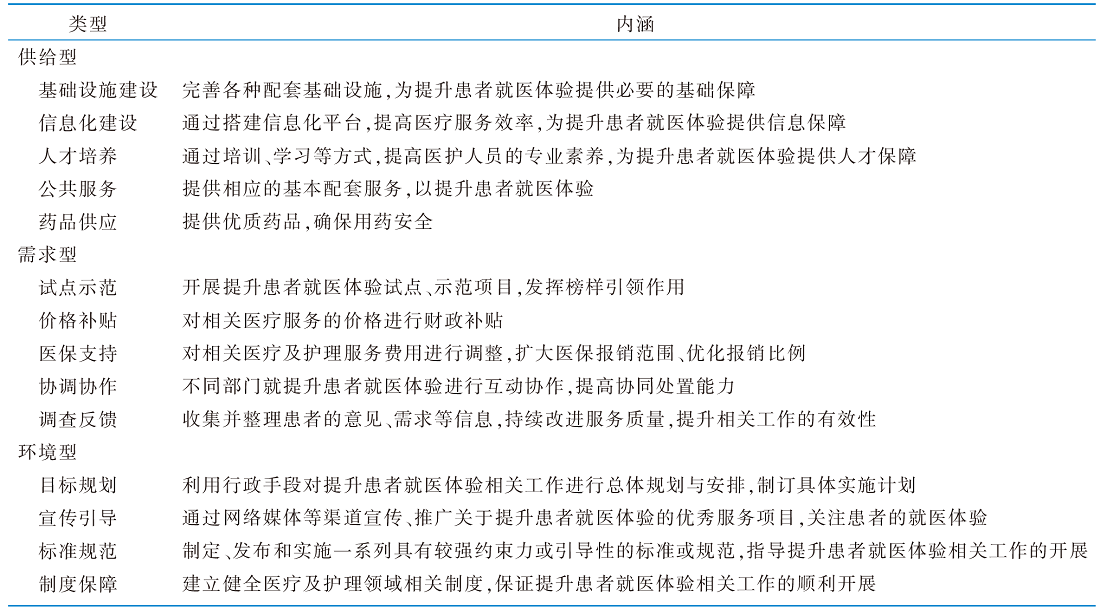 |
表1 政策工具的分类和内涵
Table 1 Classification and connotation of policy instruments
| |
 |
表2 纳入政策文本的基本特征(n=36)
Table 2 Basic characteristics of the included policies(n=36)
| |
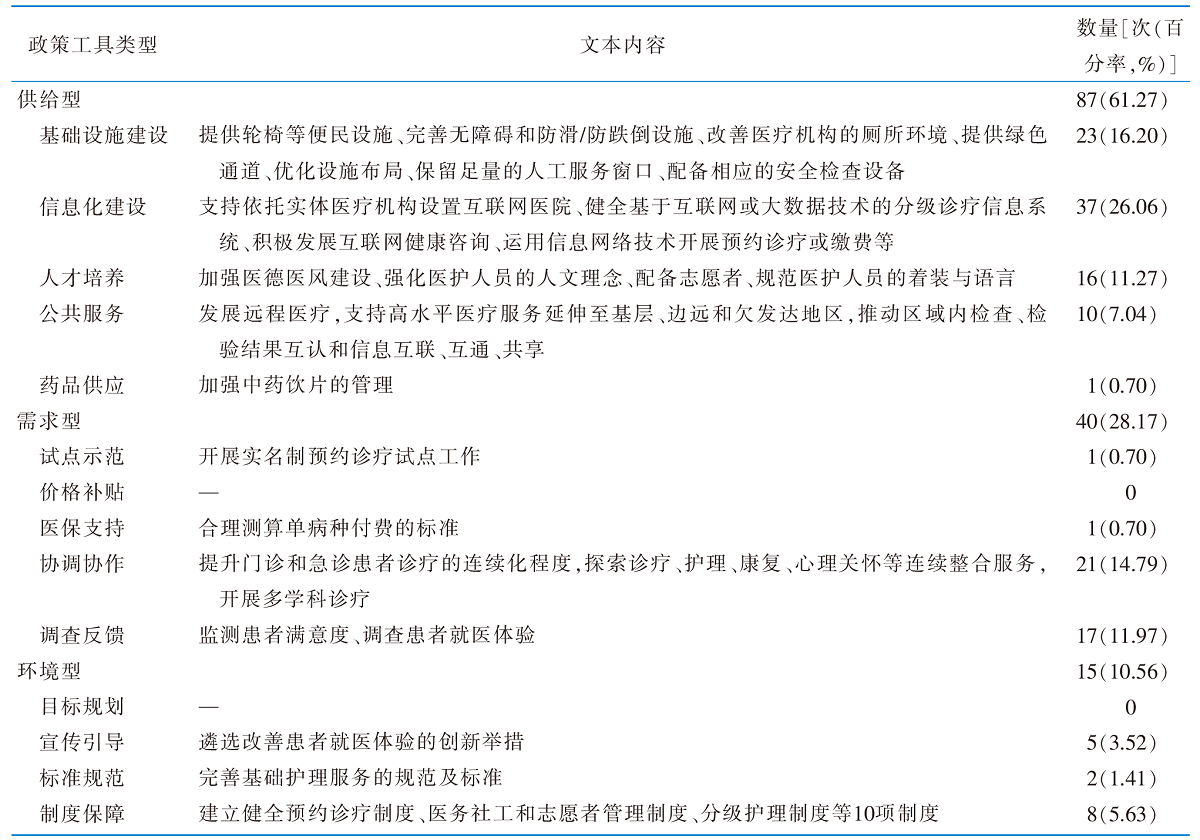 |
表3 政策工具的使用情况(n=142)
Table 3 Distribution of policy instruments(n=142)
| |
 |
表4 政策工具与政策目标的交互分析结果[n=142,次(百分率,%)]
Table 4 Statistics on the interaction between policy instruments and policy objectives[n=142,cases(percentage,%)]
| |
| [1] |
王婷婷, 兰美娟, 张玉萍, 等. 一院多区差异法管理对提升患者就医体验的效果研究[J]. 中华护理杂志, 2024, 59(15):1797-1803.
DOI URL |
| Wang TT, Lan MJ, Zhang YP, et al. Study on the effect of differentiated management in a multi-campus hospital for im-proving patient experience[J]. Chin J Nurs, 2024, 59(15):1797-1803. | |
| [2] | 国家卫生计生委,国家中医药局. 关于印发进一步改善医疗服务行动计划的通知[EB/OL].(2015-01-12)[2025-09-19]. https://www.nhc.gov.cn/yzygj/c100068/201501/bc1385cb70b44b25990f18-fac02e80b8.shtml. |
| National Health and Family Planning Commission,National Administration of Traditional Chinese Medicine. Notice on printing and distributing the action plan for further improving medical services[EB/OL].(2015-01-12)[2025-09-19]. https://www.nhc.gov.cn/yzygj/c100068/201501/bc1385cb70b44b25990f18-fac02e80b8.shtml. | |
| [3] | 陈潇, 张育红, 杨春, 等. 基于重要性矩阵的住院患者护理服务体验关键驱动因素分析[J]. 护理学杂志, 2024, 39(21):68-72. |
| Chen X, Zhang YH, Yang C, et al. Critical factors of inpatient experience with nursing care using importance-performance matrix analysis[J]. J Nurs Sci, 2024, 39(21):68-72. | |
| [4] | 周秋莲, 钱思兰, 管永萍. 在护理工作中实施就医体验管理的实践与体会[J]. 中国实用护理杂志, 2013, 29(2):4-5. |
| Zhou QL, Qian SL, Guan YP. Practice and experience of imple-menting medical experience management in nursing work[J]. Chin J Pract Nurs, 2013, 29(2):4-5. | |
| [5] | 张育琳, 金晓凤, 黄文婷, 等. 改善患者就医体验提升满意度实践探索[J]. 中国医院, 2024, 28(6):88-90. |
| Zhang YL, Jin XF, Huang WT, et al. Improving patient experie-nce to enhance satisfaction:practical exploration[J]. Chin Hosp, 2024, 28(6):88-90. | |
| [6] | 叶小云, 章莉丽, 陈维娅, 等. 基于提升患者就医体验的门诊服务融合实践[J]. 中华医院管理杂志, 2024, 40(10):809-812. |
| Ye XY, Zhang LL, Chen WY, et al. Exploration of integrating outpatient services in improving patients’ medical experience[J]. Chin J Hosp Admin, 2024, 40(10):809-812. | |
| [7] |
明爱红, 龙秀红, 梁志金, 等. 国内医疗护理员培训和管理省级政策的文本分析[J]. 中华护理杂志, 2025, 60(8):960-967.
DOI URL |
| Ming AH, Long XH, Liang ZJ, et al. Textual analysis of pro-vincial policy on nursing assistant training and management in China[J]. Chin J Nurs, 2025, 60(8):960-967. | |
| [8] | 陈永成, 郭筱克, 田博韬. 三维政策工具视角下我国DRG政策文本量化分析[J]. 中国医院, 2025, 29(4):35-39. |
| Chen YC, Guo XK, Tian BT. Quantitative analysis of China’s DRG policy texts from the perspective of three-dimensional policy tools[J]. Chin Hosp, 2025, 29(4):35-39. | |
| [9] |
余舒欣, 林荣, 祝雪花. 政策工具视角下国内护理卫生政策的文本分析[J]. 中华护理杂志, 2023, 58(7):843-849.
DOI URL |
|
Yu SX, Lin R, Zhu XH. Textual analysis of China’s nursing and health policies from the perspective of policy instruments[J]. Chin J Nurs, 2023, 58(7):843-849.
DOI URL |
|
| [10] |
张家睿, 张淑娥, 殷东, 等. 政策工具视角下激励优质卫生资源下沉的政策文本分析[J]. 中国全科医学, 2019, 22(34):4190-4196.
DOI |
| Zhang JR, Zhang SE, Yin D, et al. Incentive policies for allocating high-quality health resources to primary healthcare institutions:an analysis from the perspective on policy tools[J]. Chin Gen Pract, 2019, 22(34):4190-4196. | |
| [11] | 徐诗琦, 康静, 覃娴静, 等. 政策工具视角下2003—2022年我国发热门诊政策文本研究[J]. 中国医院, 2023, 27(7):45-49. |
| Xu SQ, Kang J, Qin XJ, et al. Research on the policy text of fever clinics in China from 2003 to 2022 from the perspec-tive of policy tools[J]. Chin Hosp, 2023, 27(7):45-49. | |
| [12] | 屈明叶, 刘扣英, 汤婷, 等. 政策工具视角下我国慢性阻塞性肺疾病健康管理相关政策分析[J]. 华西医学, 2024, 39(4):535-540. |
| Qu MY, Liu KY, Tang T, et al. Analysis of policies related to health management of chronic obstructive pulmonary disease in China from the perspective of policy tools[J]. West China Med J, 2024, 39(4):535-540. | |
| [13] |
陆信, 杨勇, 黄坚, 等. 政策工具视角下我国儿童用药领域相关政策文本分析[J]. 医药导报, 2025, 44(6):1010-1016.
DOI |
| Lu X, Yang Y, Huang J, et al. Textual analysis of relevant policies on children’s medicines in China based on the pers-pective of policy tools[J]. Her Med, 2025, 44(6):1010-1016. | |
| [14] | 蒋明珠, 应晓华, 江蔚曦, 等. 我国疫苗管理政策文本的量化研究:基于政策工具、政策主体、政策落点的文本分析[J]. 中国卫生政策研究, 2022, 15(11):60-67. |
| Jiang MZ, Ying XH, Jiang WX, et al. Quantitative research of vaccine management policy in China:text analysis based on policy instruments,policy subjects and policy points[J]. Chin J Health Policy, 2022, 15(11):60-67. | |
| [15] | 国家卫生健康委,国家中医药局. 关于开展改善就医感受提升患者体验主题活动的通知[EB/OL].(2023-05-26)[2025-09-22]. https://www.gov.cn/zhengce/zhengceku/202305/content_6883385.htm. |
| National Health Commission, National Administration of Tradi-tional Chinese Medicine. Notice on the theme of improving medical experience and patient experience[EB/OL].(2023-05-26)[2025-09-22]. https://www.gov.cn/zhengce/zhengceku/2023-05/content_6883385.htm. | |
| [16] | 祝嫦娥, 郑慧凌, 朱慧崟, 等. 智慧医疗系统使用对患者就医满意度的影响机制研究:基于技术接受模型的视角[J]. 中国医院管理, 2019, 39(10):61-64. |
| Zhu CE, Zheng HL, Zhu HY, et al. Study on the influence mechanism of the use of hospital intelligent medical system on patients’ satisfaction:based on the perspective of techno-logy acceptance model[J]. Chin Hosp Manag, 2019, 39(10):61-64. | |
| [17] |
荆舒, 戴振威, 苏小游, 等. 群医学理念在护理实践中的应用及启示[J]. 中华护理杂志, 2025, 60(4):493-499.
DOI URL |
| Jing S, Dai ZW, Su XY, et al. The application and enligh-tenment of population medicine in nursing practice[J]. Chin J Nurs, 2025, 60(4):493-499. | |
| [18] | 张智霖, 许嘉乐, 周兰姝. 护理信息学的发展现状及展望[J]. 军事护理, 2025, 42(1):13-16. |
| Zhang ZL, Xu JL, Zhou LS. Current status and prospect of nursing informatics[J]. Mil Nurs, 2025, 42(1):13-16. | |
| [19] | 刘伶俐, 陈琦琦, 程瑞霞, 等. 2 672名护士护理信息实践能力的潜在剖面分析及影响因素[J]. 护理研究, 2025, 39(21):3567-3573. |
| Liu LL, Chen QQ, Cheng RX, et al. Latent profile analysis and influencing factors of nursing information practice ability in 2 672 nurses[J]. Chin Nurs Res, 2025, 39(21):3567-3573. | |
| [20] | 和立道. 医疗卫生基本公共服务的城乡差距及均等化路径[J]. 财经科学, 2011(12):114-120. |
| He LD. The urban-rural gap of medical and health public services and the path of equalization[J]. Finance Econ, 2011(12):114-120. | |
| [21] |
方国栋, 杨园园, 孙威. 基于多循环Acc-Cost模型的北京市医疗资源优化配置研究[J]. 地理研究, 2025, 44(2):603-618.
DOI |
|
Fang GD, Yang YY, Sun W. Research on optimal allocation of medical resources in Beijing based on multi-cycle Acc-Cost model[J]. Geogr Res, 2025, 44(2):603-618.
DOI |
|
| [22] | 刘文君, 周艳, 陈亚飞, 等. 住院患者护理满意度量表的研究进展[J]. 中华护理杂志, 2016, 51(2):190-195. |
| Liu WJ, Zhou Y, Chen YF, et al. Research progress of nursing satisfaction scale for inpatients[J]. Chin J Nurs, 2016, 51(2):190-195. | |
| [23] | 吴红, 王承程, 申婧璇. 在线医疗情境下的患者体验测量量表构建[J]. 管理学报, 2025, 22(1):135-144. |
| Wu H, Wang CC, Shen JX. Development of Patient Experience Measurement Scale for the Online Healthcare Context Chinese[J]. Chin J Manag, 2025, 22(1):135-144. | |
| [24] | 蒋媛, 张建芳, 杨兴, 等. 以患者满意度为导向的优化护理对单边双通道内镜技术术后功能恢复的影响研究[J]. 军事护理, 2025, 42(8):33-36. |
| Jiang Y, Zhang JF, Yang X, et al. Study on the impact of patient satisfaction-oriented optimized nursing on functional recovery after UBE surgery[J]. Mil Nurs, 2025, 42(8):33-36. | |
| [25] |
王哲, 许惠靖, 王宇宇, 等. 经济毒性对慢性病患者不良健康结局影响的研究进展[J]. 护理学报, 2023, 30(17):34-38.
DOI |
| Wang Z, Xu HJ, Wang YY, et al. Research progress on the effect of economic toxicity on adverse health outcomes of patients with chronic diseases[J]. J Nurs(China), 2023, 30(17):34-38. | |
| [26] | 王正君, 司峰, 周郁秋, 等. 财务导航模式在癌症患者中的应用进展[J]. 军事护理, 2023, 40(12):81-84. |
| Wang ZJ, Si F, Zhou YQ, et al. Application and development of financial navigation in cancer patients[J]. Mil Nurs, 2023, 40(12):81-84. | |
| [27] | 戴雪妙, 金倩倩, 王新. 开展优质护理服务存在的常见问题与对策[J]. 中国医院管理, 2014, 34(11):78-79. |
| Dai XM, Jin QQ, Wang X. The common problems and coun-termeasures of carrying out high quality nursing service[J]. Chin Hosp Manag, 2014, 34(11):78-79. | |
| [28] | 李毅静, 蒋艳. 基于患者体验的护理提升行动与思考[J]. 中国卫生质量管理, 2024, 31(4):63-67. |
| Li YJ, Jiang Y. Action and reflection on nursing improvement based on patient experience[J]. Chin Health Qual Manag, 2024, 31(4):63-67. | |
| [29] | 甘戈, 程念, 宋大平, 等. 慢性病全程健康管理成效与经验[J]. 中国卫生经济, 2024, 43(1):31-33,66. |
| Gan G, Cheng N, Song DP, et al. Results and experience of chronic disease health management[J]. Chin Health Econ, 2024, 43(1):31-33,66. | |
| [30] |
田君叶, 郭爱敏, 王艳玲, 等. 1287所医疗机构对高级实践护士培训需求的调查研究[J]. 中华护理杂志, 2024, 59(20):2522-2528.
DOI |
| Tian JY, Guo AM, Wang YL, et al. Research on the training needs of advanced practice nurses in 1 287 medical institu-tions[J]. Chin J Nurs, 2024, 59(20):2522-2528. | |
| [31] | 江华, 陆悦, 侯淑肖, 等. 慢性病管理高级执业护师方向护理硕士培养的探索与实践[J]. 中国护理管理, 2023, 23(5):660-664. |
| Jiang H, Lu Y, Hou SX, et al. Exploration and practice of training mode for master of professional degree of Nurse Pra-ctitioner in noncommunicable diseases management[J]. Chin Nurs Manag, 2023, 23(5):660-664. | |
| [32] | 朱迪, 柯菊青, 解雨, 等. 江苏省急诊急救专科护士灾害护理能力横断面研究[J]. 护理管理杂志, 2024, 24(1):16-19,31. |
| Zhu D, Ke JQ, Xie Y, et al. Cross-sectional study on disaster nursing ability of emergency nurses in Jiangsu Province[J]. J Nurs Adm, 2024, 24(1):16-19,31. | |
| [33] | 李春燕, 黄萍, 王晓静, 等. 急诊急救专科护士培训基地评价指标的构建[J]. 中华护理教育, 2024, 21(7):780-787. |
| Li CY, Huang P, Wang XJ, et al. Construction of an evalua-tion index system of training bases for emergency specialty nurses[J]. Chin J Nurs Educ, 2024, 21(7):780-787. |
| [1] | 梁和静, 许鹊, 史云霞, 祖金美, 黄文静, 杨春旭, 郭明华, 王磊. 颈动脉内膜剥脱术围手术期护理质量评价指标的构建[J]. 中华护理杂志, 2026, 61(9): 1237-1244. |
| [2] | 王丹丹, 吕会力, 李付华, 李慧, 张侠, 史小艳, 张苇. 三级医院硕士学历护士工作重塑的影响因素及路径分析[J]. 中华护理杂志, 2026, 61(7): 973-978. |
| [3] | 中华护理学会人文护理专业委员会, 中华护理学会急诊护理专业委员会, (执笔:刘义兰, 汪唯, 甘秀妮, 朱陈萍, 杨霞, 熊莉娟, 朱丽辉, 徐翠荣, 郭舒婕, 张洁, 金晓燕, 李君, 李丽, 黄素芳, 王晓洁, 周晨曦, 李映兰. 对急诊科护士的人文关怀策略专家共识[J]. 中华护理杂志, 2026, 61(5): 612-615. |
| [4] | 关锐, 赵亚莎, 张士变, 李巧丽, 郭清洁, 李亚楠, 韩箫笛. 姿势调节训练在ICU肌肉骨骼损伤护士中的应用研究[J]. 中华护理杂志, 2026, 61(4): 543-548. |
| [5] | 盛旭, 丛胜楠, 张娟, 凌秀凤, 朱珠, 陈声容, 赵静. 辅助生殖专科护理质量评价指标体系的构建及验证[J]. 中华护理杂志, 2026, 61(3): 293-301. |
| [6] | 连蕊, 郑福雪, 田君叶, 谭艳芬, 宋亚静, 韩宁, 李妍, 蒙景雯, 曾镇罡. 供应-加工-配送模式下低值医用耗材智能管理的研究[J]. 中华护理杂志, 2026, 61(3): 394-400. |
| [7] | 曾晗月, 彭寅森, 陈腾霞, 李韵, 朱守淋, 黄乐娇, 王彩莲, 毛世芳. 《成人有创机械通气气道内吸引技术操作》团体标准临床实践现状及影响因素分析[J]. 中华护理杂志, 2026, 61(2): 198-204. |
| [8] | 兰星, 刘婷, 李勍, 柯稳, 李鑫, 张转运, 翟洁, 刘佳佳. 700所医疗机构麻醉科专科护士工作及管理现状的调查研究[J]. 中华护理杂志, 2026, 61(2): 237-243. |
| [9] | 李丽, 曹英娟, 翟永华, 颜艳, 孙一诺, 李悦, 张玲玲. 机器人辅助手术多维协同护理管理方案的构建及应用研究[J]. 中华护理杂志, 2026, 61(12): 1688-1694. |
| [10] | 尚文涵, 李思雨, 刘艳存, 姜桐桐, 么莉. 国内护理人力资源配置现状及分析[J]. 中华护理杂志, 2026, 61(11): 1520-1526. |
| [11] | 吴觅之, 魏惠燕, 潘红英, 张燕, 姚单芳, 王佳璐, 李琼琼. 专科护士协调下超重或肥胖患者多学科管理门诊的建设及评价[J]. 中华护理杂志, 2026, 61(11): 1527-1534. |
| [12] | 刘静, 翁亚娟, 魏敏, 孙振, 李剑, 李如月. 糖尿病足手术患者就医旅程困境及护理策略研究[J]. 中华护理杂志, 2026, 61(10): 1325-1332. |
| [13] | 姜珊, 郭彩霞, 郭立华, 赵媛媛, 肖蒙, 杨依玲, 魏春艳, 李硕, 刘殿媛, 尚志丽. 外周静脉留置针并发症风险管理系统的开发与应用[J]. 中华护理杂志, 2025, 60(8): 908-913. |
| [14] | 明爱红, 龙秀红, 梁志金, 李砺, 黎凤民, 林思慧, 杨云帆, 王智慧, 冯甜. 国内医疗护理员培训和管理省级政策的文本分析[J]. 中华护理杂志, 2025, 60(8): 960-967. |
| [15] | 黄婵, 池艳宇, 闵玉娣, 曹培叶, 刘君, 郑镕昕, 张海燕. 基于信息交互需求的护理会诊信息系统的开发及应用[J]. 中华护理杂志, 2025, 60(6): 645-651. |
| 阅读次数 | ||||||
|
全文 |
|
|||||
|
摘要 |
|
|||||
