

中华护理杂志 ›› 2026, Vol. 61 ›› Issue (9): 1261-1268.DOI: 10.3761/j.issn.0254-1769.2026.09.016
李艳桃1( ), 杨连招1,*(), 龙秀红2, 陈玲1, 高慧1, 覃文婷1, 朱芳慧1, 罗雪儿1
收稿日期:2025-10-22
出版日期:2026-05-10
发布日期:2026-04-30
*通讯作者:
杨连招,E-mail:1403066844@qq.com作者简介:李艳桃:女,本科(硕士在读),护士,E-mail:liyantao0521@163.com李艳桃:提出选题、检索和筛选文献、论文撰写和修改;杨连招:提供课题基金和指导性支持、修订和审阅论文;龙秀红、陈玲、高慧:设计论文框架、审阅和修订论文;覃文婷、朱芳慧、罗雪儿:筛选文献、资料提取及质量评价
基金资助:
LI Yantao1(), YANG Lianzhao1,*(), LONG Xiuhong2, CHEN Ling1, GAO Hui1, QIN Wenting1, ZHU Fanghui1, LUO Xueer1
Received:2025-10-22
Online:2026-05-10
Published:2026-04-30
* Corresponding author:
YANG Lianzhao,E-mail:1403066844@qq.comFunding program:摘要:
目的 通过Meta整合,系统梳理HIV感染者/AIDS患者创伤后成长的真实体验及影响因素,为制订针对性干预策略提供依据。方法 计算机检索PubMed、Embase、Web of Science、Scopus、ProQuest、PsycINFO、中国知网、万方数据库、维普数据库、中国生物医学文献服务系统中关于HIV感染者/AIDS患者创伤后成长的质性研究,检索时限为建库至2025年8月,采用澳大利亚乔安娜布里格斯研究所循证卫生保健中心质性研究质量评价工具对符合要求的文献进行评价,采用汇集性Meta整合法进行结果整合。结果 最终纳入9篇文献,共提炼出31个研究结果,归纳为7个类别,形成3个整合结果,即HIV感染者/AIDS患者相关创伤的表现与初始反应、创伤后成长的动态实现路径及影响因素。结论 HIV感染者/AIDS患者创伤后成长需经历创伤应对、行为调适、成长内化三阶段方可实现;其成长进程受有力的社会支持、充足资源保障等促进因素,以及社会歧视、医患沟通质量不足等阻碍因素的双重影响。医护人员应正确理解HIV感染者/AIDS患者创伤后成长的相关表现,挖掘其积极的心理体验,采取措施帮助其应对相关创伤。
李艳桃, 杨连招, 龙秀红, 陈玲, 高慧, 覃文婷, 朱芳慧, 罗雪儿. HIV感染者/AIDS患者创伤后成长体验的Meta整合[J]. 中华护理杂志, 2026, 61(9): 1261-1268.
LI Yantao, YANG Lianzhao, LONG Xiuhong, CHEN Ling, GAO Hui, QIN Wenting, ZHU Fanghui, LUO Xueer. Meta-synthesis of post-traumatic growth experiences in people living with HIV/AIDS[J]. Chinese Journal of Nursing, 2026, 61(9): 1261-1268.
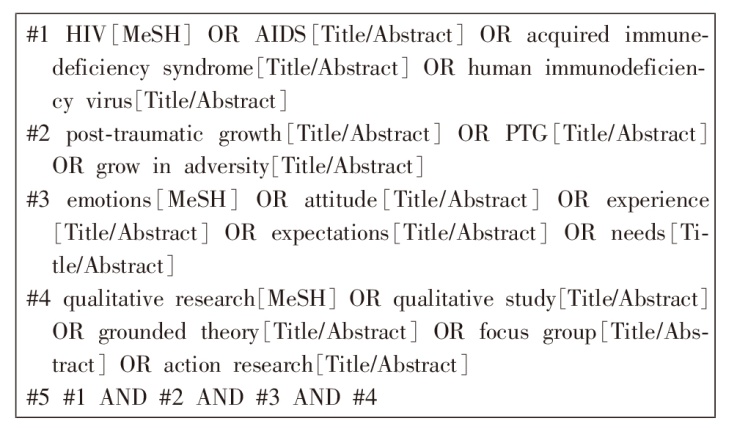
图1 PubMed检索策略
Figure 1 PubMed search strategy
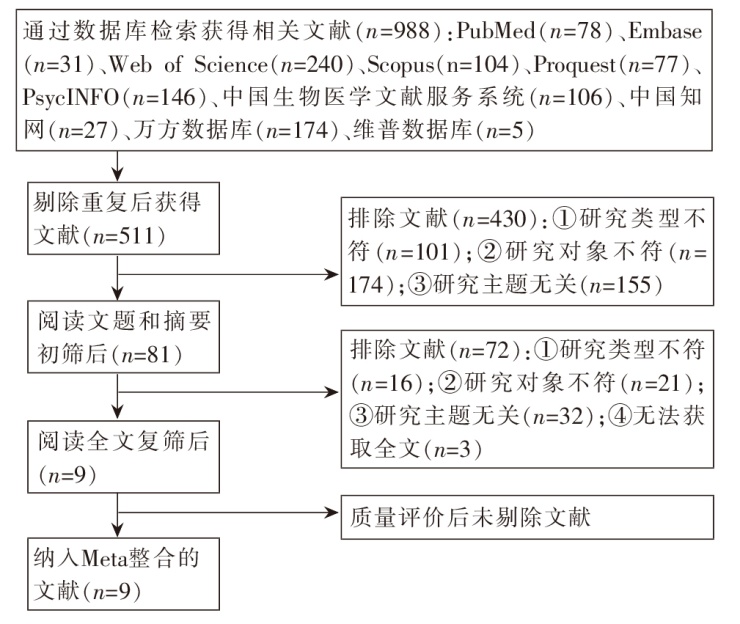
图2 文献筛选流程
Figure 2 Flow diagram of literature screening
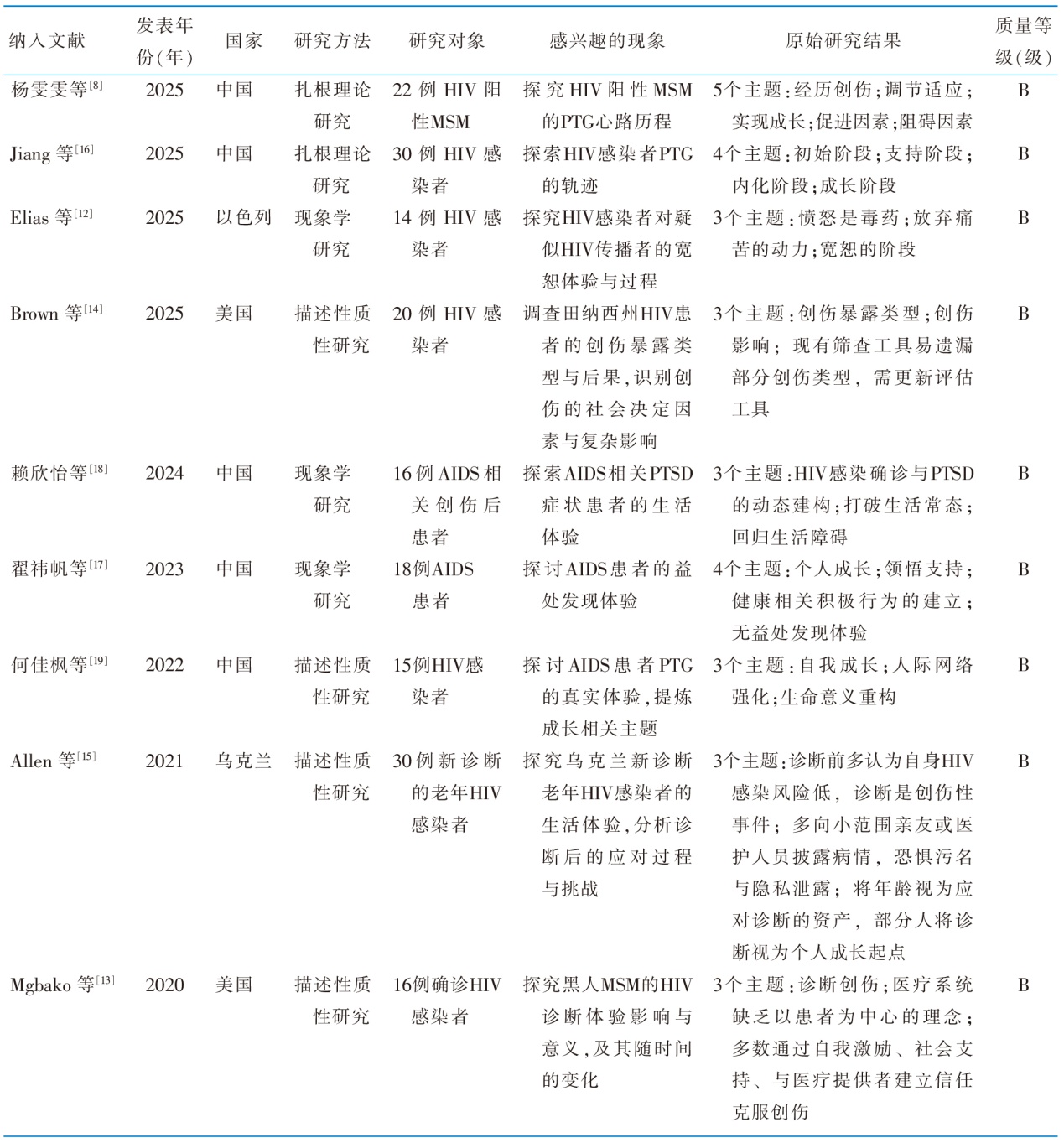 |
表1 纳入文献的基本特征(n=9)
Table 1 Basic characteristics of included literature(n=9)
| |
| [1] | UNAIDS. Homepage-2024 GLOBAL AIDS UPDATE[EB/OL].(2024-08-01)[2025-08-20]. https://crossroads.unaids.org/. |
| [2] | 孙美艳, 潘燕云, 何加敏, 等. 上海市MSM HIV感染者自我管理现状及影响因素研究[J]. 中国艾滋病性病, 2025, 31(1):75-80. |
| Sun MY, Pan YY, He JM, et al. Self-management status and influencing factors among men who have sex with men living with HIV in Shanghai[J]. Chin J AIDS STD, 2025, 31(1):75-80. | |
| [3] |
杨红丽, 朱政, 胡雁, 等. HIV感染者随访期间核心症状及严重程度的调查研究[J]. 中华护理杂志, 2021, 56(5):727-731.
DOI URL |
| Yang HL, Zhu Z, Hu Y, et al. Investigation on core symptoms and severity during follow-up among people living with HIV[J]. Chin J Nurs, 2021, 56(5):727-731. | |
| [4] |
陆雪倩, 孙文秀, 潘燕云, 等. 老年HIV感染者心理痛苦现状及影响因素研究[J]. 中华护理杂志, 2024, 59(22):2747-2753.
DOI URL |
| Lu XQ, Sun WX, Pan YY, et al. Current status and influencing factors of psychological distress among elderly people living with HIV[J]. Chin J Nurs, 2024, 59(22):2747-2753. | |
| [5] |
黄巧荣, 杨连招, 陈玲, 等. 聚焦解决模式对HIV感染者/AIDS患者焦虑、抑郁影响的Meta分析[J]. 中华护理杂志, 2023, 58(22):2792-2800.
DOI URL |
| Huang QR, Yang LZ, Chen L, et al. Meta-analysis of the effect of solution-focused approach on anxiety and depression in people living with HIV/AIDS[J]. Chin J Nurs, 2023, 58(22):2792-2800. | |
| [6] |
Machinga-Asaolu RO. Post-traumatic growth promoting and in-hibiting factors among intimate partner violence survivors:a systematic review[J]. Trauma Violence Abuse, 2025, 26(4):789-803.
DOI URL |
| [7] |
Relf MV. Nurses,nurse-led interventions,and nursing models of care:essential in HIV prevention,care,and treatment[J]. J Assoc Nurses AIDS Care, 2022, 33(4):361-363.
DOI URL |
| [8] | 杨雯雯, 吴雨函, 游心怡, 等. HIV阳性MSM创伤后成长心路历程的质性研究[J]. 中国艾滋病性病, 2025, 31(6):648-654. |
| Yang WW, Wu YH, You XY, et al. A qualitative study on the psychological journey of post-traumatic growth among HIV-positive men who have sex with men[J]. Chin J AIDS STD, 2025, 31(6):648-654. | |
| [9] | 沈银忠. 中国艾滋病诊疗指南(2024版)[J]. 中国艾滋病性 病, 2024, 30(8):779-806. |
| Shen YZ. Chinese guidelines for diagnosis and treatment of AIDS(2024 edition)[J]. Chin J AIDS STD, 2024, 30(8):779-806. | |
| [10] | 胡雁, 郝玉芳. 循证护理学[M]. 2版. 北京: 人民卫生出版社, 2018:125-130. |
| Hu Y, Hao YF. Evidence-based nursing[M]. 2nd ed. Beijing: People’s Medical Publishing House, 2018:125-130. | |
| [11] |
Lockwood C, Munn Z, Porritt K. Qualitative research synthe-sis:methodological guidance for systematic reviewers utilizing meta-aggregation[J]. Int J Evid Based Healthc, 2015, 13(3):179-187.
DOI URL |
| [12] |
Elias K, Turner D, Katchman E, et al. “I realized I had a choi-ce”:the forgiveness journey of people living with HIV[J]. AIDS Care, 2025, 37(1):62-73.
DOI URL |
| [13] |
Mgbako O, Benoit E, Iyengar NS, et al. “Like a ticking time bomb”:the persistence of trauma in the HIV diagnosis ex-perience among black men who have sex with men in New York City[J]. BMC Public Health, 2020, 20(1):1247.
DOI PMID |
| [14] |
Brown LL, Acuña AJ, Osman A, et al. Demystifying traumatic experiences and complex effects in people with HIV and post-traumatic stress disorder in Tennessee[J]. Health Equity, 2025, 9(1):131-141.
DOI PMID |
| [15] |
Allen A, Zaviryukha I, Kiriazova T, et al. The lived experience of a newly diagnosed older person with HIV in Ukraine[J]. Qual Health Res, 2021, 31(12):2290-2303.
DOI URL |
| [16] |
Jiang LW, Chen TT, Cao BC, et al. Trajectories of posttrauma-tic growth among people living with HIV:a grounded theory-based qualitative analysis[J]. BMC Public Health, 2025, 25(1):574.
DOI |
| [17] | 翟祎帆, 徐艳, 张玉杰, 等. 艾滋病患者益处发现体验的质性研究[J]. 护理学杂志, 2023, 38(4):87-90. |
| Zhai YF, Xu Y, Zhang YJ, et al. A qualitative study on bene-fit finding experiences among patients with AIDS[J]. J Nurs Sci, 2023, 38(4):87-90. | |
| [18] | 赖欣怡, 王红红, 唐楚蕾. 艾滋病相关创伤后应激障碍症状患者的生活体验质性研究[J]. 中国艾滋病性病, 2024, 30(6):618-622. |
| Lai XY, Wang HH, Tang CL. A qualitative study on the lived experiences of patients with AIDS-related post-traumatic stress disorder symptoms[J]. Chin J AIDS STD, 2024, 30(6):618-622. | |
| [19] | 何佳枫, 钱湘云, 余静, 等. 获得性免疫缺陷综合征病人创伤后成长的质性研究[J]. 全科护理, 2022, 20(14):1976-1979. |
| He JF, Qian XY, Yu J, et al. A qualitative study on post-traumatic growth among patients with acquired immunodefici-ency syndrome[J]. Chin Gen Pract Nurs, 2022, 20(14):1976-1979. | |
| [20] | 刘聪, 李芳, 杨莉, 等. 首次确诊HIV感染病人抑郁状况调查及影响因素分析[J]. 护理研究, 2017, 31(23):2894-2896. |
| Liu C, Li F, Yang L, et al. Investigation on depression status and influencing factors among patients newly diagnosed with HIV infection[J]. Chin Nurs Res, 2017, 31(23):2894-2896. | |
| [21] | 王克荣, 李潇, 韩晶, 等. 政策引导下的我国艾滋病护理工作变迁[J]. 中国护理管理, 2021, 21(12):1810-1814. |
| Wang KR, Li X, Han J, et al. Changes in AIDS nursing in China under policy guidance[J]. Chin Nurs Manag, 2021, 21(12):1810-1814. | |
| [22] |
黄莺, 王华芬, 邵丽芳, 等. HIV感染者/AIDS患者对其他专科医护人员披露诊断时心理体验的质性研究[J]. 中华护理杂志, 2023, 58(12):1483-1488.
DOI URL |
| Huang Y, Wang HF, Shao LF, et al. A qualitative study on the psychological experiences of people living with HIV/AIDS when disclosing their diagnosis to non-HIV specialist health-care providers[J]. Chin J Nurs, 2023, 58(12):1483-1488. | |
| [23] | 邵圯婷, 徐园园, 袁欣, 等. 接受抗病毒治疗HIV感染者生存质量及其影响因素调查[J]. 中国艾滋病性病, 2025, 31(2):184-189. |
| Shao YT, Xu YY, Yuan X, et al. Investigation on quality of life and influencing factors among HIV-infected patients re-ceiving antiretroviral therapy[J]. Chin J AIDS STD, 2025, 31(2):184-189. | |
| [24] |
Madundo K, Knettel BA, Knippler E, et al. Prevalence,seve-rity,and associated factors of depression in newly diagnosed people living with HIV in Kilimanjaro,Tanzania:a cross-sectional study[J]. BMC Psychiatry, 2023, 23(1):83.
DOI PMID |
| [25] | 赖龙芳. 首诊艾滋病患者心理痛苦现状与病耻感及生活质量的关系[J]. 辽宁医学杂志, 2025, 39(1):62-65. |
| Lai LF. Relationship between psychological distress,stigma,and quality of life among newly diagnosed AIDS patients[J]. Liaoning Med J, 2025, 39(1):62-65. | |
| [26] | 马云丽, 雷升颖, 杜飞飞, 等. 红花岗区疾病预防控制中心与社区组织联合实施MSM“两点一线”HIV检测工作模式[J]. 中国艾滋病性病, 2025, 31(3):322-324. |
| Ma YL, Lei SY, Du FF, et al. A “two-point-one-line” HIV test-ing model for men who have sex with men jointly imple-mented by Honghuagang District Center for disease control and prevention and community-based organizations[J]. Chin J AIDS STD, 2025, 31(3):322-324. | |
| [27] | 张悦, 徐蕾, 杨中方, 等. HIV/AIDS患者社会支持干预概念框架的发展:现实主义整合[J]. 军事护理, 2025, 42(12):44-48. |
| Zhang Y, Xu L, Yang ZF, et al. Development of a conceptual framework for social support interventions for people living with HIV/AIDS:a realist synthesis[J]. Military Nurs J, 2025, 42(12):44-48. | |
| [28] | 尚灿珠, 张莎, 劳云飞, 等. HIV/AIDS患者创伤后成长现状及影响因素研究[J]. 中国艾滋病性病, 2024, 30(10):1057-1062. |
| Shang CZ, Zhang S, Lao YF, et al. Current status and influe-ncing factors of post-traumatic growth among people living with HIV/AIDS[J]. Chin J AIDS STD, 2024, 30(10):1057-1062. | |
| [29] | 柴程良, 何林, 蒋健敏. 人工智能+数字技术:驱动艾滋病防治高质量发展的核心引擎[J]. 中国艾滋病性病, 2025, 31(8):829-832. |
| Chai CL, He L, Jiang JM. Artificial intelligence and digital technology:the core engine driving high-quality development of HIV/AIDS prevention and control[J]. Chin J AIDS STD, 2025, 31(8):829-832. | |
| [30] | 钱晨, 张涛. 艾滋病相关短视频的传播特征及其影响因素分析[J]. 中国艾滋病性病, 2021, 27(12):1394-1399. |
| Qian C, Zhang T. Analysis of communication characteristics and influencing factors of AIDS-related short videos[J]. Chin J AIDS STD, 2021, 27(12):1394-1399. |
| [1] | 叶俊霜, 沈丽佳, 孟霞靓, 张玉姣, 蔡根莲, 邵碧云, 周亚辉, 张柳倩, 应金萍. 维持性血液透析患者对口腔衰弱认知和体验的质性研究[J]. 中华护理杂志, 2026, 61(9): 1215-1220. |
| [2] | 刘幸, 范文祥, 周庭戌, 商临萍. 慢性阻塞性肺疾病患者戒烟行为促进与障碍因素的质性研究[J]. 中华护理杂志, 2026, 61(8): 1021-1027. |
| [3] | 舒适, 朱杉, 余艮珍, 张萍, 周晨曦, 彭维, 王珍. 特发性中枢性性早熟患儿患病体验与需求的质性研究[J]. 中华护理杂志, 2026, 61(8): 1074-1079. |
| [4] | 许国萍, 胡欢婷, 李丽, 金静芬, 蒋佳奖, 任英. 膝关节假体周围感染患者就医决策历程的质性研究[J]. 中华护理杂志, 2026, 61(8): 1101-1106. |
| [5] | 黄璇, 郭书萍, カルデナス暁東, 谢云影, 王瀚敏, 张玉美, 刘焘丽, 李莉. 银屑病患者自我报告结局评估工具测量学属性的评价及护理启示[J]. 中华护理杂志, 2026, 61(8): 1117-1124. |
| [6] | 张滢, 刘淑娟, 王婧瑞, 马千蓉. 轻度认知障碍患者对虚拟现实技术使用体验的Meta整合[J]. 中华护理杂志, 2026, 61(8): 1125-1131. |
| [7] | 韩林, 杨丽娟, 李太东, 郑晓丽, 程敏, 郭琛, 郑培培. ICU机械通气清醒患者沟通体验的Meta整合[J]. 中华护理杂志, 2026, 61(7): 901-908. |
| [8] | 王阳阳, 杨旻斐, 黄科儿, 姚晓月, 赵燕祥, 李佳麒, 尹娜, 黄凌, 张菊. 老年创伤性脑损伤合并衰弱患者早期运动康复照护促进与阻碍因素的质性研究[J]. 中华护理杂志, 2026, 61(7): 939-946. |
| [9] | 管颖慧, 谢鑑辉, 欧阳雅琦, 徐乐, 田佳琦, 王琼. 1型糖尿病青少年向成人医疗过渡体验的Meta整合[J]. 中华护理杂志, 2026, 61(7): 979-985. |
| [10] | 曾佳琳, 符冰, 杨泠韵, 江庆华. 头颈癌患者自我报告结局评估工具的评价及护理启示[J]. 中华护理杂志, 2026, 61(7): 986-994. |
| [11] | 王秀丽, 代春豪, 许梓婷, 李昊远, 冷敏敏, 张海博, 李晴, 杨丽娟. 运动干预在老年肌少性肥胖患者中应用的范围综述[J]. 中华护理杂志, 2026, 61(7): 995-1001. |
| [12] | 刘晓, 李丽, 施忠英. 青少年神经性厌食患者及其父母出院准备体验及需求的质性研究[J]. 中华护理杂志, 2026, 61(6): 814-821. |
| [13] | 朱金星, 顾招芹, 汤婷, 陈秋圆, 丁宁, 李方. 阻塞性睡眠呼吸暂停综合征患者疾病感知经历的质性研究[J]. 中华护理杂志, 2026, 61(5): 653-659. |
| [14] | 路梦新, 于晓燕, 张胜龙, 马璐, 王子瑜, 丁锦平, 辛婷婷, 张丙良. 肝移植患者不同阶段康复需求的纵向质性研究[J]. 中华护理杂志, 2026, 61(5): 660-666. |
| [15] | 中华医学会骨科学分会护理学组 执笔:梅迎雪, 韩梦月, 潘韩丽, 韩冰, 杨旭. 骨科大手术患者静脉血栓栓塞症预防专家共识[J]. 中华护理杂志, 2026, 61(4): 437-441. |
| 阅读次数 | ||||||
|
全文 |
|
|||||
|
摘要 |
|
|||||
