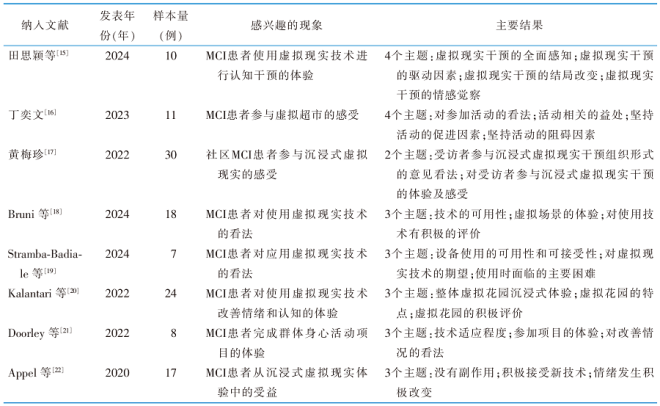
| [1] |
Salari N, Lotfi F, Abdolmaleki A, et al. The global prevalence of mild cognitive impairment in geriatric population with em-phasis on influential factors:a systematic review and meta-ana-lysis[J]. BMC Geriatr, 2025, 25(1):313.
DOI
PMID
|
| [2] |
Mian M, Tahiri J, Eldin R, et al. Overlooked cases of mild cognitive impairment:implications to early Alzheimer’s disease[J]. Ageing Res Rev, 2024, 98:102335.
DOI
URL
|
| [3] |
黄金燕, 翟惠敏, 王细文, 等. 园艺治疗对养老机构轻度认知障碍老年人的影响效果研究[J]. 中华护理杂志, 2025, 60(14):1749-1756.
DOI
URL
|
|
Huang JY, Zhai HM, Wang XW, et al. Study on the effect of a horticultural therapy on the elderly with mild cognitive impairment in nursing homes[J]. Chin J Nurs, 2025, 60(14):1749-1756.
DOI
URL
|
| [4] |
Venegas-Sanabria LC, Cavero-Redondo I, Lorenzo-Garcia P, et al. Efficacy of nonpharmacological interventions in cognitive impairment:systematic review and network meta-analysis[J]. Am J Geriatr Psychiatry, 2024, 32(12):1443-1465.
DOI
PMID
|
| [5] |
杨冰清, 宋玉磊, 殷海燕, 等. 虚拟超市用于轻度认知障碍评估与康复训练的研究进展[J]. 护理学杂志, 2024, 39(21):120-124.
|
|
Yang BQ, Song YL, Yin HY, et al. A review of virtual super-market for mild cognitive impairment assessment and rehabi-litation training[J]. J Nurs Sci, 2024, 39(21):120-124.
|
| [6] |
杨青, 钟书华. 中国虚拟现实技术发展研究:回顾与展望[J]. 科学管理研究, 2020, 38(5):20-26.
|
|
Yang Q, Zhong SH. A study on the development of virtual reality technology in China:review and prospect[J]. Sci Manag Res, 2020, 38(5):20-26.
|
| [7] |
Buele J, Avilés-Castillo F, Del-Valle-Soto C, et al. Effects of a dual intervention(motor and virtual reality-based cognitive) on cognition in patients with mild cognitive impairment:a single-blind,randomized controlled trial[J]. J Neuroeng Rehabil, 2024, 21(1):130.
DOI
|
| [8] |
Yu J, Song JR, Shen Q. Effects of fully immersive virtual rea-lity training on cognitive function in patients with mild cog-nitive impairment:a systematic review and meta-analysis[J]. Front Hum Neurosci, 2024, 18:1467697.
DOI
URL
|
| [9] |
Petersen RC. Mild cognitive impairment as a diagnostic entity[J]. J Intern Med, 2004, 256(3):183-194.
DOI
PMID
|
| [10] |
Albert MS, DeKosky ST, Dickson D, et al. The diagnosis of mild cognitive impairment due to Alzheimer’s disease:recom-mendations from the National Institute on Aging-Alzheimer’s Association workgroups on diagnostic guidelines for Alzhei-mer’s disease[J]. Alzheimers Dement, 2011, 7(3):270-279.
DOI
URL
|
| [11] |
Petersen RC, Lopez O, Armstrong MJ, et al. Practice guideline update summary:mild cognitive impairment[RETIRED]:report of the guideline development,dissemination,and implementa-tion subcommittee of the American Academy of Neurology[J]. Neurology, 2018, 90(3):126-135.
DOI
PMID
|
| [12] |
中国卒中学会血管性认知障碍分会. 中国血管性认知障碍诊治指南(2024版)[J]. 中华医学杂志, 2024, 104(31):2881-2894.
|
|
Chinese Stroke Association Vascular Cognitive Impairment Subcommittee. Chinese guidelines for the diagnosis and treat-ment of vascular cognitive impairment(2024 edition)[J]. Natl Med J China, 2024, 104(31):2881-2894.
|
| [13] |
胡雁. 如何开展质性研究的系统评价和Meta整合[J]. 上海护理, 2020, 20(7):1-5.
|
|
Hu Y. How to carry out systematic review and meta-synthesis of qualitative studies[J]. Shanghai Nurs, 2020, 20(7):1-5.
|
| [14] |
Munn Z, Porritt K, Lockwood C, et al. Establishing confidence in the output of qualitative research synthesis:the ConQual approach[J]. BMC Med Res Methodol, 2014, 14:108.
DOI
URL
|
| [15] |
田思颖, 李苏爱, 刘梦娆, 等. 轻度认知障碍患者参与虚拟现实技术认知干预体验的质性研究[J]. 中华护理杂志, 2024, 59(5):569-575.
DOI
URL
|
|
Tian SY, Li SA, Liu MR, et al. Qualitative research on emo-tional experience of mild cognitive impairment patients par-ticipating in cognitive intervention based on virtual reality technology[J]. Chin J Nurs, 2024, 59(5):569-575.
|
| [16] |
丁奕文. 虚拟超市认知评估与训练系统对轻度认知障碍老年人干预效果研究[D]. 长春: 吉林大学, 2023.
|
|
Ding YW. The effect of virtual supermarket cognitive asses-sment and training system on the elderly with mild cognitive impairment[D]. Changchun: Jilin University, 2023.
|
| [17] |
黄梅珍. 基于沉浸式虚拟现实认知训练对社区轻度认知障碍患者干预效果及机制研究[D]. 福州: 福建医科大学, 2022.
|
|
Huang MZ. Research on the effects and mechanisms of immersive virtual reality-based cognitive training intervention for mild cognitive impairment patients in the community[D]. Fuzhou: Fujian Medical University, 2022.
|
| [18] |
Bruni F, Mancuso V, Panigada J, et al. Exploring how older adults experience semAPP,a 360° media-based tool for memo-ry assessment:qualitative study[J]. JMIR Aging, 2024, 7:e56796.
DOI
URL
|
| [19] |
Stramba-Badiale C, Tuena C, Goulene KM, et al. Enhancing spatial navigation skills in mild cognitive impairment patients:a usability study of a new version of ANTaging software[J]. Front Hum Neurosci, 2024, 17:1310375.
DOI
URL
|
| [20] |
Kalantari S, Bill Xu T, Mostafavi A, et al. Using a nature-based virtual reality environment for improving mood states and cognitive engagement in older adults:a mixed-method feasibility study[J]. Innov Aging, 2022, 6(3):igac015.
|
| [21] |
Doorley JD, Mace RA, Popok PJ, et al. Feasibility randomized controlled trial of a mind-body activity program for older adults with chronic pain and cognitive decline:the virtual “active brains” study[J]. Gerontologist, 2022, 62(7):1082-1094.
DOI
URL
|
| [22] |
Appel L, Appel E, Bogler O, et al. Older adults with cognitive and/or physical impairments can benefit from immersive vir-tual reality experiences:a feasibility study[J]. Front Med, 2020, 6:329.
|
| [23] |
王凯蓉, 卫婉蕊, 马睛雅, 等. 沉浸式虚拟现实认知训练对认知障碍患者干预效果的系统评价[J]. 中华护理杂志, 2022, 57(2):230-236.
DOI
URL
|
|
Wang KR, Wei WR, Ma JY, et al. Effects of immersive virtual reality-based cognitive training for people with cognitive impairment:a systematic review[J]. Chin J Nurs, 2022, 57(2):230-236.
|
| [24] |
Hirsh DA, Crampton PES, Osman NY. Applying self-determina-tion theory to stem medical schools’ clinical teacher sustaina-bility crisis[J]. Med Educ, 2024, 58(1):118-128.
DOI
URL
|
| [25] |
邹炜祯, 岳丽青, 李冰玉, 等. NICU早产儿父母参与袋鼠式护理体验质性研究的Meta整合[J]. 中华护理杂志, 2025, 60(20):2534-2541.
DOI
URL
|
|
Zou WZ, Yue LQ, Li BY, et al. Experience of parents enga-ging in kangaroo mother care for preterm infants in the NICU:a qualitative Meta-synthesis[J]. Chin J Nurs, 2025, 60(20):2534-2541.
|


 ), 刘淑娟2,*(