

中华护理杂志 ›› 2026, Vol. 61 ›› Issue (5): 689-696.DOI: 10.3761/j.issn.0254-1769.2026.05.016
王凡1( ), 赵文娟2, 曹佳伟2, 陆箴琦1,*()
收稿日期:2025-08-27
出版日期:2026-03-10
发布日期:2026-03-05
*通讯作者:
陆箴琦,E-mail:luzhenqi1972@163.com作者简介:王凡:女,本科(硕士在读),护士,E-mail:pumcwangfan@163.com
基金资助:
WANG Fan1(), ZHAO Wenjuan2, CAO Jiawei2, LU Zhenqi1,*()
Received:2025-08-27
Online:2026-03-10
Published:2026-03-05
* Corresponding author:
LU Zhenqi,E-mail:luzhenqi1972@163.comFunding program:摘要:
目的 构建并验证肝癌患者经股动脉介入治疗术后穿刺处出血并发症预测模型,为医护人员早期识别及预防患者穿刺处出血并发症提供参考。 方法 采用前瞻性研究,便利选取2024年6—12月上海市某三级甲等专科医院收治的915例经股动脉行介入治疗的肝癌患者作为建模组,2025年3—5月上海市及北京市3所三级甲等医院收治的582例肝癌患者为验证组。采用Lasso-Logistic回归筛选特征性预测因子后构建Logistic预测模型,以列线图形式呈现。应用受试者操作特征曲线下面积、Hosmer-Lemeshow检验及临床决策曲线对模型进行区分度、校准度及临床实用性评价。采用Bootstrap法进行内部验证。 结果 基于Lasso-Logistic回归,筛选出血小板减少症、术后高血压、总胆红素、血管穿刺次数及压迫方式5个预测因子进行模型构建。预测模型的受试者操作特征曲线下面积为0.760(95%CI:0.719~0.800),灵敏度为66.9%,特异度为74.6%,准确率为82.8%,校准曲线、Hosmer-Lemeshow检验(P=0.818)及临床决策曲线均显示,该模型的拟合优度及临床实用性良好。 结论 构建的预测模型可有效预测肝癌患者穿刺处出血并发症的发生,具有良好的可靠性,可为医护人员识别高危患者并实施个性化、精准化预见性护理策略提供依据。
王凡, 赵文娟, 曹佳伟, 陆箴琦. 肝癌患者介入治疗术后穿刺处出血并发症预测模型的构建及验证[J]. 中华护理杂志, 2026, 61(5): 689-696.
WANG Fan, ZHAO Wenjuan, CAO Jiawei, LU Zhenqi. Construction and validation of a predictive model for puncture site bleeding complications in liver cancer patients after interventional therapy[J]. Chinese Journal of Nursing, 2026, 61(5): 689-696.
 |
表1 建模组穿刺处出血并发症的单因素分析[例(百分比,%)]
Table 1 Univariate analysis of puncture site bleeding complications in modeling group patients[case(percentage,%)]
| |
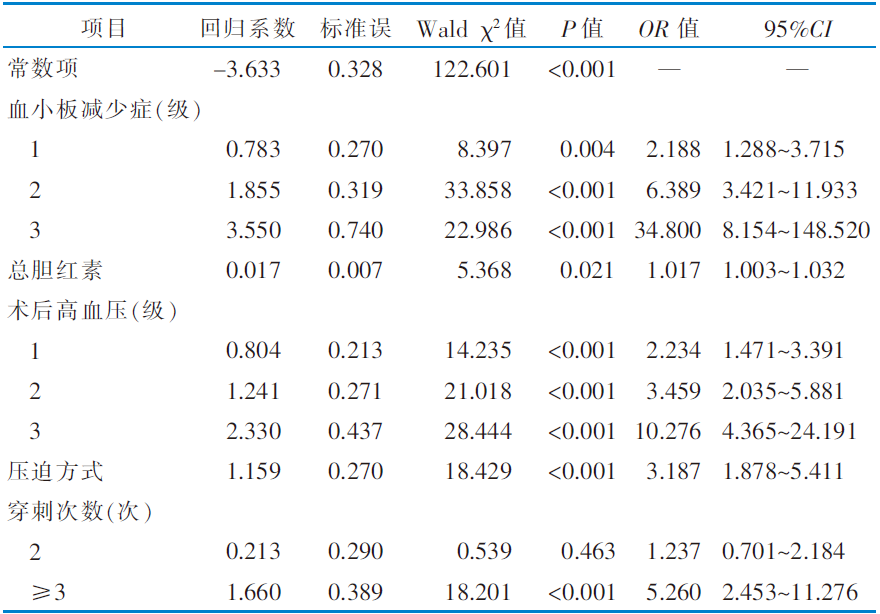 |
表2 肝癌患者介入治疗术后穿刺处出血并发症影响因素的多因素Logistic分析(n=915)
Table 2 Multivariate Logistic regression analysis of factors influencing puncture site bleeding complications in liver cancer patients after interventional therapy(n=915)
| |
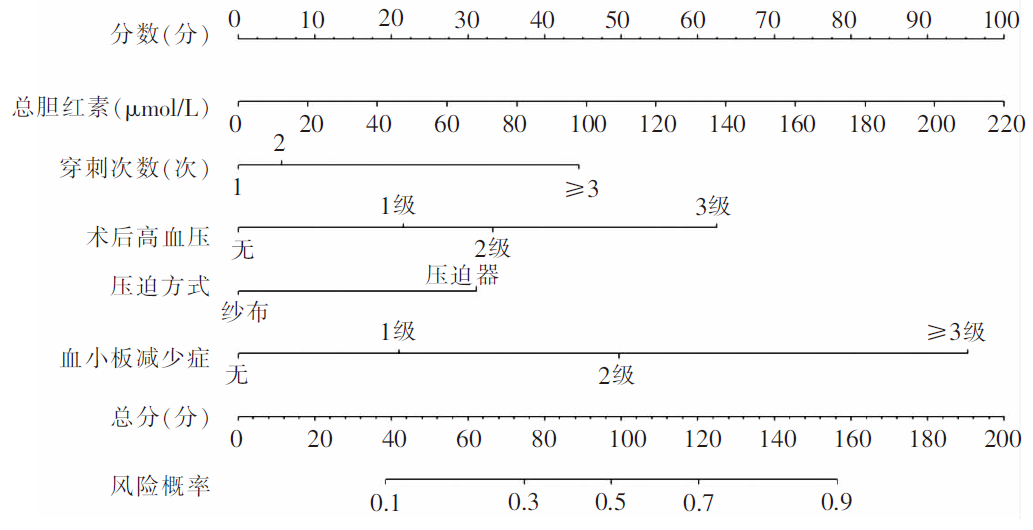
图1 肝癌患者介入治疗术后穿刺处出血并发症预测的列线图
Figure 1 Nomogram for puncture site bleeding complications in liver cancer patients after interventional therapy
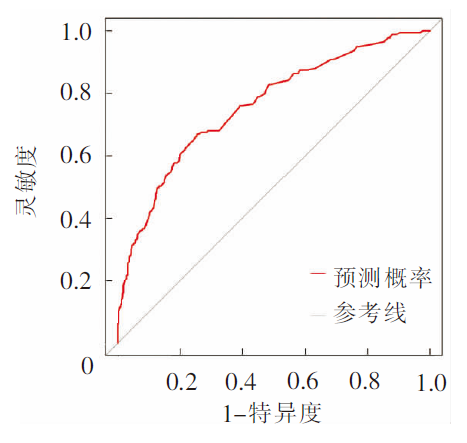
图2 模型建模组ROC曲线
Figure 2 ROC in the modeling group
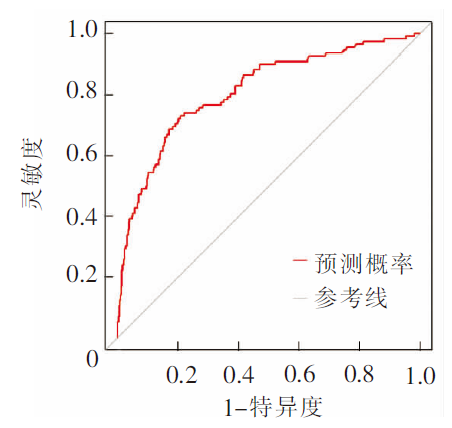
图3 模型验证组ROC曲线
Figure 3 ROC in the validation group
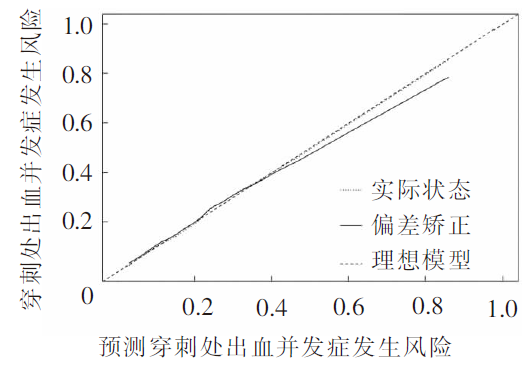
图4 模型建模组校准曲线
Figure 4 Calibration curve in the modeling group
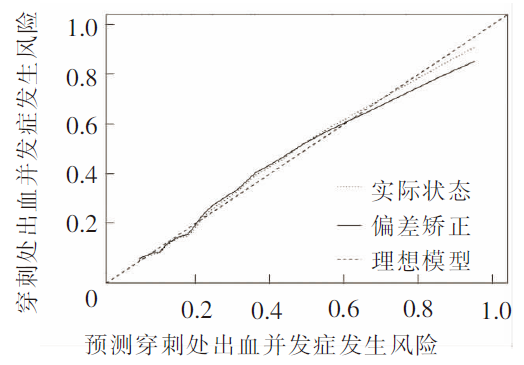
图5 模型验证组校准曲线
Figure 5 Calibration curve in the validation group
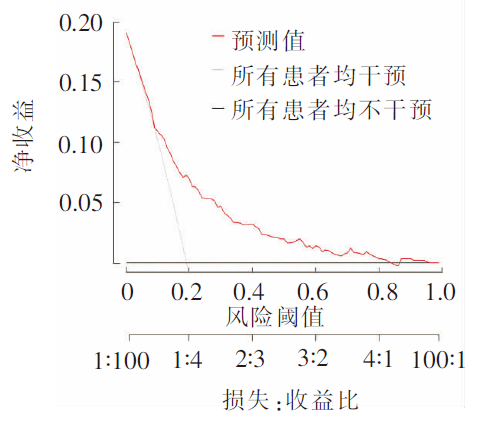
图6 模型建模组决策曲线
Figure 6 Decision curve in the modeling group
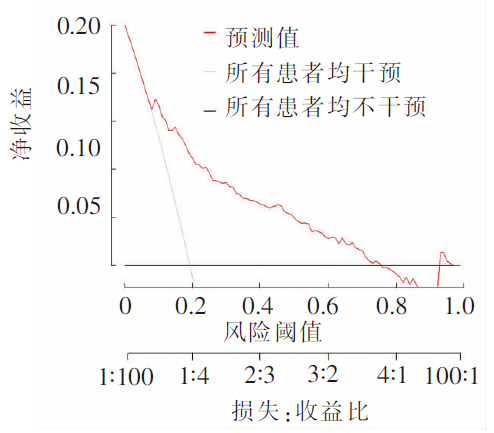
图7 模型验证组决策曲线
Figure 7 Decision curve in the validation group
| [1] | Han BF, Zheng RS, Zeng HM, et al. Cancer incidence and mor-tality in China,2022[J]. J Natl Cancer Cent, 2024, 4(1):47-53. |
| [2] | 赵健萍, 张必翔, 张志伟, 等. 血管介入在肝癌中的应用[J]. 肝胆胰外科杂志, 2023, 35(6):331-336. |
| Zhao JP, Zhang BX, Zhang ZW, et al. Application of vascular intervention in the treatment of hepatocellular carcinoma[J]. J Hepatopancreatobiliary Surg, 2023, 35(6):331-336. | |
| [3] |
Bogabathina H, Shi RH, Singireddy S, et al. Reduction of vas-cular complication rates from femoral artery access in contem-porary women undergoing cardiac catheterization[J]. Cardiovasc Revasc Med, 2018, 19(6 Suppl):27-30.
DOI URL |
| [4] | 吴雅琴, 莫伟, 向华, 等. 肝癌患者介入术后股动脉穿刺处出血的研究进展[J]. 中华介入放射学电子杂志, 2023, 11(4):352-356. |
| Wu YQ, Mo W, Xiang H, et al. Research progress on bleeding at femoral artery puncture site after interventional therapy for liver cancer patients[J]. Chin J Interv Radiol Electron Ed, 2023, 11(4):352-356. | |
| [5] | 吴雅琴, 莫伟, 向华, 等. 肝癌患者介入治疗穿刺处出血影响因素的真实世界研究[J]. 中华介入放射学电子杂志, 2023, 11(2):117-122. |
| Wu YQ, Mo W, Xiang H, et al. A real world study of influen-cing factors of bleeding at the puncture site in patients with liver cancer undergoing interventional therapy[J]. Chin J Interv Radiol Electron Ed, 2023, 11(2):117-122. | |
| [6] | 王瑞雪, 吴英媛, 姜学爽. 经皮冠状动脉介入治疗术后股动脉出血的危险因素[J]. 当代护士(上旬刊), 2022, 29(10):119-122. |
| Wang RX, Wu YY, Jiang XS. Risk factors of femoral artery blee-ding after percutaneous coronary intervention[J]. Mod Nurse, 2022, 29(10):119-122. | |
| [7] | 田鸿福, 王慧, 邱峰. 神经介入术后股动脉穿刺处出血的影响因素[J]. 国际脑血管病杂志, 2020, 28(4):255-259. |
| Tian HF, Wang H, Qiu F. Influencing factors of bleeding at femoral artery puncture site after neuro intervention[J]. Int J Cerebrovasc Dis, 2020, 28(4):255-259. | |
| [8] | 国家卫生健康委员会医政司. 原发性肝癌诊疗指南(2024年版)[J]. 中华肝脏病杂志, 2024, 32(7):581-630. |
| Department of Medical Administration of National Health Com-mission. Guideline for diag-nosis and treatment of primary liver cancer(2024 version)[J]. Chin J Hepatol, 2024, 32(7):581-630. | |
| [9] | 《中华消化外科杂志》编辑委员会. 血小板生成素受体激动剂在肝癌围手术期临床应用中国专家共识(2025版)[J]. 中华消化外科杂志, 2025, 24(1):21-30. |
| Editorial Board of Chinese Journal of Digestive Surgery. Chinese expert consensus on the clinical application of thrombopoietin receptor agonist in the perioperative period of liver cancer(2025 edition)[J]. Chin J Dig Surg, 2025, 24(1):21-30. | |
| [10] | 王维箭, 欧永强, 潘华福, 等. 老年冠心病病人冠状动脉介入术后穿刺部位血肿风险列线图模型的建立及验证[J]. 中西医结合心脑血管病杂志, 2022, 20(10):1830-1834. |
| Wang WJ, Ou YQ, Pan HF, et al. Establishment and verifica-tion of risk nomogram model of hematoma at puncture site in elderly patients with coronary heart disease after coronary intervention[J]. Chin J Integr Med Cardio Cerebrovasc Dis, 2022, 20(10):1830-1834. | |
| [11] | 景毅鹏, 孙晓祯, 底瑞青, 等. 股动脉穿刺处出血性并发症相关危险因素分析及风险评分表构建[J]. 中国实用护理杂志, 2022, 38(33):2581-2587. |
| Jing YP, Sun XZ, Di RQ, et al. Analysis of risk factors and construction of prediction a risk score scale of hemorrhagic complications at the puncture site after cerebrovascular inte-rvention with femoral artery access[J]. Chin J Pract Nurs, 2022, 38(33):2581-2587. | |
| [12] |
刘雨骅, 韩梦雅, 徐琰, 等. 住院老年患者认知衰弱列线图模型的构建与验证[J]. 中华护理杂志, 2025, 60(15):1811-1817.
DOI |
| Liu YH, Han MY, Xu Y, et al. Construction and validation of a nomogram model for predicting cognitive frailty in hospitali-zed older adults[J]. Chin J Nurs, 2025, 60(15):1811-1817. | |
| [13] | 廖姣姣, 陶立元, 许璐, 等. 二分类或生存结局时预测模型建立研究的样本量计算[J]. 中华儿科杂志, 2023, 61(9):804. |
| Liao JJ, Tao LY, Xu L, et al. Sample size calculation for predictive model development studies with binary or survival outcomes[J]. Chin J Pediatr, 2023, 61(9):804. | |
| [14] | 王慧萍, 高峰, 徐晖, 等. 恶性肿瘤患儿化疗后医院感染发生风险预测模型的构建及验证[J]. 中华护理教育, 2025, 22(6):751-758. |
| Wang HP, Gao F, Xu H, et al. Construction and validation of a risk prediction model for nosocomial infection in children with malignant tumor after chemotherapy[J]. Chin J Nurs Educ, 2025, 22(6):751-758. | |
| [15] | Steyerberg EW. Clinical prediction models:a practical app-roach to development,validation,and updating, 2nd edition[M]. Berlin: Springer Nature,2019:55-56. |
| [16] | National Cancer Institute. Common terminology criteria for ad-verse events(CTCAE) version 5.0[EB/OL].(2017-11-27)[2025-07-03]. https://dctd.cancer.gov/research/ctep-trials/for-sites/adver-seevents/ctcae-v5-5x7.pdf,2017-11-27. |
| [17] | 徐春静, 曾莉. 经股动脉行介入治疗术后穿刺点并发症预防控制的研究进展[J]. 全科护理, 2019, 17(31):3887-3891. |
| Xu CJ, Zeng L. Research progress on prevention and control of complications at puncture point after interventional therapy through femoral artery[J]. Chin Gen Pract Nurs, 2019, 17(31):3887-3891. | |
| [18] | 张先军, 轧春妹, 耿丽, 等. 动脉压迫止血器应用于肝癌介入术后患者效果的Meta分析[J]. 中华护理杂志, 2016, 51(7):874-880. |
| Zhang XJ, Ya CM, Geng L, et al. The effect of arterial compres-sion hemostasis device on liver cancer patients after interven-tional therapy:a Meta-analysis[J]. Chin J Nurs, 2016, 51(7):874-880. | |
| [19] | 孟建朝, 宋青青, 张弦. 室间隔缺损封堵术后穿刺血管并发症发生风险预测模型的构建及其效果检验[J]. 护理实践与研究, 2023, 20(6):846-851. |
| Meng JC, Song QQ, Zhang X. Construction of risk prediction model for vascular complications after closure of ventricular septal defect and its effect test[J]. Nurs Pract Res, 2023, 20(6):846-851. | |
| [20] |
Alba AC, Agoritsas T, Walsh M, et al. Discrimination and cali-bration of clinical prediction models:users’ guides to the me-dical literature[J]. JAMA, 2017, 318(14):1377-1384.
DOI URL |
| [21] |
Nezic DG. Assessing the performance of risk prediction models[J]. Eur J Cardiothorac Surg, 2020, 58(2):401.
DOI PMID |
| [22] | 马美雪, 孙西龙, 郭永高, 等. TACE对原发性肝癌肝功能指标的影响[J]. 海南医学院学报, 2017, 23(12):1705-1708. |
| Ma MX, Sun XL, Guo YG, et al. Effect of TACE on liver function indexes in patients with primary liver cancer[J]. J Hainan Med Univ, 2017, 23(12):1705-1708. | |
| [23] |
Sang YQ, Roest M, de Laat B, et al. Interplay between plate-lets and coagulation[J]. Blood Rev, 2021, 46:100733.
DOI URL |
| [24] | 苏爽, 李婷婷, 宋杨, 等. TBIL、GGT及ALP在肝癌患者TACE术后生存预后评估中的作用[J]. 分子诊断与治疗杂志, 2025, 17(6):1055-1057,1061. |
| Su S, Li TT, Song Y, et al. The role of TBIL,GGT and ALP in the evaluation of survival and prognosis of patients with liver cancer after TACE[J]. J Mol Diagn Ther, 2025, 17(6):1055-1057,1061. | |
| [25] | 庞珂, 邓永梅, 梁建姝, 等. 神经介入术股动脉穿刺点并发症影响因素分析[J]. 中国卒中杂志, 2022, 17(4):380-384. |
| Pang K, Deng YM, Liang JS, et al. Analysis of risk factors of femoral artery puncture site complications after neuroendova-scular treatment[J]. Chin J Stroke, 2022, 17(4):380-384. |
| [1] | 中华护理学会静脉输液治疗专业委员会, 北京护理学会, (执笔:李佳, 李旭英, 覃惠英, 陈利芬, 吴珍明, 胡泽吟, 罗梦娜, 范育英, 吴嘉慧, 林宇萍, 王蕾, 孙文彦, 冯毕龙, 高伟, 李亚南, 侯罗娅, 李春燕. 中心静脉通路装置拔除护理专家共识[J]. 中华护理杂志, 2026, 61(9): 1157-1162. |
| [2] | 周霞, 马艳艳, 师正坤, 于海霞, 周艳, 胡红玲, 李莜, 陈思思, 张京慧. 隧道式经股静脉PICC置入术在困难静脉通路婴幼儿中的应用研究[J]. 中华护理杂志, 2026, 61(9): 1163-1170. |
| [3] | 黄萍, 李黎, 郭骊莉, 徐莹, 叶赟, 江淑芳. 与无针输液接头相关的导管相关性血流感染风险评估工具的构建与初步应用[J]. 中华护理杂志, 2026, 61(9): 1171-1179. |
| [4] | 李佳, 张玉玲, 邢乐, 张利峰, 牛秀峰, 许莉. 早产儿经上肢置入PICC尖端继发性异位风险预测模型的建立与验证[J]. 中华护理杂志, 2026, 61(9): 1180-1186. |
| [5] | 何娟, 赵蕾蕾, 叶冠军, 余艳芬, 傅晓君, 周琴. 1例双侧无名静脉及上腔静脉人工血管置换术后患者经上肢置入PICC的护理[J]. 中华护理杂志, 2026, 61(9): 1187-1191. |
| [6] | 梁江淑渊, 曾妃, 何鹏, 谢梦珊, 江悦, 蒋宗恒, 王建茗. 静脉-静脉体外膜肺氧合患者早期活动风险等级评估系统的构建及应用研究[J]. 中华护理杂志, 2026, 61(9): 1192-1199. |
| [7] | 陈晨, 顾肖, 郭凡, 王敏, 倪兴梅, 黄琴, 程念开. 3种衰弱评估工具对急诊老年创伤患者不良结局的预测价值[J]. 中华护理杂志, 2026, 61(9): 1200-1207. |
| [8] | 郑煜琳, 刘晋宁, 张静, 郭会敏, 谷艳梅, 张莉莉. 酒精性肝病患者肝移植术后再饮酒现状及其影响因素分析[J]. 中华护理杂志, 2026, 61(9): 1208-1214. |
| [9] | 叶俊霜, 沈丽佳, 孟霞靓, 张玉姣, 蔡根莲, 邵碧云, 周亚辉, 张柳倩, 应金萍. 维持性血液透析患者对口腔衰弱认知和体验的质性研究[J]. 中华护理杂志, 2026, 61(9): 1215-1220. |
| [10] | 王芸姣, 杨玉金, 郑春艳, 彭菲津, 王淑贞, 蒋喜露, 周为民, 王薇, 张娜. 糖尿病下肢动脉硬化闭塞症患者介入术后康复护理方案的构建及应用研究[J]. 中华护理杂志, 2026, 61(9): 1221-1229. |
| [11] | 杨明霞, 安冉, 臧金凤, 李春梅. 老年慢性病共病患者及照护者老老照护能力与自我忽视的相关性分析[J]. 中华护理杂志, 2026, 61(9): 1230-1236. |
| [12] | 梁和静, 许鹊, 史云霞, 祖金美, 黄文静, 杨春旭, 郭明华, 王磊. 颈动脉内膜剥脱术围手术期护理质量评价指标的构建[J]. 中华护理杂志, 2026, 61(9): 1237-1244. |
| [13] | 韩媛媛, 石玉竹, 尚文涵, 么莉. 870所三级甲等医院老年住院患者跌倒伤害发生现状与影响因素分析[J]. 中华护理杂志, 2026, 61(9): 1245-1252. |
| [14] | 夏云芳, 王洪, 崔岱, 付真真, 朱敏. 1例弥漫性毒性甲状腺肿合并超敏反应综合征青少年患者的护理[J]. 中华护理杂志, 2026, 61(9): 1253-1256. |
| [15] | 周益飞, 王海苹, 胡益环, 应莉, 罗松娜. 1例氢氟酸中毒并发呼吸心搏骤停患者的急救护理[J]. 中华护理杂志, 2026, 61(9): 1257-1260. |
| 阅读次数 | ||||||
|
全文 |
|
|||||
|
摘要 |
|
|||||
