

中华护理杂志 ›› 2026, Vol. 61 ›› Issue (5): 674-681.DOI: 10.3761/j.issn.0254-1769.2026.05.014
叶惠林1( ), 邬小容1, 唐维荣1, 殷云睿1, 李跃荣2,*()
收稿日期:2025-10-13
出版日期:2026-03-10
发布日期:2026-03-05
*通讯作者:
李跃荣,E-mail:liyuerong12@sohu.com作者简介:叶惠林:女,硕士,主管护师,E-mail:824588321@qq.com
基金资助:
YE Huilin1(), WU Xiaorong1, TANG Weirong1, YIN Yunrui1, LI Yuerong2,*()
Received:2025-10-13
Online:2026-03-10
Published:2026-03-05
* Corresponding author:
LI Yuerong,E-mail:liyuerong12@sohu.comFunding program:摘要:
目的 了解减重代谢手术后患者治疗依从性现状并分析其影响因素,为制订个性化干预策略提供参考。 方法 采用便利抽样法,于2024年2—4月选取重庆市某三级甲等医院减重代谢手术后复查与随访的451例患者为调查对象。使用一般资料调查表及减重手术后患者治疗依从性量表进行调查,采用潜在剖面分析、多元Logistic回归分析进行数据分析。 结果 回收有效问卷434份,有效问卷回收率为96.23%。减重代谢手术后患者治疗依从性总分为(62.81±17.40)分,其治疗依从性分为4个潜在类别,即高依从组(28.34%)、随访驱动组(26.73%)、自我管理组(21.89%)与低依从组(23.04%)。性别、手术后时间与目前BMI是减重代谢手术后患者治疗依从性潜在剖面分类的影响因素(P<0.05)。 结论 减重代谢手术后患者治疗依从性处于中等水平且存在异质性,并受多种因素影响。医护人员可根据不同类别特征及影响因素,制订个性化干预方案,以提升患者的治疗依从性并改善减重效果。
叶惠林, 邬小容, 唐维荣, 殷云睿, 李跃荣. 减重代谢手术后患者治疗依从性现状及影响因素分析[J]. 中华护理杂志, 2026, 61(5): 674-681.
YE Huilin, WU Xiaorong, TANG Weirong, YIN Yunrui, LI Yuerong. The status and influencing factors of treatment adherence among patients after bariatric surgery[J]. Chinese Journal of Nursing, 2026, 61(5): 674-681.
 |
表1 减重代谢手术后患者的一般资料及治疗依从性潜在剖面的单因素分析
Table 1 Univariate analysis of latent profiles of treatment adherence among patients after bariatric surgery
| |
 |
表2 减重代谢手术后患者治疗依从性潜在剖面的拟合指标(n=434)
Table 2 Model fit indices of treatment adherence latent profiles among patients after bariatric surgery(n=434)
| |
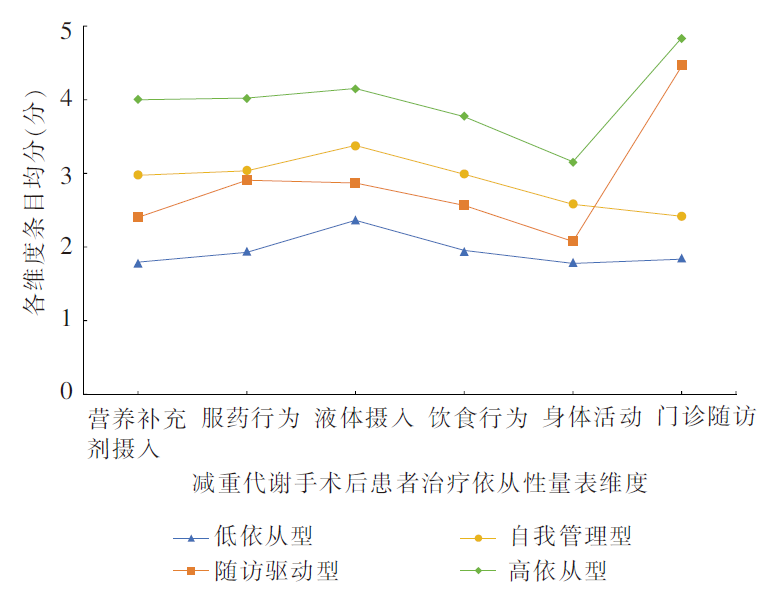
图1 减重代谢手术后患者治疗依从性潜在剖面的特征分布
Figure 1 Characteristic profiles of the latent classes for treatment adherence among patients after bariatric surgery
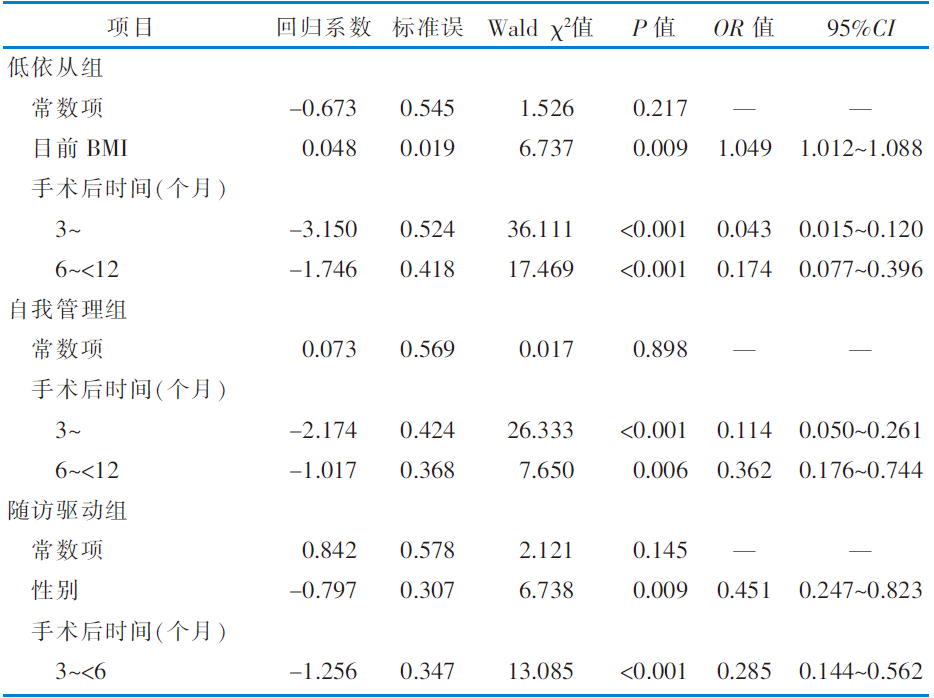 |
表3 减重代谢手术后患者治疗依从性潜在剖面的Logistic回归分析(n=434)
Table 3 Multinomial Logistic regression analysis of latent profiles for treatment adherence among patients after bariatric surgery(n=434)
| |
| [1] |
Risk Factor Collaboration(NCD-RisC) NCD. Worldwide trends in underweight and obesity from 1990 to 2022:a pooled ana-lysis of 3663 population-representative studies with 222 million children,adolescents,and adults[J]. Lancet, 2024, 403(10431):1027-1050.
DOI URL |
| [2] | World Obesity Federation. World Obesity Atlas 2025[EB/OL].(2025-03-04)[2026-01-09]. https://www.worldobesity.org/resour-ces/resource-library/world-obesity-atlas-2025. |
| [3] |
Wang YF, Zhao L, Gao LW, et al. Health policy and public health implications of obesity in China[J]. Lancet Diabetes Endocrinol, 2021, 9(7):446-461.
DOI URL |
| [4] |
Ahmed AE, Alanazi WR, ALMuqbil BI, et al. Impact of age on postoperative complications following bariatric surgery[J]. Qatar Med J, 2019, 2019(3):11.
DOI PMID |
| [5] |
Carter J, Chang J, Birriel TJ, et al. ASMBS position statement on preoperative patient optimization before metabolic and baria-tric surgery[J]. Surg Obes Relat Dis, 2021, 17(12):1956-1976.
DOI URL |
| [6] |
Sundgot-Borgen C, Bond DS, Rø Ø, et al. Associations of adhe-rence to physical activity and dietary recommendations with weight recurrence 1-5 years after metabolic and bariatric sur-gery[J]. Surg Obes Relat Dis, 2024, 20(4):383-390.
DOI URL |
| [7] |
朱涵菲, 杨宁琍, 任子淇, 等. 减重代谢术后患者饮食依从性影响因素的质性研究[J]. 中华护理杂志, 2021, 56(1):56-61.
DOI |
| Zhu HF, Yang NL, Ren ZQ, et al. Influencing factors of dietary adherence among patients following bariatric surgery:a qualita-tive study[J]. Chin J Nurs, 2021, 56(1):56-61. | |
| [8] |
温忠麟, 谢晋艳, 王惠惠. 潜在类别模型的原理、步骤及程序[J]. 华东师范大学学报(教育科学版), 2023, 41(1):1-15.
DOI |
| Wen ZL, Xie JY, Wang HH. Principles, procedures and pro-grams of latent class models[J]. J East China Norm Univ Educ Sci, 2023, 41(1):1-15. | |
| [9] | Nylund-Gibson K, Garber AC, Carter DB, et al. Ten frequently asked questions about latent transition analysis[J]. Psychol Me-thods, 2023, 28(2):284-300. |
| [10] | 倪平, 陈京立, 刘娜. 护理研究中量性研究的样本量估计[J]. 中华护理杂志, 2010, 45(4):378-380. |
| Ni P, Chen JL, Liu N. The sample size estimation in quan-titative nursing research[J]. Chin J Nurs, 2010, 45(4):378-380. | |
| [11] |
花红霞, 杨宁琍, 梁辉. 减重代谢手术后病人放牧饮食潜在类别的影响因素分析[J]. 腹部外科, 2024, 37(5):348-355.
DOI |
| Hua HX, Yang NL, Liang H. Latent class analysis of influen-cing factors of grazing behavior among patients undergoing metabolic and bariatric surgery[J]. J Abdom Surg, 2024, 37(5):348-355. | |
| [12] | 邬小容, 严露培, 龚发平, 等. 减重术后病人治疗依从性量表的编制及信效度检验[J]. 护理研究, 2025, 39(22):3784-3790. |
| Wu XR, Yan LP, Gong FP, et al. Development of a Treatment Adherence Scale for Post-Bariatric Surgery Patients and its reliability and validity test[J]. Chin Nurs Res, 2025, 39(22):3784-3790. | |
| [13] |
Kuipers E, Timmerman J, van Det M, et al. The need for ob-jective physical activity measurements in routine bariatric care[J]. Obes Surg, 2022, 32(9):2975-2986.
DOI |
| [14] | 岑巧, 张晶磊, 谢铭, 等. 减重术后患者运动干预的范围综述[J]. 护理学杂志, 2025, 40(16):118-123. |
| Cen Q, Zhang JL, Xie M, et al. Exercise interventions follo-wing bariatric surgery:a scoping review[J]. J Nurs Sci, 2025, 40(16):118-123. | |
| [15] | 罗彦, 马丽娜, 余惠红, 等. 湖北省居民健康素养现况及其影响因素分析[J]. 实用预防医学, 2019, 26(5):599-602. |
| Luo Y, Ma LN, Yu HH, et al. Analysis on the current situa-tion of residents’ health literacy in Hubei Province and its influencing factors[J]. Pract Prev Med, 2019, 26(5):599-602. | |
| [16] |
MacKenzie CS, Gekoski WL, Knox VJ. Age,gender,and the underutilization of mental health services:the influence of help-seeking attitudes[J]. Aging Ment Health, 2006, 10(6):574-582.
DOI URL |
| [17] | 刘学颖. 个体化护理干预对减重代谢手术患者术后恢复、自我管理能力及生活质量的影响[J]. 航空航天医学杂志, 2023, 34(1):82-85. |
| Liu XY. Effect of individualized nursing intervention on pos-toperative recovery,self-management ability and quality of life of patients undergoing weight loss metabolic surgery[J]. J Aerosp Med, 2023, 34(1):82-85. | |
| [18] | 史潇, 於克伟, 张永鸿, 等. 肥胖症病人减重代谢手术后自我管理的研究进展[J]. 循证护理, 2024, 10(8):1365-1369. |
| Shi X, Yu KW, Zhang YH, et al. Research progress on self-management of obese patients after metabolic bariatric sur-gery[J]. Chin Evid Based Nurs, 2024, 10(8):1365-1369. | |
| [19] |
Harbury CM, Callister R, Collins CE. Nutrition “fat facts” are not common knowledge[J]. Health Promot J Austr, 2018, 29(1):93-99.
DOI PMID |
| [20] |
Mohammed MR, Mahdy T, Hashem A, et al. Impact of baseline BMI and adherence to follow-up on the outcome of sleeve gastrectomy in treatment of adolescent obesity[J]. Obes Surg, 2021, 31(6):2567-2575.
DOI PMID |
| [21] |
Salemonsen E, Førland G, Saetre Hansen B, et al. Beneficial self-management support and user involvement in Healthy Life Centres:a qualitative interview study in persons afflicted by overweight or obesity[J]. Health Expect, 2020, 23(5):1376-1386.
DOI URL |
| [22] |
郑丹萍, 朱宏伟, 杨雨佳, 等. 内化体重偏见及体重可控信念对减重女性饮食行为的影响[J]. 中国医学科学院学报, 2025, 47(5):822-829.
DOI |
|
Zheng DP, Zhu HW, Yang YJ, et al. Impacts of internalized weight bias and weight control beliefs on eating behaviors in women losing weight[J]. Acta Acad Med Sin, 2025, 47(5):822-829.
DOI |
|
| [23] |
Zhu HF, Zhao K, Ren ZQ, et al. Determinants of dietary adhe-rence among Chinese patients after bariatric surgery based on the attitude-social influence-efficacy model[J]. Obes Surg, 2022, 32(9):3064-3073.
DOI |
| [24] |
Luca P, Nicolas C, Marina V, et al. Where are my patients? Lost and found in bariatric surgery[J]. Obes Surg, 2021, 31(5):1979-1985.
DOI PMID |
| [25] | 望露, 杨倩蓉, 全丽丽. 基于行为分阶段转变理论的护理模式对肺结核患者的护理效果分析[J]. 中国防痨杂志, 2024, 46(增刊):253-255. |
| Wang L, Yang QR, Quan LL. Analysis of nursing effect of nurs-ing mode based on behavior phased change theory on pulmonary tuberculosis patients[J]. Chin J Antituberc, 2024, 46(Suppl):253-255. | |
| [26] |
Goulart MR, Schmidt KES, Waclawovsky G, et al. Patient adhe-rence,satisfaction and changes in anthropometric parameters with e-health versus in-person monitoring in metabolic baria-tric surgery patients:a study protocol for a systematic review and non-inferiority meta-analysis of cohort studies[J]. PLoS One, 2025, 20(1):e0313434.
DOI URL |
| [27] |
Barka I, Sayedoff P, Garnier N, et al. Sociodemographic factors associated with loss to follow-up after bariatric surgery[J]. Obes Surg, 2021, 31(6):2701-2708.
DOI PMID |
| [28] |
Hansson LM, Rasmussen F. Attitudes towards obesity in the Swedish general population:the role of one’s own body size,weight satisfaction,and controllability beliefs about obesity[J]. Body Image, 2014, 11(1):43-50.
DOI PMID |
| [1] | 杨嘉琪, 王怡童, 李洁, 王丽娜. 老年维持性血液透析患者碎片化运动干预方案的构建及初步应用[J]. 中华护理杂志, 2026, 61(5): 581-589. |
| [2] | 张笑天, 黄姣, 郑园华, 熊宇欣, 孙鑫, 李鸿艳. 腹膜透析患者饮食与肌少症的相关性研究及护理启示[J]. 中华护理杂志, 2026, 61(5): 590-597. |
| [3] | 庄珊珊, 徐超凡, 施亚凤, 曹越秀, 吕颖. 维持性血液透析患者社会疏离感发展轨迹及其影响因素的研究[J]. 中华护理杂志, 2026, 61(5): 598-604. |
| [4] | 温佳, 郭慧芳, 郭晶晶, 田云霞, 杨玥, 刘波. 维持性血液透析患者社会疏离感的范围综述[J]. 中华护理杂志, 2026, 61(5): 605-611. |
| [5] | 中华护理学会人文护理专业委员会, 中华护理学会急诊护理专业委员会, (执笔:刘义兰, 汪唯, 甘秀妮, 朱陈萍, 杨霞, 熊莉娟, 朱丽辉, 徐翠荣, 郭舒婕, 张洁, 金晓燕, 李君, 李丽, 黄素芳, 王晓洁, 周晨曦, 李映兰. 对急诊科护士的人文关怀策略专家共识[J]. 中华护理杂志, 2026, 61(5): 612-615. |
| [6] | 中国抗癌协会肿瘤康复整合护理专业委员会, (执笔:钟就娣, 王影新, 刘飞, 潜艳, 康璐, 颜红艳, 杨明雪, 廖洋洋, 刘群红. 老年肺癌患者术后分级运动的专家共识[J]. 中华护理杂志, 2026, 61(5): 616-621. |
| [7] | 徐晓静, 尚茜, 李娟, 张培培, 史素玲. 中青年肺癌化疗患者家庭参与式多模态运动干预方案的构建及应用研究[J]. 中华护理杂志, 2026, 61(5): 622-629. |
| [8] | 严满琳, 黄薇融, 张智慧, 李显蓉. 肠造口患者社会疏离感干预方案的构建及初步验证[J]. 中华护理杂志, 2026, 61(5): 630-638. |
| [9] | 刘苗苗, 唐浪娟, 吴利, 高云倩, 梁慧, 晏康容, 谢方婷. 老年糖尿病视网膜病变患者认知衰弱风险预测模型的构建及验证[J]. 中华护理杂志, 2026, 61(5): 639-645. |
| [10] | 刘宁宁, 万玉峰, 田小红, 王英, 刘文君, 高丽莹. 老年慢性阻塞性肺疾病患者稳定期晨间症状的网络分析[J]. 中华护理杂志, 2026, 61(5): 646-652. |
| [11] | 朱金星, 顾招芹, 汤婷, 陈秋圆, 丁宁, 李方. 阻塞性睡眠呼吸暂停综合征患者疾病感知经历的质性研究[J]. 中华护理杂志, 2026, 61(5): 653-659. |
| [12] | 路梦新, 于晓燕, 张胜龙, 马璐, 王子瑜, 丁锦平, 辛婷婷, 张丙良. 肝移植患者不同阶段康复需求的纵向质性研究[J]. 中华护理杂志, 2026, 61(5): 660-666. |
| [13] | 崔一凡, 张明名, 张晓雪, 郑煜琳, 王文爽, 王欣然. 老年腹部大手术患者肌肉状况及影响因素的纵向研究[J]. 中华护理杂志, 2026, 61(5): 667-673. |
| [14] | 周敏, 王林娟, 黄雀兰, 付勤, 李贾贾, 付坤会, 董琪, 孟令雨. 15所三级医院儿科ICU护士对外周动脉导管管理的知信行现状调查[J]. 中华护理杂志, 2026, 61(5): 682-688. |
| [15] | 王凡, 赵文娟, 曹佳伟, 陆箴琦. 肝癌患者介入治疗术后穿刺处出血并发症预测模型的构建及验证[J]. 中华护理杂志, 2026, 61(5): 689-696. |
| 阅读次数 | ||||||
|
全文 |
|
|||||
|
摘要 |
|
|||||
