

中华护理杂志 ›› 2024, Vol. 59 ›› Issue (9): 1130-1137.DOI: 10.3761/j.issn.0254-1769.2024.09.016
董蕾( ), 刘佳(), 赵琴, 赵洪圉, 朱肖
收稿日期:2023-05-31
出版日期:2024-05-10
发布日期:2024-04-28
*通讯作者:
刘佳,E-mail:chucklejl@163.com作者简介:董蕾:女,本科(硕士在读),E-mail:dl1590544@163.com
基金资助:
DONG Lei(), LIU Jia(), ZHAO Qin, ZHAO Hongyu, ZHU Xiao
Received:2023-05-31
Online:2024-05-10
Published:2024-04-28
摘要:
目的 系统评价脑卒中患者虚拟现实康复体验,为临床脑卒中患者康复实践提供参考。方法 检索PubMed、Web of Science、Scopus、Embase、Cochrane Library、CINAHL、中国知网、万方数据库、中国生物医学文献数据库、维普数据库中相关质性研究,检索时限为建库至2023年4月,采用澳大利亚乔安娜布里格斯研究所(Joanna Briggs Institute,JBI)循证卫生保健中心质性研究质量评价标准(2020版)进行文献质量评价,运用汇集性整合法整合结果,并采用JBI循证卫生保健中心构建的质性研究整合证据评估工具(confidence in the qualitative evidence,ConQual)对整合结果进行质量评级。结果 共纳入14篇文献,提炼45个主题,归纳出10个类别,最终形成3个整合结果,即感知虚拟现实康复益处、感知虚拟现实康复障碍、对虚拟现实康复的期望和需求。ConQual评分显示,整合证据体为中等水平。结论 脑卒中患者对虚拟现实康复态度积极,但未来应优化脑卒中虚拟现实康复支持系统,完善虚拟现实康复技术反馈机制和个性化内容,创新虚拟现实多功能康复模式,并推动虚拟现实康复延伸至社区和居家,促进脑卒中患者虚拟现实康复实践。
董蕾, 刘佳, 赵琴, 赵洪圉, 朱肖. 脑卒中患者虚拟现实康复体验质性研究的Meta整合[J]. 中华护理杂志, 2024, 59(9): 1130-1137.
DONG Lei, LIU Jia, ZHAO Qin, ZHAO Hongyu, ZHU Xiao. Experience of virtual reality rehabilitation of stroke patients:a Meta-synthesis of qualitative study[J]. Chinese Journal of Nursing, 2024, 59(9): 1130-1137.

图1 PubMed文献检索策略
Figure 1 PubMed database literature retrieval strategy
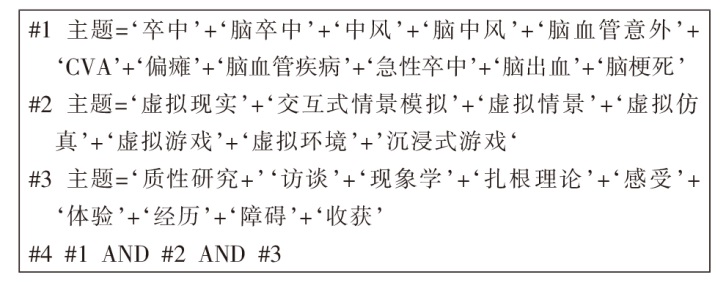
图2 中国知网文献检索策略
Figure 2 China national knowledge infrastructure database literature retrieval strategy

图3 文献筛选流程图
Figure 3 Literature screening process
 |
表1 纳入文献的基本特征(n=14)
Table 1 The basic characteristics of the included literature(n=14)
| |
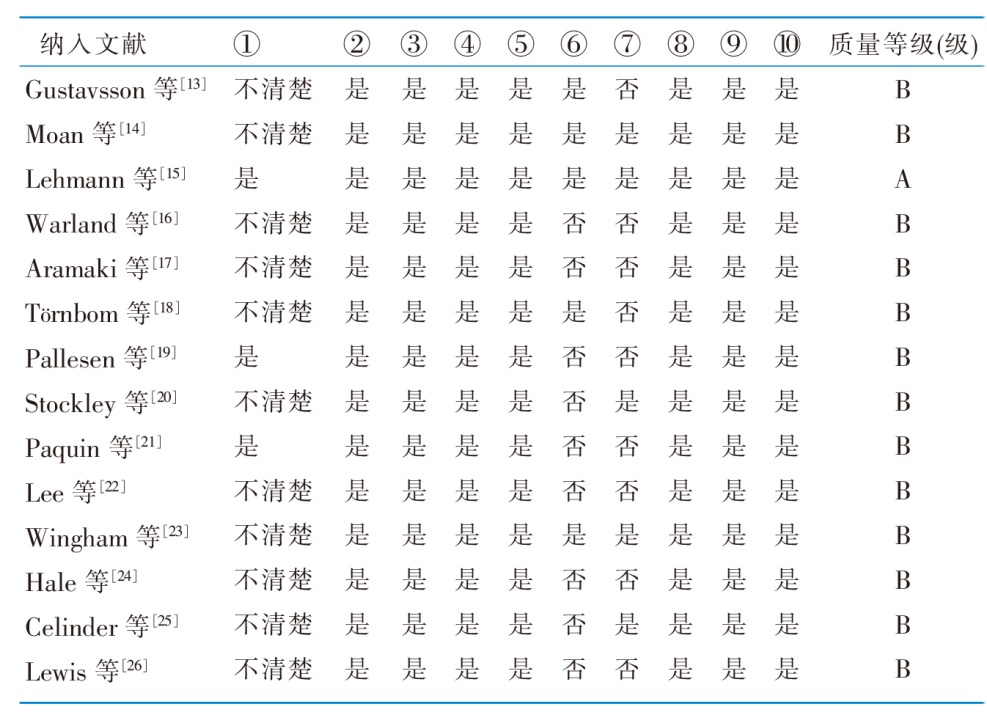 |
表2 纳入文献的方法学质量评价结果(n=14)
Table 2 Methodological quality evaluation of the included literature(n=14)
| |
| [1] |
Zhang BH, Li D, Liu Y, et al. Virtual reality for limb motor function,balance,gait,cognition and daily function of stroke patients:a systematic review and meta-analysis[J]. J Adv Nurs, 2021, 77(8):3255-3273.
DOI URL |
| [2] |
Campbell B, Khatri P. Stroke[J]. Lancet, 2020, 396(10244):129-142.
DOI PMID |
| [3] |
Malik AN, Tariq H, Afridi A, et al. Technological advancements in stroke rehabilitation[J]. J Pak Med Assoc, 2022, 72(8):1672-1674.
DOI PMID |
| [4] | 朱小佳, 李静, 黄丽容, 等. 德国早期康复服务理念的临床渗透及启示[J]. 中华护理杂志, 2018, 53(11):1333-1337. |
| Zhu XJ, Li J, Huang LR, et al. Clinical practice of early rehabilitation nursing in Germany and its implications[J]. Chin J Nurs, 2018, 53(11):1333-1337. | |
| [5] |
Mariano B. Towards a global strategy on digital health[J]. Bull World Health Organ, 2020, 98(4):231-231A.
DOI URL |
| [6] |
Maggio MG, Latella D, Maresca G, et al. Virtual reality and cognitive rehabilitation in people with stroke:an overview[J]. J Neurosci Nurs, 2019, 51(2):101-105.
DOI URL |
| [7] | Choi YH, Paik NJ. Mobile game-based virtual reality program for upper extremity stroke rehabilitation[J]. J Vis Exp, 2018(133):56241. |
| [8] |
Faria AL, Pinho MS, Bermúdez i Badia S. A comparison of two personalization and adaptive cognitive rehabilitation approaches:a randomized controlled trial with chronic stroke patients[J]. J Neuroeng Rehabil, 2020, 17(1):1-15.
DOI |
| [9] |
Lin RC, Chiang SL, Heitkemper MM, et al. Effectiveness of early rehabilitation combined with virtual reality training on muscle strength,mood state,and functional status in patients with acute stroke:a randomized controlled trial[J]. Worldviews Evid Based Nurs, 2020, 17(2):158-167.
DOI URL |
| [10] | 胡雁, 郝玉芳. 循证护理学[M]. 2版. 北京: 人民卫生出版社, 2018. |
| Hu Y, Hao YF. Evidence-based nursing[M]. 2nd ed. Beijing: People’s Medical Publishing House, 2018. | |
| [11] | The Joanna Briggs Institute. Critical appraisal checklist for qualitative research[EB/OL]. [2023-05-14]. https://jbi-global-wiki.refined.site/space/MANUAL. |
| [12] |
Munn Z, Porritt K, Lockwood C, et al. Establishing confidence in the output of qualitative research synthesis:the ConQual approach[J]. BMC Med Res Methodol, 2014, 14:108.
DOI URL |
| [13] |
Gustavsson M, Kjörk EK, Erhardsson M, et al. Virtual reality gaming in rehabilitation after stroke-user experiences and perceptions[J]. Disabil Rehabil, 2022, 44(22):6759-6765.
DOI URL |
| [14] |
Moan ME, Vonstad EK, Su XM, et al. Experiences of stroke survivors and clinicians with a fully immersive virtual reality treadmill exergame for stroke rehabilitation:a qualitative pilot study[J]. Front Aging Neurosci, 2021, 13:735251.
DOI URL |
| [15] |
Lehmann I, Baer G, Schuster-Amft C. Experience of an upper limb training program with a non-immersive virtual reality system in patients after stroke:a qualitative study[J]. Physiotherapy, 2020, 107:317-326.
DOI URL |
| [16] |
Warland A, Paraskevopoulos I, Tsekleves E, et al. The feasibility,acceptability and preliminary efficacy of a low-cost,virtual-reality based,upper-limb stroke rehabilitation device:a mixed methods study[J]. Disabil Rehabil, 2019, 41(18):2119-2134.
DOI PMID |
| [17] |
Aramaki AL, Sampaio RF, Cavalcanti A, et al. Use of client-centered virtual reality in rehabilitation after stroke:a feasibility study[J]. Arq Neuropsiquiatr, 2019, 77(9):622-631.
DOI URL |
| [18] |
Törnbom K, Danielsson A. Experiences of treadmill walking with non-immersive virtual reality after stroke or acquired brain injury:a qualitative study[J]. PLoS One, 2018, 13(12):e0209214.
DOI URL |
| [19] | Pallesen H, Andersen MB, Hansen GM, et al. Patients’ and health professionals’ experiences of using virtual reality technology for upper limb training after stroke:a qualitative substudy[J]. Rehabil Res Pract, 2018, 2018:4318678. |
| [20] | Stockley RC, O’Connor DA, Smith P, et al. A mixed methods small pilot study to describe the effects of upper limb training using a virtual reality gaming system in people with chronic stroke[J]. Rehabil Res Pract, 2017, 2017:9569178. |
| [21] |
Paquin K, Crawley J, Harris JE, et al. Survivors of chronic stroke-participant evaluations of commercial gaming for rehabilitation[J]. Disabil Rehabil, 2016, 38(21):2144-2152.
DOI PMID |
| [22] |
Lee M, Pyun SB, Chung J, et al. A further step to develop patient-friendly implementation strategies for virtual reality-based rehabilitation in patients with acute stroke[J]. Phys Ther, 2016, 96(10):1554-1564.
PMID |
| [23] |
Wingham J, Adie K, Turner D, et al. Participant and caregiver experience of the Nintendo Wii SportsTM after stroke:qualitative study of the trial of WiiTM in stroke(TWIST)[J]. Clin Rehabil, 2015, 29(3):295-305.
DOI PMID |
| [24] |
Hale LA, Satherley JA, McMillan NJ, et al. Participant perceptions of use of CyWee Z as adjunct to rehabilitation of upper-limb function following stroke[J]. J Rehabil Res Dev, 2012, 49(4):623-634.
PMID |
| [25] |
Celinder D, Peoples H. Stroke patients’ experiences with Wii Sports? During inpatient rehabilitation[J]. Scand J Occup Ther, 2012, 19(5):457-463.
DOI PMID |
| [26] |
Lewis GN, Woods C, Rosie JA, et al. Virtual reality games for rehabilitation of people with stroke:perspectives from the users[J]. Disabil Rehabil Assist Technol, 2011, 6(5):453-463.
DOI PMID |
| [27] |
Shin JH, Ryu H, Jang SH. A task-specific interactive game-based virtual reality rehabilitation system for patients with stroke:a usability test and two clinical experiments[J]. J Neuroeng Rehabil, 2014, 11(1):1-10.
DOI URL |
| [28] |
Proffitt R, Warren J, Lange B, et al. Safety and feasibility of a first-person view,full-body interaction game for telerehabilitation post-stroke[J]. Int J Telerehabil, 2018, 10(1):29-36.
DOI PMID |
| [29] |
王文娜, 张振香, 张杜杜, 等. 照顾者对脑卒中患者自我护理贡献量表的编制及信效度检验[J]. 中华护理杂志, 2023, 58(1):39-45.
DOI |
|
Wang WN, Zhang ZX, Zhang DD, et al. Development and psychometric test of the Caregiver Contribution to Self-Care of Stroke Patient Scale[J]. Chin J Nurs, 2023, 58(1):39-45.
DOI |
|
| [30] |
王文娜, 林蓓蕾, 张振香, 等. 脑卒中患者远程康复体验质性研究的Meta整合[J]. 中华护理杂志, 2021, 56(2):199-206.
DOI |
| Wang WN, Lin BL, Zhang ZX, et al. Meta-synthesis of qualitative research on the real experience of telerehabilitation for stroke survivor[J]. Chin J Nurs, 2021, 56(2):199-206. | |
| [31] |
Kim WS, Cho S, Ku J, et al. Clinical application of virtual reality for upper limb motor rehabilitation in stroke:review of technologies and clinical evidence[J]. J Clin Med, 2020, 9(10):3369.
DOI URL |
| [32] | 国家卫生健康委员会, 国家发展改革委员会, 教育部, 等. 关于加快推进康复医疗工作发展的意见[J]. 中国康复理论与实践, 2021, 27(9):993-995. |
| National Health Commission, National Development and Reform Commission, Ministry of Education, et al. Opinions on accelerating the development of rehabilitation medical work[J]. Chin J Rehabil Theory Pract, 2021, 27(9):993-995. |
| [1] | 叶俊霜, 沈丽佳, 孟霞靓, 张玉姣, 蔡根莲, 邵碧云, 周亚辉, 张柳倩, 应金萍. 维持性血液透析患者对口腔衰弱认知和体验的质性研究[J]. 中华护理杂志, 2026, 61(9): 1215-1220. |
| [2] | 李艳桃, 杨连招, 龙秀红, 陈玲, 高慧, 覃文婷, 朱芳慧, 罗雪儿. HIV感染者/AIDS患者创伤后成长体验的Meta整合[J]. 中华护理杂志, 2026, 61(9): 1261-1268. |
| [3] | 刘幸, 范文祥, 周庭戌, 商临萍. 慢性阻塞性肺疾病患者戒烟行为促进与障碍因素的质性研究[J]. 中华护理杂志, 2026, 61(8): 1021-1027. |
| [4] | 舒适, 朱杉, 余艮珍, 张萍, 周晨曦, 彭维, 王珍. 特发性中枢性性早熟患儿患病体验与需求的质性研究[J]. 中华护理杂志, 2026, 61(8): 1074-1079. |
| [5] | 许国萍, 胡欢婷, 李丽, 金静芬, 蒋佳奖, 任英. 膝关节假体周围感染患者就医决策历程的质性研究[J]. 中华护理杂志, 2026, 61(8): 1101-1106. |
| [6] | 黄璇, 郭书萍, カルデナス暁東, 谢云影, 王瀚敏, 张玉美, 刘焘丽, 李莉. 银屑病患者自我报告结局评估工具测量学属性的评价及护理启示[J]. 中华护理杂志, 2026, 61(8): 1117-1124. |
| [7] | 张滢, 刘淑娟, 王婧瑞, 马千蓉. 轻度认知障碍患者对虚拟现实技术使用体验的Meta整合[J]. 中华护理杂志, 2026, 61(8): 1125-1131. |
| [8] | 韩林, 杨丽娟, 李太东, 郑晓丽, 程敏, 郭琛, 郑培培. ICU机械通气清醒患者沟通体验的Meta整合[J]. 中华护理杂志, 2026, 61(7): 901-908. |
| [9] | 王阳阳, 杨旻斐, 黄科儿, 姚晓月, 赵燕祥, 李佳麒, 尹娜, 黄凌, 张菊. 老年创伤性脑损伤合并衰弱患者早期运动康复照护促进与阻碍因素的质性研究[J]. 中华护理杂志, 2026, 61(7): 939-946. |
| [10] | 管颖慧, 谢鑑辉, 欧阳雅琦, 徐乐, 田佳琦, 王琼. 1型糖尿病青少年向成人医疗过渡体验的Meta整合[J]. 中华护理杂志, 2026, 61(7): 979-985. |
| [11] | 曾佳琳, 符冰, 杨泠韵, 江庆华. 头颈癌患者自我报告结局评估工具的评价及护理启示[J]. 中华护理杂志, 2026, 61(7): 986-994. |
| [12] | 王秀丽, 代春豪, 许梓婷, 李昊远, 冷敏敏, 张海博, 李晴, 杨丽娟. 运动干预在老年肌少性肥胖患者中应用的范围综述[J]. 中华护理杂志, 2026, 61(7): 995-1001. |
| [13] | 刘晓, 李丽, 施忠英. 青少年神经性厌食患者及其父母出院准备体验及需求的质性研究[J]. 中华护理杂志, 2026, 61(6): 814-821. |
| [14] | 朱金星, 顾招芹, 汤婷, 陈秋圆, 丁宁, 李方. 阻塞性睡眠呼吸暂停综合征患者疾病感知经历的质性研究[J]. 中华护理杂志, 2026, 61(5): 653-659. |
| [15] | 路梦新, 于晓燕, 张胜龙, 马璐, 王子瑜, 丁锦平, 辛婷婷, 张丙良. 肝移植患者不同阶段康复需求的纵向质性研究[J]. 中华护理杂志, 2026, 61(5): 660-666. |
| 阅读次数 | ||||||
|
全文 |
|
|||||
|
摘要 |
|
|||||
