

中华护理杂志 ›› 2026, Vol. 61 ›› Issue (6): 741-748.DOI: 10.3761/j.issn.0254-1769.2026.06.003
朱静1( ), 孙艳1, 司惠芳1, 李秀娟1, 加米娜·瓦合甫1, 常海霞2,*()
收稿日期:2025-03-11
出版日期:2026-03-20
发布日期:2026-03-23
*通讯作者:
常海霞,E-mail:13639956939@163.com作者简介:朱静:女,本科,主管护师,E-mail:1454161796@qq.com
基金资助:
ZHU Jing1(), SUN Yan1, SI Huifang1, LI Xiujuan1, GAMINA Wahefu1, CHANG Haixia2,*()
Received:2025-03-11
Online:2026-03-20
Published:2026-03-23
Funding program:摘要:
目的 探究成人急性白血病患者化疗期间心理弹性的变化轨迹,并分析相关影响因素,为制订针对性的心理干预策略提供依据。 方法 采用便利抽样法,选取2023年1月—2024年8月新疆维吾尔自治区某三级甲等医院血液肿瘤科收治的260例成人急性白血病患者作为调查对象。在首次化疗入院第1天,采用心理弹性量表、正性负性情绪量表、领悟社会支持量表、简易版疾病认知问卷、医学应对方式问卷进行调查,并在化疗后第1、3、6个月时采用心理弹性量表再次评估患者的心理弹性。使用群组轨迹模型识别患者心理弹性的变化轨迹,运用多分类Logistic回归分析其影响因素。 结果 共244例患者完成随访。通过群组轨迹模型分析,识别出高心理弹性上升组(36.5%)、中心理弹性平稳组(39.3%)、低心理弹性组(14.8%)和心理弹性脆弱组(9.4%)4种变化轨迹。多分类Logistic回归分析结果显示,正性或负性情绪、社会支持水平、疾病认知水平、医学应对方式是成人急性白血病患者化疗期间心理弹性变化轨迹的影响因素(P<0.05)。 结论 成人急性白血病患者化疗期间的心理弹性存在4种变化轨迹,医护人员应根据其影响因素制订针对性的心理干预策略,以提升患者的心理弹性和生活质量。
朱静, 孙艳, 司惠芳, 李秀娟, 加米娜·瓦合甫, 常海霞. 成人急性白血病患者化疗期间心理弹性的变化轨迹及影响因素研究[J]. 中华护理杂志, 2026, 61(6): 741-748.
ZHU Jing, SUN Yan, SI Huifang, LI Xiujuan, GAMINA Wahefu, CHANG Haixia. Change trajectory and influencing factors of psychological resilience in adult patients with acute leukemia during chemotherapy[J]. Chinese Journal of Nursing, 2026, 61(6): 741-748.
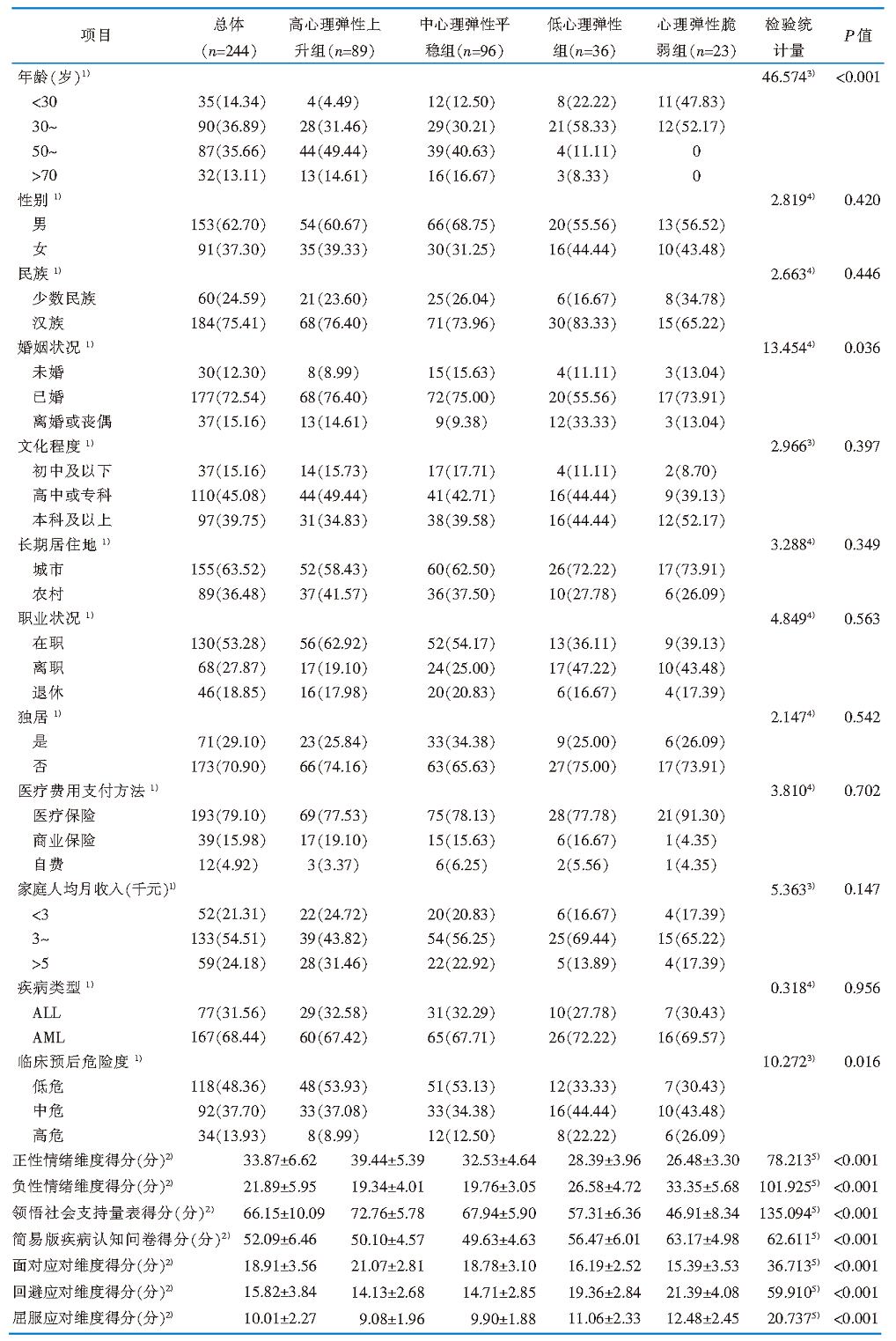 |
表1 调查对象的一般资料及化疗期间心理弹性变化轨迹的单因素分析结果
Table 1 The general information of survey subjects and univariate analysis of the trajectory of psychological resilience changes during chemotherapy
| |
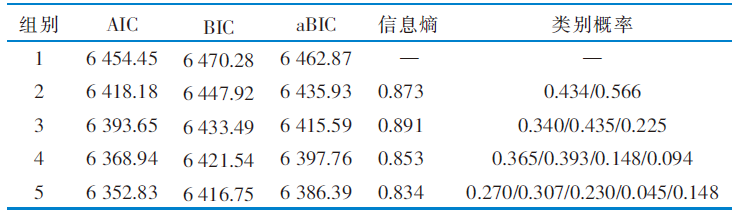 |
表2 成人急性白血病患者化疗期间的心理弹性变化轨迹模型拟合结果
Table 2 Model fitting index results of psychological resilience trajectories in adult leukemia patients during chemotherapy
| |
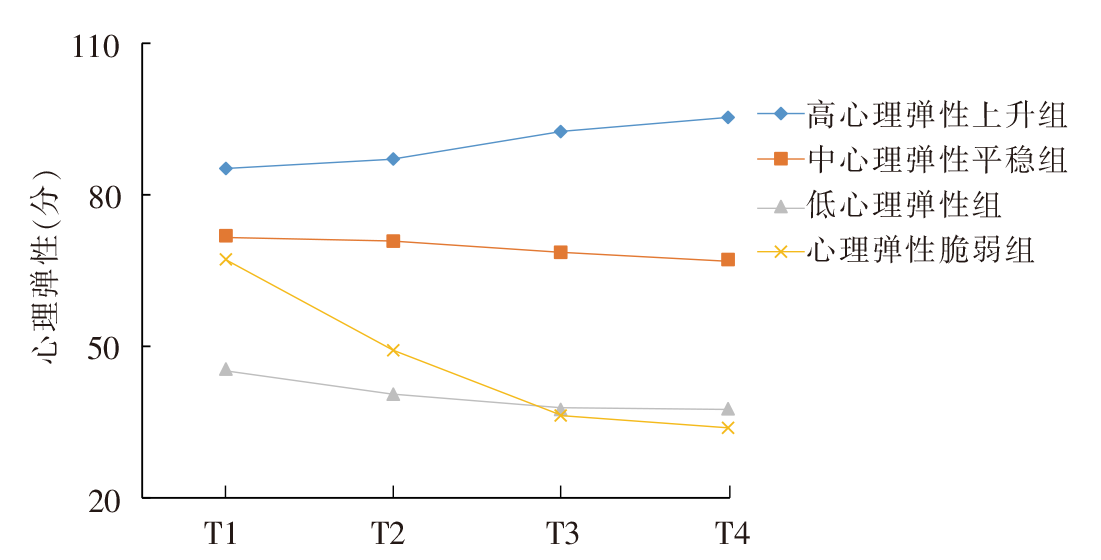
图1 成人急性白血病患者化疗期间的心理弹性变化轨迹 注:T1为首次化疗入院第1天;T2为化疗后第1个月;T3为化疗后第3个月;T4为化疗后第6个月。
Figure 1 Trajectory of psychological resilience in adult leukemia patients during chemotherapy
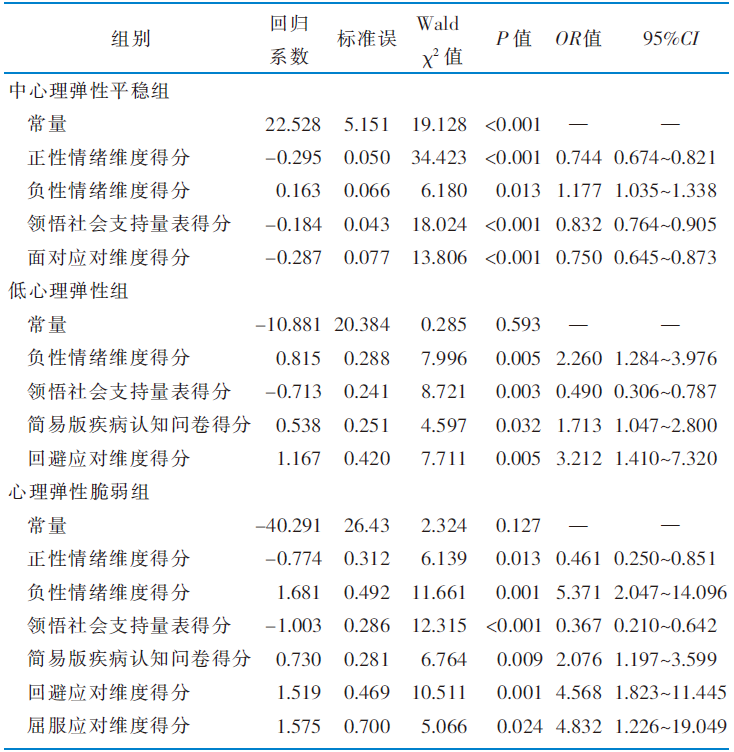 |
表3 成人急性白血病患者化疗期间心理弹性变化轨迹的多分类Logistic回归分析(n=244)
Table 3 Multivariate Logistic regression analysis of psychological resilience trajectories in adult leukemia patients during chemotherapy(n=244)
| |
| [1] | Sung H, Ferlay J, Siegel RL, et al. Global cancer statistics 2020:GLOBOCAN estimates of incidence and mortality worldwide for 36 cancers in 185 countries[J]. CA Cancer J Clin, 2021, 71(3):209-249. |
| [2] | Agostinelli G, Muzzatti B, Serpentini S, et al. Cancer-related psychological distress in lymphoma survivor:an Italian cross-sectional study[J]. Front Psychol, 2022,13:872329. |
| [3] | 彭芳, 张静平, 李小云, 等. 急性白血病化疗患者生活质量的影响因素研究[J]. 中国全科医学, 2012, 15(2):139-141. |
| Peng F, Zhang JP, Li XY, et al. Factors influencing the quality of life of acute leukemia patients receiving chemotherapy[J]. Chin Gen Pract, 2012, 15(2):139-141. | |
| [4] | 张丽敏, 张秀贞, 刘传新. 恶性血液肿瘤患者焦虑情绪与生命质量:心理弹性的中介作用和自我效能感的调节作用[J]. 中华行为医学与脑科学杂志, 2024, 33(12):1099-1105. |
| Zhang LM, Zhang XZ, Liu CX. Anxiety and quality of life in patients with hematologic malignancy:the mediating role of resilience and the moderating role of self-efficacy[J]. Chin J Behav Med Brain Sci, 2024, 33(12):1099-1105. | |
| [5] |
刘晓宇, 陆海英, 单亚维, 等. 全膝关节置换患者术前心理弹性现状及其影响因素分析[J]. 中华护理杂志, 2022, 57(17):2102-2108.
DOI |
|
Liu XY, Lu HY, Shan YW, et al. The status and influencing factors associated with psychological resilience in preoperative patients with total knee arthroplasty[J]. Chin J Nurs, 2022, 57(17):2102-2108.
DOI |
|
| [6] | 赵玉敬, 陆爱文, 亓欣. 血液系统恶性肿瘤患者心理弹性现状及影响因素[J]. 国际护理学杂志, 2021, 40(12):2144-2147. |
| Zhao YJ, Lu AW, Qi X. Current situation and influencing factors of psychological resilience in patients with hematological malignancies[J]. Int J Nurs, 2021, 40(12):2144-2147. | |
| [7] | 梁春荣, 卿雅丽, 曾清清, 等. PCI术后冠心病病人心理弹性的纵向研究[J]. 护理研究, 2024, 38(11):1934-1942. |
| Liang CR, Qing YL, Zeng QQ, et al. Longitudinal study on psychological resilience in patients with coronary heart disease after PCI[J]. Chin Nurs Res, 2024, 38(11):1934-1942. | |
| [8] | 李黎, 管祥云, 姜园园, 等. 基于群组轨迹模型的体力活动变化轨迹与中老年人认知功能的关系研究[J]. 中华现代护理杂志, 2024, 30(32):4373-4377. |
| Li L, Guan XY, Jiang YY, et al. Relationship between physical activity trajectories and cognitive function of middle-aged and older adults based on group-based trajectory model[J]. Chin J Mod Nurs, 2024, 30(32):4373-4377. | |
| [9] | 中国抗癌协会血液肿瘤专业委员会, 中华医学会血液学分会白血病淋巴瘤学组. 中国成人急性淋巴细胞白血病诊断与治疗指南(2024年版)[J]. 中华血液学杂志, 2024, 45(5):417-429. |
| Hematology Oncology Committee, Chinese Anti-Cancer Association, Leukemia & Lymphoma Group, Chinese Society of Hematology, Chinese Medical Association. Chinese guideline for diagnosis and treatment of adult acute lymphoblastic leukemia(2024)[J]. Chin J Hematol, 2024, 45(5):417-429. | |
| [10] | 中华医学会血液学分会白血病淋巴瘤学组. 中国成人急性髓系白血病(非急性早幼粒细胞白血病)诊疗指南(2021年版)[J]. 中华血液学杂志, 2021, 42(8):617-623. |
| Leukemia & Lymphoma Group, Chinese Society of Hematology, Chinese Medical Association. Chinese guidelines for the diagnosis and treatment of adult acute myeloid leukemia(not APL)(2021)[J]. Chin J Hematol, 2021, 42(8):617-623. | |
| [11] |
Shimony S, Stahl M, Stone RM. Acute myeloid leukemia:2025 update on diagnosis,risk-stratification,and management[J]. Am J Hematol,2025, 100(5):860-891.
DOI URL |
| [12] |
Connor KM, Davidson JR. Development of a new resilience scale:the Connor-Davidson Resilience Scale(CD-RISC)[J]. Depress Anxiety, 2003, 18(2):76-82.
DOI URL |
| [13] |
Wu L, Tan Y, Liu Y. Factor structure and psychometric evaluation of the Connor-Davidson Resilience Scale in a new employee population of China[J]. BMC Psychiatry, 2017, 17(1):49.
DOI PMID |
| [14] |
Watson D, Clark LA, Tellegen A. Development and validation of brief measures of positive and negative affect:the PANAS scales[J]. J Pers Soc Psychol, 1988, 54(6):1063-1070.
DOI PMID |
| [15] | 黄丽, 杨廷忠, 季忠民. 正性负性情绪量表的中国人群适用性研究[J]. 中国心理卫生杂志, 2003, 17(1):54-56. |
| Huang L, Yang TZ, Ji ZM. Applicability of the Positive and Negative Affect Scale in Chinese[J]. Chin Ment Health J, 2003, 17(1):54-56. | |
| [16] |
Zimet GD, Powell SS, Farley GK, et al. Psychometric characteristics of the multidimensional Scale of Perceived Social Support[J]. J Pers Assess, 1990, 55(3/4):610-617.
DOI URL |
| [17] | 黄丽, 姜乾金, 任蔚红. 应对方式、社会支持与癌症病人心身症状的相关性研究[J]. 中国心理卫生杂志, 1996, 10(4):160-161. |
| Huang L, Jiang QJ, Ren WH. Correlation between coping style,social support and psychosomatic symptoms of cancer patients[J]. Chin Ment Health J, 1996, 10(4):160-161. | |
| [18] |
Broadbent E, Petrie KJ, Main J, et al. The Brief Illness Perception Questionnaire[J]. J Psychosom Res, 2006, 60(6):631-637.
DOI PMID |
| [19] | 孙伟铭, 楼青, 袁也丰, 等. 简易版疾病认知问卷中文版在躯体化障碍患者中的应用[J]. 重庆医科大学学报, 2015, 40(8):1138-1142. |
| Sun WM, Lou Q, Yuan YF, et al. Application of the Chinese version of Brief Illness Perception Questionnaire in patients with somatoform disorder[J]. J Chongqing Med Univ, 2015, 40(8):1138-1142. | |
| [20] |
Feifel H, Strack S, Nagy VT. Coping strategies and associated features of medically ill patients[J]. Psychosom Med, 1987, 49(6):616-625.
DOI PMID |
| [21] | 沈晓红, 姜乾金. 医学应对方式问卷中文版701例测试报告[J]. 中国行为医学科学, 2000, 9(1):18-20. |
| Shen XH, Jiang QJ. Report on application of Chinese version of MCMQ in 701 patients[J]. Chin J Behav Med Sci, 2000, 9(1):18-20. | |
| [22] | Bonanno GA, Westphal M, Mancini AD. Resilience to loss and potential trauma[J]. Annu Rev Clin Psychol, 2011,7:511-535. |
| [23] | 王颖, 刘焕焕, 王爱华. 乳腺癌化疗患者创伤后成长与心身症状及心理弹性的相关性[J]. 国际护理学杂志, 2022, 41(18):3333-3337. |
| Wang Y, Liu HH, Wang AH. Correlation between post-traumatic growth and psychosomatic symptoms and psychological resilience in breast cancer patients undergoing chemotherapy[J]. lnt J Nurs, 2022, 41(18):3333-3337. | |
| [24] | 康玉玲. 情绪ABC理论干预对急性心肌梗死患者心理状态及应激反应的影响[J]. 中国健康心理学杂志, 2021, 29(6):843-847. |
| Kang YL. Effect of emotional ABC theory on mental state and stress response in patients with acute myocardial infarction[J]. China J Health Psychol, 2021, 29(6):843-847. | |
| [25] | 张艳, 胡德英, 刘义兰, 等. 妇科肿瘤患者医学应对及负性情绪在家庭关怀度与心理弹性间的中介作用[J]. 护理学杂志, 2023, 38(12):89-92. |
| Zhang Y, Hu DY, Liu YL, et al. The mediating role of medical coping and negative emotions in the relationship between family APGAR and psychological resilience of gynecologic oncology patients[J]. J Nurs Sci, 2023, 38(12):89-92. | |
| [26] |
廖俪雯, 王琳. 护士心理弹性干预的研究进展[J]. 中华护理杂志, 2023, 58(8):942-949.
DOI |
|
Liao LW, Wang L. Research progress on resilience intervention for nurses[J]. Chin J Nurs, 2023, 58(8):942-949.
DOI |
|
| [27] |
李红颐, 李雪, 范宇莹, 等. ICU患者创伤心理反应的潜在剖面及影响因素的混合研究[J]. 中华护理杂志, 2025, 60(7):842-849.
DOI |
|
Li HY, Li X, Fan YY, et al. A mixed study of latent profile analysis and influencing factors of psychological responses to trauma in ICU patients[J]. Chin J Nurs, 2025, 60(7):842-849.
DOI |
|
| [28] |
Greco A, Steca P, Pozzi R, et al. The influence of illness severity on health satisfaction in patients with cardiovascular disease:the mediating role of illness perception and self-efficacy beliefs[J]. Behav Med, 2015, 41(1):9-17.
DOI URL |
| [29] | 刘莉莉, 林平, 赵振娟. 自我效能、社会支持及应对方式对急性心肌梗死患者心理弹性影响的路径分析[J]. 中华护理杂志, 2016, 51(1):21-25. |
| Liu LL, Lin P, Zhao ZJ. A path analysis of impacts of self-efficacy,social support and coping style on resilience in acute myocardial infarction patients[J]. Chin J Nurs, 2016, 51(1):21-25. | |
| [30] |
姚芡芡, 刘丽, 罗艳芳, 等. 原发性脑肿瘤患者心理弹性潜在类别分析[J]. 中华护理杂志, 2022, 57(19):2363-2370.
DOI |
|
Yao QQ, Liu L, Luo YF, et al. Analysis of potential categories of psychological resilience in primary brain tumor patients[J]. Chin J Nurs, 2022, 57(19):2363-2370.
DOI |
|
| [31] |
徐萍, 闫荣, 张淼淼, 等. 头颈部肿瘤患者身体意象潜在剖面分析及影响因素研究[J]. 中华护理杂志, 2025, 60(2):215-222.
DOI |
|
Xu P, Yan R, Zhang MM, et al. Latent profile analysis and influencing factors of body image among patients with head and neck cancer[J]. Chin J Nurs, 2025, 60(2):215-222.
DOI |
| [1] | 陈淑萍, 谢宝缘, 陈绵绵, 李美玲, 林翠芬. 淋巴瘤患者化疗随访方案的构建及应用研究[J]. 中华护理杂志, 2026, 61(6): 725-732. |
| [2] | 李春秀, 修红, 刘敏, 邹晓君, 王晴, 丁书凡, 赵志平, 李晓娟. 血液肿瘤患者营养不良风险预测模型的构建及验证[J]. 中华护理杂志, 2026, 61(6): 733-740. |
| [3] | 张莹, 杜若飞, 杨惠敏, 徐晓霞, 李黎明, 杜亚婷. 初诊血液肿瘤老年患者的衰弱现状及影响因素研究[J]. 中华护理杂志, 2026, 61(6): 749-756. |
| [4] | 顾培培, 王衍蝶, 曾妃, 梁江淑渊, 蔡凌云, 朱岩, 赵淑华. 肺移植等候期患者肌少症影响因素分析及护理对策[J]. 中华护理杂志, 2026, 61(6): 790-796. |
| [5] | 覃文婷, 杨连招, 龙秀红, 陈玲, 高慧, 桑树林. 老年HIV感染者心理社会适应的潜在剖面分析及影响因素研究[J]. 中华护理杂志, 2026, 61(6): 797-805. |
| [6] | 王雪娇, 蒋玲, 马倩, 李现文, 张彦, 吕亚, 施晓芸. 育龄期宫颈癌患者家庭支持方案的构建及应用研究[J]. 中华护理杂志, 2026, 61(6): 806-813. |
| [7] | 张柔, 贺方园, 杨晓宇, 陈冬笋, 李根霞, 孙可盈, 赵晶, 郭晓丽. 双胎孕妇营养素养的影响因素分析及护理启示[J]. 中华护理杂志, 2026, 61(6): 822-828. |
| [8] | 路梦新, 于晓燕, 张胜龙, 马璐, 王子瑜, 丁锦平, 辛婷婷, 张丙良. 肝移植患者不同阶段康复需求的纵向质性研究[J]. 中华护理杂志, 2026, 61(5): 660-666. |
| [9] | 崔一凡, 张明名, 张晓雪, 郑煜琳, 王文爽, 王欣然. 老年腹部大手术患者肌肉状况及影响因素的纵向研究[J]. 中华护理杂志, 2026, 61(5): 667-673. |
| [10] | 叶惠林, 邬小容, 唐维荣, 殷云睿, 李跃荣. 减重代谢手术后患者治疗依从性现状及影响因素分析[J]. 中华护理杂志, 2026, 61(5): 674-681. |
| [11] | 周敏, 王林娟, 黄雀兰, 付勤, 李贾贾, 付坤会, 董琪, 孟令雨. 15所三级医院儿科ICU护士对外周动脉导管管理的知信行现状调查[J]. 中华护理杂志, 2026, 61(5): 682-688. |
| [12] | 王鑫, 徐慧萍, 黄倩, 孙义芳, 郭子鑫, 张昕雨. 髋关节置换患者躯体功能变化轨迹的潜在类别及影响因素分析[J]. 中华护理杂志, 2026, 61(4): 460-466. |
| [13] | 汪芳莹, 陈雪峰, 贾燕, 吴婉英. 鼻咽癌患者围放疗期症状负担类别的潜在转变及影响因素分析[J]. 中华护理杂志, 2026, 61(4): 490-497. |
| [14] | 金冠珍, 刘延锦, 金波, 王彦艳, 张玲, 刘芳芳. 老年原发性青光眼患者跌倒警觉度现状及影响因素研究[J]. 中华护理杂志, 2026, 61(4): 506-512. |
| [15] | 芦凤娟, 解子惠, 关银银, 裴晓莉, 房玉霞. 骨科护士疼痛共情的现状及影响因素研究[J]. 中华护理杂志, 2026, 61(4): 549-556. |
| 阅读次数 | ||||||
|
全文 |
|
|||||
|
摘要 |
|
|||||
