

中华护理杂志 ›› 2026, Vol. 61 ›› Issue (6): 797-805.DOI: 10.3761/j.issn.0254-1769.2026.06.011
覃文婷1( ), 杨连招1,*(), 龙秀红2, 陈玲1, 高慧1, 桑树林1
收稿日期:2025-09-24
出版日期:2026-03-20
发布日期:2026-03-23
*通讯作者:
杨连招,E-mail:1403066844@qq.com作者简介:覃文婷:女,本科(硕士在读),护士,E-mail:2393849047@qq.com
基金资助:
QIN Wenting1(), YANG Lianzhao1,*(), LONG Xiuhong2, CHEN Ling1, GAO Hui1, SANG Shulin1
Received:2025-09-24
Online:2026-03-20
Published:2026-03-23
Funding program:摘要:
目的 探索老年HIV感染者心理社会适应类别的潜在剖面,并探讨不同类别的影响因素,为后续制订精准干预措施提供参考依据。 方法 采用便利抽样法,选取2025年1—8月就诊于广西壮族自治区某三级甲等综合医院感染科关爱门诊的老年HIV感染者为调查对象,采用一般资料调查表、疾病心理社会适应量表、简易疾病感知问卷、医学应对方式量表、社会支持评定量表、心理弹性量表进行调查。运用潜在剖面分析、单因素分析和多元Logistic回归分析探索心理社会适应的潜在剖面及影响因素。 结果 发放问卷427份,回收有效问卷408份,有效问卷回收率为95.55%。老年HIV感染者心理社会适应可分为3个潜在剖面,包含相对适应良好型(64.46%)、局部适应障碍型(30.15%)和全面适应不良型(5.39%);Logistic回归分析结果显示,年龄、HIV感染年限、家庭人均月收入、疾病感知、社会支持、心理弹性是不同潜在剖面特征的影响因素(P<0.05)。 结论 老年HIV感染者心理社会适应处于中等水平,具有明显的类别特征。医护人员需重点关注全面适应不良型、局部适应障碍型类别的患者,基于患者的疾病感知、社会支持与心理弹性特征,采取个性化措施促进形成相对良好型的适应模式。
覃文婷, 杨连招, 龙秀红, 陈玲, 高慧, 桑树林. 老年HIV感染者心理社会适应的潜在剖面分析及影响因素研究[J]. 中华护理杂志, 2026, 61(6): 797-805.
QIN Wenting, YANG Lianzhao, LONG Xiuhong, CHEN Ling, GAO Hui, SANG Shulin. A study on latent profile analysis of psychosocial adaptation and its determinants in elderly HIV patients[J]. Chinese Journal of Nursing, 2026, 61(6): 797-805.
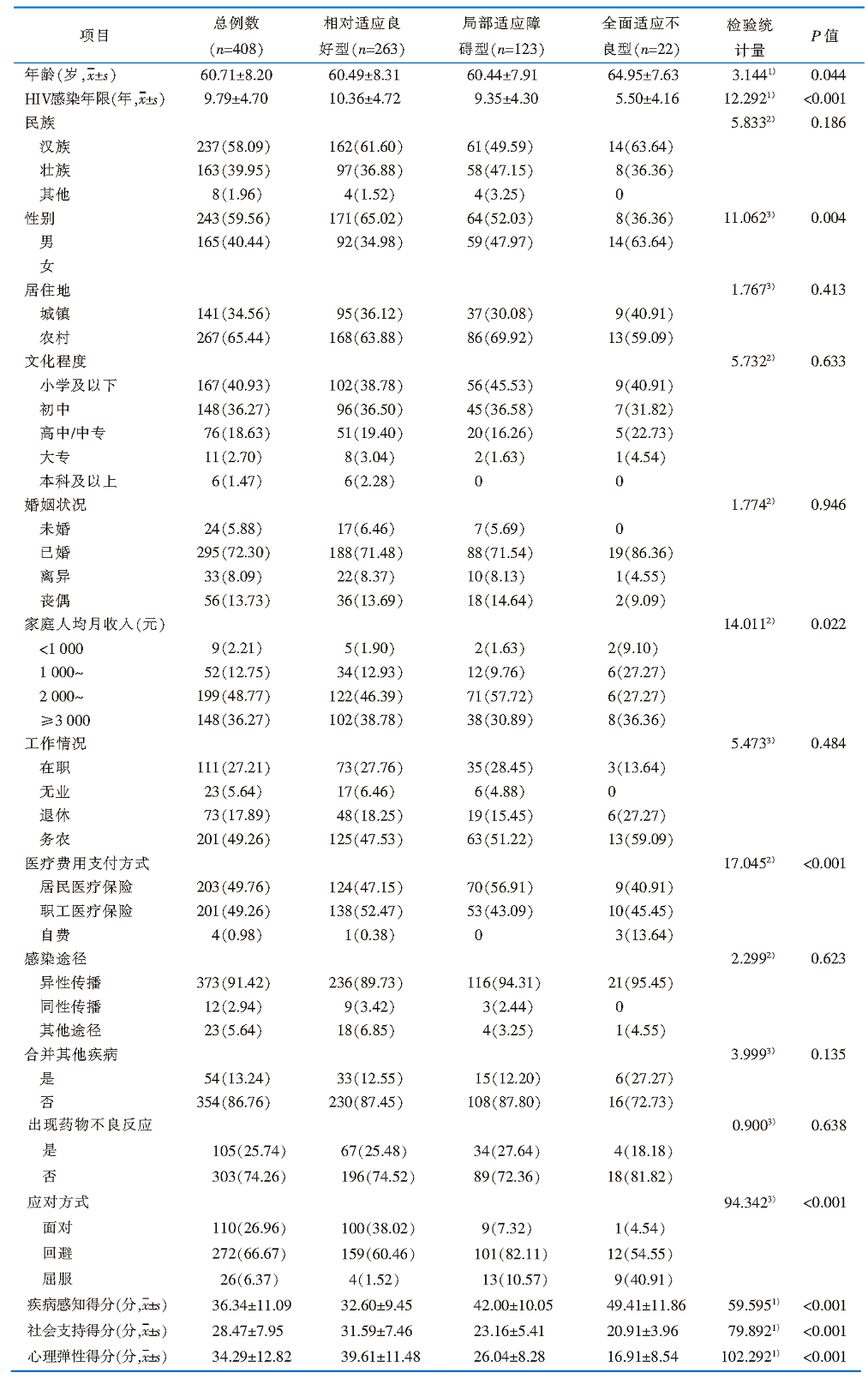 |
表1 老年HIV感染者一般资料及心理社会适应类别影响因素的单因素分析
Table 1 Baseline characteristics and univariate analysis of factors influencing psychosocial adaptation categories in elderly HIV patients
| |
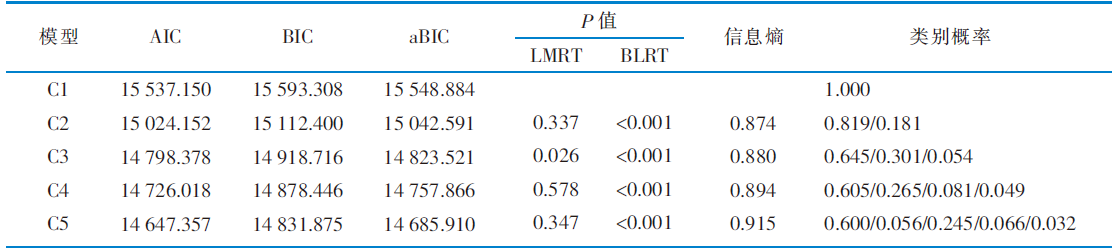 |
表2 老年HIV感染者心理社会适应潜在剖面模型的拟合指标(n=408)
Table 2 Goodness-of-fit indices for the latent profile model of psychosocial adaptation in elderly HIV patients(n=408)
| |
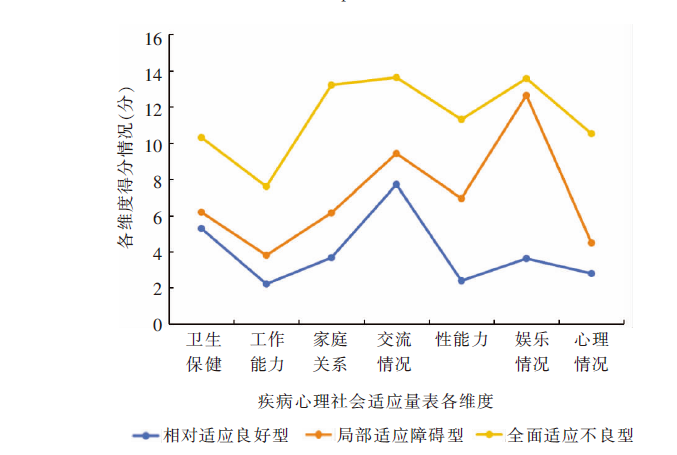
图1 老年HIV感染者心理社会适应的潜在剖面分布特征
Figure 1 Characteristics of the latent profile distribution of psychosocial adaptation in elderly HIV patients
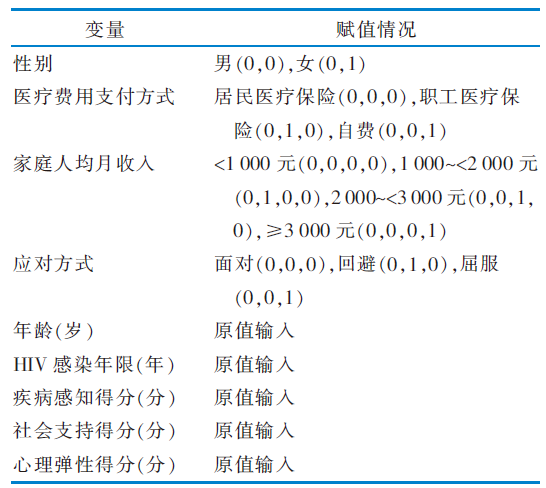 |
表3 自变量赋值情况
Table 3 Assignment of independent variables
| |
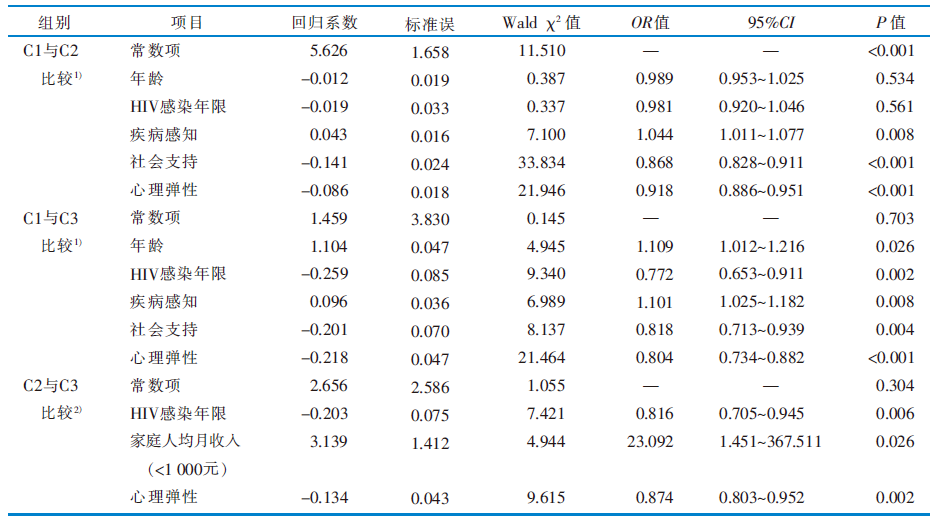 |
表4 老年HIV感染者心理社会适应潜在剖面影响因素的多因素分析
Table 4 Multivariate analysis of factors influencing the latent profiles of psychosocial adaptation in elderly HIV patients
| |
| [1] | 沈银忠. 中国艾滋病诊疗指南(2024版)[J]. 中国艾滋病性病, 2024, 30(8):779-806. |
| Shen YZ. Chinese guidelines for diagnosis and treatment of human immunodeficiency virus infection/acquired immunode-ficiency syndrome(2024 edition)[J]. Chin J AIDS STD, 2024, 30(8):779-806. | |
| [2] | Yuan FS, Liu L, Liu LH, et al. Epidemiological and spatiotem-poral analyses of HIV/AIDS prevalence among older adults in Sichuan,China between 2008 and 2019:a population-based study[J]. Int J Infect Dis, 2021,105:769-775. |
| [3] | 韩孟杰. 我国艾滋病流行形势分析和防治展望[J]. 中国艾滋病性病, 2023, 29(3):247-250. |
| Han MJ. Analysis of AIDS epidemic situation in China and its prevention and treatment prospect[J]. Chin J AIDS STD, 2023, 29(3):247-250. | |
| [4] | 陈小雪, 郞杰那么, 王若兰, 等. 基于社会网络模型的泸州市≥50岁HIV/AIDS患者社会支持分析[J]. 中国艾滋病性病, 2024, 30(1):39-43. |
| Chen XX, Lang JNM, Wang RL, et al. Community follow-up management-based social support for HIV/AIDS patients aged 50 and above in Luzhou City[J]. Chin J AIDS STD, 2024, 30(1):39-43. | |
| [5] | 郝佳欣, 陈菊娣, 冯丽梅. 医疗环境下老年HIV/AIDS患者污名化的研究现状[J]. 中国艾滋病性病, 2025, 31(7):805-809. |
| Hao JX, Chen JD, Feng LM. Research progress on the stigma-tization of elder patients living with HIV in healthcare set-tings[J]. Chin J AIDS STD, 2025, 31(7):805-809. | |
| [6] | 王盼盼. D型人格中青年急性心肌梗死患者的心理社会适应及其干预模式研究[D]. 郑州: 郑州大学, 2019. |
| Wang PP. Psychosocial adaptation and intervention model in young and middle-aged acute myocardial infarction patients with type D personality[D]. Zhengzhou: Zhengzhou University, 2019. | |
| [7] |
Londono Y, McMillan DE. Psychosocial adaptation:an evolutio-nary concept analysis exploring a common multidisciplinary language[J]. J Adv Nurs, 2015, 71(11):2504-2519.
DOI PMID |
| [8] | 王鑫, 张志云, 吴冬玲, 等. HIV感染者心理社会适应状况及影响因素的研究[J]. 中国性科学, 2025, 34(4):139-144. |
| Wang X, Zhang ZY, Wu DL, et al. Research on the psycho-social adaptation status and influencing factors of human immunodeficiency virus-infected individuals[J]. Chin J Hum Sex, 2025, 34(4):139-144. | |
| [9] | 姜乾金. 应激(压力)系统模型-理论与实践[C]// 第十七届全国心理学学术会议论文摘要集. 北京,2014:1612. |
| Jiang QJ. Stress system model:theory and practice[C]// The 17th National Academic Congress of Psychology,Beijing,2014:1612. | |
| [10] |
Zhao ZX, Mei YX, Wang XX, et al. Meaning in life among nursing students:a latent profile analysis[J]. BMC Nurs, 2023, 22(1):264.
DOI |
| [11] | WHO. Impact of AIDS on older people in Africa: Zimbabwe case study[EB/OL].[2025-08-20]. https://iris.who.int/handle/10665/67545. |
| [12] | 吴凡. 以社会支持网络为基础的社区健康老龄化护理实践模式构建及验证[D]. 北京: 北京协和医学院, 2020. |
| Wu F. Construction and verification of a community healthy aging nursing practice model based on social support net-works[D]. Beijing: Peking Union Medical College, 2020. | |
| [13] | 姚静静. 癌症患者适应水平的横断面调查及其预测因素分析[D]. 上海: 第二军医大学, 2013. |
| Yao JJ. A cross-sectional survey on adaptation levels and analysis of predictive factors in cancer patients[D]. Shanghai: Second Military Medical University, 2013. | |
| [14] | 梅雅琪, 李惠萍, 杨娅娟, 等. 中文版疾病感知问卷简化版在女性乳腺癌患者中的信效度检验[J]. 护理学报, 2015, 22(24):11-14. |
| Mei YQ, Li HP, Yang YJ, et al. Reliability and validity of Chinese version of the Brief Illness Perception Questionnaire in patients with breast cancer[J]. J Nurs (China), 2015, 22(24):11-14. | |
| [15] | 沈晓红, 姜乾金. 医学应对方式问卷中文版701例测试报告[J]. 中国行为医学科学, 2000, 9(1):18-20. |
| Shen XH, Jiang QJ. Report on application of Chinese version of MCMQ in 701 patients[J]. Chin J Beh Med Sci, 2000, 9(1):18-20. | |
| [16] | 肖水源. 《社会支持评定量表》的理论基础与研究应用[J]. 临床精神医学杂志, 1994, 4(2):98-100. |
| Xiao SY. Theoretical basis and research application of the social support rating scale[J]. J Clin Psychiatry, 1994, 4(2):98-100. | |
| [17] | Yu XN, Zhang JX. Factor analysis and psychometric evalus-tion of the Connor-Davison Resilience scale(CD-RISC) with Chinese people[J]. Social Behaw Pers, 2007, 35(1):19-30. |
| [18] |
尹奎, 彭坚, 张君. 潜在剖面分析在组织行为领域中的应用[J]. 心理科学进展, 2020, 28(7):1056-1070.
DOI |
|
Yin K, Peng J, Zhang J. The application of latent profile analysis in organizational behavior research[J]. Adv Psychol Sci, 2020, 28(7):1056-1070.
DOI |
|
| [19] | Hoho VN, Kheswa JG. The psychosocial well-being of South African university students living with HIV/AIDS[J]. J Hum Ecol, 2017, 59(2/3):108-116. |
| [20] |
黄莺, 王华芬, 邵丽芳, 等. HIV感染者/AIDS患者对其他专科医护人员披露诊断时心理体验的质性研究[J]. 中华护理杂志, 2023, 58(12):1483-1488.
DOI |
|
Huang Y, Wang HF, Shao LF, et al. A qualitative study on the psychological experience of HIV/AIDS patients for the disclosing of HIV to non-AIDS professionals[J]. Chin J Nurs, 2023, 58(12):1483-1488.
DOI |
|
| [21] | 游心怡, 文琪, 王文慧, 等. HIV阳性男男性行为者心理健康素养的潜在类别分析[J]. 现代预防医学, 2024, 51(16):3029-3034,3067. |
| You XY, Wen Q, Wang WH, et al. Latent class analysis of mental health literacy among HIV-positive men who have sex with men[J]. Mod Prev Med, 2024, 51(16):3029-3034,3067. | |
| [22] | 谢思颖, 余彬, 熊君, 等. 中老年HIV/AIDS患者疾病感知与心理健康相关关系研究[J]. 中国艾滋病性病, 2022, 28(3):316-320. |
| Xie SY, Yu B, Xiong J, et al. Research on the relationship between disease perception and mental health in middle-aged and elderly HIV/AIDS patients[J]. Chin J AIDS STD, 2022, 28(3):316-320. | |
| [23] |
Pavon Blanco A, Turner MA, Petrof G, et al. To what extent do disease severity and illness perceptions explain depres-sion,anxiety and quality of life in hidradenitis suppurativa?[J]. Br J Dermatol, 2019, 180(2):338-345.
DOI PMID |
| [24] |
常可意, 吴杨峰, 单锶楷, 等. HIV感染者/AIDS患者参与同伴支持体验质性研究的Meta整合[J]. 中华护理杂志, 2024, 59(1):108-116.
DOI |
| Chang KY, Wu YF, Shan SK, et al. A meta-synthesis of qualitative studies on the experience of HIV-infected people/AIDS patients participating in peer support[J]. Chin J Nurs, 2024, 59(1):108-116. | |
| [25] |
Rubtsova AA, Kempf MC, Taylor TN, et al. Healthy aging in older women living with HIV infection:a systematic review of psychosocial factors[J]. Curr HIV/AIDS Rep, 2017, 14(1):17-30.
DOI |
| [26] | 肖雪玲, 雷云霄, 王红红. 老年HIV感染者和AIDS患者常见心理问题及干预的研究进展[J]. 中华护理杂志, 2014, 49(12):1425-1429. |
| Xiao XL, Lei YX, Wang HH. The psychological characteristics and interventions of older adults with HIV/AIDS:a review[J]. Chin J Nurs, 2014, 49(12):1425-1429. | |
| [27] |
陆雪倩, 孙文秀, 潘燕云, 等. 老年HIV感染者心理痛苦现状及影响因素研究[J]. 中华护理杂志, 2024, 59(22):2747-2753.
DOI |
| Lu XQ, Sun WX, Pan YY, et al. Current status and influen-cing factors of psychological distress among elderly people living with HIV[J]. Chin J Nurs, 2024, 59(22):2747-2753. | |
| [28] |
Brown MJ, Gao CJ, Kaur A, et al. Social support,internalized HIV stigma,resilience and depression among people living with HIV:a moderated mediation analysis[J]. AIDS Behav, 2023, 27(4):1106-1115.
DOI |
| [29] |
Gottert A, Friedland B, Geibel S, et al. The people living with HIV(PLHIV) resilience scale:development and validation in three countries in the context of the PLHIV stigma index[J]. AIDS Behav, 2019, 23(Suppl 2):172-182.
DOI PMID |
| [1] | 陈淑萍, 谢宝缘, 陈绵绵, 李美玲, 林翠芬. 淋巴瘤患者化疗随访方案的构建及应用研究[J]. 中华护理杂志, 2026, 61(6): 725-732. |
| [2] | 李春秀, 修红, 刘敏, 邹晓君, 王晴, 丁书凡, 赵志平, 李晓娟. 血液肿瘤患者营养不良风险预测模型的构建及验证[J]. 中华护理杂志, 2026, 61(6): 733-740. |
| [3] | 朱静, 孙艳, 司惠芳, 李秀娟, 加米娜·瓦合甫, 常海霞. 成人急性白血病患者化疗期间心理弹性的变化轨迹及影响因素研究[J]. 中华护理杂志, 2026, 61(6): 741-748. |
| [4] | 张莹, 杜若飞, 杨惠敏, 徐晓霞, 李黎明, 杜亚婷. 初诊血液肿瘤老年患者的衰弱现状及影响因素研究[J]. 中华护理杂志, 2026, 61(6): 749-756. |
| [5] | 孙丹萍, 黄莺, 唐丹婷, 邵丽芳. 1例HIV感染者并发血栓性血小板减少性紫癜的护理[J]. 中华护理杂志, 2026, 61(6): 757-760. |
| [6] | 王敏, 纪亚楠, 曹芳, 聂臣聪, 陈瑶, 张继权, 陈志美, 杜金磊. 危重症患者管饲依赖症状变化轨迹及影响因素研究[J]. 中华护理杂志, 2026, 61(6): 761-767. |
| [7] | 郑燕, 曾永珂, 陈静, 罗小琴, 夏良香, 郑思琳. 心脏术后患者谵妄风险预测模型的应用研究[J]. 中华护理杂志, 2026, 61(6): 768-774. |
| [8] | 赵浩, 赵颖, 杨艳珍. 慢性心力衰竭患者家庭照顾者照护技能干预方案的构建及应用研究[J]. 中华护理杂志, 2026, 61(6): 775-782. |
| [9] | 付海炜, 朱晓菊, 毕建静, 黎美娴, 张小迪, 王宗华. 肺癌患者癌症相关认知障碍核心症状与生活质量的相关性研究[J]. 中华护理杂志, 2026, 61(6): 783-789. |
| [10] | 顾培培, 王衍蝶, 曾妃, 梁江淑渊, 蔡凌云, 朱岩, 赵淑华. 肺移植等候期患者肌少症影响因素分析及护理对策[J]. 中华护理杂志, 2026, 61(6): 790-796. |
| [11] | 王雪娇, 蒋玲, 马倩, 李现文, 张彦, 吕亚, 施晓芸. 育龄期宫颈癌患者家庭支持方案的构建及应用研究[J]. 中华护理杂志, 2026, 61(6): 806-813. |
| [12] | 刘晓, 李丽, 施忠英. 青少年神经性厌食患者及其父母出院准备体验及需求的质性研究[J]. 中华护理杂志, 2026, 61(6): 814-821. |
| [13] | 张柔, 贺方园, 杨晓宇, 陈冬笋, 李根霞, 孙可盈, 赵晶, 郭晓丽. 双胎孕妇营养素养的影响因素分析及护理启示[J]. 中华护理杂志, 2026, 61(6): 822-828. |
| [14] | 韩朝颖, 赵雅宁, 刘瑶, 李雪梅, 常学优, 李建民. 社区慢性病老年人内在能力与社会衰弱的相关性研究[J]. 中华护理杂志, 2026, 61(6): 829-835. |
| [15] | 张勇, 郑炜慧, 邓倩倩, 周晓颖, 刘丹, 谷嘉怡, 常红娟. 团体音乐治疗在社区精神障碍患者中的应用效果评价[J]. 中华护理杂志, 2026, 61(6): 836-843. |
| 阅读次数 | ||||||
|
全文 |
|
|||||
|
摘要 |
|
|||||
