

中华护理杂志 ›› 2026, Vol. 61 ›› Issue (4): 490-497.DOI: 10.3761/j.issn.0254-1769.2026.04.008
汪芳莹1( ), 陈雪峰2, 贾燕2, 吴婉英3,*()
收稿日期:2025-10-20
出版日期:2026-02-20
发布日期:2026-02-06
*通讯作者:
吴婉英,E-mail:764286275@qq.com作者简介:汪芳莹:女,本科(硕士在读),E-mail:634513098@qq.com
基金资助:
WANG Fangying1(), CHEN Xuefeng2, JIA Yan2, WU Wanying3,*()
Received:2025-10-20
Online:2026-02-20
Published:2026-02-06
* Corresponding author:
WU Wanying,E-mail:764286275@qq.comFunding program:摘要:
目的 基于潜在转变分析探讨鼻咽癌患者围放疗期症状负担的潜在类别及个体在类别间的转变模式,并分析影响转变的相关因素。方法 便利选取2024年10月至2025年9月浙江省某三级甲等医院240例头颈放疗科的鼻咽癌患者作为调查对象,于放疗前、放疗中期及放疗结束时采用安德森症状评估量表-头颈癌模块评估症状负担。通过潜在剖面分析识别症状负担亚组,并基于最优模型进行潜在转变分析,采用二元Logistic回归探讨其影响因素。结果 共233例鼻咽癌患者完成3次调查,围放疗期患者的症状负担可分为低负担型与高负担型两类。潜在转变分析识别出8种转变模式,其中在各相邻阶段分别有41.10%和42.50%的低负担型患者转为高负担型,而大部分高负担型患者维持原状态。二元Logistic回归分析显示,放疗前中期螺旋断层放疗和BMI超重有助于维持低负担型,放疗中后期有子女者症状加重风险较低,而本科或大专以上文化程度和家族肿瘤史者更易从高负担型向低负担型改善。结论 鼻咽癌患者围放疗期症状负担具有异质性和阶段转变性。临床应重视早期筛查与连续监测,结合精准放疗、营养支持、健康教育及社会支持等综合干预,以延缓症状进展,提高患者的生活质量。
汪芳莹, 陈雪峰, 贾燕, 吴婉英. 鼻咽癌患者围放疗期症状负担类别的潜在转变及影响因素分析[J]. 中华护理杂志, 2026, 61(4): 490-497.
WANG Fangying, CHEN Xuefeng, JIA Yan, WU Wanying. Subgroups and transition patterns of symptom burden among nasopharyngeal carcinoma patients during the peri-radiotherapy period:a latent transition analysis[J]. Chinese Journal of Nursing, 2026, 61(4): 490-497.
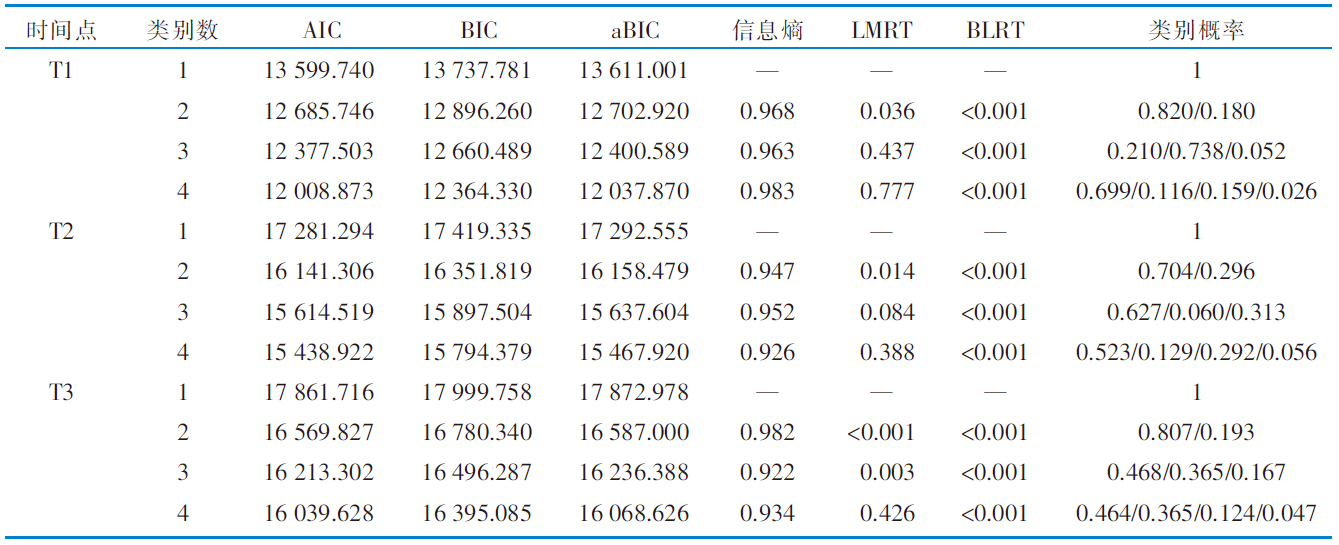 |
表1 鼻咽癌患者围放疗期症状负担潜在剖面分析(n=233)
Table 1 Latent profile analysis of symptom burden among nasopharyngeal carcinoma patients during the peri-radiotherapy period(n=233)
| |
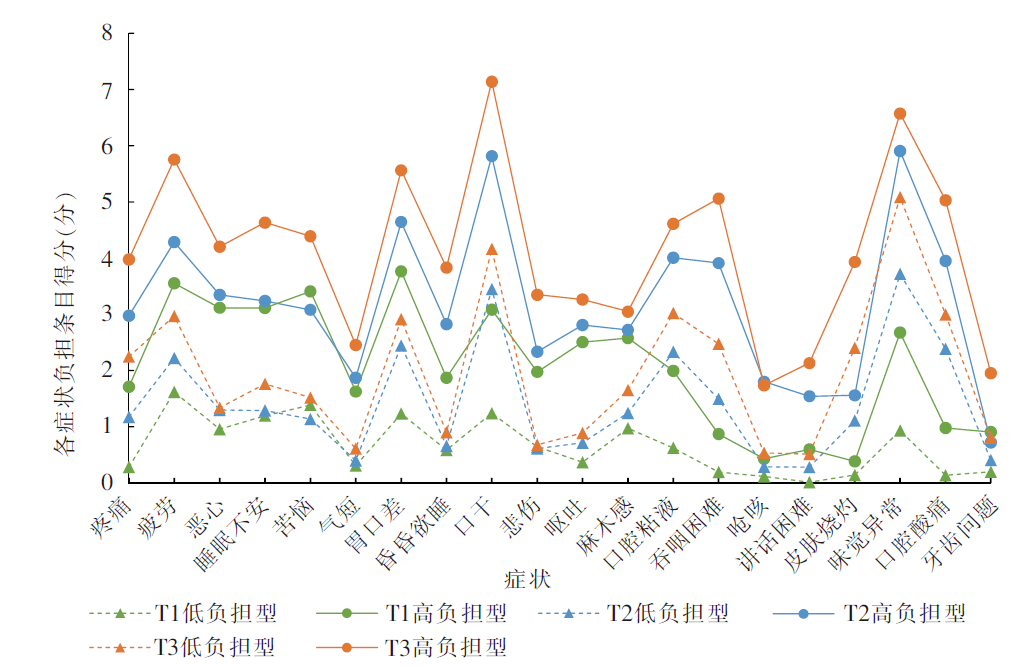
图1 鼻咽癌患者围放疗期症状负担两类别分布图 注:T1为放疗前1 d;T2为放疗中期;T3为放疗结束时。
Figure 1 Distribution of the 2 latent classes of symptom burden among nasopharyngeal carcinoma patients during the peri-radiotherapy period
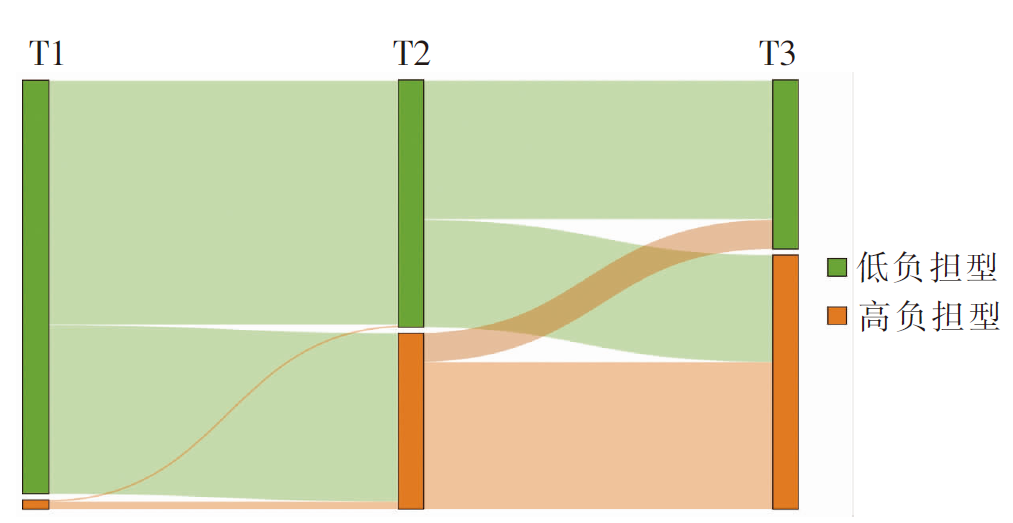
图2 鼻咽癌患者围放疗期症状负担潜在转变流向图 注:T1为放疗前1 d;T2为放疗中期;T3为放疗结束时。
Figure 2 Latent transition flowchart of symptom burden in nasopharyngeal carcinoma patients during the peri-radiotherapy period
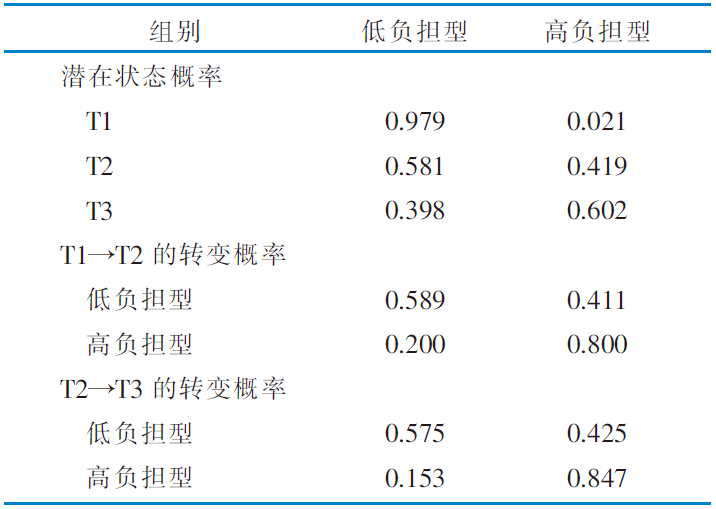 |
表2 症状潜在类别转变的概率情况
Table 2 Probabilities of transitions between latent symptom burden classes
| |
 |
表3 鼻咽癌患者围放疗期症状负担潜在转变的单因素分析[例(百分比,%)]
Table 3 Univariate analysis of latent transitions in symptom burden among nasopharyngeal carcinoma patients during the peri-radiotherapy[case(percentage,%)]
| |
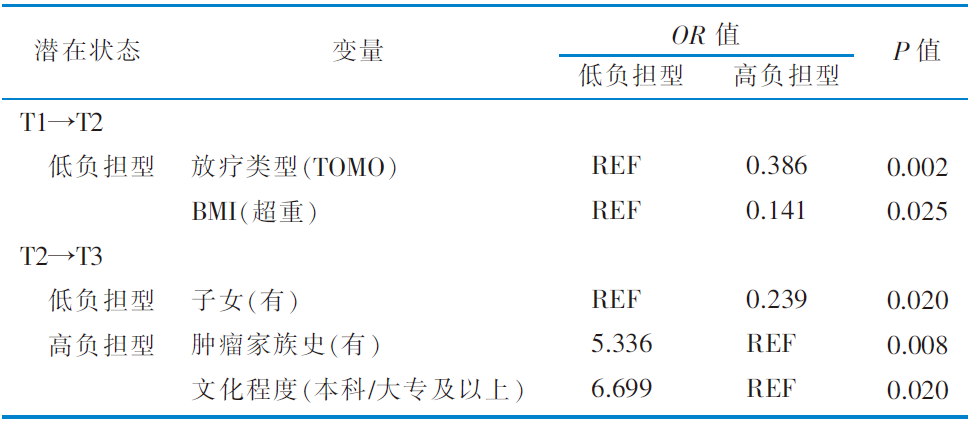 |
表4 鼻咽癌患者围放疗期症状负担潜在转变的二元Logistic回归分析
Table 4 Binary Logistic regression analysis of latent transitions in symptom burden among nasopharyngeal carcinoma patients during the peri-radiotherapy
| |
| [1] |
Su ZY, Siak PY, Lwin YY, et al. Epidemiology of nasopharyngeal carcinoma:current insights and future outlook[J]. Cancer Metastasis Rev, 2024, 43(3):919-939.
DOI |
| [2] | 李静, 蔡文文, 吴庆彩, 等. 鼻咽癌患者放疗相关症状群及其网络分析[J]. 护理学报, 2025, 32(14):1-6. |
| Li J, Cai WW, Wu QC, et al. Radiotherapy-related symptom clusters in patients with nasopharyngeal carcinoma:a network analysis[J]. J Nurs(China), 2025, 32(14):1-6. | |
| [3] |
徐萍, 闫荣, 张淼淼, 等. 头颈部肿瘤患者身体意象潜在剖面分析及影响因素研究[J]. 中华护理杂志, 2025, 60(2):215-222.
DOI URL |
|
Xu P, Yan R, Zhang MM, et al. Latent profile analysis and influencing factors of body image among patients with head and neck cancer[J]. Chin J Nurs, 2025, 60(2):215-222.
DOI URL |
|
| [4] |
刘琪, 刘佳丽, 刘玉, 等. 鼻咽癌患者诱导化疗序贯同期放化疗期间躯体-心理症状负担轨迹及影响因素研究[J]. 护理学报, 2025, 32(1):1-6.
DOI |
| Liu Q, Liu JL, Liu Y, et al. Physical-psychological symptom burden trajectories and influencing factors in nasopharyngeal carcinoma patients during induction chemotherapy plus concurrent chemoradiotherapy[J]. J Nurs(China), 2025, 32(1):1-6. | |
| [5] | 王碧瑶, 张敏强, 张洁婷, 等. 基于转变矩阵描述的个体阶段性发展:潜在转变模型[J]. 心理研究, 2015, 8(4):36-43. |
| Wang BY, Zhang MQ, Zhang JT, et al. Describing the stage process of individual through transition matrix:latent transition model[J]. Psychol Res, 2015, 8(4):36-43. | |
| [6] | Black JC, Burkett HL, Rockhill KM, et al. Initiation patterns and transitions among adults using stimulant drugs:latent transition analysis[J]. J Med Internet Res, 2023,25:e46747. |
| [7] | 康敏. 中国鼻咽癌放射治疗指南(2022版)[J]. 中华肿瘤防治杂志, 2022, 29(9):611-622. |
| Kang M. Radiotherapy guidelines for nasopharyngeal carcinoma in China(2022 edition)[J]. Chin J Cancer Prev Treat, 2022, 29(9):611-622. | |
| [8] | 韩媛, 张美芬, 张俊娥. 鼻咽癌患者放疗期间与放疗后症状困扰的调查研究[J]. 中华护理杂志, 2010, 45(7):626-628. |
| Han Y, Zhang MF, Zhang JE. Symptom distress during and after radiation therapy in patients with nasopharyngeal carcinoma[J]. Chin J Nurs, 2010, 45(7):626-628. | |
| [9] |
温忠麟, 谢晋艳, 王惠惠. 潜在类别模型的原理、步骤及程序[J]. 华东师范大学学报(教育科学版), 2023, 41(1):1-15.
DOI |
| Wen ZL, Xie JY, Wang HH. Principles,procedures and programs of latent class models[J]. J East China Norm Univ Educ Sci, 2023, 41(1):1-15. | |
| [10] | 王孟成, 毕向阳. 潜变量建模与Mplus应用-进阶篇[M]. 重庆: 重庆大学出版社, 2018:15. |
| Wang MC, Bi XY. Latent variable modeling and Mplus application-advanced chapter[M]. Chongqing: Chongqing University Press, 2018:15. | |
| [11] | 周浩, 龙立荣. 共同方法偏差的统计检验与控制方法[J]. 心理科学进展, 2004, 12(6):942-950. |
| Zhou H, Long LR. Statistical remedies for common method biases[J]. Adv Psychol Sci, 2004, 12(6):942-950. | |
| [12] |
铁万琴, 张曦, 王永琦, 等. 乳腺癌患者化疗前后症状特征的潜在转变分析及护理对策[J]. 中华护理杂志, 2025, 60(2):193-200.
DOI URL |
|
Tie WQ, Zhang X, Wang YQ, et al. Analysis of potential changes in symptom characteristics of breast cancer patients before and after chemotherapy and nursing countermeasures[J]. Chin J Nurs, 2025, 60(2):193-200.
DOI URL |
|
| [13] |
Pavlou M, Ambler G, Qu C, et al. An evaluation of sample size requirements for developing risk prediction models with binary outcomes[J]. BMC Med Res Methodol, 2024, 24(1):146.
DOI PMID |
| [14] |
Dunnack YH, Xu WL, Lee JW, et al. Symptom patterning across the cancer care trajectory for patients receiving chemoradiation for head and neck cancer:a retrospective longitudinal study using latent transition analysis[J]. Cancer Nurs, 2024, 47(4):261-270.
DOI URL |
| [15] |
刘美子, 安然, 吴子童, 等. 头颈部肿瘤患者核心症状及症状群的网络分析与护理对策[J]. 中华护理杂志, 2024, 59(7):828-834.
DOI URL |
|
Liu MZ, An R, Wu ZT, et al. A network analysis and nursing implications of core symptoms and symptom clusters in head and neck cancer patients[J]. Chin J Nurs, 2024, 59(7):828-834.
DOI URL |
|
| [16] |
Grosu-Bularda A, Lita FF, Hodea FV, et al. Navigating the complexities of radiation injuries:therapeutic principles and reconstructive strategies[J]. J Pers Med, 2024, 14(11):1100.
DOI URL |
| [17] | Li NN, Hou LL, Li S. Distinct subgroups of patients with lung cancer receiving chemotherapy:a latent transition analysis[J]. Front Oncol, 2020,10:522407. |
| [18] | Lu S, Fan HQ, Hu XY, et al. Dosimetric comparison of helical tomotherapy,volume-modulated arc therapy,and fixed-field intensity-modulated radiation therapy in locally advanced nasopharyngeal carcinoma[J]. Front Oncol, 2021,11:764946. |
| [19] | 邓春涟, 胡海芹, 孙起玄, 等. 食管癌不同放疗技术剂量学比较及近期疗效观察[J]. 中华肿瘤防治杂志, 2025, 32(4):231-236. |
| Deng CL, Hu HQ, Sun QX, et al. Dosimetry comparison of different radiotherapy technologies and short-term curative effect in esophageal cancer[J]. Chin J Cancer Prev Treat, 2025, 32(4):231-236. | |
| [20] | Wang QL, Qin JY, Cao RX, et al. Comparison of dosimetric benefits of three precise radiotherapy techniques in nasopharyngeal carcinoma patients using a priority-classified plan optimization model[J]. Front Oncol, 2021,11:646584. |
| [21] |
Song XR, Su L, Lin QJ, et al. Effect of nutritional status before radiotherapy on radiation-induced acute toxicities in patients with nasopharyngeal carcinoma[J]. Head Neck, 2023, 45(3):620-628.
DOI URL |
| [22] | Fan XM, Cui HX, Peng HB, et al. The influence of evidence-based nutritional support plans on the nutritional status and adverse effects of radiotherapy in individuals with nasopharyngeal carcinoma[J]. Front Nutr, 2025,12:1503294. |
| [23] | 张曦, 杜雪, 杨雪, 等. 乳腺癌患者自我管理现状及影响因素的纵向研究[J]. 护理管理杂志, 2022, 22(5):336-341. |
| Zhang X, Du X, Yang X, et al. Longitudinal study on current status and influencing factors of self-management in breast cancer patients[J]. J Nurs Adm, 2022, 22(5):336-341. | |
| [24] |
张妍欣, 杨丽, 李家燕, 等. 鼻咽癌患者同步放化疗后自我管理积极度现状及影响因素分析[J]. 中华护理杂志, 2022, 57(15):1853-1859.
DOI URL |
|
Zhang YX, Yang L, Li JY, et al. Analysis on the current situation and influencing factors of the self-management positivity of patients in the recovery period after simultaneous radiotherapy for nasopharyngeal carcinoma[J]. Chin J Nurs, 2022, 57(15):1853-1859.
DOI URL |
|
| [25] |
Courtney EP, Goldenberg JL. Breast cancer family history and behavioral health intentions:an esteem-relevant mechanism informed by the terror management health model[J]. Curr Oncol, 2025, 32(10):544.
DOI URL |
| [26] | 周小英, 张雯, 张岩, 等. 原发性肝癌介入手术病人自我管理效能感的影响因素分析[J]. 护理研究, 2022, 36(10):1857-1860. |
| Zhou XY, Zhang W, Zhang Y, et al. Influencing factors of self-management efficacy in patients with primary liver cancer undergoing interventional surgery[J]. Chin Nurs Res, 2022, 36(10):1857-1860. |
| [1] | 中华医学会骨科学分会护理学组委员会 执笔:梅迎雪, 韩梦月, 潘韩丽, 韩冰, 杨旭. 骨科大手术患者静脉血栓栓塞症预防专家共识[J]. 中华护理杂志, 2026, 61(4): 437-441. |
| [2] | 杜姝姝, 曹亚琴, 闵继康, 冯悦, 吴琦, 蒋凤仙. 骨质疏松椎体压缩性骨折患者术后自我管理方案的构建及应用研究[J]. 中华护理杂志, 2026, 61(4): 442-451. |
| [3] | 张颖, 吕硕洋, 赵贵纯, 蒋莹卿, 黄立群, 张红兵, 杨惠林, 倪莉, 眭文洁. 骨质疏松椎体压缩性骨折患者术后运动行为困境的质性研究[J]. 中华护理杂志, 2026, 61(4): 452-459. |
| [4] | 王鑫, 徐慧萍, 黄倩, 孙义芳, 郭子鑫, 张昕雨. 髋关节置换患者躯体功能变化轨迹的潜在类别及影响因素分析[J]. 中华护理杂志, 2026, 61(4): 460-466. |
| [5] | 陈丹露, 陈茹, 单亚维, 施春香, 沈中鸣. 远程医疗技术在全膝关节置换患者术后运动康复中应用的范围综述[J]. 中华护理杂志, 2026, 61(4): 467-474. |
| [6] | 潘圆圆, 王董慧, 傅慧琳. 基于信息框架效应的垂体瘤患者自我管理行为干预方案的应用研究[J]. 中华护理杂志, 2026, 61(4): 475-482. |
| [7] | 何小琼, 刘轶, 乐莉, 刘瑜. 腹腔镜阑尾切除术后患儿快速康复游戏运动棋盘的设计与应用研究[J]. 中华护理杂志, 2026, 61(4): 483-489. |
| [8] | 荆凤, 蒋凌云, 曹玉伶, 田茂婷, 裘佳佳, 汤立晨, 胡雁. 乳腺癌内分泌治疗患者骨关节症状风险预测模型的构建与初步验证[J]. 中华护理杂志, 2026, 61(4): 498-505. |
| [9] | 金冠珍, 刘延锦, 金波, 王彦艳, 张玲, 刘芳芳. 老年原发性青光眼患者跌倒警觉度现状及影响因素研究[J]. 中华护理杂志, 2026, 61(4): 506-512. |
| [10] | 孔娟, 刘雪燕, 袁晓冬, 曹英娟. 成人全身型重症肌无力患者症状管理旅程地图的研究[J]. 中华护理杂志, 2026, 61(4): 513-520. |
| [11] | 史子月, 蒋恩社, 瞿嘉园, 余雅倩, 张大学, 付明珠, 邓小梅. 广东省综合医院住院患者负性情绪筛查量表的常模研究[J]. 中华护理杂志, 2026, 61(4): 521-529. |
| [12] | 秦雨霜, 俞丽丽, 程丽历, 黄娟, 奚鑫, 王丽雁, 田恩, 林利容, 范尧, 杨聚荣, 周明芳. 多学科管理下终末期肾病患者妊娠体验的质性研究[J]. 中华护理杂志, 2026, 61(4): 530-535. |
| [13] | 刘艳翠, 刘宇, 沈琴, 宇丽. 医护人员视角下危重症患儿早期活动影响因素的质性研究[J]. 中华护理杂志, 2026, 61(4): 536-542. |
| [14] | 关锐, 赵亚莎, 张士变, 李巧丽, 郭清洁, 李亚楠, 韩箫笛. 姿势调节训练在ICU肌肉骨骼损伤护士中的应用研究[J]. 中华护理杂志, 2026, 61(4): 543-548. |
| [15] | 芦凤娟, 解子惠, 关银银, 裴晓莉, 房玉霞. 骨科护士疼痛共情的现状及影响因素研究[J]. 中华护理杂志, 2026, 61(4): 549-556. |
| 阅读次数 | ||||||
|
全文 |
|
|||||
|
摘要 |
|
|||||
