

中华护理杂志 ›› 2026, Vol. 61 ›› Issue (1): 85-92.DOI: 10.3761/j.issn.0254-1769.2026.01.012
蒋向玲1,*( ), 陆慧芬2, 虞幼军1, 林晓丽1, 黄佩铃1
收稿日期:2025-07-17
出版日期:2026-01-10
发布日期:2026-01-04
*通讯作者:
蒋向玲:女,E-mail:825891160@qq.com基金资助:
JIANG Xiangling1,*(), LU Huifen2, YU Youjun1, LIN Xiaoli1, HUANG Peiling1
Received:2025-07-17
Online:2026-01-10
Published:2026-01-04
* Corresponding author:
JIANG Xiangling,E-mail:825891160@qq.comFunding program:摘要:
目的 探讨鼻咽癌放疗后听力损伤的发生现状及其影响因素,为听力损伤的防控提供参考。 方法 采用分层随机抽样法,于2023年10月—2025年3月选取佛山市某三级甲等医院的431例鼻咽癌放疗后患者进行调查,收集患者的疾病资料、放疗后耳部护理行为及并发症等随访资料,并评估听力损伤情况。采用随机森林算法与弹性网络回归,分析并确定影响放疗后听力损伤的主要影响因素。 结果 鼻咽癌放疗后1~12年内,患者平均听阈为(47.37±21.90)dB,听力损伤总体发生率为73.78%(318/431)。经单因素分析、随机森林算法及弹性网络回归分析结果显示,放疗后年限、顺铂剂量、年龄、放疗后中耳炎首次出现时间、耳部并发症数量及前2年内咽鼓管功能锻炼情况是鼻咽癌放疗后听力损伤的主要影响因素。 结论 鼻咽癌放疗后听力损伤发生率较高,临床医护人员应在优化治疗方案减少听力损伤的同时,重视放疗后耳部并发症的预防与处理,以延缓听力损伤的发生进程并减轻其严重程度。
蒋向玲, 陆慧芬, 虞幼军, 林晓丽, 黄佩铃. 鼻咽癌患者放疗后听力损伤影响因素研究及护理启示[J]. 中华护理杂志, 2026, 61(1): 85-92.
JIANG Xiangling, LU Huifen, YU Youjun, LIN Xiaoli, HUANG Peiling. Influencing factors and nursing implications of hearing impairment in patients with post-radiotherapy nasopharyngeal cancer[J]. Chinese Journal of Nursing, 2026, 61(1): 85-92.
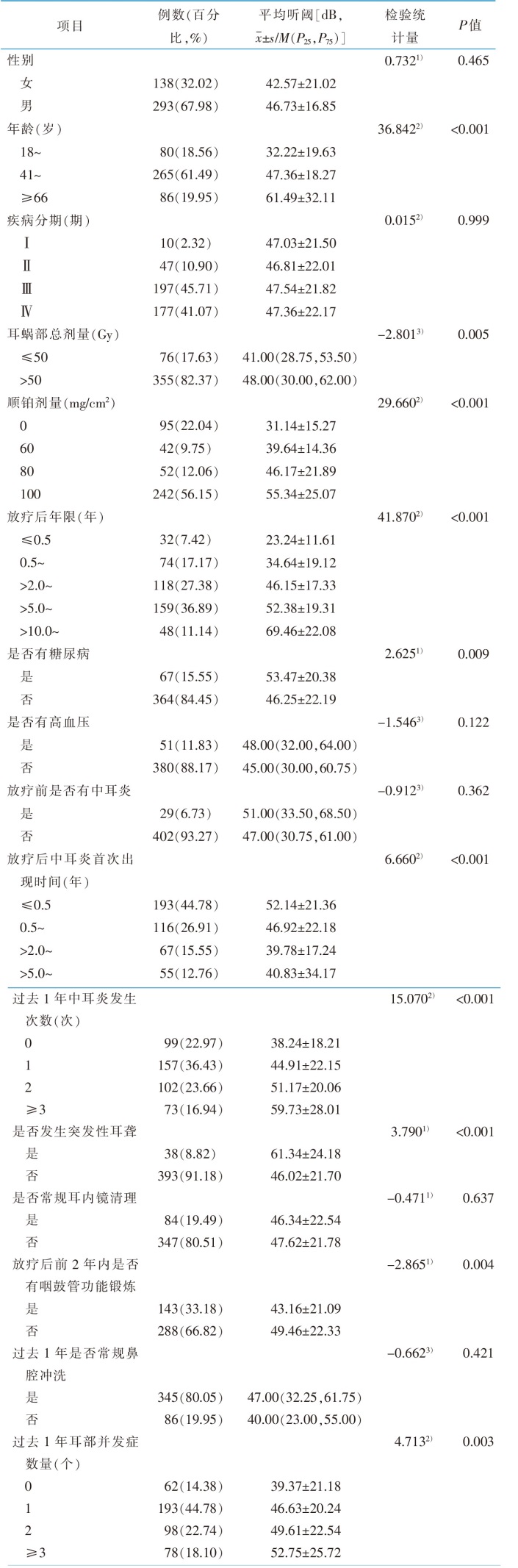 |
表1 调查对象的一般资料及平均听阈的相关因素分析(n=431)
Table 1 Univariate analysis of general data and mean hearing threshold in patients after radiotherapy for nasopharyngeal carcinoma(n=431)
| |
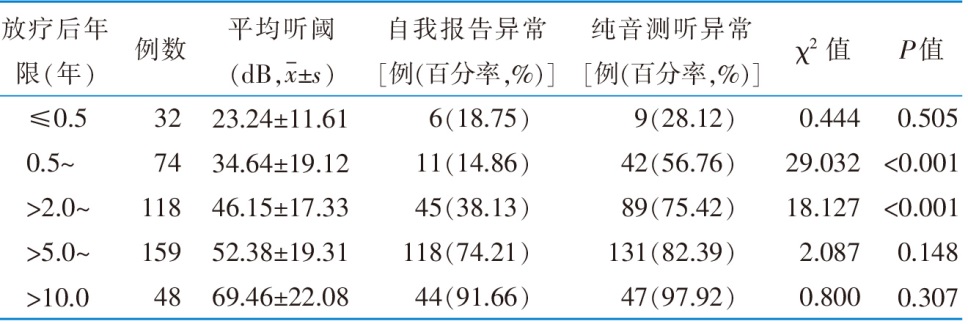 |
表2 鼻咽癌放疗后1~12年内听力损伤发生情况(n=431)
Table 2 Analysis of hearing impairment following radiotherapy for nasopharyngeal carcinoma within 1~12 years(n=431)
| |
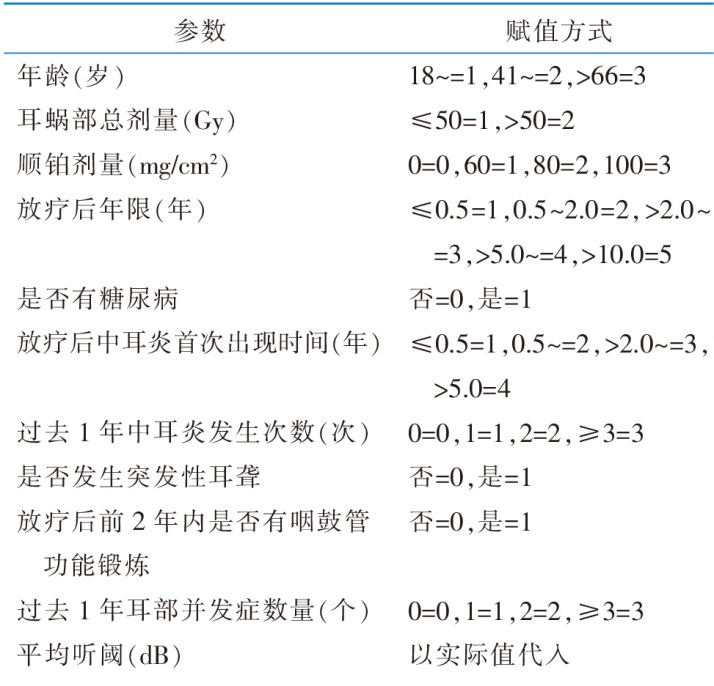 |
表3 自变量赋值方式
Table 3 Independent-variable assignment method
| |
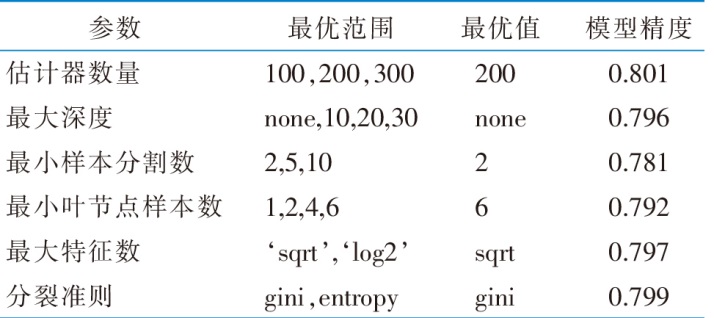 |
表4 鼻咽癌放疗后患者听力损伤随机森林模型参数调优最优范围及最优值
Table 4 Optimal ranges and optimal values of hyperparameter tuning for the random forest model of hearing impairment after radiotherapy for nasopharyngeal carcinoma
| |
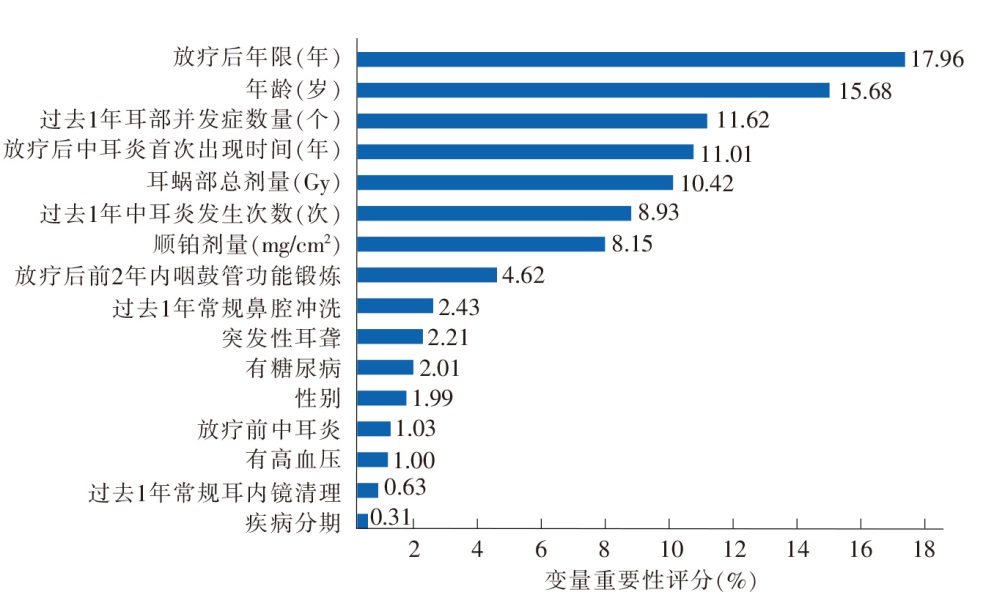
图1 随机森林模型的变量重要性评分排序
Figure 1 Ranking of variable importance scores for random forest prediction model
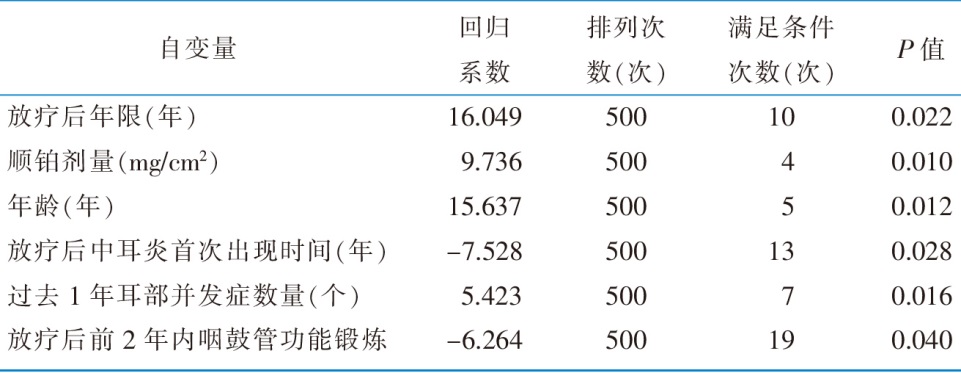 |
表5 鼻咽癌放疗后患者听力损伤的多因素分析结果(n=431)
Table 5 Multifactorial analysis of hearing impairment after radiotherapy for nasopharyngeal carcinoma(n=431)
| |
| [1] | Sung H, Ferlay J, Siegel RL, et al. Global cancer statistics 2020:GLOBOCAN estimates of incidence and mortality world-wide for 36 cancers in 185 countries[J]. CA Cancer J Clin, 2021, 71(3):209-249. |
| [2] |
Wong KCW, Hui EP, Lo KW, et al. Nasopharyngeal carcinoma:an evolving paradigm[J]. Nat Rev Clin Oncol, 2021, 18(11):679-695.
DOI |
| [3] |
McDowell LJ, Rock K, Xu W, et al. Long-term late toxicity,quality of life,and emotional distress in patients with naso-pharyngeal carcinoma treated with intensity modulated radiation therapy[J]. Int J Radiat Oncol Biol Phys, 2018, 102(2):340-352.
DOI URL |
| [4] | 孙映凤, 杨海弟, 郑亿庆. 鼻咽癌放疗后听力损失特征分析[J]. 中国听力语言康复科学杂志, 2017, 15(2):115-118. |
| Sun YF, Yang HD, Zheng YQ. The characteristics of nasopha-ryngeal carcinoma radiotherapy after hearing loss[J]. Chin Sci J Hear Speech Rehabil, 2017, 15(2):115-118. | |
| [5] |
Jiang MJ, Li HF, Chen C, et al. Postirradiation otitis media with effusion in nasopharyngeal carcinoma:a comprehensive review of pathogenesis,management,and prevention[J]. Int J Radiat Oncol Biol Phys, 2025, 123(4):1018-1034.
DOI URL |
| [6] |
张纤, 马秋平, 曹汝汝, 等. 社区老年人主观认知下降危险因素的Meta分析[J]. 中华护理杂志, 2023, 58(3):342-348.
DOI URL |
| Zhang X, Ma QP, Cao RR, et al. Risk factors of subjective cognitive decline of the elder adults in communities:a Meta-analysis[J]. Chin J Nurs, 2023, 58(3):342-348. | |
| [7] |
Phillips OR, Baguley DM, Pearson SE, et al. The long-term im-pacts of hearing loss,tinnitus and poor balance on the quality of life of people living with and beyond cancer after plati-num-based chemotherapy:a literature review[J]. J Cancer Surviv, 2023, 17(1):40-58.
DOI PMID |
| [8] |
Mittal R, Lisi CV, Gerring R, et al. Current concepts in the pathogenesis and treatment of chronic suppurative otitis media[J]. J Med Microbiol, 2015, 64(10):1103-1116.
DOI PMID |
| [9] | Burger AM, Duinkerken CW, van Sluis KE, et al. Treatment-related hearing loss in weekly versus triweekly cisplatin chemoradiation for head and neck cancer[J]. Eur Arch Otorhi-nolaryngol, 2024, 281(12):6627-6635. |
| [10] | Yip PL, Mok KJ, Ho HS, et al. Sensorineural hearing loss in nasopharyngeal carcinoma survivors in the modern treatment era:the early and late effects of radiation and cisplatin[J]. Clin Oncol, 2022, 34(4):e160-e167. |
| [11] |
乔丽敏, 赵雅宁, 刘瑶, 等. 老年轻型缺血性脑卒中患者社会衰弱的影响因素及护理启示[J]. 中华护理杂志, 2025, 60(10):1251-1256.
DOI URL |
|
Qiao LM, Zhao YN, Liu Y, et al. Study on influencing factors of social frailty in elderly patients with mild ischemic stroke[J]. Chin J Nurs, 2025, 60(10):1251-1256.
DOI URL |
|
| [12] | 中国临床肿瘤学会(CSCO). CSCO鼻咽癌诊疗指南2020[M/OL]. 北京: 中国临床肿瘤学会, 2020[2025-07-16]. https://www.csco.org.cn/cn/nlist.aspx?cids=645. |
| Chinese Society of Clinical Oncology(CSCO). CSCO Guide-lines for the Diagnosis and Treatment of Nasopharyngeal Car-cinoma 2020[M/OL]. Beijing: Chinese Society of Clinical Onco-logy(CSCO), 2020[2025-07-16]. https://www.csco.org.cn/cn/nlist.aspx?cids=645. | |
| [13] | Harrell FE. Regression modeling strategies[M]. 2nd ed. New York: Springer,2015:97. |
| [14] | Scornet E, Biau G, Vert JP. Consistency of random forests[J]. Ann Statist, 2015, 43(4):1716-1741.. |
| [15] | World Health Organization. World report on hearing[EB/OL].(2021-03-03)[2025-07-16]. https://www.who.int/publications/i/item/9789240020481. |
| [16] | Shi WX, Hou X, Bao XY, et al. Mechanism and protection of radiotherapy induced sensorineural hearing loss for head and neck cancer[J]. Biomed Res Int, 2021,2021:3548706. |
| [17] |
Chan SL, Ng LS, Goh X, et al. Time course and clinical char-acterization of cisplatin-induced ototoxicity after treatment for nasopharyngeal carcinoma in a South East Asian population[J]. Head Neck, 2018, 40(7):1425-1433.
DOI URL |
| [18] | Wungcharoen P, Prayongrat A, Tangjaturonrasme N. Hearing loss and middle ear effusion in nasopharyngeal carcinoma follow-ing radiotherapy:dose-response relationship and normal tissue complication probability modeling[J]. Int Arch Otorhinolaryn-gol, 2025, 29(2):1-9. |
| [19] |
Kalyanam B, Sarala N, Azeem Mohiyuddin SM, et al. Auditory function and quality of life in patients receiving cisplatin chemotherapy in head and neck cancer:a case series follow-up study[J]. J Cancer Res Ther, 2018, 14(5):1099-1104.
DOI URL |
| [20] |
Ohkoshi A, Ishii R, Higashi K, et al. Sensorineural hearing loss after concurrent chemoradiotherapy with high-dose cisplatin in head and neck cancer patients:roles of nutrition and trace elements[J]. Auris Nasus Larynx, 2025, 52(2):141-145.
DOI PMID |
| [21] | Kessler L, Koo C, Richter CP, et al. Hearing loss during che-motherapy:prevalence,mechanisms,and protection[J]. Am J Can-cer Res, 2024, 14(9):4597-4632. |
| [22] |
Shankar V, Seethapathy J, Srinivas S, et al. Oncologists’ views on ototoxicity monitoring in head and neck cancer patients:a South Indian qualitative study[J]. PLoS One, 2025, 20(1):e0312847.
DOI URL |
| [23] |
Yücel B, Erdiş ED, Bahar S, et al. Factors affecting permanent sensorineural hearing loss and bone conduction in patients after receiving radiotherapy to the head and neck region[J]. Turk Arch Otorhinolaryngol, 2022, 60(4):212-219.
DOI PMID |
| [24] |
Alshehri S, Musleh A. The role of eustachian tube dysfunction in recurrent chronic otitis media:a cross-sectional study of anatomical and functional variations[J]. Healthcare, 2025, 13(1):77.
DOI URL |
| [25] |
廖婷婷, 杨丽, 王仁生, 等. 鼻咽癌患者家庭延续性护理平台的构建与应用研究[J]. 中华护理杂志, 2020, 55(9):1399-1405.
DOI URL |
| Liao TT, Yang L, Wang RS, et al. Construction and application of home-based continuous care platform for patients with na-sopharyngeal carcinoma[J]. Chin J Nurs, 2020, 55(9):1399-1405. | |
| [26] | Taneja V, Taneja MK, Singh VP. Role of mahendra maneuver in sinusitis and eustachian tube dysfunction[J]. Indian J Oto-laryngol Head Neck Surg, 2025, 77(1):392-395. |
| [27] | Casale J, Shumway KR, Hatcher JD. Physiology, Eustachian Tube Function[M/OL].[2025-9-13]. https://www.ncbi.nlm.nih.gov/books/NBK532284/. |
| [28] |
Apoorva KV, Vijendra Shenoy S, Athiyamaan MS, et al. Radia-tion dose to the cochlea and its association with sensorineu-ral hearing loss in head and neck cancer:a prospective study[J]. Am J Otolaryngol, 2023, 44(4):103914.
DOI URL |
| [1] | 陶彬彬, 阴倩羽, 柴召午, 敖春燕, 刘萍, 张黔, 杨冰. 口腔健康教育方案的构建及在社区老年人中的应用研究[J]. 中华护理杂志, 2026, 61(1): 9-16. |
| [2] | 茹秀丽, 韩梦丹, 纪莉莉, 周丽娜, 李雪雯, 张亦爽. 药物自我管理行为对社区老年慢性共病患者衰弱的影响研究[J]. 中华护理杂志, 2026, 61(1): 17-22. |
| [3] | 陆沁怡, 陆程倩, 赵亚芬, 金学勤. 跌倒恐惧对社区老年2型糖尿病患者跌倒警觉度的影响研究[J]. 中华护理杂志, 2026, 61(1): 23-29. |
| [4] | 高维杰, 孙玉梅. 失智老年人及其照顾者使用喘息服务障碍因素的Meta整合[J]. 中华护理杂志, 2026, 61(1): 30-37. |
| [5] | 汪婧颖, 罗雅婷, 贾思培, 甘港, 刘敏, 张秋香, 谢建飞. 数字健康干预在农村老年人抑郁管理中应用的范围综述[J]. 中华护理杂志, 2026, 61(1): 38-45. |
| [6] | 中华护理学会呼吸护理专业委员会(执笔:曾妃, 兰美娟, 蔡凌云, 顾培培, 朱岩, 王衍蝶, 梁江淑渊). 儿童肺移植术后肺康复护理专家共识[J]. 中华护理杂志, 2026, 61(1): 46-52. |
| [7] | 中华护理学会安宁疗护专业委员会(执笔:郭俊晨, 谌永毅, 应文娟, 吕茵茵, 赵云, 强万敏, 徐晓霞, 胡永红. 成人安宁疗护患者多学科共同照护管理专家共识[J]. 中华护理杂志, 2026, 61(1): 53-56. |
| [8] | 郑焠燕, 封亚萍, 刘志梅, 胡慧群. 双手及单手握球锻炼在PICC置管患者中应用效果的比较研究[J]. 中华护理杂志, 2026, 61(1): 57-62. |
| [9] | 郭恩慧, 朗秋燕, 温汉春, 甘衍梅, 王书林, 李高叶. 静脉-动脉体外膜肺氧合护理标准化方案在复杂高危冠心病患者中的应用研究[J]. 中华护理杂志, 2026, 61(1): 63-69. |
| [10] | 高丹, 姚丽伟, 黄金鹏, 刘晓霞, 张玥, 毛潇潇. 增强现实体感运动在结核性脓胸清除术患者早期活动中的应用研究[J]. 中华护理杂志, 2026, 61(1): 70-77. |
| [11] | 彭媛, 杨正伟, 何川, 陈玉琴. 下肢加压疗法预防乳腺癌患者化疗致周围神经病变的效果研究[J]. 中华护理杂志, 2026, 61(1): 78-84. |
| [12] | 郑文静, 张文倩, 蒋秋焕, 候琳琳, 张蒙蒙. 2型糖尿病患者自我管理行为维持困境的质性研究[J]. 中华护理杂志, 2026, 61(1): 93-98. |
| [13] | 王红艳, 刘静, 汪红英, 夏宁宁, 肖磊娟, 苑影影. 术前量化加压束臂运动对血液透析患者自体动静脉内瘘成熟的影响研究[J]. 中华护理杂志, 2026, 61(1): 99-105. |
| [14] | 王阳阳, 尹娜, 李佳麒, 张菊, 龚婷婷, 杨旻斐. 老年创伤性脑损伤患者衰弱风险预测模型的构建和验证[J]. 中华护理杂志, 2026, 61(1): 106-112. |
| [15] | 李奎, 潘爱红, 徐佩丽, 许采颉, 任汝南, 王春. 维持性血液透析患者容量管理行为潜在剖面分析及影响因素研究[J]. 中华护理杂志, 2026, 61(1): 113-120. |
| 阅读次数 | ||||||
|
全文 |
|
|||||
|
摘要 |
|
|||||
