

中华护理杂志 ›› 2026, Vol. 61 ›› Issue (1): 106-112.DOI: 10.3761/j.issn.0254-1769.2026.01.015
王阳阳1( ), 尹娜2, 李佳麒2, 张菊2, 龚婷婷1, 杨旻斐1,*()
收稿日期:2025-08-11
出版日期:2026-01-10
发布日期:2026-01-04
*通讯作者:
杨旻斐,E-mail:2200056@zju.edu.cn作者简介:王阳阳:女,本科(硕士在读),护士,E-mail:wyy200101@126.com
基金资助:
WANG Yangyang1(), YIN Na2, LI Jiaqi2, ZHANG Ju2, GONG Tingting1, YANG Minfei1,*()
Received:2025-08-11
Online:2026-01-10
Published:2026-01-04
* Corresponding author:
YANG Minfei,E-mail:2200056@zju.edu.cnFunding program:摘要:
目的 分析老年创伤性脑损伤(traumatic brain injury,TBI)患者衰弱的影响因素,构建并验证其风险预测模型的效果,为老年TBI患者的衰弱防范提供参考。 方法 回顾性收集2024年10月—2025年3月,在浙江省某三级甲等综合医院2个院区因TBI急诊入院的337例老年患者的临床资料。其中,建模组纳入237例,验证组纳入100例。通过单因素分析、二元Logistic回归分析和Lasso回归探讨老年TBI患者衰弱的风险因素,并进行共线性检验,运用R软件绘制老年TBI患者衰弱列线图预测模型;采用Bootstrap法进行内部验证和空间外部验证,采用Hosmer-Lemeshow检验、受试者操作特征曲线下面积、校准曲线、决策曲线评价模型的预测性能。 结果 模型变量包括多重用药、格拉斯哥昏迷评分、修正创伤评分。建模组受试者操作特征曲线下面积为0.854(95%CI:0.808~0.900),最佳临界值0.454,灵敏度74.20%,特异度78.10%,内部验证Hosmer-Lemeshow检验(χ2=4.188,P=0.899)提示模型拟合优度较好。 结论 构建的老年TBI患者衰弱预测模型具有较好的区分度、校准度和临床实用性,可为早期筛查、预防衰弱高危的老年TBI患者提供参考。
王阳阳, 尹娜, 李佳麒, 张菊, 龚婷婷, 杨旻斐. 老年创伤性脑损伤患者衰弱风险预测模型的构建和验证[J]. 中华护理杂志, 2026, 61(1): 106-112.
WANG Yangyang, YIN Na, LI Jiaqi, ZHANG Ju, GONG Tingting, YANG Minfei. Construction and validation of a frailty risk prediction model for elderly patients with traumatic brain injury[J]. Chinese Journal of Nursing, 2026, 61(1): 106-112.
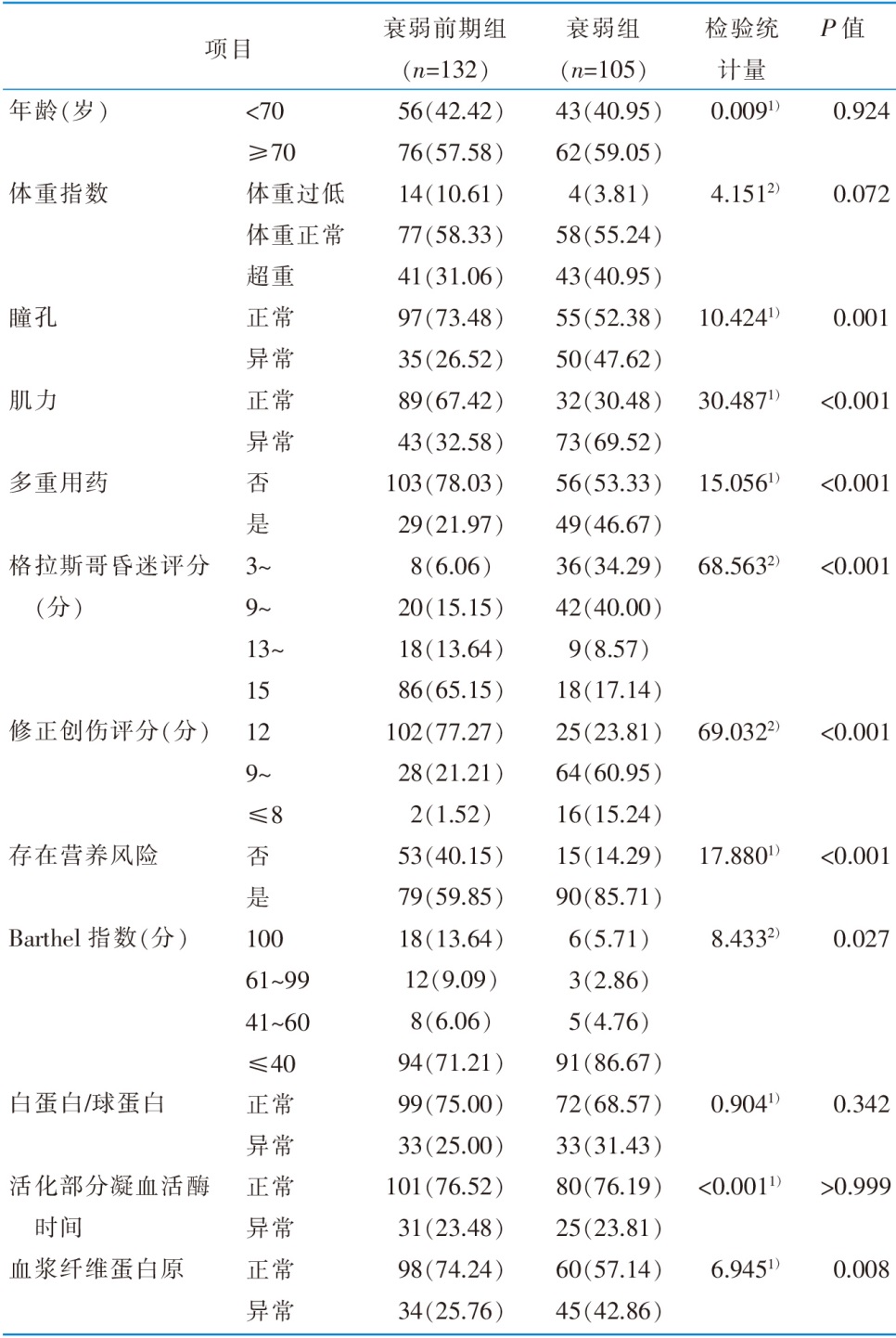 |
表1 老年创伤性脑损伤患者衰弱的单因素分析结果[n=237,例(百分比,%)]
Table 1 Univariate analysis results of frailty in elderly patients with TBI [n=237,case(percentage,%)]
| |
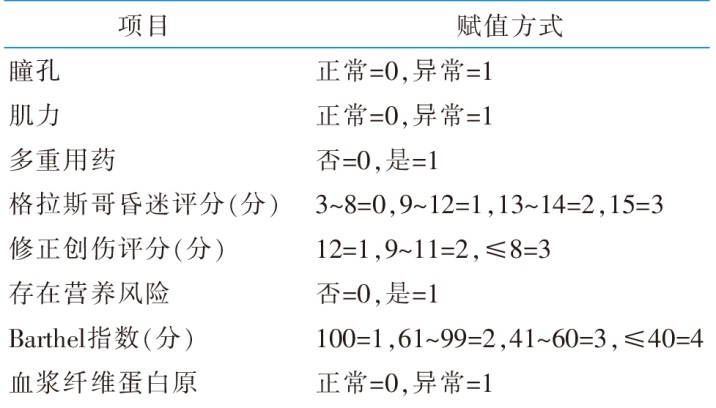 |
表2 自变量赋值方式
Table 2 Assignment of independent variables
| |
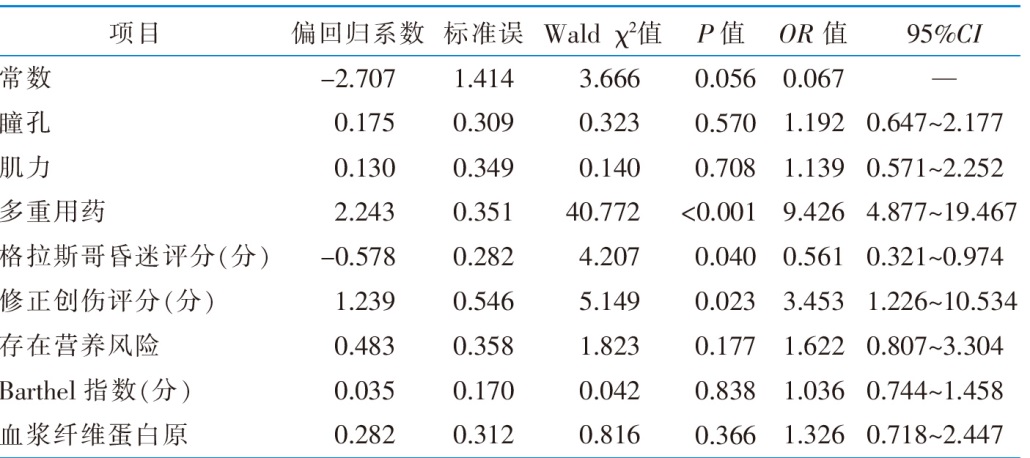 |
表3 老年颅脑创伤患者衰弱影响因素的二元Logistic回归分析(n=237)
Table 3 Logistic regression analysis of factors affecting frailty in elderly patients with TBI(n=237)
| |
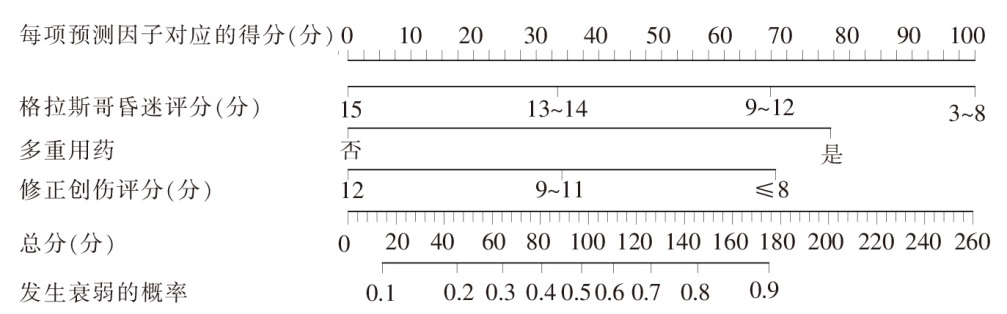
图1 老年创伤性脑损伤患者衰弱风险预测模型列线图
Figure 1 Nomogram for predicting frailty risk in elderly patients with TBI
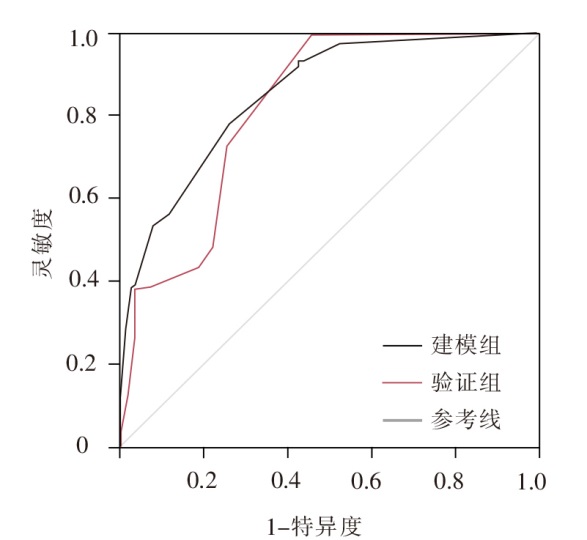
图2 老年创伤性脑损伤患者衰弱风险评估模型的受试者操作特征曲线
Figure 2 Receiver operating characteristic curve of the risk assessment model for frailty in elderly patients with TBI
| [1] |
朱冬平, 邵鹏, 乔跃华, 等. ICU转出重型颅脑创伤患者家属迁移应激护理方案的构建及应用效果评价[J]. 中华急危重症护理杂志, 2025, 6(3):261-267.
DOI |
| Zhu DP, Shao P, Qiao YH, et al. Application and effect evalua-tion of relocation stress nursing program for family members of patients with severe traumatic brain injury transferred from ICU[J]. Chin J Emerg Crit Care Nurs, 2025, 6(3):261-267. | |
| [2] |
Maas AIR, Menon DK, Manley GT, et al. Traumatic brain inju-ry:progress and challenges in prevention,clinical care,and research[J]. Lancet Neurol, 2022, 21(11):1004-1060.
DOI URL |
| [3] | Waltzman D, Haarbauer-Krupa J, Womack LS. Traumatic brain injury in older adults:a public health perspective[J]. JAMA Neu-rol, 2022, 79(5):437-438. |
| [4] | 杨云梅, 拓西平, 于普林, 等. 中华医学会老年医学分会,《中华老年医学杂志》编辑委员会,老年人衰弱预防中国专家共识(2022)[J]. 中华老年医学杂志, 2022, 41(5):503-511. |
| Yang YM, Ta XP, Yu PL, et al. Chinese Medical Association Geriatrics Branch,Editorial Committee of Chinese Journal of Geriatrics. Chinese expert consensus on prevention of frailty in the elderly(2022)[J]. Chin J Geriatr, 2022, 41(5):503-511. | |
| [5] | 魏晓蕾, 沈晨, 麻盛淼, 等. 基于医疗大数据的电子化衰弱评估工具的研究进展[J]. 中国护理管理, 2023, 23(8):1215-1219. |
| Wei XL, Shen C, Ma SM, et al. Research progress on electronic frailty assessment tools based on medical big data[J]. Chin Nurs Manag, 2023, 23(8):1215-1219. | |
| [6] | Liu H, Wu WX, Xu M, et al. Frailty predicts in-hospital death in traumatic brain injury patients:a retrospective cohort study[J]. Ther Clin Risk Manag, 2024,20:665-675. |
| [7] | Tracy BM, Carlin MN, Tyson JW, et al. The 11-item modified Frailty Index as a tool to predict unplanned events in trauma-tic brain injury[J]. Am Surg, 2020, 86(11):1596-1601. |
| [8] |
Ocagli H, Cella N, Stivanello L, et al. The Barthel index as an indicator of hospital outcomes:a retrospective cross-sectional study with healthcare data from older people[J]. J Adv Nurs, 2021, 77(4):1751-1761.
DOI URL |
| [9] |
Zonsius MC, Myftari K, Newman M, et al. Optimizing older adults’ medication use[J]. Am J Nurs, 2022, 122(3):38-43.
DOI PMID |
| [10] | Li NN, Liu GL, Gao H, et al. Geriatric syndromes,chronic in-flammation,and advances in the management of frailty:a review with new insights[J]. Biosci Trends, 2023, 17(4):262-270. |
| [11] |
Roohollahi F, Molavi S, Mohammadi M, et al. Prognostic value of frailty for outcome following traumatic brain injury:a sys-tematic review and meta-analysis[J]. J Neurotrauma, 2024, 41(3/4):331-348.
DOI URL |
| [12] |
Kadyrova A, Baudinov I, Alin G, et al. Roles of diagnostic ima-ging techniques in traumatic brain injury[J]. Biomedicine, 2022, 42(1):1-10.
DOI URL |
| [13] |
Peduzzi P, Concato J, Kemper E, et al. A simulation study of the number of events per variable in logistic regression analysis[J]. J Clin Epidemiol, 1996, 49(12):1373-1379.
DOI PMID |
| [14] |
Hamidi M, Zeeshan M, Leon-Risemberg V, et al. Frailty as a prognostic factor for the critically ill older adult trauma patients[J]. Am J Surg, 2019, 218(3):484-489.
DOI PMID |
| [15] | Teasdale G, Jennett B. Assessment of coma and impaired con-sciousness. A practical scale[J]. Lancet, 1974, 2(7872):81-84. |
| [16] | Champion HR, Sacco WJ, Copes WS, et al. A revision of the trauma score[J]. J Trauma Inj Infect Crit Care,29(5):623-629. |
| [17] | Kondrup J, Rasmussen HH, Hamberg O, et al. Nutritional risk screening(NRS 2002):a new method based on an analysis of controlled clinical trials[J]. Clin Nutr,2003,22(3):321-336. |
| [18] | 张雅芝, 厉春林, 刘园园, 等. 颅脑损伤患者轻度认知功能障碍影响因素的Meta分析[J]. 中华急危重症护理杂志, 2023, 4(3):263-269. |
| Zhang YZ, Li CL, Liu YY, et al. Meta-analysis of influencing factors of mild cognitive impairment in patients with trauma-tic brain injury[J]. Chin J Emerg Crit Care Nurs, 2023, 4(3):263-269. | |
| [19] | 郭子鑫, 徐慧萍, 张艳, 等. 住院老年患者口腔衰弱与肌少症共病现状及影响因素研究[J]. 中华护理杂志, 2025, 60(3):281-287. |
| Guo ZX, Xu HP, Zhang Y, et al. Current situation and influe-ncing factors of comorbidities of oral frailty and sarcopenia in elderly hospitalized patients[J]. Chin J Nurs, 2025, 60(3):281-287. | |
| [20] |
Clara Drenthvan Maanen A, Wilting I, Jansen PAF. Prescribing medicines to older people:how to consider the impact of ageing on human organ and body functions[J]. Br J Clin Pharmacol, 2020, 86(10):1921-1930.
DOI PMID |
| [21] |
姚自强, 秦宁, 石双姣, 等. 数字健康技术在高血压患者药物管理中的应用进展[J]. 中华护理杂志, 2023, 58(11):1403-1409.
DOI URL |
| Yao ZQ, Qin N, Shi SJ, et al. Application progress of digital health technology in the medication management of hyper-tensive patients[J]. Chin J Nurs, 2023, 58(11):1403-1409. | |
| [22] | 庄杨帆. 老年创伤患者严重不良事件预后模型构建及临床应用[D]. 武汉: 华中科技大学, 2022. |
| Zhuang YF. Development and clinical application assessment of a prognostic model for adverse outcomes in geriatric trau-ma patients[D]. Wuhan: Huazhong University of Science and Technology, 2022. | |
| [23] | Liu ZY, Huang YH, Li L, et al. Development and clinical appli-cation of an automated machine learning-based delirium risk prediction model for emergency polytrauma patients[J]. Front Physiol, 2025,16:1629329. |
| [24] |
沈娇妮, 郦杭婷, 吴佳, 等. 老年下肢骨关节炎患者衰弱风险评估模型的构建及验证[J]. 中华护理杂志, 2024, 59(18):2206-2213.
DOI URL |
|
Shen JN, Li HT, Wu J, et al. Construction and validation of a risk assessment model for frailty in elderly patients with lower extremity osteoarthritis[J]. Chin J Nurs, 2024, 59(18):2206-2213.
DOI URL |
|
| [25] | Yang J, Ran MZ, Li HY, et al. New insight into neurological degeneration:inflammatory cytokines and blood-brain barrier[J]. Front Mol Neurosci, 2022,15:1013933. |
| [26] |
Raquer AP, Fong CT, Walters AM, et al. Delirium and its asso-ciations with critical care utilizations and outcomes at the time of hospital discharge in patients with acute brain injury[J]. Medicina, 2024, 60(2):304.
DOI URL |
| [27] | 高悦, 陈可, 蒋丹丹, 等. 老年急诊创伤患者衰弱现状及其危险因素[J]. 临床与病理杂志, 2025, 45(1):46-54. |
| Gao Y, Chen K, Jiang DD, et al. Frailty status and risk factor analysis in elderly emergency trauma patients[J]. J Clin Pathol Res, 2025, 45(1):46-54. | |
| [28] |
Fimognari FL, De Vincentis A, Arone A, et al. Clinical out-comes and phenotypes of respiratory failure in older subjects admitted to an acute care geriatric hospital ward[J]. Intern Emerg Med, 2024, 19(5):1359-1367.
DOI PMID |
| [29] | Cosarderelioglu C, Nidadavolu LS, George CJ, et al. Brain renin-angiotensin system at the intersect of physical and cognitive frailty[J]. Front Neurosci, 2020,14:586314. |
| [30] |
吕桂兰, 曹虎男, 王浩, 等. 维持性血液透析中低血压风险预测的Meta建模及验证[J]. 中华护理杂志, 2024, 59(21):2611-2619.
DOI URL |
|
Lü GL, Cao HN, Wang H, et al. Meta-modeling and validation of a risk prediction model for intradialytic hypotension in maintenance hemodialysis patients[J]. Chin J Nurs, 2024, 59(21):2611-2619.
DOI URL |
| [1] | 陶彬彬, 阴倩羽, 柴召午, 敖春燕, 刘萍, 张黔, 杨冰. 口腔健康教育方案的构建及在社区老年人中的应用研究[J]. 中华护理杂志, 2026, 61(1): 9-16. |
| [2] | 茹秀丽, 韩梦丹, 纪莉莉, 周丽娜, 李雪雯, 张亦爽. 药物自我管理行为对社区老年慢性共病患者衰弱的影响研究[J]. 中华护理杂志, 2026, 61(1): 17-22. |
| [3] | 陆沁怡, 陆程倩, 赵亚芬, 金学勤. 跌倒恐惧对社区老年2型糖尿病患者跌倒警觉度的影响研究[J]. 中华护理杂志, 2026, 61(1): 23-29. |
| [4] | 高维杰, 孙玉梅. 失智老年人及其照顾者使用喘息服务障碍因素的Meta整合[J]. 中华护理杂志, 2026, 61(1): 30-37. |
| [5] | 汪婧颖, 罗雅婷, 贾思培, 甘港, 刘敏, 张秋香, 谢建飞. 数字健康干预在农村老年人抑郁管理中应用的范围综述[J]. 中华护理杂志, 2026, 61(1): 38-45. |
| [6] | 中华护理学会呼吸护理专业委员会(执笔:曾妃, 兰美娟, 蔡凌云, 顾培培, 朱岩, 王衍蝶, 梁江淑渊). 儿童肺移植术后肺康复护理专家共识[J]. 中华护理杂志, 2026, 61(1): 46-52. |
| [7] | 中华护理学会安宁疗护专业委员会(执笔:郭俊晨, 谌永毅, 应文娟, 吕茵茵, 赵云, 强万敏, 徐晓霞, 胡永红. 成人安宁疗护患者多学科共同照护管理专家共识[J]. 中华护理杂志, 2026, 61(1): 53-56. |
| [8] | 郑焠燕, 封亚萍, 刘志梅, 胡慧群. 双手及单手握球锻炼在PICC置管患者中应用效果的比较研究[J]. 中华护理杂志, 2026, 61(1): 57-62. |
| [9] | 郭恩慧, 朗秋燕, 温汉春, 甘衍梅, 王书林, 李高叶. 静脉-动脉体外膜肺氧合护理标准化方案在复杂高危冠心病患者中的应用研究[J]. 中华护理杂志, 2026, 61(1): 63-69. |
| [10] | 高丹, 姚丽伟, 黄金鹏, 刘晓霞, 张玥, 毛潇潇. 增强现实体感运动在结核性脓胸清除术患者早期活动中的应用研究[J]. 中华护理杂志, 2026, 61(1): 70-77. |
| [11] | 彭媛, 杨正伟, 何川, 陈玉琴. 下肢加压疗法预防乳腺癌患者化疗致周围神经病变的效果研究[J]. 中华护理杂志, 2026, 61(1): 78-84. |
| [12] | 蒋向玲, 陆慧芬, 虞幼军, 林晓丽, 黄佩铃. 鼻咽癌患者放疗后听力损伤影响因素研究及护理启示[J]. 中华护理杂志, 2026, 61(1): 85-92. |
| [13] | 郑文静, 张文倩, 蒋秋焕, 候琳琳, 张蒙蒙. 2型糖尿病患者自我管理行为维持困境的质性研究[J]. 中华护理杂志, 2026, 61(1): 93-98. |
| [14] | 王红艳, 刘静, 汪红英, 夏宁宁, 肖磊娟, 苑影影. 术前量化加压束臂运动对血液透析患者自体动静脉内瘘成熟的影响研究[J]. 中华护理杂志, 2026, 61(1): 99-105. |
| [15] | 李奎, 潘爱红, 徐佩丽, 许采颉, 任汝南, 王春. 维持性血液透析患者容量管理行为潜在剖面分析及影响因素研究[J]. 中华护理杂志, 2026, 61(1): 113-120. |
| 阅读次数 | ||||||
|
全文 |
|
|||||
|
摘要 |
|
|||||
