
Chinese Journal of Nursing ›› 2026, Vol. 61 ›› Issue (4): 442-451.DOI: 10.3761/j.issn.0254-1769.2026.04.002
• Perioperative Safety and Management for Orthopedic Patients • Previous Articles Next Articles
DU Shushu1( ), CAO Yaqin2, MIN Jikang3, FENG Yue2, WU Qi2, JIANG Fengxian1,*()
Received:2025-06-09
Online:2026-02-20
Published:2026-02-06
* Corresponding author:
JIANG Fengxian,E-mail:jiangfengxian@suda.edu.cnFunding program:
杜姝姝1(), 曹亚琴2, 闵继康3, 冯悦2, 吴琦2, 蒋凤仙1,*()
通讯作者:
蒋凤仙,E-mail:jiangfengxian@suda.edu.cn作者简介:杜姝姝:女,硕士,护师,E-mail:291779140@qq.com
基金资助:DU Shushu, CAO Yaqin, MIN Jikang, FENG Yue, WU Qi, JIANG Fengxian. Construction and application of a postoperative self-management program for patients with osteoporotic vertebral compression fractures[J]. Chinese Journal of Nursing, 2026, 61(4): 442-451.
杜姝姝, 曹亚琴, 闵继康, 冯悦, 吴琦, 蒋凤仙. 骨质疏松椎体压缩性骨折患者术后自我管理方案的构建及应用研究[J]. 中华护理杂志, 2026, 61(4): 442-451.
Add to citation manager EndNote|Ris|BibTeX
URL: https://zh.zhhlzzs.com/EN/10.3761/j.issn.0254-1769.2026.04.002
 |
Table 1 Self-management program for OVCF surgery patients based on the COM-B model
| |
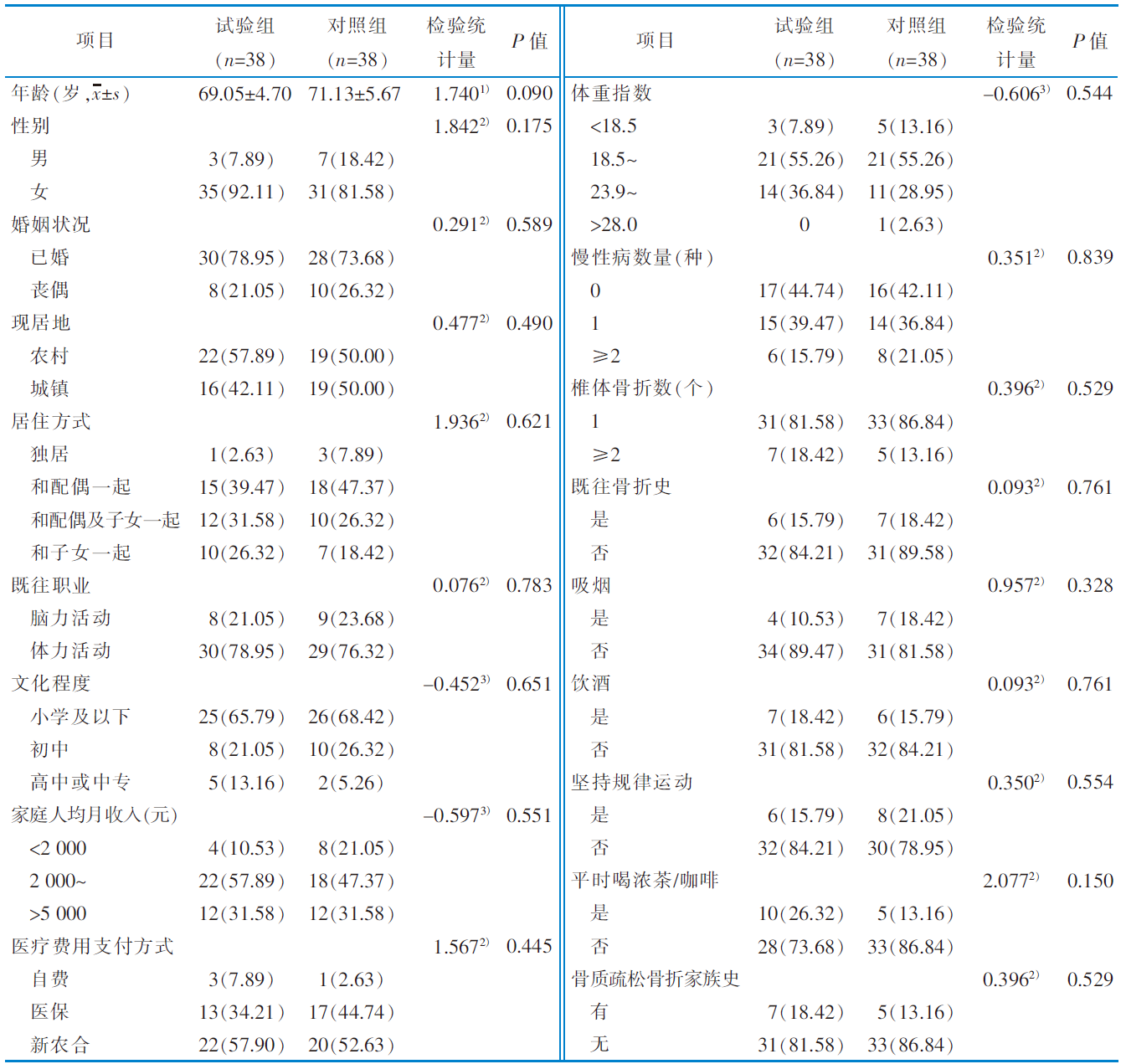 |
Table 2 Baseline characteristics of 2 groups of patients
| |
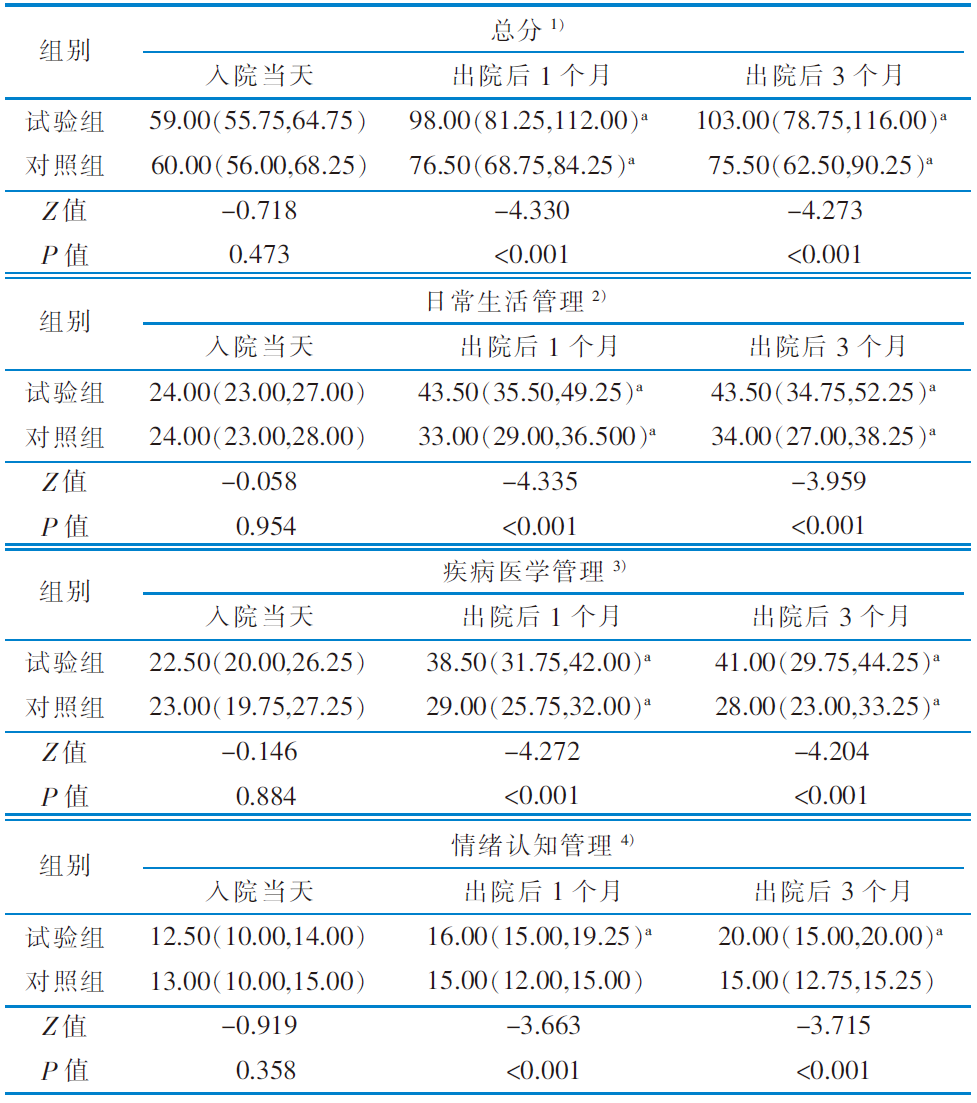 |
Table 3 Comparison of self-management behavior levels between the 2 groups [scores,M(P25,P75)]
| |
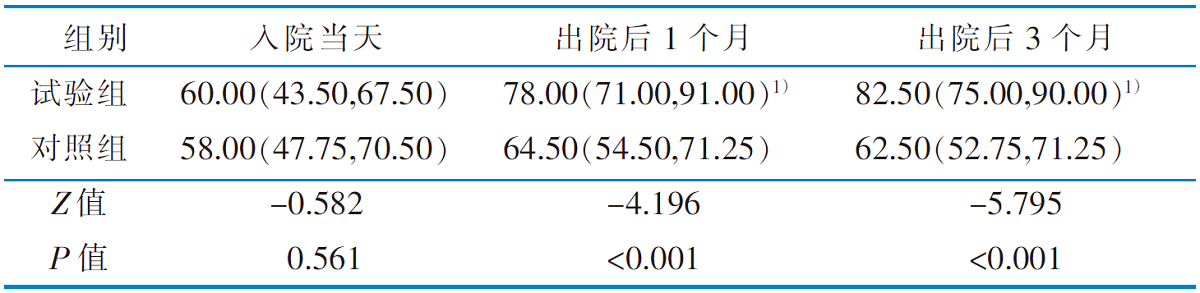 |
Table 4 Comparison of self-efficacy between the 2 groups[scores,M(P25,P75)]
| |
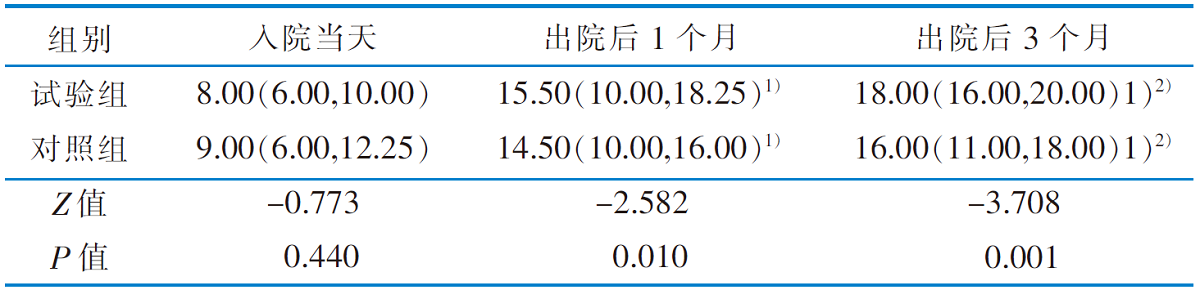 |
Table 5 Comparison of knowledge levels between the 2 groups[scores,M(P25,P75)]
| |
| [1] |
Kutsal FY, Ergani GOE. Vertebral compression fractures:still an unpredictable aspect of osteoporosis[J]. Turk J Med Sci, 2021, 51(2):393-399.
DOI URL |
| [2] |
Cui L, Chen L, Xia W, et al. Vertebral fracture in postmenopausal Chinese women:a population-based study[J]. Osteoporos Int, 2017, 28(9):2583-2590.
DOI PMID |
| [3] | 中国康复医学会骨质疏松预防与康复专业委员会. 骨质疏松性椎体压缩骨折诊治专家共识(2021版)[J]. 中华医学杂志, 2021, 101(41):3371-3379. |
| Chinese Society of Rehabilitation Medicine-Professional Committee for Prevention and Rehabilitation of Osteoporosis. Expert consensus on diagnosis and treatment of osteoporotic vertebral compression fracture(2021 edition)[J]. Natl Med J China, 2021, 101(41):3371-3379. | |
| [4] | Sun Y, Ma HN, Yang F, et al. Clinical efficacy and safety of zoledronic acid combined with PVP/PKP in the treatment of osteoporotic vertebral compression fracture:a systematic review and meta-analysis of randomized controlled trials[J]. Biomed Res Int, 2021,2021:6650358. |
| [5] | 中华医学会骨质疏松和骨矿盐疾病分会. 原发性骨质疏松症诊疗指南(2022)[J]. 中华骨质疏松和骨矿盐疾病杂志, 2022, 15(6):573-611. |
| Chinese Society of Osteoporosis and Bone Mineral Research. Guidelines for diagnosis and treatment of primary osteoporosis(2022)[J]. Chin J Osteoporos Bone Miner Res, 2022, 15(6):573-611. | |
| [6] | 廖爱群, 肖露微, 冷娟娟, 等. 骨质疏松性椎体压缩性骨折患者疾病知识和健康行为的现状及其相关性研究[J]. 中国社区医师, 2023, 39(1):133-135. |
| Liao AQ, Xiao LW, Leng JJ, et al. Study on the current situation and correlation of disease knowledge and health behavior of patients with osteoporotic vertebral compression fracture[J]. Chin Community Dr, 2023, 39(1):133-135. | |
| [7] | Michie S, van Stralen MM, West R. The behaviour change wheel:a new method for characterising and designing behaviour change interventions[J]. Implement Sci, 2011,6:42. |
| [8] |
朱虹宣, 庞建美, 孙盛楠, 等. 老年肺癌患者术后过渡期肺康复行为影响因素的质性研究[J]. 中华护理杂志, 2024, 59(1):15-21.
DOI URL |
|
Zhu HX, Pang JM, Sun SN, et al. A qualitative study of the factors of pulmonary rehabilitation behavior of elderly patients with lung cancer in the post-operative transitional period[J]. Chin J Nurs, 2024, 59(1):15-21.
DOI URL |
|
| [9] | 中华中医药学会. 骨质疏松性骨折中医诊疗指南[J]. 中医正骨, 2023, 35(1):1-9. |
| China Association of Chinese Medicine. Guidelines for TCM diagnosis and treatment of osteoporotic fractures[J]. J Tradit Chin Orthop Traumatol, 2023, 35(1):1-9. | |
| [10] | 许正伟, 郝定均, 程黎明, 等. 骨质疏松性椎体压缩骨折椎体强化术后康复治疗指南(2022版)[J]. 中华创伤杂志, 2022, 38(11):961-972. |
| Xu ZW, Hao DJ, Cheng LM, et al. Guideline for postoperative rehabilitation treatment following vertebral augmentation for osteoporotic vertebral compression fracture(version 2022)[J]. Chin J Trauma, 2022, 38(11):961-972. | |
| [11] |
Mears SC, Kates SL. A guide to improving the care of patients with fragility fractures,edition 2[J]. Geriatr Orthop Surg Rehabil, 2015, 6(2):58-120.
DOI URL |
| [12] |
Gregson CL, Armstrong DJ, Bowden J, et al. UK clinical guideline for the prevention and treatment of osteoporosis[J]. Arch Osteoporos, 2022, 17(1):58.
DOI PMID |
| [13] | 中国康复医学会骨质疏松预防与康复专业委员会. 骨质疏松性骨折二级预防中国专家共识[J]. 中华医学杂志, 2022, 102(45):3581-3591. |
| Chinese Society of Rehabilitation Medicine-Professional Committee for Prevention and Rehabilitation of Osteoporosis. China expert consensus on secondary prevention of osteoporotic fracture[J]. Natl Med J China, 2022, 102(45):3581-3591. | |
| [14] |
Ponzano M, Tibert N, Brien S, et al. International consensus on the non-pharmacological and non-surgical management of osteoporotic vertebral fractures[J]. Osteoporos Int, 2023, 34(6):1065-1074.
DOI PMID |
| [15] |
Giangregorio LM, McGill S, Wark JD, et al. Too Fit To Fracture:outcomes of a Delphi consensus process on physical activity and exercise recommendations for adults with osteoporosis with or without vertebral fractures[J]. Osteoporos Int, 2015, 26(3):891-910.
DOI PMID |
| [16] | 丁悦, 张嘉, 岳华, 等. 骨质疏松性椎体压缩性骨折诊疗与管理专家共识[J]. 中华骨质疏松和骨矿盐疾病杂志, 2018, 11(5):425-437. |
| Ding Y, Zhang J, Yue H, et al. Expert consensus on diagnosis,treatment and management of osteoporotic vertebral compression fracture[J]. Chin J Osteoporos Bone Miner Res, 2018, 11(5):425-437. | |
| [17] |
Conley RB, Adib G, Adler RA, et al. Secondary fracture prevention:consensus clinical recommendations from a multistakeholder coalition[J]. J Bone Miner Res, 2020, 35(1):36-52.
DOI URL |
| [18] | Kim SH, Ramani PS, Jahagirdar VR, et al. Endocrine assessment,chemotherapy,nonsurgical treatment,and rehabilitation for osteoporotic spine fractures:WFNS spine committee recommendations[J]. J Neurosurg Sci, 2022, 66(4):300-310. |
| [19] | “建立中国老年骨质疏松症三级防控体系专家共识”编写组, 中国老年保健医学研究会老年骨质疏松分会, 中国老年保健医学研究会老年内分泌代谢分会, 等. 建立中国老年骨质疏松症三级防控体系专家共识[J]. 中华内科杂志, 2022, 61(6):617-630. |
| Writing Group of Expert Consensus on Establishing a Three Level System for Prevention, Elderly Osteoporosis Branch of the Chinese Geriatric Health Medicine Research Association, Endocrine and Metabolic Branch of the Chinese Geriatric Health Medicine Research Association, et al. Expert consensus on establishing a three-level system for prevention and control osteoporosis in the elderly in China[J]. Chin J Intern Med, 2022, 61(6):617-630. | |
| [20] | 中华医学会骨质疏松和骨矿盐疾病分会, 中华医学会骨科学分会. 骨质疏松性骨折后再骨折防治专家共识[J]. 中华骨科杂志, 2022, 42(17):1101-1111. |
| Chinese Society of Osteoporosis and Bone Mineral Research, Chinese Orthopaedic Association. Expert consensus on prevention and treatment of recurrent fractures after osteoporotic fractures[J]. China J Orthop, 2022, 42(17):1101-1111. | |
| [21] |
Svensson HK, Olsson LE, Hansson T, et al. The effects of person-centered or other supportive interventions in older women with osteoporotic vertebral compression fractures:a systematic review of the literature[J]. Osteoporos Int, 2017, 28(9):2521-2540.
DOI PMID |
| [22] | 屈京楼, 朱亚鑫, 曲波. 德尔菲法在医学教育研究中的应用[J]. 中华医学教育杂志, 2019, 39(3):227-230. |
| Qu JL, Zhu YX, Qu B. The Delphi method and its application in medical education research[J]. Chin J Med Educ, 2019, 39(3):227-230. | |
| [23] | 邓永鸿. 原发性骨质疏松症患者自我管理行为量表的编制及应用研究[D]. 天津: 天津中医药大学, 2018. |
| Deng YH. Development and application of Self-Management Behavior Scale for Patients with Primary Osteoporosis[D]. Tianjin: Tianjin University of Traditional Chinese Medicine, 2018. | |
| [24] |
Horan ML, Kim KK, Gendler P, et al. Development and evaluation of the Osteoporosis Self-Efficacy Scale[J]. Res Nurs Health, 1998, 21(5):395-403.
DOI PMID |
| [25] | 陈玉平, 刘雪琴. 骨质疏松症自我效能量表的信度与效度测定[J]. 解放军护理杂志, 2005, 22(8):38-39. |
| Chen YP, Liu XQ. Reliability and validity of Osteoporosis Self-Efficacy Scale[J]. Nurs J Chin PLA, 2005, 22(8):38-39. | |
| [26] | 陈玉平, 刘雪琴, 蔡德鸿. 骨质疏松症知识问卷的信度和效度测定[J]. 中国骨质疏松杂志, 2005, 11(3):339-341. |
| Chen YP, Liu XQ, Cai DH. Reliability and validity of Osteoporosis Knowledge Tests[J]. Chin J Osteoporos, 2005, 11(3):339-341. | |
| [27] |
Guo ZJ, Yang QH, Yang F, et al. Illness perceptions in relation to self-management behaviour among elderly patients with COPD:a cross-sectional study[J]. Int J Nurs Pract, 2024, 30(5):e13264.
DOI URL |
| [28] |
Jia DM, Zhang K, Xu YM. The relationship between social support and relapse tendency among those who struggle with drug addiction:multiple mediators of exercise self-efficacy and health-related quality of life[J]. J Drug Issues, 2024, 54(1):120-133.
DOI URL |
| [29] |
李莉, 申雅文, 李德龙, 等. 脆性骨折术后患者康复自我效能感的影响因素及路径分析[J]. 中华护理杂志, 2024, 59(24):3003-3008.
DOI URL |
|
Li L, Shen YW, Li DL, et al. Analysis of influencing factors and pathways of postoperative self-efficacy in patients with fragility fracture[J]. Chin J Nurs, 2024, 59(24):3003-3008.
DOI URL |
|
| [30] |
罗屹惟, 程悦, 罗如珍, 等. 骨质疏松椎体压缩性骨折患者术后居家康复体验的质性研究[J]. 中华护理杂志, 2022, 57(10):1165-1171.
DOI URL |
| Luo YW, Cheng Y, Luo RZ, et al. Experiences of home-based rehabilitation continuity care after osteoporotic vertebral compression fracture:a qualitative study[J]. Chin J Nurs, 2022, 57(10):1165-1171. |
| [1] | ZHANG Ying, LÜ Shuoyang, ZHAO Guichun, JIANG Yingqing, HUANG Liqun, ZHANG Hongbing, YANG Huilin, NI Li, SUI Wenjie. A quantitative study on the dilemma of exercise in patients with osteoporotic vertebral compression fractures after surgery [J]. Chinese Journal of Nursing, 2026, 61(4): 452-459. |
| [2] | WANG Xin, XU Huiping, HUANG Qian, SUN Yifang, GUO Zixin, ZHANG Xinyu. Analysis of latent classes and influencing factors for physical function trajectories in hip arthroplasty patients [J]. Chinese Journal of Nursing, 2026, 61(4): 460-466. |
| [3] | PAN Yuanyuan, WANG Donghui, FU Huilin. Applied research on an intervention program based on the information framing effect for self-management behaviors in pituitary adenoma patients [J]. Chinese Journal of Nursing, 2026, 61(4): 475-482. |
| [4] | WANG Fangying, CHEN Xuefeng, JIA Yan, WU Wanying. Subgroups and transition patterns of symptom burden among nasopharyngeal carcinoma patients during the peri-radiotherapy period:a latent transition analysis [J]. Chinese Journal of Nursing, 2026, 61(4): 490-497. |
| [5] | JING Feng, JIANG Lingyun, CAO Yuling, TIAN Maoting, QIU Jiajia, TANG Lichen, HU Yan. Development and preliminary validation of a risk prediction model for musculoskeletal symptoms among breast cancer patients with endocrine therapy [J]. Chinese Journal of Nursing, 2026, 61(4): 498-505. |
| [6] | JIN Guanzhen, LIU Yanjin, JIN Bo, WANG Yanyan, ZHANG Ling, LIU Fangfang. Current situation and influencing factors of self-awareness of falls in elderly patients with primary glaucoma [J]. Chinese Journal of Nursing, 2026, 61(4): 506-512. |
| [7] | KONG Juan, LIU Xueyan, YUAN Xiaodong, CAO Yingjuan. A study on the symptom management journey map of adult patients with generalized myasthenia gravis [J]. Chinese Journal of Nursing, 2026, 61(4): 513-520. |
| [8] | SHI Ziyue, JIANG Enshe, QU Jiayuan, YU Yaqian, ZHANG Daxue, FU Mingzhu, DENG Xiaomei. Norm construction of a Negative Emotion Screening Scale for Inpatients in General Hospitals:a Guangdong provincial norm [J]. Chinese Journal of Nursing, 2026, 61(4): 521-529. |
| [9] | QIN Yushuang, YU Lili, CHENG Lili, HUANG Juan, XI Xin, WANG Liyan, TIAN En, LIN Lirong, FAN Yao, YANG Jurong, ZHOU Mingfang. Experience of pregnant women with end-stage renal disease under multidisciplinary management:a qualitative study [J]. Chinese Journal of Nursing, 2026, 61(4): 530-535. |
| [10] | LU Fengjuan, XIE Zihui, GUAN Yinyin, PEI Xiaoli, FANG Yuxia. Latent profile analysis of empathy for pain and its associated factors among orthopedic nurses [J]. Chinese Journal of Nursing, 2026, 61(4): 549-556. |
| [11] | LIU Chunli, TENG Xue, ZHANG Liuliu, YANG Bo, ZHANG Maomao, LI Xiaoxu, YU Rong, SHI Ruchun. Research progress on identification and management of malpositioned central venous access device tip into the azygos vein [J]. Chinese Journal of Nursing, 2026, 61(4): 566-570. |
| [12] | ZHOU Xinying, XU Yihong, ZHOU Liping, GONG Xiaoyan, YE Huan, LIU Xiaona, ZHUANG Yiyu. A scoping review on the relationship between gender differences and health related quality of life among stroke patients [J]. Chinese Journal of Nursing, 2026, 61(4): 571-577. |
| [13] | XUE Jing, WANG Zhe, CHENG Fangqun, CHEN Siyu, HE Cong, XU Qiang, PENG Peng, CHENG Peiyu. Resilience developmental trajectories and influencing factors in infertile women undergoing in vitro fertilization and embryo transfer treatment [J]. Chinese Journal of Nursing, 2026, 61(3): 302-309. |
| [14] | HUANG Huihong, LIU Jinlian, WANG Zirui, LI Jinlu, SHI Li, YANG Rui. Analysis of the influencing factors and pathways of pain levels in patients undergoing in vitro fertilization and embryo transfer after oocyte retrieval surgery [J]. Chinese Journal of Nursing, 2026, 61(3): 310-317. |
| [15] | WU Meiliyang, YANG Liu, YANG Juan, QU Jia, MIN Min. Mapping the assisted reproductive treatment journey for infertility patients and implications for care [J]. Chinese Journal of Nursing, 2026, 61(3): 318-325. |
| Viewed | ||||||
|
Full text |
|
|||||
|
Abstract |
|
|||||
