

Chinese Journal of Nursing ›› 2026, Vol. 61 ›› Issue (3): 302-309.DOI: 10.3761/j.issn.0254-1769.2026.03.002
• Special Planning—Assisted Reproductive Care • Previous Articles Next Articles
XUE Jing1( ), WANG Zhe2, CHENG Fangqun2, CHEN Siyu2, HE Cong1, XU Qiang1, PENG Peng1, CHENG Peiyu2,*()
Received:2025-02-13
Online:2026-02-10
Published:2026-02-03
* Corresponding author:
CHENG Peiyu,E-mail:517761145@qq.com
薛晶1(), 王喆2, 成放群2, 陈思宇2, 贺聪1, 徐强1, 彭鹏1, 成沛玉2,*()
通讯作者:
成沛玉,E-mail:517761145@qq.com作者简介:薛晶:女,硕士,护士,E-mail:1274027071@qq.com
XUE Jing, WANG Zhe, CHENG Fangqun, CHEN Siyu, HE Cong, XU Qiang, PENG Peng, CHENG Peiyu. Resilience developmental trajectories and influencing factors in infertile women undergoing in vitro fertilization and embryo transfer treatment[J]. Chinese Journal of Nursing, 2026, 61(3): 302-309.
薛晶, 王喆, 成放群, 陈思宇, 贺聪, 徐强, 彭鹏, 成沛玉. 不孕症患者体外受精-胚胎移植治疗期间心理弹性变化轨迹及影响因素研究[J]. 中华护理杂志, 2026, 61(3): 302-309.
Add to citation manager EndNote|Ris|BibTeX
URL: https://zh.zhhlzzs.com/EN/10.3761/j.issn.0254-1769.2026.03.002
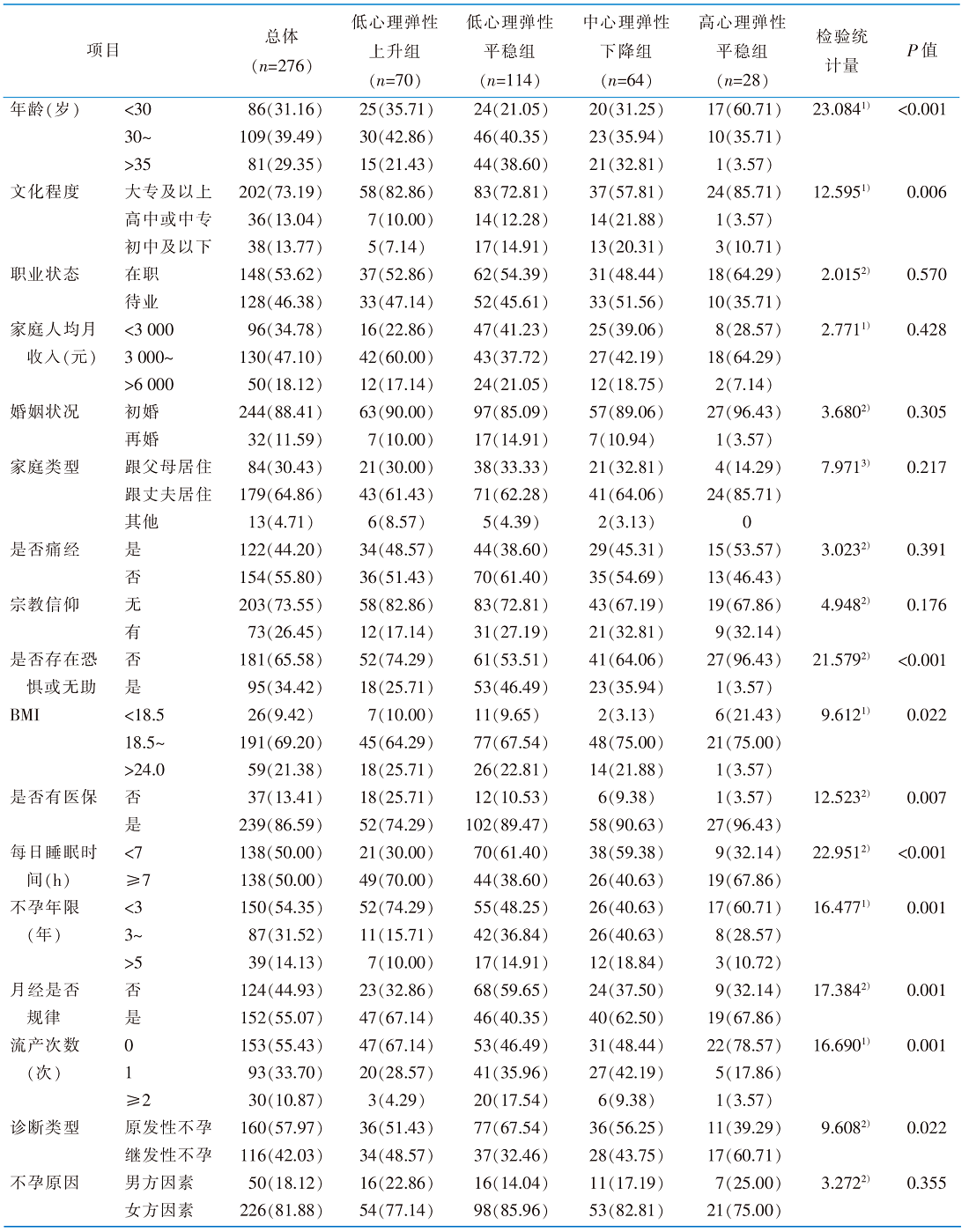 |
Table 1 Univariate analysis of participants’ characteristics and latent classes of psychological resilience development trajectories[cases(percentage,%)]
| |
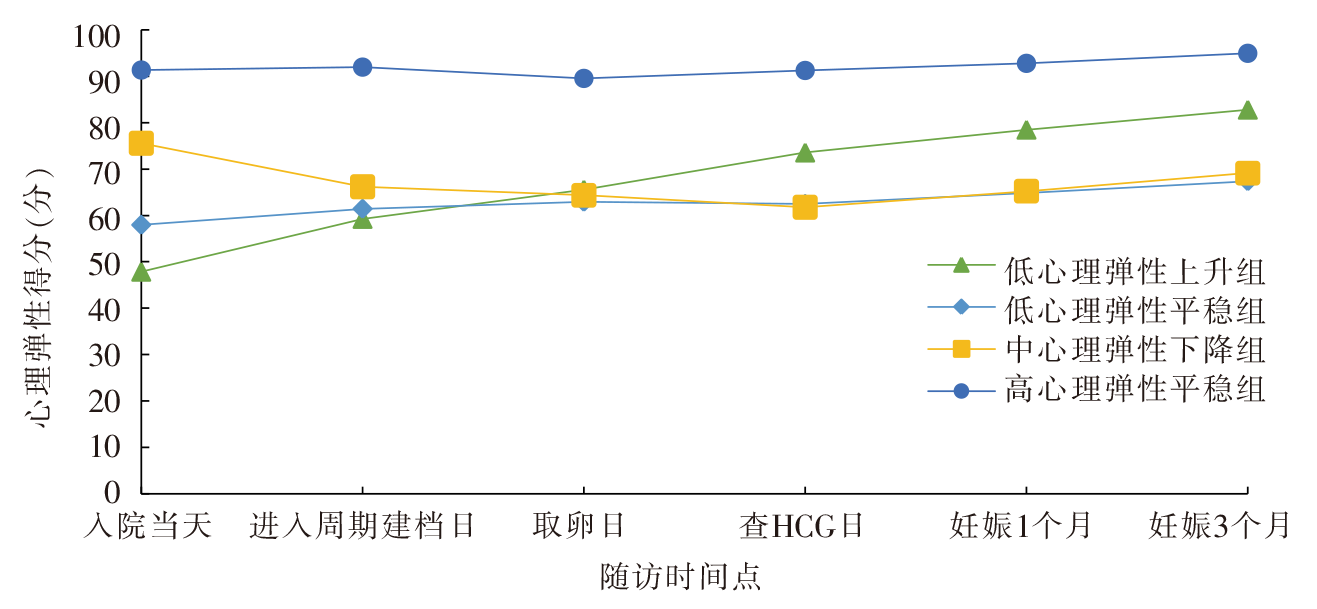
Figure 1 Categories of psychological resilience trajectories in infertile patients during IVF-ET treatment
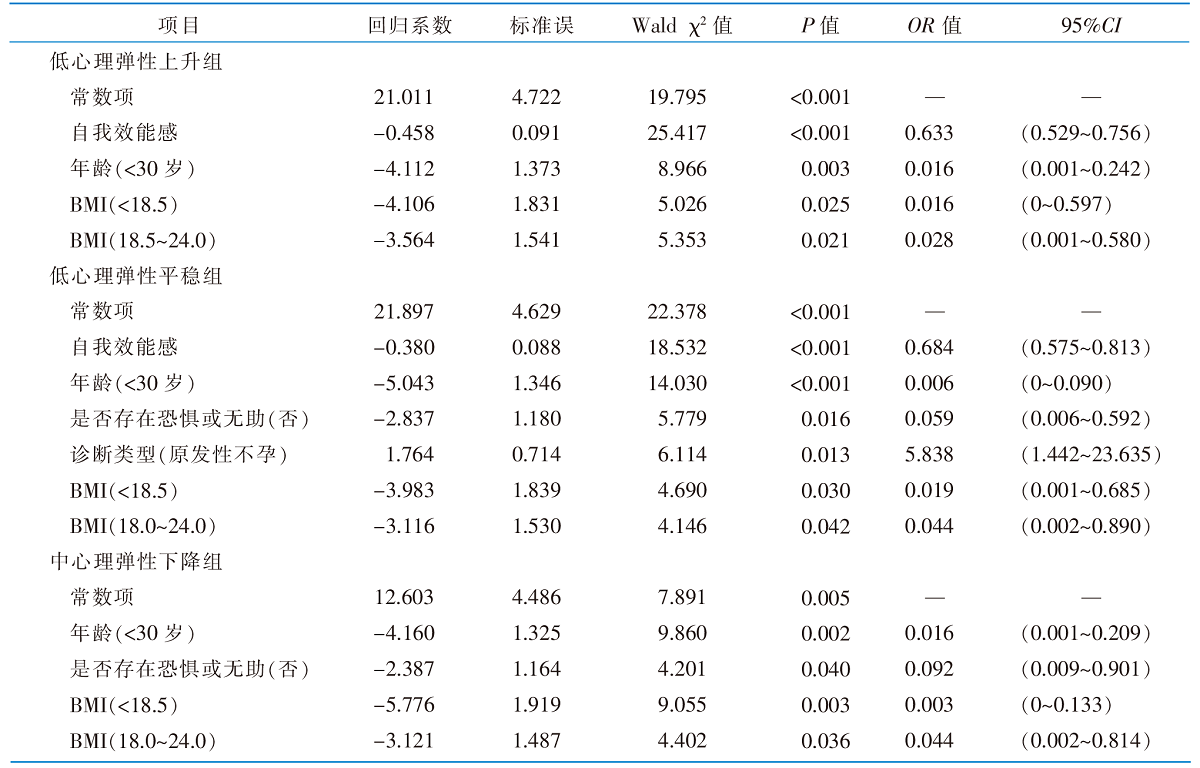 |
Table 2 Multivariate logistic regression analysis results of potential categories of psychological resilience change trajectories in infertile patients during IVF-ET treatment(n=276)
| |
| [1] | 代玮, 郭艺红. 2023年欧洲人类生殖与胚胎学学会《不明原因不孕症的诊断与治疗指南》解读[J]. 实用妇产科杂志, 2024, 40(7):527-531. |
| Dai W, Guo YH. Interpretation of “guidelines for diagnosis and treatment of unexplained infertility” by the European Society of Human Reproduction and Embryology in 2023[J]. J Pract Obstet Gynecol, 2024, 40(7):527-531. | |
| [2] |
杨孟叶, 张艳, 钮芳芳. 辅助生殖技术助孕患者健康信息需求及干预的研究进展[J]. 中华护理杂志, 2021, 56(1):143-148.
DOI URL |
|
Yang MY, Zhang Y, Niu FF. Research progress on health information needs and interventions for patients receiving assisted reproductive technology for pregnancy[J]. Chin J Nurs, 2021, 56(1):143-148.
DOI URL |
|
| [3] | Li GP, Jiang ZH, Kang XF, et al. Trajectories and predictors of anxiety and depression amongst infertile women during their first IVF/ICSI treatment cycle[J]. J Psychosom Res, 2021,142:110357. |
| [4] |
Galhardo A, Alves J, Moura-Ramos M, et al. Infertility-related stress and depressive symptoms-the role of experiential avoidance:a cross-sectional study[J]. J Reprod Infant Psychol, 2020, 38(2):139-150.
DOI PMID |
| [5] |
Wang LY, Tang YY, Wang YY. Predictors and incidence of depression and anxiety in women undergoing infertility treatment:a cross-sectional study[J]. PLoS One, 2023, 18(4):e0284414.
DOI URL |
| [6] | 李嘉, 程章, Randy PP, 等. 中国不孕症患者治疗动因及阻因的调查研究[J]. 中华生殖与避孕杂志, 2023, 43(7):729-734. |
| Li J, Cheng Z, Randy PP, et al. Investigation on the treatment motivations and barriers of infertility patients in China[J]. Chin J Reprod Contracept, 2023, 43(7):729-734. | |
| [7] | 李娴, 白玲, 张毅勋. 自尊在肠癌患者心理弹性与社交回避及苦恼间的中介效应分析[J]. 中华现代护理杂志, 2024, 30(22):3034-3039. |
| Li X, Bai L, Zhang YX. Mediating effect of self-esteem between psychological resilience and social avoidance and distress in colorectal cancer patients[J]. Chin J Mod Nurs, 2024, 30(22):3034-3039. | |
| [8] |
姚芡芡, 刘丽, 罗艳芳, 等. 原发性脑肿瘤患者心理弹性潜在类别分析[J]. 中华护理杂志, 2022, 57(19):2363-2370.
DOI URL |
|
Yao QQ, Liu L, Luo YF, et al. Analysis of potential categories of psychological resilience in primary brain tumor patients[J]. Chin J Nurs, 2022, 57(19):2363-2370.
DOI URL |
|
| [9] |
Khan NH, Shahnawaz MG, Patel A, et al. Resilience among involuntarily childless couples and individuals undergoing infertility treatment:a systematic review[J]. Hum Fertil, 2023, 26(6):1562-1583.
DOI URL |
| [10] |
Shan YW, Liu XY, Chen WJ, et al. Predictors of psychological resilience trajectories in patients with knee arthroplasty:a longitudinal study[J]. J Adv Nurs, 2023, 79(5):1926-1938.
DOI URL |
| [11] | 谢幸, 苟文丽. 妇产科学[M]. 8版. 北京: 人民卫生出版社, 2013. |
| Xie X, Gou WL. Obstetrics and gynecology[M]. 8th ed. Beijing: People’s Medical Publishing House, 2013. | |
| [12] | 刘源, 骆方, 刘红云. 多阶段混合增长模型的影响因素:距离与形态[J]. 心理学报, 2014, 46(9):1400-1412. |
|
Liu Y, Luo F, Liu HY. Factors of piecewise growth mixture model:distance and pattern[J]. Acta Psychol Sin, 2014, 46(9):1400-1412.
DOI URL |
|
| [13] |
Connor KM, Davidson JRT. Development of a new resilience scale:the Connor-Davidson Resilience Scale(CD-RISC)[J]. Depress Anxiety, 2003, 18(2):76-82.
DOI URL |
| [14] |
Yu XN, Lau JTF, Mak WWS, et al. Factor structure and psychometric properties of the Connor-Davidson Resilience Scale among Chinese adolescents[J]. Compr Psychiatry, 2011, 52(2):218-224.
DOI URL |
| [15] | Schwarzer R, Born A. Optimistic self-beliefs:assess-ment of general perceived self-efficacy in thirteen cultures[J]. Wor Psychol, 1997, 3(1-2):177-190. |
| [16] | 王才康, 胡中锋, 刘勇. 一般自我效能感量表的信度和效度研究[J]. 应用心理学, 2001, 7(1):37-40. |
| Wang CK, Hu ZF, Liu Y. Evidences for reliability and validity of the Chinese version of General Self-Efficacy Scale[J]. Chin J Appl Psychol, 2001, 7(1):37-40. | |
| [17] |
Zimet GD, Powell SS, Farley GK, et al. Psychometric characteristics of the Multidimensional Scale of Perceived Social Support[J]. J Pers Assess, 1990, 55(3/4):610-617.
DOI URL |
| [18] | 黄丽, 姜乾金, 任蔚红. 应对方式、社会支持与癌症病人心身症状的相关性研究[J]. 中国心理卫生杂志, 1996, 10(4):160-161. |
| Huang L, Jiang QJ, Ren WH. Correlation between coping style,social support and psychosomatic symptoms of cancer patients[J]. Chin Ment Health J, 1996, 10(4):160-161. | |
| [19] | 张帆, 朱树贞, 邓平基. 领悟社会支持量表在国内住院病人社会支持研究中的应用评价[J]. 护理研究, 2018, 32(13):2048-2052. |
| Zhang F, Zhu SZ, Deng PJ. Evaluation of Perceived Social Support Scale used in study of social support among hospitalized patients in China[J]. Chin Nurs Res, 2018, 32(13):2048-2052. | |
| [20] | 王盼盼, 孙洪梅, 靳荣秀, 等. 基于潜变量增长混合模型探讨IVF-ET患者心理症状与压力变化轨迹[J]. 中国性科学, 2025, 34(1):155-160. |
| Wang PP, Sun HM, Jin RX, et al. Investigation on change trajectories of psychological symptoms and stress in vitro fertilization-embryo transfer patients based on latent growth mixture model[J]. Chin J Hum Sex, 2025, 34(1):155-160. | |
| [21] | 莫圆圆. 不孕女性心理弹性的潜在类别及其心理体验研究[D]. 苏州: 苏州大学, 2021. |
| Mo YY. A study on the potential categories of psychological resilience of infertile women and their psychological experience[D]. Suzhou: Soochow University, 2021. | |
| [22] |
刘晓宇, 陆海英, 单亚维, 等. 全膝关节置换患者术前心理弹性现状及其影响因素分析[J]. 中华护理杂志, 2022, 57(17):2102-2108.
DOI URL |
|
Liu XY, Lu HY, Shan YW, et al. The status and influencing factors associated with psychological resilience in preoperative patients with total knee arthroplasty[J]. Chin J Nurs, 2022, 57(17):2102-2108.
DOI URL |
|
| [23] |
Xu J, Zhouchen YB, Wang R, et al. A Chinese version of the Infertility Self-Efficacy Scale:reliability and validity assessment[J]. Heliyon, 2024, 10(9):e30686.
DOI URL |
| [24] |
Mirzaasgari H, Momeni F, Pourshahbaz A, et al. The relationship between coping strategies and infertility self-efficacy with pregnancy outcomes of women undergoing in vitro fertilization:a prospective cohort study[J]. Int J Reprod Biomed, 2022, 20(7):539-548.
DOI PMID |
| [25] |
Dabbagh Rezaeiyeh R, Mehrara A, Mohammad Ali Pour A, et al. Impact of various parameters as predictors of the success rate of in vitro fertilization[J]. Int J Fertil Steril, 2022, 16(2):76-84.
DOI PMID |
| [26] |
Mascarenhas M, Kulkarni M, Balen A. Can the ethnic differences in IVF cycle outcome be influenced by the impact of BMI?[J]. Hum Fertil, 2020, 23(4):275-281.
DOI URL |
| [27] |
Karabulut A, Özkan S, Oğuz N. Predictors of fertility quality of life(FertiQoL) in infertile women:analysis of confounding factors[J]. Eur J Obstet Gynecol Reprod Biol, 2013, 170(1):193-197.
DOI PMID |
| [28] | Zhao Q, Huangfu CJ, Li JZ, et al. Psychological resilience as the mediating factor between stigma and social avoidance and distress of infertility patients in China:a structural equation modeling analysis[J]. Psychol Res Behav Manag, 2022,15:391-403. |
| [29] |
Bhamani SS, Zahid N, Zahid W, et al. Association of depression and resilience with fertility quality of life among patients presenting to the infertility centre for treatment in Karachi,Pakistan[J]. BMC Public Health, 2020, 20(1):1607.
DOI |
| [30] |
Harrison C, Boivin J, Gameiro S. Talking about possible IVF/ICSI failure and need for multiple cycles in treatment planning:qualitative investigation of multi-cycle planning and its acceptability to patients and staff[J]. Hum Reprod, 2022, 37(3):488-498.
DOI URL |
| [31] |
Kunzler AM, Stoffers-Winterling J, Stoll M, et al. Mental health and psychosocial support strategies in highly contagious emerging disease outbreaks of substantial public concern:a systematic scoping review[J]. PLoS One, 2021, 16(2):e0244748.
DOI URL |
| [1] | HUANG Huihong, LIU Jinlian, WANG Zirui, LI Jinlu, SHI Li, YANG Rui. Analysis of the influencing factors and pathways of pain levels in patients undergoing in vitro fertilization and embryo transfer after oocyte retrieval surgery [J]. Chinese Journal of Nursing, 2026, 61(3): 310-317. |
| [2] | WU Meiliyang, YANG Liu, YANG Juan, QU Jia, MIN Min. Mapping the assisted reproductive treatment journey for infertility patients and implications for care [J]. Chinese Journal of Nursing, 2026, 61(3): 318-325. |
| [3] | HUANG Chunyan, SHEN Xiaoxing, ZHU Haiqiong, CHEN Yun, OUYANG Wenhui, YANG Chen, OUYANG Xiaojun. Development and efficacy assessment of oral exercise interventions in older adults [J]. Chinese Journal of Nursing, 2026, 61(3): 326-331. |
| [4] | SONG Yanru, DU Yunhong, YUE Yuanyuan, CHEN Xiaojie, WU Ruizhi, WANG Li. A mixed-methods study on the status and influencing factors of social isolation in patients with chronic obstructive pulmonary disease [J]. Chinese Journal of Nursing, 2026, 61(3): 353-360. |
| [5] | LI Xiuping, LIANG Jiaojiao, WANG Lingling, FU Qin, HOU Ming, LI Ping. A study on the relationship between family resilience,care ability,and frailty in middle-aged and older stroke patients and their family caregivers [J]. Chinese Journal of Nursing, 2026, 61(3): 361-367. |
| [6] | TIAN Fengmei, LI Huiling, AN Qing, WANG Jinyue, TAN Liping, ZHAO Lishuang. Latent profile analysis and influencing factors of symptom burden in patients with mid to late-stage colorectal cancer [J]. Chinese Journal of Nursing, 2026, 61(3): 368-376. |
| [7] | ZHANG Shiji, TIAN Yanzhen, LI Jinxiu, DENG Libang, ZHANG Tao. Analysis of influencing factors of medication discrepancy in elderly empty-nest diabetic patients at home [J]. Chinese Journal of Nursing, 2026, 61(3): 377-384. |
| [8] | LI Wenyuan, CHEN Xiaowen, LIN Yanqin, YANG Xihong. Nursing care of 6 patients with acute pulmonary embolism undergoing catheter-directed thrombolysis treatment [J]. Chinese Journal of Nursing, 2026, 61(3): 406-411. |
| [9] | ZHANG Defa, WANG Qian, JIN Yuqin, YAN Rong, MAO Huiqing, XU Ping, ZHANG Miaomiao. Research progress and nursing enlightenment of patient-reported outcome measures for cancer immuno-therapy [J]. Chinese Journal of Nursing, 2026, 61(3): 419-426. |
| [10] | ZHU Haixiang, LI Yan, XU Qijin, CHEN Jinxuan, HAN Xiaoxue, WU Yuan. Development and application research of a Graded and Categorized Symptom Recognition Tool in patients with chronic heart failure [J]. Chinese Journal of Nursing, 2026, 61(2): 149-156. |
| [11] | WANG Weiyun, GU Zejuan, TANG Yifan, SU Ziwen, LIU Changhong. Research on fluid balance thresholds in heart failure patients and nursing strategies [J]. Chinese Journal of Nursing, 2026, 61(2): 157-165. |
| [12] | ZHANG Yingying, MA Yan, WU Lili, ZHANG Li, SUN Ying, LIU Lu, ZHUANG Yiyu. Development and validation of a Symptom Perception Distress Scale for patients with cardiovascular diseases [J]. Chinese Journal of Nursing, 2026, 61(2): 174-181. |
| [13] | LI Fang, XU Cuirong, JIANG Lin, ZHANG Lixia, XIAO Yanhua, YUAN Xiao, HUANG Chaoyang, BAO Jiawei. Construction and verification of a risk prediction model for venous inflammation in preterm neonates with PICC placed in lower limbs [J]. Chinese Journal of Nursing, 2026, 61(2): 190-197. |
| [14] | DING Jiarong, CHEN Hui, WANG Xuerui, SUN Xiaoling, ZHANG Yin. A longitudinal qualitative study on self-management experiences and needs of patients with urinary incontinence after orthotopic neobladder surgery [J]. Chinese Journal of Nursing, 2026, 61(2): 205-212. |
| [15] | DU Xuelian, CHEN Huajian, HUANG Shaojuan, LI Canhui, DONG Peiwen, LIAO Jiangbo, OU Bowei. Development and application study of a pelvic fracture patient risk assessment system [J]. Chinese Journal of Nursing, 2026, 61(2): 213-219. |
| Viewed | ||||||
|
Full text |
|
|||||
|
Abstract |
|
|||||
