

Chinese Journal of Nursing ›› 2025, Vol. 60 ›› Issue (11): 1309-1315.DOI: 10.3761/j.issn.0254-1769.2025.11.005
• Research and Management of Intestinal Disease Care • Previous Articles Next Articles
ZHENG Cunfeng( ), WANG Zheng, LIU Haijing, GAO Jie, QIN Ya, ZHANG Qing()
Received:2024-11-15
Online:2025-06-10
Published:2025-06-03
Contact:
ZHANG Qing
郑存风(), 王峥, 刘海静, 高杰, 秦娅, 张清()
通讯作者:
张清
作者简介:郑存风:女,本科(硕士在读),主管护师,E-mail:646228767@qq.com
ZHENG Cunfeng, WANG Zheng, LIU Haijing, GAO Jie, QIN Ya, ZHANG Qing. Longitudinal study on core symptoms and nursing strategies for patients with colorectal cancer undergoing postoperative chemotherapy[J]. Chinese Journal of Nursing, 2025, 60(11): 1309-1315.
郑存风, 王峥, 刘海静, 高杰, 秦娅, 张清. 结直肠癌术后化疗患者核心症状的纵向研究及护理对策[J]. 中华护理杂志, 2025, 60(11): 1309-1315.
Add to citation manager EndNote|Ris|BibTeX
URL: https://zh.zhhlzzs.com/EN/10.3761/j.issn.0254-1769.2025.11.005
 |
Table 1 General information of the survey subjects(n=264)
| |
 |
Table 2 Incidence and severity of symptoms at different stages for postoperative chemotherapy patients with colorectal cancer(n=264)
| |
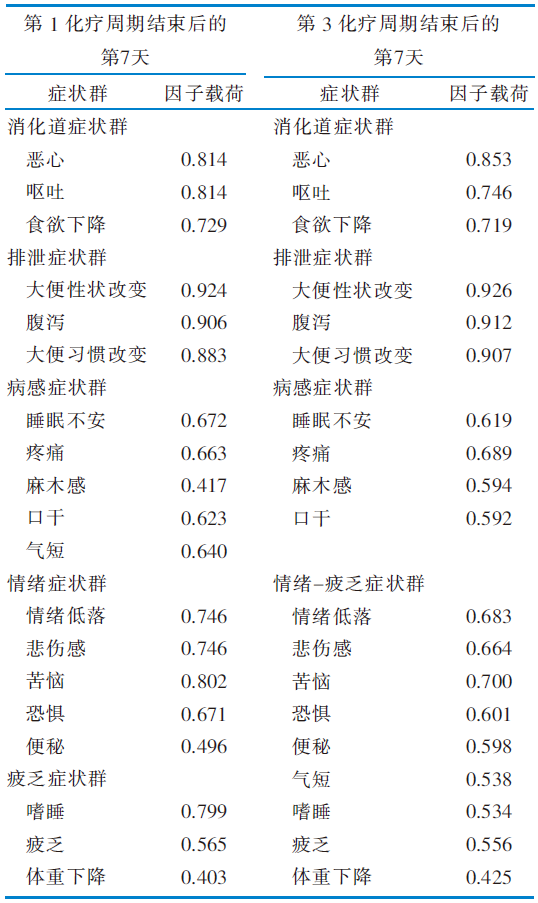 |
Table 3 The results of factor analysis at different stages for postoperative chemotherapy patients with colorectal cancer(n=264)
| |
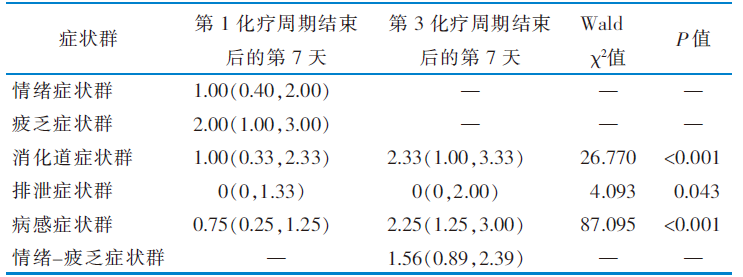 |
Table 4 The severity of symptoms clusters for postoperative chemotherapy patients with colorectal cancer at different stages[n=264,score,M(P25,P75)]
| |
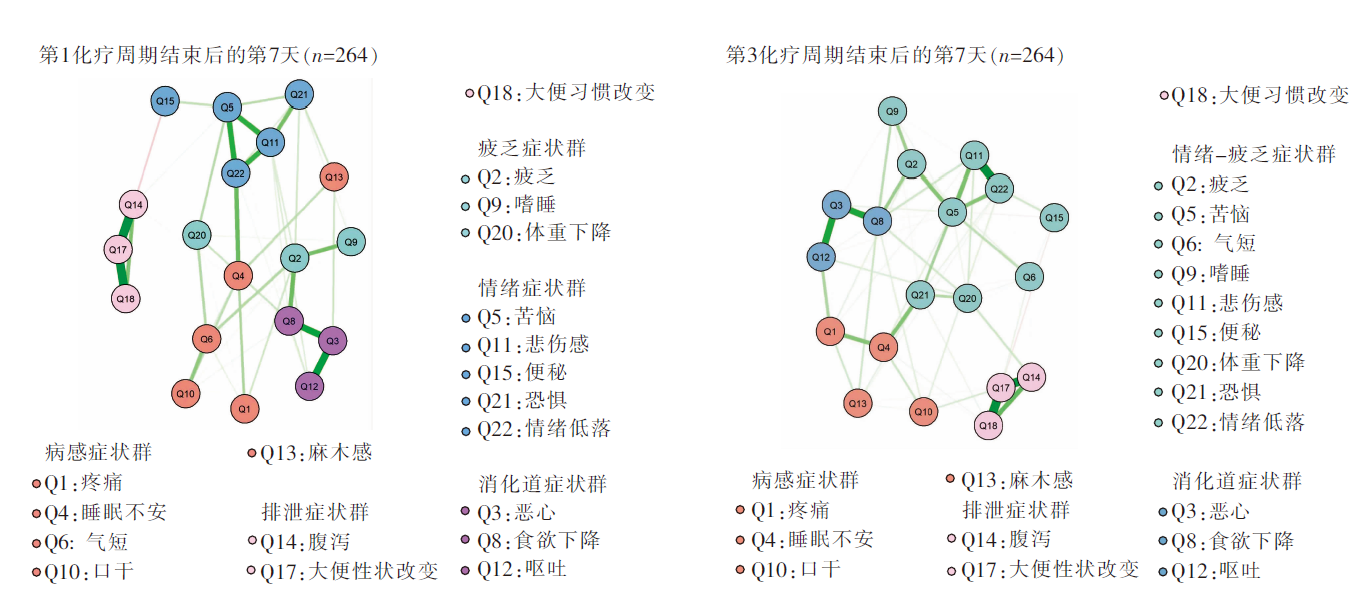
Figure 1 Symptom network diagrams of postoperative chemotherapy patients with colorectal cancer at different stages
| [1] | Bray F, Laversanne M, Sung H, et al. Global cancer statistics 2022:GLOBOCAN estimates of incidence and mortality worldwide for 36 cancers in 185 countries[J]. CA Cancer J Clin, 2024, 74(3):229-263. |
| [2] | Wang K, Diao M, Yang ZX, et al. Identification of core symptom cluster in patients with digestive cancer:a network analysis[J]. Cancer Nurs, 2025, 48(1):E55-E63. |
| [3] | 冯芳茗, 张伟英, 何佳倩, 等. 消化道癌症患者化疗期间症状群及影响因素分析[J]. 解放军护理杂志, 2020, 37(9):13-17. |
| Feng FM, Zhang WY, He JQ, et al. Symptom clusters and influencing factors for patients with gastrointestinal cancer during chemotherapy[J]. Nurs J Chin PLA, 2020, 37(9):13-17. | |
| [4] |
叶艳欣, 秦岚, 骆佳慧, 等. 肺癌患者化疗相关症状群的发生现状及影响因素分析[J]. 中华护理杂志, 2023, 58(18):2230-2238.
DOI |
|
Ye YX, Qin L, Luo JH, et al. Study on status and influencing factors of chemotherapy related symptom cluster among lung cancer patients[J]. Chin J Nurs, 2023, 58(18):2230-2238.
DOI |
|
| [5] | 胡月. 胃癌术后化疗患者症状群与生活质量的纵向研究[D]. 南京: 南京中医药大学, 2018. |
| Hu Y. Longitudinal study on symptom groups and quality of life of patients with postoperative chemotherapy for gastric cancer[D]. Nanjing: Nanjing University of Chinese Medicine, 2018. | |
| [6] | Li X, Zou YL, Zhang ZY, et al. Chemotherapy-related symptom networks in distinct subgroups of Chinese patients with gastric cancer[J]. Asia Pac J Oncol Nurs, 2023, 11(3):100366. |
| [7] | Teng LP, Zhou Z, Yang YT, et al. Identifying central symptom clusters and correlates in patients with lung cancer post-chemotherapy:a network analysis[J]. Asia Pac J Oncol Nurs, 2024, 11(4):100383. |
| [8] | 国家卫生健康委员会医政司,中华医学会肿瘤学分会. 国家卫健委中国结直肠癌诊疗规范(2023版)[J]. 中国实用外科杂志, 2023, 43(6):602-630. |
| Hospital Authority of National Health Commission of the Peo-ple’s Republic of China;Chinese Society of Oncology. Chinese Medical Association Chinese protocol of diagnosis and treatment of colorectal ancer of the National Health Commission(2023 edition)[J]. Chin J Pract Surg, 2023, 43(6):602-630. | |
| [9] |
Epskamp S, Borsboom D, Fried EI. Estimating psychological networks and their accuracy:a tutorial paper[J]. Behav Res Methods, 2018, 50(1):195-212.
DOI PMID |
| [10] | Wang XS, Wang Y, Guo H, et al. Chinese version of the M. D. Anderson Symptom Inventory:validation and application of symptom measurement in cancer patients[J]. Cancer, 2004, 101(8):1890-1901. |
| [11] | 顾铭. 安德森症状评估量表大肠癌模块的编制及应用研究[D]. 上海: 上海中医药大学, 2019. |
| Gu M. Development and application of Anderson Symptom Assessment Scale for colorectal cancer module[D]. Shanghai: Shanghai University of Traditional Chinese Medicine, 2019. | |
| [12] |
Kim E, Jahan T, Aouizerat BE, et al. Changes in symptom clusters in patients undergoing radiation therapy[J]. Support Care Cancer, 2009, 17(11):1383-1391.
DOI PMID |
| [13] | 苏晓雨, 王青青, 刘风侠. 肿瘤患者症状群生物学机制的研究进展[J]. 癌症进展, 2022, 20(6):555-558,572. |
| Su XY, Wang QQ, Liu FX. Research progress on biological mechanism of symptom group in tumor patients[J]. Oncol Prog, 2022, 20(6):555-558,572. | |
| [14] |
褚彦香, 王颖, 熊欢. 分级管理方案在乳腺癌患者化疗所致恶心呕吐中的应用[J]. 中华护理杂志, 2019, 54(12):1815-1819.
DOI |
| Chu YX, Wang Y, Xiong H. Clinical practice of grading management scheme for chemotherapy induced nausea and vomiting in breastcancer patients[J]. Chin J Nurs, 2019, 54(12):1815-1819. | |
| [15] |
刘美子, 安然, 吴子童, 等. 头颈部肿瘤患者核心症状及症状群的网络分析与护理对策[J]. 中华护理杂志, 2024, 59(7):828-834.
DOI |
|
Liu MZ, An R, Wu ZT, et al. A network analysis and nursing implications of core symptoms and symptom clusters in head and neck cancer patients[J]. Chin J Nurs, 2024, 59(7):828-834.
DOI |
|
| [16] | Wei ZH, Ren L, Wang XM, et al. Network of depression and anxiety symptoms in patients with epilepsy[J]. Epilepsy Res, 2021, 175:106696. |
| [17] |
邹炎铃, 李易, 张紫嫣, 等. 基于体质特征的胃癌化疗患者核心症状及影响因素研究[J]. 中华护理杂志, 2024, 59(18):2238-2243.
DOI |
| Zou YL, Li Y, Zhang ZY, et al. Examining core symptoms and influencing factors of patients with gastric cancer undergoing chemotherapy:the role of Traditional Chinese Medicine constitutional traits[J]. Chin J Nurs, 2024, 59(18):2238-2243. | |
| [18] | Rha SY, Park M, Lee J. Stability of symptom clusters and sentinel symptoms during the first two cycles of adjuvant chemo-therapy[J]. Support Care Cancer, 2019, 27(5):1687-1695. |
| [1] | HUANG Panpan, LI Liling, HU Xiaojing. Research progress of early exercise rehabilitation in infants with congenital heart disease [J]. Chinese Journal of Nursing, 2025, 60(9): 1050-1055. |
| [2] | CHEN Liou, ZHANG Wenting, LIU Junqi, WANG Yuncong, WANG Zhenlin, QI Sai, YANG Na. Study on the effect of pulmonary lobes surface projection localization combined with pulmonary segment drainage and sputum expectoration technique on airway clearance in patients with aspiration pneumonia [J]. Chinese Journal of Nursing, 2025, 60(9): 1056-1061. |
| [3] | YANG Nana, CHENG Chuanli, ZENG Hui, FU Dandan, WANG Yan, CHEN Yue, RAN Hongmin, FAN Hongjing, LONG Xia. Evaluation of the effect of graded exercise rehabilitation on patients with acute exacerbation of chronic obstructive pulmonary disease [J]. Chinese Journal of Nursing, 2025, 60(9): 1062-1067. |
| [4] | CAO Yun, SUN Guozhen, CHEN Feng, JI Xueli, YAN Mengwan, JING Lei, QIAN Kun. A study of modified ankle pump exercise in stroke patients [J]. Chinese Journal of Nursing, 2025, 60(9): 1068-1074. |
| [5] | XIE Min, QI Wenkai, YIN Ling, ZHANG Xuan, ZHAO Ruqin. Potential profile analysis and influencing factors of kinesiophobia in patients with peritoneal dialysis [J]. Chinese Journal of Nursing, 2025, 60(9): 1080-1086. |
| [6] | CHEN Bingqian, ZHAO Bin, SUN Jiarong, HAO Sifang, HOU Xiaoli. Oral health management dilemmas of chronic periodontitis patients with implant dentures:a qualitative study [J]. Chinese Journal of Nursing, 2025, 60(9): 1087-1092. |
| [7] | QIN Chunlan, WU Zhenyun, QIAN Hongying, ZHAO Qian, SUN Jinting. Experiences of disease self-control among patients with chronic obstructive pulmonary disease:a qualitative study [J]. Chinese Journal of Nursing, 2025, 60(9): 1093-1098. |
| [8] | LI Ziwei, FENG Lijuan, CHEN Xusheng, HUANG Yi, YANG Jie. Development and application of a Fear of Movement Assessment Scale for patients with peripherally inserted central catheters [J]. Chinese Journal of Nursing, 2025, 60(9): 1099-1106. |
| [9] | CHENG Zhiqiang, ZHANG Baozhen, TANG Liping, LI Jing, XIA Jiaoyun, WEI Xueyan, GONG Zhixian, ZHANG Meizhen, LI Lusi. Reliability and validity test of the Chinese version of the Urinary Incontinence Awareness and Attitude Scale [J]. Chinese Journal of Nursing, 2025, 60(9): 1107-1112. |
| [10] | SHI Meiqin, WU Jianfang, ZHANG Duo, WU Chunping, CHEN Ling, TAO Lei. Nursing care for postoperative laryngeal function rehabilitation in a patient undergoing primary voice prosthesis implantation after total laryngectomy [J]. Chinese Journal of Nursing, 2025, 60(9): 1120-1123. |
| [11] | GU Qian, HUANG Xi, SHI Weixiong, WU Jing, TAN Ruoming, WANG Feng. Nursing care for a patient with cytokine release syndrome following T-cell immunotherapy [J]. Chinese Journal of Nursing, 2025, 60(9): 1124-1127. |
| [12] | ZHOU Miao, CHEN Xing, PENG Fei, SUN Shangxue, LI Yangyang. Systematic review of risk prediction instruments for central line associated bloodstream infections in ICU patients [J]. Chinese Journal of Nursing, 2025, 60(9): 1132-1139. |
| [13] | PENG Yingjie, LIU Aihong, ZHU Wenli, MEI Yuxin, ZHOU Meng, GUAN Wenjing. Systematic review of readiness assessment tools for advance care planning in older adults [J]. Chinese Journal of Nursing, 2025, 60(9): 1146-1153. |
| [14] | RAN Lingxiao, WANG Dongmin, XU Ke, WANG Cong, CAO Hua, CUN Wei, JIANG Yan. Application of biomechanical simulation based on three-dimensional human body model in preventing pressure ulcers:a scoping review [J]. Chinese Journal of Nursing, 2025, 60(8): 1012-1018. |
| [15] | JIN Yujia, JIANG Hu, WANG Xiaoxuan, YI Jingna, MEI Yongxia, GUO Zhiting, ZHANG Zhenxiang, LIN Beilei. Application of information-based risk communication in primary prevention of cardiovascular diseases:a scoping review [J]. Chinese Journal of Nursing, 2025, 60(8): 1019-1025. |
| Viewed | ||||||
|
Full text |
|
|||||
|
Abstract |
|
|||||
