

Chinese Journal of Nursing ›› 2026, Vol. 61 ›› Issue (11): 1445-1452.DOI: 10.3761/j.issn.0254-1769.2026.11.001
• Special Planning-Cognitive Health Promotion for the Middle-Aged and Elderly • Next Articles
ZENG Shunfeng1( ), HAN Yao2, DU Qingqing2, YUAN Pingqiao1()
Received:2026-01-19
Online:2026-06-10
Published:2026-06-10
* Corresponding author:
YUAN Pingqiao,E-mail:1845800108@qq.comFunding program:
曾顺凤1(), 韩瑶2, 杜青青2, 袁平乔1()
通讯作者:
袁平乔,E-mail:1845800108@qq.com作者简介:曾顺凤:女,本科(硕士在读),护士,E-mail:2083179561@qq.com曾顺凤:研究设计、研究实施、论文撰写;韩瑶、杜青青:数据收集与整理、统计学分析;袁平乔:研究指导、论文审阅与修改、基金支持
基金资助:ZENG Shunfeng, HAN Yao, DU Qingqing, YUAN Pingqiao. Application research of digital eye-tracking technology in cognitive function assessment for middle-aged and elderly individuals[J]. Chinese Journal of Nursing, 2026, 61(11): 1445-1452.
曾顺凤, 韩瑶, 杜青青, 袁平乔. 眼动追踪技术在中老年人认知功能评估中的应用研究[J]. 中华护理杂志, 2026, 61(11): 1445-1452.
Add to citation manager EndNote|Ris|BibTeX
URL: https://zh.zhhlzzs.com/EN/10.3761/j.issn.0254-1769.2026.11.001
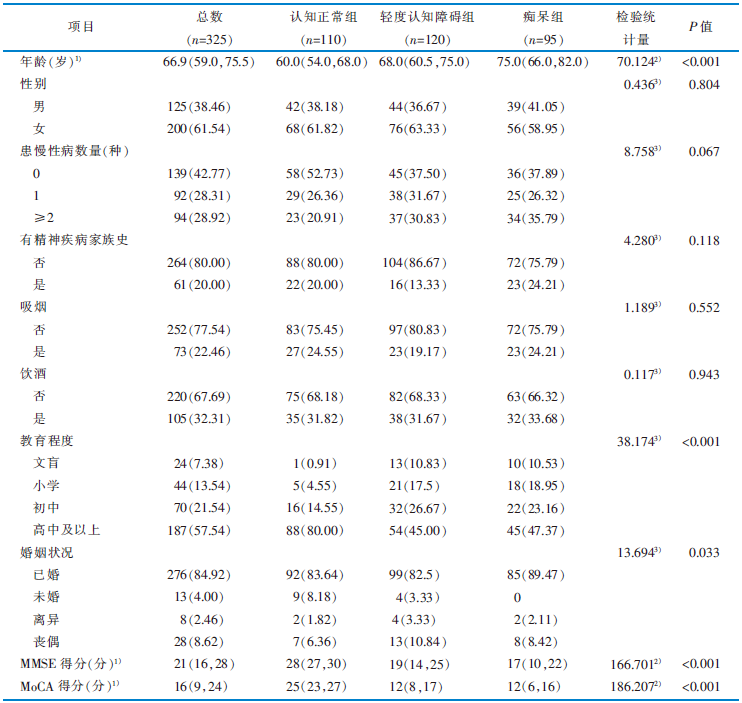 |
Table 1 Comparison of demographic characteristics and neuropsychological assessment results among study participants
| |
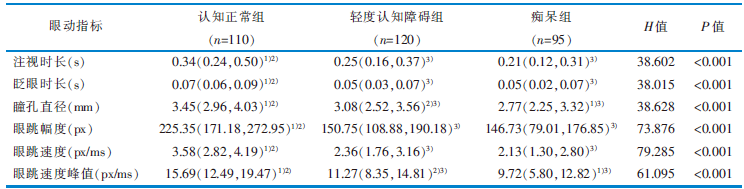 |
Table 2 Analysis of differences in eye movement metrics among 3 groups of subjects[M(P25,P75)]
| |
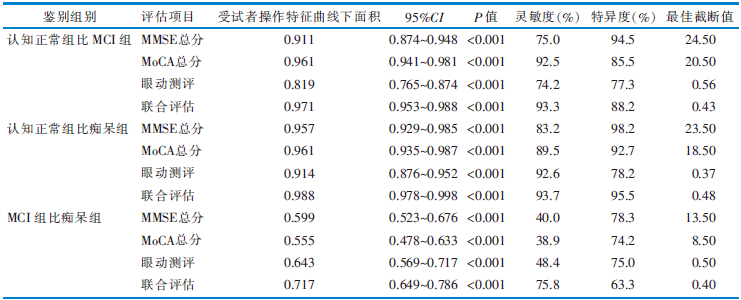 |
Table 3 Evaluation of the diagnostic validity of neuropsychological assessments and eye-tracking visual pairing comparison tasks for classifying research subjects
| |
| [1] | Feng L, Ye KX, Feng QS, et al. Trends in cognitive impairment among older adults in China from 2002 to 2022:evaluating the impact of the COVID-19 pandemic[J]. J Prev Alzheimers Dis, 2026, 13(1):100370. |
| [2] | Bai W, Chen P, Cai H, et al. Worldwide prevalence of mild cognitive impairment among community dwellers aged 50 years and older:a meta-analysis and systematic review of epidemiology studies[J]. Age Ageing, 2022, 51(8):afac173. |
| [3] | Malek-Ahmadi M. Reversion from mild cognitive impairment to normal cognition:a meta-analysis[J]. Alzheimer Dis Assoc Disord, 2016, 30(4):324-330. |
| [4] | Yu HH, Tan L, Jiao MJ, et al. Dissecting the clinical and pathological prognosis of MCI patients who reverted to normal cognition:a longitudinal study[J]. BMC Med, 2025, 23(1):260. |
| [5] | 杨华露, 刘春艳, 王盼, 等. 中国认知功能社区筛查及管理指南(2025版)[J]. 中华老年医学杂志, 2025, 44(11):1472-1490. |
| Yang HL, Liu CY, Wang P, et al. Chinese guidelines for community cognitive function screening and management(2025 edition)[J]. Chin J Geriatr, 2025, 44(11):1472-1490. | |
| [6] | 张纤, 马秋平, 曹汝汝, 等. 社区老年人主观认知下降危险因素的Meta分析[J]. 中华护理杂志, 2023, 58(3):342-348. |
| Zhang Q, Ma QP, Cao RR, et al. Risk factors of subjective cognitive decline of the elder adults in communities:a Meta-analysis[J]. Chin J Nurs, 2023, 58(3):342-348. | |
| [7] | Krishnamurthy HK, Jayaraman V, Krishna K, et al. An overview of the genes and biomarkers in Alzheimer’s disease[J]. Ageing Res Rev, 2025,104:102599. |
| [8] | Carotenuto A, Traini E, Fasanaro AM, et al. Tele-neuropsychological assessment of Alzheimer’s disease[J]. J Pers Med, 2021, 11(8):688. |
| [9] | Folstein MF, Folstein SE, McHugh PR. “Mini-mental state”. A practical method for grading the cognitive state of patients for the clinician[J]. J Psychiatr Res, 1975, 12(3):189-198. |
| [10] | Nasreddine ZS, Phillips NA, Bédirian V, et al. The Montreal Cognitive Assessment,MoCA:a brief screening tool for mild cognitive impairment[J]. J Am Geriatr Soc, 2005, 53(4):695-699. |
| [11] | Aiello EN, Pasotti F, Appollonio I, et al. Equating Mini-Mental State Examination(MMSE) and Montreal Cognitive Assessment(MoCA) scores:conversion norms from a healthy Italian population sample[J]. Aging Clin Exp Res, 2022, 34(7):1721-1724. |
| [12] | Iaccarino L, La Joie R, Koeppe R, et al. rPOP:robust PET-only processing of community acquired heterogeneous amyloid-PET data[J]. Neuroimage, 2022,246:118775. |
| [13] | Nie J, Qiu Q, Phillips M, et al. Early diagnosis of mild cognitive impairment based on eye movement parameters in an aging Chinese population[J]. Front Aging Neurosci, 2020,12:221. |
| [14] | Tokushige SI, Matsumoto H, Matsuda SI, et al. Early detection of cognitive decline in Alzheimer’s disease using eye tracking[J]. Front Aging Neurosci 2023,15:1123456. |
| [15] | 杜阳洒, 黄凯玲, 肖波. 眼动追踪技术在神经系统疾病患者认知功能评估中的应用和研究进展[J]. 中华神经医学杂志, 2023, 22(7):729-734. |
| Du YS, Huang KL, Xiao B. Eye tracking technology in cognitive assessment of neurological disorders[J]. Chin J Neuromed, 2023, 22(7):729-734. | |
| [16] | Boujelbane MA., Trabelsi K, Salem A, et al. Eye tracking during visual paired-comparison tasks:a systematic review and meta-analysis of the diagnostic test accuracy for detecting cognitive decline[J]. J Alzheimers Dis, 2024, 99(1):207-221. |
| [17] | 胡慧秀, 孙超, 赵雅洁, 等. 我国9个省份老年人身体及认知功能状况的调查研究[J]. 中华护理杂志, 2023, 58(1):68-73. |
| Hu HX, Sun C, Zhao YJ, et al. Investigation and character analysis of function of 12141 older people in 9 provinces[J]. Chin J Nurs, 2023, 58(1):68-73. | |
| [18] | Haque RU, Manzanares CM, Brown LN, et al. VisMET:a passive,efficient,and sensitive assessment of visuospatial memory in healthy aging,mild cognitive impairment,and Alzheimer’s disease[J]. Learn Mem, 2019, 26(3):93-100. |
| [19] | 中国科学报. 5300万老年期痴呆患者如何管?这位专家给出了答案[EB/OL]. (2025-03-29)[2026-01-06]. https://news.sciencenet.cn/htmlnews/2025/3/541276.shtm. |
| Chinese Science News. How to manage 53 million dementia patients? An expert provides the answer[EB/OL]. (2025-03-29)[2026-01-06]. https://news.sciencenet.cn/htmlnews/2025/3/541276.shtm. | |
| [20] | 中国痴呆与认知障碍指南写作组,中国医师协会神经内科医师分会认知障碍疾病专业委员会. 2018中国痴呆与认知障碍诊治指南(一):痴呆及其分类诊断标准[J]. 中华医学杂志, 2018,98(13):965-970. |
| Writing Group of the Guidelines for the Diagnosis and Treatment of Dementia and Cognitive Impairment in China,Professional Committee of Cognitive Disorders of the Neurology Branch of the Chinese Medical Doctor Association. Guidelines for the diagnosis and treatment of dementia and cognitive impairment in China in 2018(1):dementia and its classification and diagnostic criteria[J]. Natl Med J China, 2018, 98(13):965-970. | |
| [21] | Petersen RC, Doody R, Kurz A, et al. Current concepts in mild cognitive impairment[J]. Arch Neurol, 2001, 58(12):1985-1992. |
| [22] | 王征宇, 张明园. 中文版简易智能状态检查(MMSE)的应用[J]. 上海精神医学, 1989, 7(3):108-111. |
| Wang ZY, Zhang MY. Application of the Chinese version of the Mini-Mental State Examination(MMSE)[J]. Shanghai Arch Psychiatry, 1989, 7(3):108-111. | |
| [23] | 张立秀, 刘雪琴. 蒙特利尔认知评估量表中文版的信效度研究[J]. 护理研究, 2007, 21(31):2906-2907. |
| Zhang LX, Liu XQ. A study on reliability and validity of MOCA scale of Chinese version[J]. Chin Nurs Res, 2007, 21(31):2906-2907. | |
| [24] | Kucewicz MT, Dolezal J, Kremen V, et al. Pupil size reflects successful encoding and recall of memory in humans[J]. Sci Rep, 2018,8:4949. |
| [25] | Jang H, Soroski T, Rizzo M, et al. Classification of Alzheimer’s disease leveraging multi-task machine learning analysis of speech and eye-movement data[J]. Front Hum Neurosci, 2021,15:716670. |
| [26] | Yamada Y, Shinkawa K, Kobayashi M, et al. Combining multimodal behavioral data of gait,speech,and drawing for classification of Alzheimer’s disease and mild cognitive impairment[J]. J Alzheimers Dis, 2021, 84(1):315-327. |
| [27] | 陈金雨. 基于眼动追踪和数字画钟测验的轻度认知障碍智能筛查模型的研究[D]. 太原: 山西医科大学, 2024. |
| Chen JY. An intelligent screener of mild cognitive impairment via integrated eye-tracking and digital clock drawing test[D]. Taiyuan: Shanxi Medical University, 2024. | |
| [28] | Mengoudi K, Ravi D, Yong KXX, et al. Augmenting dementia cognitive assessment with instruction-less eye-tracking tests[J]. IEEE J Biomed Health Inform, 2020, 24(11):3066-3075. |
| [29] | Wilcockson TDW, Mardanbegi D, Xia BQ, et al. Abnormalities of saccadic eye movements in dementia due to Alzheimer’s disease and mild cognitive impairment[J]. Aging, 2019, 11(15):5389-5398. |
| [30] | 朱艾荣, 蔡诗凝, 管婷玉, 等. 眼动追踪技术在护理领域中的应用进展[J]. 中华护理杂志, 2025, 60(20):2549-2552. |
| Zhu AR, Cai SN, Guan TY, et al. Application progress of eye-tracking technology in the nursing field[J]. Chin J Nurs, 2025, 60(20):2549-2552. |
| [1] | Intravenous Infusion Therapy Committee of Chinese Nursing Association, Beijing Nursing Association, (Writing Committee:LI Jia, LI Xuying, QIN Huiying, CHEN Lifen, WU Zhenming, HU Zeyin, LUO Mengna, FAN Yuying, WU Jiahui, LIN Yuping, WANG Lei, SUN Wenyan, FENG Bilong, GAO Wei, LI Yanan, HOU Luoya, LI Chunyan, ). Expert consensus on nursing care of central venous access device removal [J]. Chinese Journal of Nursing, 2026, 61(9): 1157-1162. |
| [2] | HUANG Ping, LI Li, GUO Lili, XU Ying, YE Yun, JIANG Shufang. Construction and preliminary application of a risk assessment tool for central line associated bloodstream infections with needle-free connectors [J]. Chinese Journal of Nursing, 2026, 61(9): 1171-1179. |
| [3] | HE Juan, ZHAO Leilei, YE Guanjun, YU Yanfen, FU Xiaojun, ZHOU Qin. Nursing care of a patient with peripherally inserted central catheterization via the upper limb after bilateral innominate vein and superior vena cava artificial vascular replacement [J]. Chinese Journal of Nursing, 2026, 61(9): 1187-1191. |
| [4] | ZHENG Yulin, LIU Jinning, ZHANG Jing, GUO Huimin, GU Yanmei, ZHANG Lili. Analysis of relapse to alcohol drinking and its influencing factors in patients with alcoholic liver disease after liver transplantation [J]. Chinese Journal of Nursing, 2026, 61(9): 1208-1214. |
| [5] | YE Junshuang, SHEN Lijia, MENG Xialiang, ZHANG Yujiao, CAI Genlian, SHAO Biyun, ZHOU Yahui, ZHANG Liuqian, YING Jinping. A qualitative study on the cognition and experience of oral frailty in maintenance hemodialysis patients [J]. Chinese Journal of Nursing, 2026, 61(9): 1215-1220. |
| [6] | YANG Mingxia, AN Ran, ZANG Jinfeng, LI Chunmei. Correlation analysis between elderly-to-elder care capacity and self-neglect among older adults with chronic comorbidities and their caregivers [J]. Chinese Journal of Nursing, 2026, 61(9): 1230-1236. |
| [7] | XIA Yunfang, WANG Hong, CUI Dai, FU Zhenzhen, ZHU Min. Nursing care of an adolescent patient with Graves’ disease complicated by drug-induced hypersensitivity syndrome [J]. Chinese Journal of Nursing, 2026, 61(9): 1253-1256. |
| [8] | LI Yan, XU Cuiping. Application progress of chatbots in alleviating social isolation among the elderly and nursing implications [J]. Chinese Journal of Nursing, 2026, 61(9): 1291-1296. |
| [9] | YU Yunlong, LI Shuang, LUO Yao, ZHANG Suile, PENG Yueming. A study on the correlation between symptom burden and illness perception in patients with acute exacerbation of chronic obstructive pulmonary disease [J]. Chinese Journal of Nursing, 2026, 61(8): 1036-1042. |
| [10] | ZHANG Ying, DU Ruofei, YANG Huimin, DU Yating. Analysis of latent classes and influencing factors of frailty in patients with non-Hodgkin’s lymphoma during chemotherapy [J]. Chinese Journal of Nursing, 2026, 61(8): 1051-1058. |
| [11] | LI Shan, SHAO Mengqi, QIU Chen, SU Qingqing, GAO Yuan. Current status and influencing factors of postoperative complications in 4,907 elderly patients with hip fractures [J]. Chinese Journal of Nursing, 2026, 61(8): 1059-1065. |
| [12] | XIE Haiyan, CAO Miao, YAN Rui, LIU Sidi, XUE Rongna, XIE Dan. A mixed-method study of factors influencing quality of life in patients with Behçet’s Disease [J]. Chinese Journal of Nursing, 2026, 61(8): 1066-1073. |
| [13] | DU Qian, HU Hengyu, LI Zhen, CAO Jingwen, LIU Xingge, LIU Linli. A study of the effect of occupational therapy combined with vocational rehabilitation on the return to work of postoperative colorectal cancer patients [J]. Chinese Journal of Nursing, 2026, 61(8): 1080-1087. |
| [14] | XU Guoping, HU Huanting, LI Li, JIN Jingfen, JIANG Jiajiang, REN Ying. A qualitative study on the medical decision-making process of patients with periprosthetic joint infection of the knee [J]. Chinese Journal of Nursing, 2026, 61(8): 1101-1106. |
| [15] | CHEN Jianfen, ZHU Huidi, DONG Kimberly. Nursing care of a patient with complex intestinal fistula following radical gastrectomy for gastric cancer [J]. Chinese Journal of Nursing, 2026, 61(8): 1112-1116. |
| Viewed | ||||||
|
Full text |
|
|||||
|
Abstract |
|
|||||
