

Chinese Journal of Nursing ›› 2025, Vol. 60 ›› Issue (12): 1468-1473.DOI: 10.3761/j.issn.0254-1769.2025.12.009
• Specialist Nursing Practice and Research • Previous Articles Next Articles
XU Yaozheng( ), LUO Jinkai(), MAO Wenping, YI Zuling, GUO Jinyu
Received:2025-01-22
Online:2025-06-20
Published:2025-06-17
徐耀峥(), 骆金铠(), 毛文平, 易祖玲, 郭金玉
通讯作者:
骆金铠,E-mail:jinkai1023@163.com
作者简介:徐耀峥:男,硕士,护士,E-mail:xuyaozheng@163.com
基金资助:XU Yaozheng, LUO Jinkai, MAO Wenping, YI Zuling, GUO Jinyu. A qualitative study on elderly inpatients' experiences with intelligent nursing services[J]. Chinese Journal of Nursing, 2025, 60(12): 1468-1473.
徐耀峥, 骆金铠, 毛文平, 易祖玲, 郭金玉. 老年住院患者对智慧护理服务体验的质性研究[J]. 中华护理杂志, 2025, 60(12): 1468-1473.
Add to citation manager EndNote|Ris|BibTeX
URL: https://zh.zhhlzzs.com/EN/10.3761/j.issn.0254-1769.2025.12.009
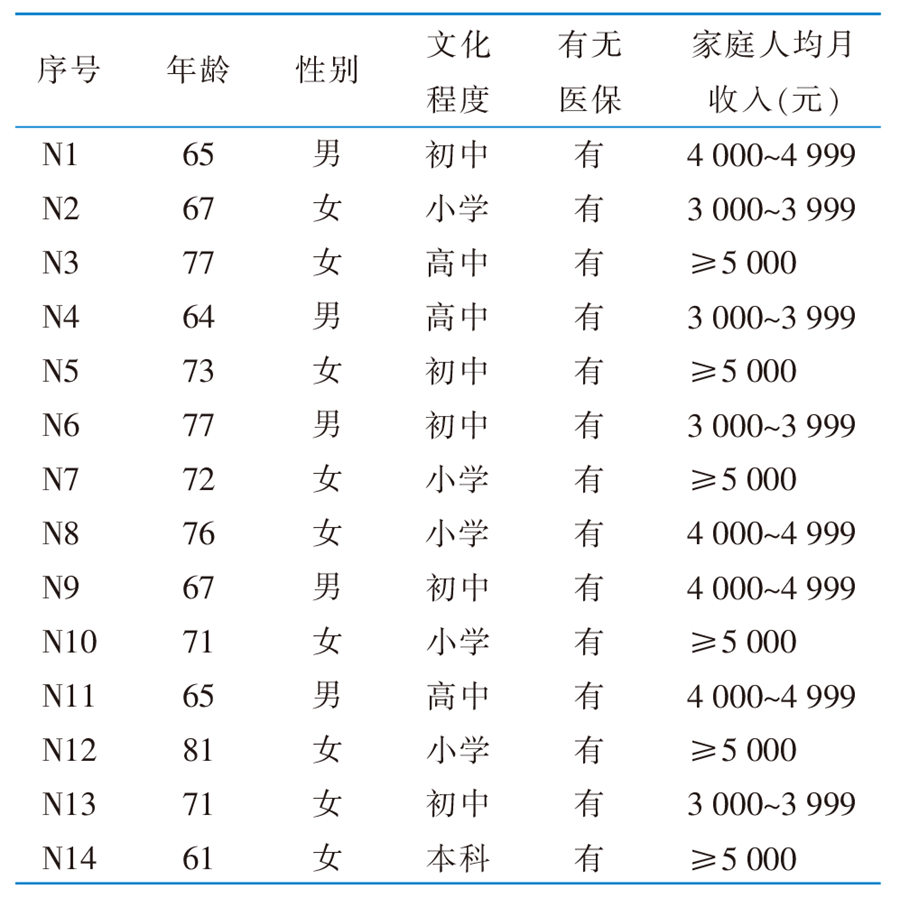 |
Table 1 General information about respondents(n=14)
| |
| [1] | 国家统计局. 王萍萍:人口总量降幅缩窄,人口素质持续提升[EB/OL].(2025-01-17)[2025-02-16]. https://www.stats.gov.cn/sj/sjjd/202501/t20250117_1958337.html. |
| National Bureau of Statistics. Wang Pingping: the decline in total population has narrowed,and the quality of the population continues to improve[EB/OL]. (2025-01-17)[2025-02-16]. https://www.stats.gov.cn/sj/sjjd/202501/t20250117_1958337.html. | |
| [2] | 吴钰, 陈霞, 张叶, 等. 国内外智慧护理研究热点及发展趋势的可视化分析[J]. 军事护理, 2024, 41(5):85-89. |
| Wu Y, Chen X, Zhang Y, et al. Research hotspots and trends of smart nursing in China and abroad:a visualized analysis[J]. Mil Nurs, 2024, 41(5):85-89. | |
| [3] |
陈沁, 张军, 杨冰香, 等. 国内外智慧护理服务模式的研究进展[J]. 护理学报, 2024, 31(17):17-21.
DOI |
| Chen Q, Zhang J, Yang BX, et al. Research progress on smart nursing service models at home and abroad[J]. J Nurs(China), 2024, 31(17):17-21. | |
| [4] |
张奕, 陈香萍, 高卿卿, 等. 护理信息系统有效性评价及相关理论模型的研究进展[J]. 中华护理杂志, 2021, 56(11):1736-1740.
DOI URL |
|
Zhang Y, Chen XP, Gao QQ, et al. Research progress of effectiveness evaluation of nursing information system and related theoretical models[J]. Chin J Nurs, 2021, 56(11):1736-1740.
DOI URL |
|
| [5] | Koebe P, Bohnet-Joschko S. The impact of digital transformation on inpatient care:mixed methods study[J]. JMIR Public Health Surveill, 2023,9:e40622. |
| [6] | 王红云, 高维杰, 胡燕. 智慧养老护理背景下我国老年人新媒介素养现状及启示[J]. 护理学杂志, 2018, 33(8):97-100. |
| Wang HY, Gao WJ, Hu Y. A review of older adults' literacy in new media in the context of smart elderly care in China[J]. J Nurs Sci, 2018, 33(8):97-100. | |
| [7] | 蒲可心, 张红, 宋洁, 等. 智慧护理在老年护理中应用的研究进展[J]. 护理研究, 2023, 37(21):3899-3902. |
| Pu KX, Zhang H, Song J, et al. Research progress on application of intelligent nursing in geriatric nursing[J]. Chin Nurs Res, 2023, 37(21):3899-3902. | |
| [8] | 孙超, 弓少华, 胡慧秀. 护理信息化在老年患者健康管理中的应用进展[J]. 中国护理管理, 2022, 22(10):1446-1452. |
| Sun C, Gong SH, Hu HX. Research progress of nursing informatization in the health management for elderly patients[J]. Chin Nurs Manag, 2022, 22(10):1446-1452. | |
| [9] | Neubauer BE, Witkop CT, Varpio L. How phenomenology can help us learn from the experiences of others[J]. Perspect Med Educ, 2019, 8(2):90-97. |
| [10] | Braun V, Clarke V. Using thematic analysis in psychology[J]. Qual Res Psychol, 2006, 3(2):77-101. |
| [11] | Neves BB, Petersen A, Vered M, et al. Artificial intelligence in long-term care:technological promise,aging anxieties,and sociotechnical ageism[J]. J Appl Gerontol, 2023, 42(6):1274-1282. |
| [12] | Holden RJ, Karsh BT. The technology acceptance model:its past and its future in health care[J]. J Biomed Inform, 2010, 43(1):159-172. |
| [13] | Zhu JT, Weng HT, Ou P, et al. Use and acceptance of smart elderly care apps among Chinese medical staff and older individuals:web-based hybrid survey study[J]. JMIR Form Res, 2023,7:e41919. |
| [14] | Ryu B, Kim S, Lee KH, et al. Inpatient satisfaction and usage patterns of personalized smart bedside station system for patient-centered service at a tertiary university hospital[J]. Int J Med Inform, 2016,95:35-42. |
| [15] | Elavsky S, Knapova L, Janiš K, et al. Multiple perspectives on the adoption of SMART technologies for improving care of older people:mixed methods study[J]. J Med Internet Res, 2024, 26:e45492. |
| [16] | Lou SY, Liu H. Awareness,use,and need of smart care for older adults:a comparative study based on a survey in Macao,China[J]. Front Public Health, 2023,11:1135164. |
| [17] | 潘爱红, 于卫华, 吴玉艳, 等. 智慧护理策略在老年病区的应用与效果评价[J]. 中国护理管理, 2020, 20(11):1621-1624. |
| Pan AH, Yu WH, Wu YY, et al. Effects of intellectual technology-based nursing strategy in geriatric ward[J]. Chin Nurs Manag, 2020, 20(11):1621-1624. | |
| [18] | Jian WS, Wang JY, Rahmanti AR, et al. Voice-based control system for smart hospital wards:a pilot study of patient acceptance[J]. BMC Health Serv Res, 2022, 22(1):287. |
| [19] | Anghel I, Cioara T, Moldovan D, et al. Smart environments and social robots for age-friendly integrated care services[J]. Int J Environ Res Public Health, 2020, 17(11):3801. |
| [20] |
郭永真, 彭若彤, 李晓阳, 等. 移动医疗准备度的概念分析及启示[J]. 中华护理杂志, 2024, 59(23):2940-2945.
DOI URL |
| Guo YZ, Peng RT, Li XY, et al. Concept analysis and enligh-tenment of mobile health readiness[J]. Chin J Nurs, 2024, 59(23):2940-2945. | |
| [21] | Shaban-Nejad A, Michalowski M, Buckeridge DL. Health inte-lligence:how artificial intelligence transforms population and personalized health[J]. NPJ Digit Med, 2018,1:53. |
| [22] |
孙雪, 王丽娜, 沈鑫华, 等. 信息化评估与监测技术在老年认知障碍人群筛查中的应用进展[J]. 中华护理杂志, 2021, 56(5):699-704.
DOI URL |
|
Sun X, Wang LN, Shen XH, et al. Progress in the application of information-based assessment and monitoring technology in the screening of old adults with cognitive impairment[J]. Chin J Nurs, 2021, 56(5):699-704.
DOI URL |
|
| [23] |
Galambos C, Rantz M, Craver A, et al. Living with intelligent sensors:older adult and family member perceptions[J]. Comput Inform Nurs, 2019, 37(12):615-627.
DOI PMID |
| [24] |
Coahran M, Hillier LM, Van Bussel L, et al. Automated fall detection technology in inpatient geriatric psychiatry:nurses' perceptions and lessons learned[J]. Can J Aging, 2018, 37(3):245-260.
DOI PMID |
| [1] | CHEN Bingqian, ZHAO Bin, SUN Jiarong, HAO Sifang, HOU Xiaoli. Oral health management dilemmas of chronic periodontitis patients with implant dentures:a qualitative study [J]. Chinese Journal of Nursing, 2025, 60(9): 1087-1092. |
| [2] | QIN Chunlan, WU Zhenyun, QIAN Hongying, ZHAO Qian, SUN Jinting. Experiences of disease self-control among patients with chronic obstructive pulmonary disease:a qualitative study [J]. Chinese Journal of Nursing, 2025, 60(9): 1093-1098. |
| [3] | TANG Ruijin, HAN Jing, LI Xiaoxu, WANG Dan. A qualitative study on family fusion experience of breast cancer patients and inspiration for nursing care [J]. Chinese Journal of Nursing, 2025, 60(8): 940-946. |
| [4] | ZHANG Ziyi, DU Bing, ZHANG Jinzhi, YIN Min. The psychological help-seeking experience of adolescents with mood disorders:a qualitative study [J]. Chinese Journal of Nursing, 2025, 60(8): 947-952. |
| [5] | WU Liping, XIAO Lina, LAI Hanqing, HUANG Qian, GUO Xuan, ZHOU Xun. Qualitative study on the experience of fall alertness in elderly patients with rheumatoid arthritis [J]. Chinese Journal of Nursing, 2025, 60(7): 836-841. |
| [6] | ZHANG Zhongning, SHEN Aomei, QI Weifang, LI Xin, ZHENG Ruishuang, QIANG Wanmin, WANG Jing. The experience of exercise adherence in breast cancer patients with endocrine-therapy based on the theory of stage change:a qualitative study [J]. Chinese Journal of Nursing, 2025, 60(6): 696-702. |
| [7] | HAN Minghua, ZHAO Qian, LUO Mingyue, HE Yapeng, ZHANG Ruihan, XUE Xiaoxiao, WU Hongxia. Experience of social isolation in patients with chronic obstructive pulmonary disease:a qualitative study [J]. Chinese Journal of Nursing, 2025, 60(5): 532-538. |
| [8] | WANG Wenjing, HAO Wumei, TAI Jingyu, DONG Qian, GUO Aimin. Experience of inhalation therapy in patients with chronic obstructive pulmonary disease:a Meta-synthesis [J]. Chinese Journal of Nursing, 2025, 60(5): 545-551. |
| [9] | CHEN Qianhe, CHEN Jun, JIANG Kaiyao, WU Xiaonan, HONG Wanting, ZHANG Chunmei. Qualitative study on the facilitating and obstacle factors of the pediatric medical fear intervention by pediatric nurses [J]. Chinese Journal of Nursing, 2025, 60(5): 575-580. |
| [10] | LIU Tingting, NIU Qiaohong, JIAO Xueping, WEI Jiawei, DUAN Shaoming, HU Congli, SU Rui. Meta-synthesis of qualitative studies on the experience of bowel symptoms in patients undergoing sphincter-preserving surgery for rectal cancer [J]. Chinese Journal of Nursing, 2025, 60(5): 603-610. |
| [11] | YANG Yang, LIU Mei, XIONG Mo, FENG Lijuan, YANG Chunzi. A qualitative study on the dual coping experience of nursing dependence among middle-aged and young patients with enterostomy and their primary caregivers [J]. Chinese Journal of Nursing, 2025, 60(4): 389-395. |
| [12] | DUAN Yu, GUO Zhanghui, ZHANG Jie, JIAO Meng, QU Jianni, LIU Guiying, ZHAO Dan, CHEN Yingyu, GUO Hong. Facilitators and barriers to the implementation of exercise for elderly patients with frailty:a qualitative Meta-synthesis [J]. Chinese Journal of Nursing, 2025, 60(3): 288-296. |
| [13] | TAN Wenxuan, ZHANG Rong, ZHANG Lili, WANG Wei, SHAO Yanhong, FANG Qinghong, ZHU Jin. Longitudinal qualitative study of supportive care needs on heart transplant patients [J]. Chinese Journal of Nursing, 2025, 60(2): 142-148. |
| [14] | ZHAI Zhongchang, YANG Linjie, WANG Huihua, ZENG Zhu, HU Yuting, WANG Jing, YANG Sai. Experiences of home-based rehabilitation of individuals with fully magnetically levitated left ventricular assist device:a qualitative study [J]. Chinese Journal of Nursing, 2025, 60(2): 149-153. |
| [15] | XIAO Runxi, ZHOU Yingfeng. Facilitators and barriers of physical activity participation among women with gestational diabetes mellitus during pregnancy:a qualitative study [J]. Chinese Journal of Nursing, 2025, 60(14): 1683-1689. |
| Viewed | ||||||
|
Full text |
|
|||||
|
Abstract |
|
|||||
