

Chinese Journal of Nursing ›› 2025, Vol. 60 ›› Issue (19): 2313-2320.DOI: 10.3761/j.issn.0254-1769.2025.19.002
• Special Planning——Hemodialysis Nursing Care • Previous Articles Next Articles
JIANG Haiqiang, GONG Juan, WU Shuang, PENG Jia, WU Chuanfang( )
)
Received:2025-03-11
Online:2025-10-10
Published:2025-09-26
Contact:
WU Chuanfang
江海强, 龚娟, 吴双, 彭佳, 吴传芳()
通讯作者:
吴传芳
作者简介:江海强:男,本科(硕士在读),主管护师,E-mail:304359080@qq.com
基金资助:JIANG Haiqiang, GONG Juan, WU Shuang, PENG Jia, WU Chuanfang. Development and validation of a risk prediction model for non-cuffed catheter dysfunction in hemodialysis patients[J]. Chinese Journal of Nursing, 2025, 60(19): 2313-2320.
江海强, 龚娟, 吴双, 彭佳, 吴传芳. 血液透析患者无涤纶套透析导管功能不良风险预测模型的构建与验证研究[J]. 中华护理杂志, 2025, 60(19): 2313-2320.
Add to citation manager EndNote|Ris|BibTeX
URL: https://zh.zhhlzzs.com/EN/10.3761/j.issn.0254-1769.2025.19.002
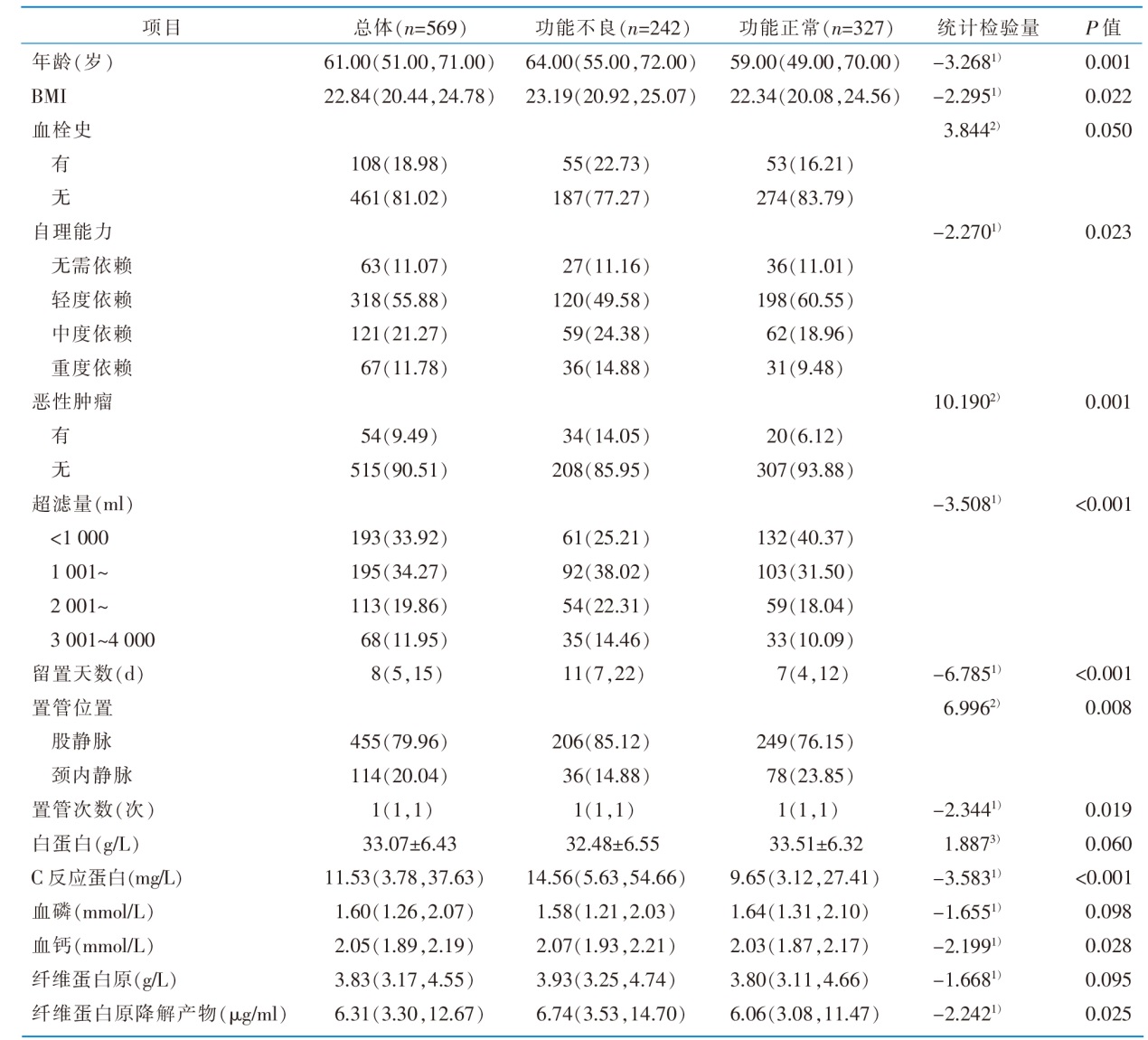 |
Table 1 Univariate analysis of general characteristics and non-cuffed catheter dysfunction in patients in the modeling group(n=569)
| |
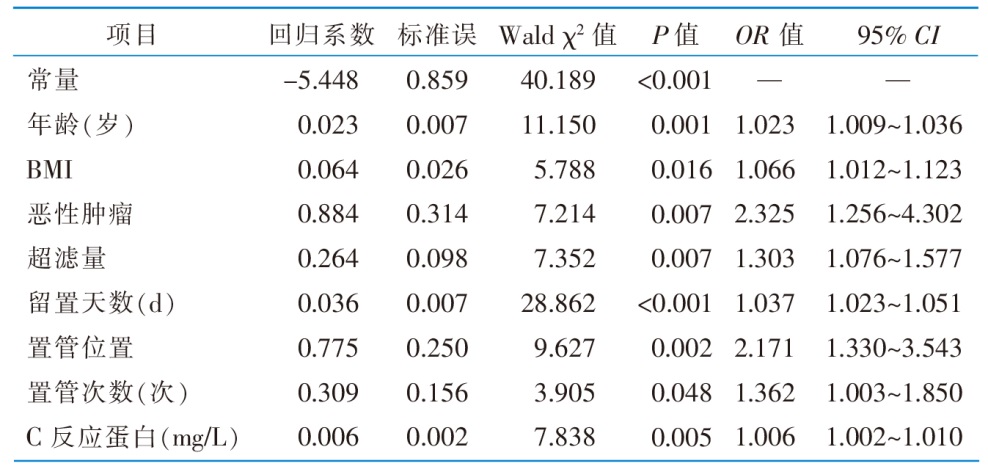 |
Table 2 Multivariate Logistic regression analysis of factors associated with non-cuffed catheter dysfunction(n=569)
| |
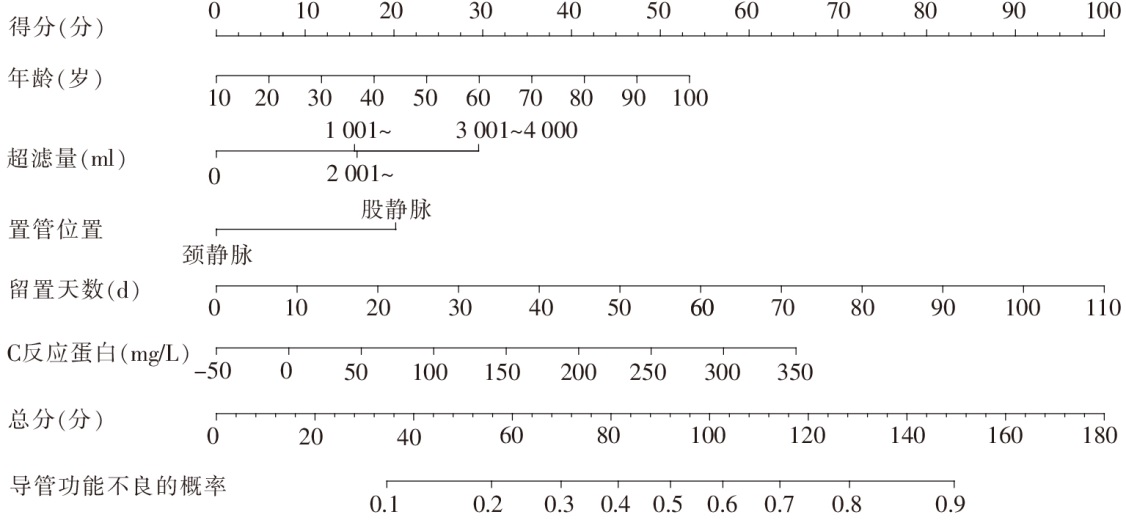
Figure 1 Nomogram for predicting the risk of catheter dysfunction in hemodialysis patients
| [1] |
董永泽, 许秀君, 沈华娟, 等. 维持性血液透析患者动静脉血管通路穿刺管理的最佳证据总结[J]. 中华护理杂志, 2023, 58(9):1135-1141.
DOI |
|
Dong YZ, Xu XJ, Shen HJ, et al. Summary of the best evidence for the management of arteriovenous access cannulation in maintenance hemodialysis patients[J]. Chin J Nurs, 2023, 58(9):1135-1141.
DOI |
|
| [2] |
中华医学会肾脏病学分会专家组. 透析通路中国指南(2024年版)[J]. 中华肾脏病杂志, 2024, 40(12):990-1070.
DOI |
|
Expert Group of the Nephrology Branch of the Chinese Medical Association. Guidelines for dialysis access in China (2024)[J]. Chin J Nephrol, 2024, 40(12):990-1070.
DOI |
|
| [3] | Harduin LO, Barroso TA, Guerra JB, et al. Guidelines on vascular access for hemodialysis from the brazilian society of angiology and vascular surgery[J]. J Vasc Bras, 2023,22. |
| [4] | 王颖, 胡蓉蓉, 刘利芬, 等. 血液透析患者首次透析血管通路应用情况及手术负担的调查[J]. 中国血液净化, 2025, 24(2):162-165,171. |
| Wang Y, Hu RR, Liu LF, et al. Survey of initial dialysis vascular access types and procedural burden in hemodialysis patients[J]. Chin J Blood Purif, 2025, 24(2):162-165,171. | |
| [5] | 徐丽华, 余姝, 吴其顺, 等. 终末期肾病患者首次血液透析血管通路情况的分析[J]. 中国血液净化, 2022, 21(11):840-843. |
| Xu LH, Yu S, Wu QS, et al. Vascular access at the initiation of hemodialysis in end stage renal disease patients[J]. Chin J Blood Purif, 2022, 21(11):840-843. | |
| [6] | 王凯. 河南省14个血液净化中心865例尿毒症患者血液透析导管并发症的流行病学调查[D]. 郑州: 郑州大学, 2016. |
| Wang K. Epidemiology of hemodialysis catheter complications:a survey of 865 dialysis patients from 14 haemodialysis centers in Henan province[D]. Zhengzhou: Zhengzhou University, 2016. | |
| [7] | 魏璐霞, 李育玲, 张光, 等. 血液透析患者中心静脉导管功能不良预防及处理的最佳证据总结[J]. 中华现代护理杂志, 2024, 30(2):215-221. |
| Wei LX, Li YL, Zhang G. et al. Summary of the best evidence in prevention and management of center venous catheter dysfunction in hemodialysis patients[J]. Chin J Mod Nurs, 2024, 30(2):215-221. | |
| [8] | 魏璐霞, 李育玲, 孟效红, 等. 血液透析患者中心静脉导管功能不良风险预测模型的构建及验证[J]. 中华现代护理杂志, 2024, 30(19):2578-2585. |
| Wei LX, Li YL, Meng XH, et al. Construction and validation of a risk prediction model for central venous catheter dysfunction in hemodialysis patients[J]. Chin J Mod Nurs, 2024, 30(19):2578-2585. | |
| [9] | 高永祥, 张晋昕. Logistic回归分析的样本量确定[J]. 循证医学, 2018, 18(2):122-124. |
| Gao YX, Zhang JX. Derermination of sample in logistic regression analysis[J]. J Evid Based Med, 2018, 18(2):122-124. | |
| [10] |
潘小容, 张世群, 郭小利, 等. 造血干细胞移植患儿口腔黏膜炎风险预测模型的构建及验证[J]. 中华护理杂志, 2023, 58(5):587-595.
DOI |
|
Pan XR, Zhang SQ, Guo XL, et al. Establishment and validation of a risk prediction model for oral mucositis in children undergoing hematopoietic stem cell transplantation[J]. Chin J Nurs, 2023, 58(5):587-595.
DOI |
|
| [11] | Lim L, Park JY, Lee H, et al. Risk factors of hemodialysis catheter dysfunction in patients undergoing continuous renal replacement therapy:a retrospective study[J]. BMC Nephrol, 2023, 24(1):334. |
| [12] |
Rozenberg I, Benchetrit S, Zitman-Gal T, et al. Prevalence and predictors of tunneled dialysis catheter dysfunction[J]. Isr Med Assoc J, 2024, 26(8):508-513.
PMID |
| [13] | Wang L, Wei F, Jiang A, et al. Longer duration of catheter patency,but similar infection rates with internal jugular vein versus iliac vein tunneled cuffed hemodialysis catheters:a single-center retrospective analysis[J]. Int Urol Nephrol, 2015, 47(10):1727-1734. |
| [14] | 孟玲. 老年糖尿病患者认知衰弱影响因素分析及风险预测模型构建研究[D]. 贵州: 遵义医科大学, 2023. |
| Meng L. Research on the influencing factors of cognitive frailty and the construction of risk prediction model in elderly diabetic patients[D]. Guizhou: Zunyi Medical University, 2023. | |
| [15] | 金其庄, 王玉柱, 叶朝阳, 等. 中国血液透析用血管通路专家共识(第2版)[J]. 中国血液净化, 2019, 18(6):365-381. |
| Jin QZ, Wang YZ, Ye CY, et al. Expert consensus of vascular access for hemodialysis in China(2nd edition)[J]. Chin J Blood Purif, 2019, 18(6):365-381. | |
| [16] | Lok CE, Huber TS, Lee T, et al. KDOQI clinical practice guideline for vascular access:2019 update[J]. Am J Kidney Dis 2020, 75(4):S1-S164. |
| [17] | 国家卫生健康委办公厅. 血管导管相关感染预防与控制指南(2021版)[J]. 中国感染控制杂志, 2021, 20(4):387-388. |
| National Health Commission. Guidelines for the prevention and control of vessel catheter associated infection(2021 edition)[J]. Chin J Infect Control, 2021, 20(4):387-388. | |
| [18] | 蔡一伟, 吴尔律, 王冶, 等. 基于三种特征筛选法的乳腺癌复发转移预测模型构建[J]. 中国数字医学, 2025, 20(3):36-43. |
| Cai YW, Wu EL, Wang Y, et al. Construction of prediction model for breast cancer recurrence and metastasis based on the three-feature screening method[J]. Chin Digit Med, 2025, 20(3):36-43. | |
| [19] |
Brzosko S, Hryszko T, Malyszko J, et al. Femoral localization and higher ultrafiltration rate but not concentration of heparin used for canal locking of hemodialysis catheter are negative predictors for its malfunction[J]. Am J Nephrol, 2008, 28(2):298-303.
PMID |
| [20] |
吕桂兰, 曹虎男, 王浩, 等. 维持性血液透析中低血压风险预测的Meta建模及验证[J]. 中华护理杂志, 2024, 59(21):2611-2619.
DOI |
|
Lü GL, Cao HN, Wang H, et al. Meta-modeling and validation of a risk prediction model for intradialytic hypotension in maintenance hemodialysis patients[J]. Chin J Nurs, 2024, 59(21):2611-2619.
DOI |
|
| [21] | 中心静脉导管冲管及封管共识专家组. 中心静脉导管冲管及封管专家共识[J]. 中华急诊医学杂志, 2022, 31(4):442-447. |
| Consensus Expert Group on Central Venous Catheter Flushing and Sealing. Expert consensus on central venous catheter flushing and sealing[J]. Chin J Emerg Med, 2022, 31(4):442-447. | |
| [22] | 钱慕周, 陈澄, 范丽花, 等. 两种股静脉过渡期血管通路在维持性血液透析中的应用效果比较[J]. 国际泌尿系统杂志, 2025, 45(1):134-137. |
| Qian MZ, Chen D, Fan LH, et al. The effects of two kinds of femoral vein vascular access in transitional period maintenance hemodialysis patients[J]. Int J Urol Nephrol, 2025, 45(1):134-137. |
| [1] | HUANG Panpan, LI Liling, HU Xiaojing. Research progress of early exercise rehabilitation in infants with congenital heart disease [J]. Chinese Journal of Nursing, 2025, 60(9): 1050-1055. |
| [2] | CHEN Liou, ZHANG Wenting, LIU Junqi, WANG Yuncong, WANG Zhenlin, QI Sai, YANG Na. Study on the effect of pulmonary lobes surface projection localization combined with pulmonary segment drainage and sputum expectoration technique on airway clearance in patients with aspiration pneumonia [J]. Chinese Journal of Nursing, 2025, 60(9): 1056-1061. |
| [3] | YANG Nana, CHENG Chuanli, ZENG Hui, FU Dandan, WANG Yan, CHEN Yue, RAN Hongmin, FAN Hongjing, LONG Xia. Evaluation of the effect of graded exercise rehabilitation on patients with acute exacerbation of chronic obstructive pulmonary disease [J]. Chinese Journal of Nursing, 2025, 60(9): 1062-1067. |
| [4] | CAO Yun, SUN Guozhen, CHEN Feng, JI Xueli, YAN Mengwan, JING Lei, QIAN Kun. A study of modified ankle pump exercise in stroke patients [J]. Chinese Journal of Nursing, 2025, 60(9): 1068-1074. |
| [5] | XIE Min, QI Wenkai, YIN Ling, ZHANG Xuan, ZHAO Ruqin. Potential profile analysis and influencing factors of kinesiophobia in patients with peritoneal dialysis [J]. Chinese Journal of Nursing, 2025, 60(9): 1080-1086. |
| [6] | CHEN Bingqian, ZHAO Bin, SUN Jiarong, HAO Sifang, HOU Xiaoli. Oral health management dilemmas of chronic periodontitis patients with implant dentures:a qualitative study [J]. Chinese Journal of Nursing, 2025, 60(9): 1087-1092. |
| [7] | QIN Chunlan, WU Zhenyun, QIAN Hongying, ZHAO Qian, SUN Jinting. Experiences of disease self-control among patients with chronic obstructive pulmonary disease:a qualitative study [J]. Chinese Journal of Nursing, 2025, 60(9): 1093-1098. |
| [8] | LI Ziwei, FENG Lijuan, CHEN Xusheng, HUANG Yi, YANG Jie. Development and application of a Fear of Movement Assessment Scale for patients with peripherally inserted central catheters [J]. Chinese Journal of Nursing, 2025, 60(9): 1099-1106. |
| [9] | CHENG Zhiqiang, ZHANG Baozhen, TANG Liping, LI Jing, XIA Jiaoyun, WEI Xueyan, GONG Zhixian, ZHANG Meizhen, LI Lusi. Reliability and validity test of the Chinese version of the Urinary Incontinence Awareness and Attitude Scale [J]. Chinese Journal of Nursing, 2025, 60(9): 1107-1112. |
| [10] | SHI Meiqin, WU Jianfang, ZHANG Duo, WU Chunping, CHEN Ling, TAO Lei. Nursing care for postoperative laryngeal function rehabilitation in a patient undergoing primary voice prosthesis implantation after total laryngectomy [J]. Chinese Journal of Nursing, 2025, 60(9): 1120-1123. |
| [11] | GU Qian, HUANG Xi, SHI Weixiong, WU Jing, TAN Ruoming, WANG Feng. Nursing care for a patient with cytokine release syndrome following T-cell immunotherapy [J]. Chinese Journal of Nursing, 2025, 60(9): 1124-1127. |
| [12] | ZHOU Miao, CHEN Xing, PENG Fei, SUN Shangxue, LI Yangyang. Systematic review of risk prediction instruments for central line associated bloodstream infections in ICU patients [J]. Chinese Journal of Nursing, 2025, 60(9): 1132-1139. |
| [13] | LIU Xiaoyi, WANG Hong, ZHOU Zhicong, SUN Xu, WANG Yiru, TONG Ziwei, LIU Xiaoying. Rehabilitation effects based on immersive virtual reality as a treatment for peripheral vestibular dysfunction:a Meta-analysis [J]. Chinese Journal of Nursing, 2025, 60(9): 1140-1145. |
| [14] | PENG Yingjie, LIU Aihong, ZHU Wenli, MEI Yuxin, ZHOU Meng, GUAN Wenjing. Systematic review of readiness assessment tools for advance care planning in older adults [J]. Chinese Journal of Nursing, 2025, 60(9): 1146-1153. |
| [15] | RAN Lingxiao, WANG Dongmin, XU Ke, WANG Cong, CAO Hua, CUN Wei, JIANG Yan. Application of biomechanical simulation based on three-dimensional human body model in preventing pressure ulcers:a scoping review [J]. Chinese Journal of Nursing, 2025, 60(8): 1012-1018. |
| Viewed | ||||||
|
Full text |
|
|||||
|
Abstract |
|
|||||
