

Chinese Journal of Nursing ›› 2025, Vol. 60 ›› Issue (17): 2095-2101.DOI: 10.3761/j.issn.0254-1769.2025.17.008
• Specialist Nursing Practice and Research • Previous Articles Next Articles
MAO Meiqi( ), LIU Yao, HAO Yang, ZHAO Yaning(), QIN Yanmei, HAN Ying
Received:2025-02-26
Online:2025-09-10
Published:2025-08-29
Contact:
ZHAO Yaning
毛美琦(), 刘瑶, 郝杨, 赵雅宁(), 秦艳梅, 韩影
通讯作者:
赵雅宁
作者简介:毛美琦:女,硕士,护师,E-mail:935228887@qq.com
基金资助:MAO Meiqi, LIU Yao, HAO Yang, ZHAO Yaning, QIN Yanmei, HAN Ying. Development and verification of a risk prediction model for social dysfunction in middle-aged and elderly patients with ischemic stroke[J]. Chinese Journal of Nursing, 2025, 60(17): 2095-2101.
毛美琦, 刘瑶, 郝杨, 赵雅宁, 秦艳梅, 韩影. 中老年缺血性脑卒中患者社会功能障碍风险预测模型的构建及验证[J]. 中华护理杂志, 2025, 60(17): 2095-2101.
Add to citation manager EndNote|Ris|BibTeX
URL: https://zh.zhhlzzs.com/EN/10.3761/j.issn.0254-1769.2025.17.008
 |
Table 1 General information of respondents and univarite analysis results of social dysfunction[case(percentage,%)]
| |
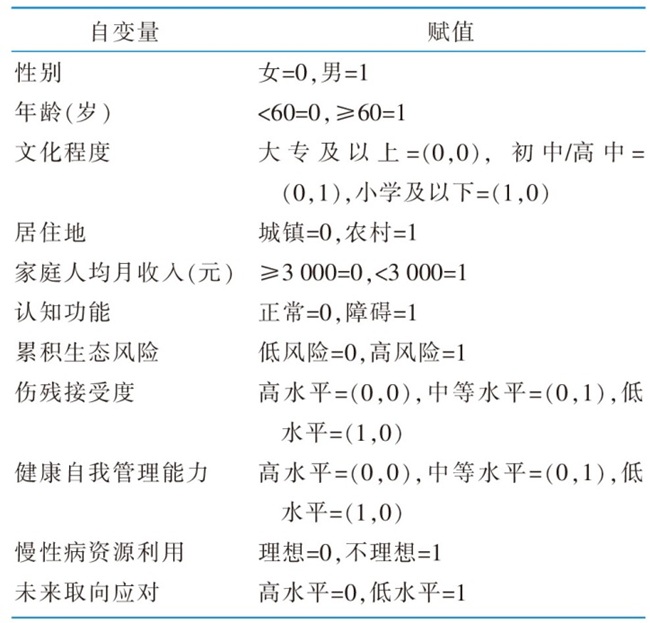 |
Table 2 The assignment of the independent variables
| |
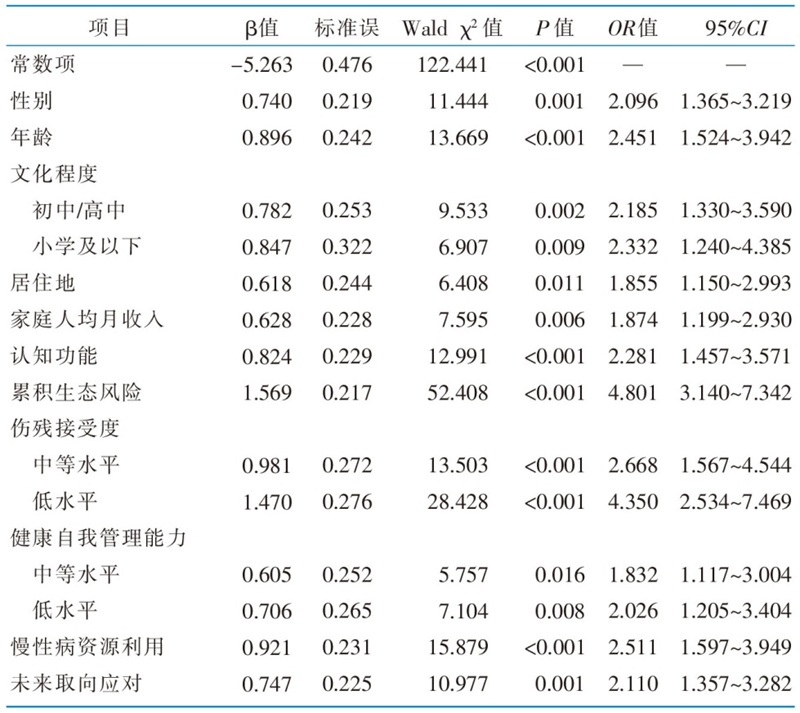 |
Table 3 Multivariate analysis of social dysfunction in middle-aged and elderly patients with ischemic stroke(n=632)
| |
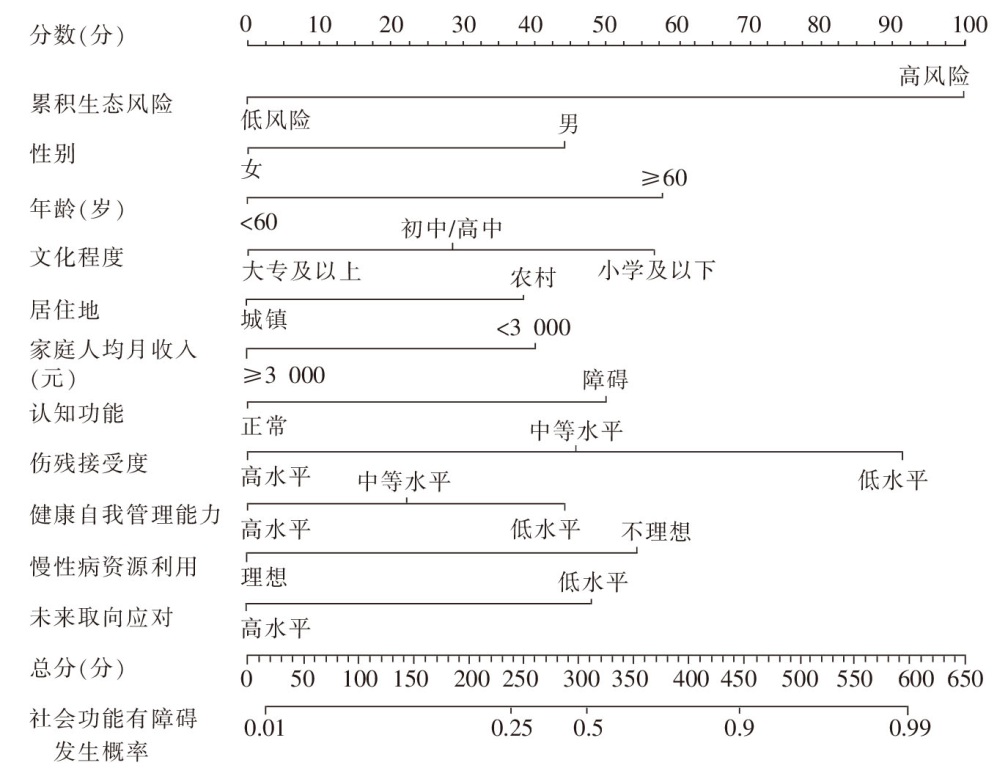
Figure 1 Nomogram of risk prediction model of social dysfunction in middle-aged and elderly patients with ischemic stroke
| [1] | Li XY, Kong XM, Yang CH, et al. Global,regional,and national burden of ischemic stroke,1990-2021:an analysis of data from the global burden of disease study 2021[J]. EClinical Medicine, 2024, 75:102758. |
| [2] |
汪燃, 黄菲. 中老年肺癌患者胸部放疗期间症状群的调查及护理对策[J]. 中华护理杂志, 2023, 58(13):1596-1602.
DOI |
|
Wang R, Huang F. Longitudinal study on symptom groups of middle-aged and elderly lung cancer patients during chest radiotherapy[J]. Chin J Nurs, 2023, 58(13):1596-1602.
DOI |
|
| [3] | 王青尔, 孙慧敏, 周婷婷, 等. 腹膜透析患者社会功能及影响因素研究[J]. 中华护理杂志, 2016, 51(6):707-711. |
| Wang QE, Sun HM, Zhou TT, et al. Social function and its influencing factors of peritoneal dialysis patients[J]. Chin J Nurs, 2016, 51(6):707-711. | |
| [4] | Shrivastav SR, Ciol MA, Lee DB. Perceived community participation and associated factors in people with stroke[J]. Arch Rehabil Res Clin Transl, 2022, 4(3):100210. |
| [5] | Ozkan H, Ambler G, Esmail T, et al. Prevalence,trajectory,and factors associated with patient-reported nonmotor outcomes after stroke:a systematic review and meta-analysis[J]. JAMA Netw Open, 2025, 8(2):e2457447. |
| [6] | 江佳隆, 李贤. 老年脑卒中患者情绪和社会功能障碍现况及其影响因素的调查研究[J]. 解放军护理杂志, 2020, 37(12):47-50. |
| Jiang JL, Li X. Status quo and influencing factors of emotional and social dysfunctions in elderly stroke patients[J]. Nurs J Chin PLA, 2020, 37(12):47-50. | |
| [7] | 中华医学会神经病学分会, 中华医学会神经病学分会脑血管病学组. 中国各类主要脑血管病诊断要点2019[J]. 中华神经科杂志, 2019, 52(9):710-715. |
| Neurology Branch of Chinese Medical Association, Cerebrova-scular Disease Group of Neurology Branch of Chinese Medical Association. Diagnostic criteria of cerebrovascular diseases in China(version 2019)[J]. Chin J Neurol, 2019, 52(9):710-715. | |
| [8] | Zhao JT, Zeng ZL, Yu JP, et al. Effect of main family caregiver’s anxiety and depression on mortality of patients with moderate-severe stroke[J]. Sci Rep, 2021, 11(1):2747. |
| [9] | Bedirhan Ustün T, Chatterji S, Kostanjsek N, et al. Developing the World Health Organization disability assessment schedule 2.0[J]. Bull World Health Organ, 2010, 88(11):815-823. |
| [10] | Hou WK, Lam WWT, Law CC, et al. Measuring social relational quality in colorectal cancer:the Social Relational Quality Scale(SRQS)[J]. Psychooncology, 2009, 18(10):1097-1105. |
| [11] | 邓宇含, 吕芯芮, 刘爽, 等. 北京市朝阳区老年人对社区卫生服务中心医养结合养老服务的需要现状及相关因素[J]. 医学与社会, 2022, 35(5):39-44. |
| Deng YH, Lü XR, Liu S, et al. Status quo and related factors of need of elderly care service of integration of medical treatment and care provided by community healthcare centers among older adults in Chaoyang district of Beijing[J]. Med Soc, 2022, 35(5):39-44. | |
| [12] |
Walker SN, Sechrist KR, Pender NJ. The health-promoting life-style profile:development and psychometric characteristics[J]. Nurs Res, 1987, 36(2):76-81.
PMID |
| [13] | Procidano ME, Heller K. Measures of perceived social support from friends and from family:three validation studies[J]. Am J Community Psychol, 1983, 11(1):1-24. |
| [14] | Fi M, Dw B. Functional evaluation:the Barthel Index[J]. Md State Med J, 1965:14,61-65. |
| [15] |
Zung WW. A rating instrument for anxiety disorders[J]. Psychosomatics, 1971, 12(6):371-379.
DOI PMID |
| [16] |
Folstein MF, Folstein SE, McHugh PR. “Mini-mental state”. A practical method for grading the cognitive state of patients for the clinician[J]. J Psychiatr Res, 1975, 12(3):189-198.
DOI PMID |
| [17] | 王慧云, 郭安娜. 简易精神状态检查量表的汉化及在脑外伤病人中的信效度研究[J]. 护理研究, 2020, 34(24):4488-4490. |
| Wang HY, Guo AN. Chinese localization of Abbreviated Mental State Examination Scale and its reliability and validity in patients with brain trauma[J]. Chin Nurs Res, 2020, 34(24):4488-4490. | |
| [18] | Linkowski DC. A scale to measure acceptance of disability[J]. Rehabil Couns Bull, 1971, 14(4):236-244. |
| [19] | 陈妮, 程云, 孙晓春, 等. 臂丛神经损伤患者伤残接受度与创伤后应激反应的相关性研究[J]. 中华护理杂志, 2009, 44(8):677-680. |
| Chen N, Cheng Y, Sun XC, et al. Relationship between acceptance of disability and posttraumatic stress response in patients with brachial plexus injury[J]. Chin J Nurs, 2009, 44(8):677-680. | |
| [20] | 赵秋利, 黄菲菲. 成年人健康自我管理能力测评量表的编制及信度和效度检验[J]. 中华现代护理杂志, 2011, 17(8):869-872. |
| Zhao QL, Huang FF. Development and the reliability and validity test of the Rating Scale of Health Self-Management for Adults[J]. Chin J Mod Nurs, 2011, 17(8):869-872. | |
| [21] | Glasgow RE, Toobert DJ, Barrera M Jr, et al. The chronic illness resources survey:cross-validation and sensitivity to intervention[J]. Health Educ Res, 2005, 20(4):402-409. |
| [22] | 钟慧琴. 社区糖尿病患者慢性病资源利用、自我效能及自我管理行为研究[D]. 石河子: 石河子大学, 2015. |
| Zhong HQ. Study on chronic disease resource utilization,self-efficacy and self-management behavior of community diabetic patients[D]. Shihezi: Shihezi University, 2015. | |
| [23] | Gan YQ, Yang MS, Zhou Y, et al. The two-factor structure of future-oriented coping and its mediating role in student engagement[J]. Pers Individ Differ, 2007, 43(4):851-863. |
| [24] | 臧学敏, 张亚军, 汪张毅. 脑卒中患者生存质量与伤残接受度、病耻感及自我效能的相关性[J]. 医学信息, 2023, 36(6):128-133. |
| Zang XM, Zhang YJ, Wang ZY. Correlation between quality of life and disability acceptance,stigma and self-efficacy in stroke patients[J]. J Med Inf, 2023, 36(6):128-133. | |
| [25] | Huang YJ, You JC, Wang Q, et al. Trajectory and predictors of post-stroke depression among patients with newly diagnosed stroke:a prospective longitudinal study[J]. J Stroke Cerebrovasc Dis, 2024, 33(12):108092. |
| [26] | Li Y, Xu HQ, Zhang T, et al. Factors associated with social isolation in stroke patients:a systematic review and meta-analysis[J]. J Stroke Cerebrovasc Dis, 2025, 34(2):108201. |
| [1] | HUANG Panpan, LI Liling, HU Xiaojing. Research progress of early exercise rehabilitation in infants with congenital heart disease [J]. Chinese Journal of Nursing, 2025, 60(9): 1050-1055. |
| [2] | CHEN Liou, ZHANG Wenting, LIU Junqi, WANG Yuncong, WANG Zhenlin, QI Sai, YANG Na. Study on the effect of pulmonary lobes surface projection localization combined with pulmonary segment drainage and sputum expectoration technique on airway clearance in patients with aspiration pneumonia [J]. Chinese Journal of Nursing, 2025, 60(9): 1056-1061. |
| [3] | YANG Nana, CHENG Chuanli, ZENG Hui, FU Dandan, WANG Yan, CHEN Yue, RAN Hongmin, FAN Hongjing, LONG Xia. Evaluation of the effect of graded exercise rehabilitation on patients with acute exacerbation of chronic obstructive pulmonary disease [J]. Chinese Journal of Nursing, 2025, 60(9): 1062-1067. |
| [4] | CAO Yun, SUN Guozhen, CHEN Feng, JI Xueli, YAN Mengwan, JING Lei, QIAN Kun. A study of modified ankle pump exercise in stroke patients [J]. Chinese Journal of Nursing, 2025, 60(9): 1068-1074. |
| [5] | XIE Min, QI Wenkai, YIN Ling, ZHANG Xuan, ZHAO Ruqin. Potential profile analysis and influencing factors of kinesiophobia in patients with peritoneal dialysis [J]. Chinese Journal of Nursing, 2025, 60(9): 1080-1086. |
| [6] | CHEN Bingqian, ZHAO Bin, SUN Jiarong, HAO Sifang, HOU Xiaoli. Oral health management dilemmas of chronic periodontitis patients with implant dentures:a qualitative study [J]. Chinese Journal of Nursing, 2025, 60(9): 1087-1092. |
| [7] | QIN Chunlan, WU Zhenyun, QIAN Hongying, ZHAO Qian, SUN Jinting. Experiences of disease self-control among patients with chronic obstructive pulmonary disease:a qualitative study [J]. Chinese Journal of Nursing, 2025, 60(9): 1093-1098. |
| [8] | LI Ziwei, FENG Lijuan, CHEN Xusheng, HUANG Yi, YANG Jie. Development and application of a Fear of Movement Assessment Scale for patients with peripherally inserted central catheters [J]. Chinese Journal of Nursing, 2025, 60(9): 1099-1106. |
| [9] | CHENG Zhiqiang, ZHANG Baozhen, TANG Liping, LI Jing, XIA Jiaoyun, WEI Xueyan, GONG Zhixian, ZHANG Meizhen, LI Lusi. Reliability and validity test of the Chinese version of the Urinary Incontinence Awareness and Attitude Scale [J]. Chinese Journal of Nursing, 2025, 60(9): 1107-1112. |
| [10] | SHI Meiqin, WU Jianfang, ZHANG Duo, WU Chunping, CHEN Ling, TAO Lei. Nursing care for postoperative laryngeal function rehabilitation in a patient undergoing primary voice prosthesis implantation after total laryngectomy [J]. Chinese Journal of Nursing, 2025, 60(9): 1120-1123. |
| [11] | GU Qian, HUANG Xi, SHI Weixiong, WU Jing, TAN Ruoming, WANG Feng. Nursing care for a patient with cytokine release syndrome following T-cell immunotherapy [J]. Chinese Journal of Nursing, 2025, 60(9): 1124-1127. |
| [12] | ZHOU Miao, CHEN Xing, PENG Fei, SUN Shangxue, LI Yangyang. Systematic review of risk prediction instruments for central line associated bloodstream infections in ICU patients [J]. Chinese Journal of Nursing, 2025, 60(9): 1132-1139. |
| [13] | PENG Yingjie, LIU Aihong, ZHU Wenli, MEI Yuxin, ZHOU Meng, GUAN Wenjing. Systematic review of readiness assessment tools for advance care planning in older adults [J]. Chinese Journal of Nursing, 2025, 60(9): 1146-1153. |
| [14] | RAN Lingxiao, WANG Dongmin, XU Ke, WANG Cong, CAO Hua, CUN Wei, JIANG Yan. Application of biomechanical simulation based on three-dimensional human body model in preventing pressure ulcers:a scoping review [J]. Chinese Journal of Nursing, 2025, 60(8): 1012-1018. |
| [15] | JIN Yujia, JIANG Hu, WANG Xiaoxuan, YI Jingna, MEI Yongxia, GUO Zhiting, ZHANG Zhenxiang, LIN Beilei. Application of information-based risk communication in primary prevention of cardiovascular diseases:a scoping review [J]. Chinese Journal of Nursing, 2025, 60(8): 1019-1025. |
| Viewed | ||||||
|
Full text |
|
|||||
|
Abstract |
|
|||||
