

中华护理杂志 ›› 2026, Vol. 61 ›› Issue (8): 1088-1094.DOI: 10.3761/j.issn.0254-1769.2026.08.011
谭远俏1( ), 刘伟宸2, 王露秀3, 张乐4, 衡清漪3, 凌瑛1,*()
收稿日期:2025-12-01
出版日期:2026-04-20
发布日期:2026-04-22
*通讯作者:
凌瑛,E-mail:lingyingnurse@126.com作者简介:谭远俏:女,本科(硕士),护士,E-mail:846782438@qq.com谭远俏:研究设计、数据收集与整理、统计学分析、资料收集与分析、论文撰写;刘伟宸:研究设计、统计学分析、论文审阅和修改;王露秀:论文审阅和修改、统计学分析;张乐、衡清漪:论文审阅和修改、资料分析;凌瑛:研究指导、基金支持、论文审阅和修改
基金资助:
TAN Yuanqiao1(), LIU Weichen2, WANG Luxiu3, ZHANG Le4, HENG Qingyi3, LING Ying1,*()
Received:2025-12-01
Online:2026-04-20
Published:2026-04-22
* Corresponding author:
LING Ying,E-mail:lingyingnurse@126.comFunding program:摘要:
目的 探究肺癌患者化疗前后社会支持亚型及动态变化,并分析其对身体活动的影响,为临床开展个性化干预提供依据。 方法 采用便利抽样法,选取2024年10月—2025年6月于南宁市2所三级甲等医院首次接受化疗的245例肺癌患者为调查对象,分别于化疗前和化疗后采用领悟社会支持量表和国际体力活动问卷-长卷进行调查。 结果 最后共回收有效问卷232份。肺癌患者化疗前社会支持得分为(60.64±11.34)分,化疗后为(59.90±11.94)分;化疗前身体活动水平为1 600.50(1 040.00,2 345.25)梅脱-分钟/周,化疗后为1 065.50(621.00,1 650.00)梅脱-分钟/周。化疗前后识别出家庭主导-低家庭外支持组、家庭主导-中家庭外支持组和家庭-朋友-他人协同高支持组3种亚型。潜在转变分析结果显示,各组均有约50%的概率稳定在原组。广义估计方程结果显示,化疗前后,不同社会支持亚型肺癌患者的身体活动水平呈下降趋势,但家庭-朋友-他人协同高支持组患者身体活动水平均高于家庭主导-低家庭外支持组和家庭外高支持组(P<0.05)。 结论 肺癌患者化疗前后的社会支持呈异质性及动态变化,高水平社会支持可促进身体活动。医护人员应早期识别肺癌患者的社会支持变化,通过个性化干预改善患者整体支持与身体活动水平,提高其生活质量。
谭远俏, 刘伟宸, 王露秀, 张乐, 衡清漪, 凌瑛. 肺癌患者化疗前后社会支持变化对身体活动的影响研究[J]. 中华护理杂志, 2026, 61(8): 1088-1094.
TAN Yuanqiao, LIU Weichen, WANG Luxiu, ZHANG Le, HENG Qingyi, LING Ying. Study on the effect of social support changes on physical activity in patients with lung cancer before and after chemotherapy[J]. Chinese Journal of Nursing, 2026, 61(8): 1088-1094.
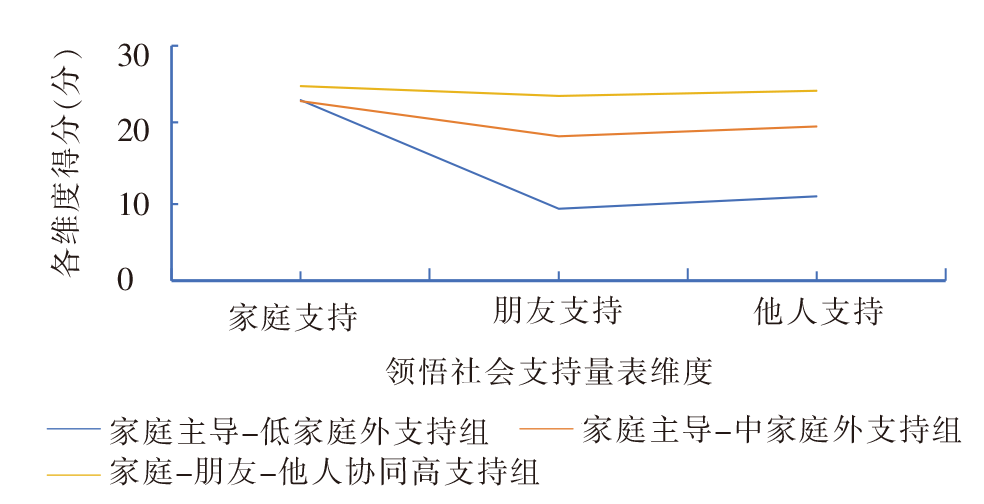
图1 化疗前肺癌患者社会支持潜在剖面图
Figure 1 Latent profile plot of social support before chemotherapy in patients with lung cancer
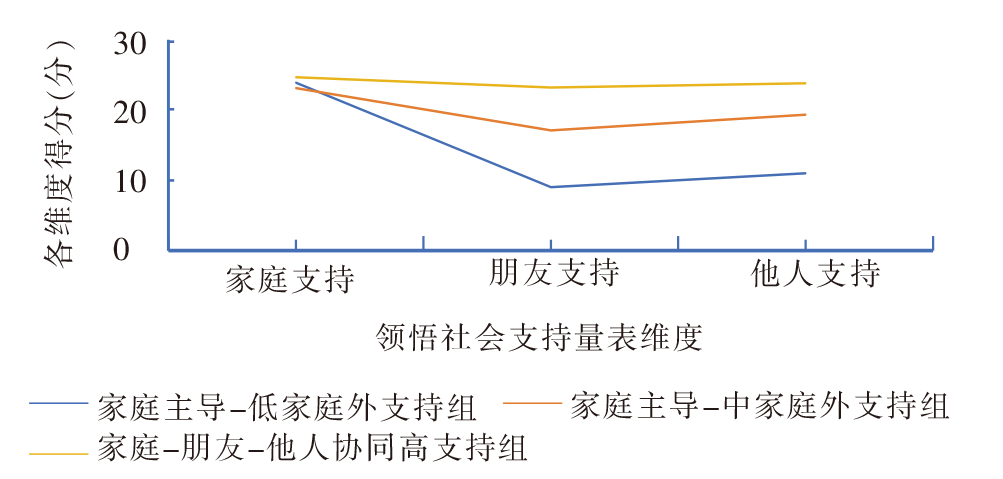
图2 化疗后肺癌患者社会支持潜在剖面图
Figure 2 Latent profile plot of social support after chemotherapy in patients with lung cancer
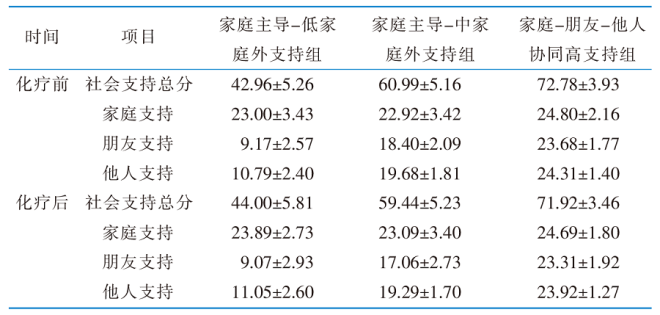 |
表1 肺癌患者化疗前后社会支持亚型各维度得分(分,$\bar{x}\pm s$)
Table 1 Dimension scores of social support across latent profiles before and after chemotherapy in patients with lung cancer(scores,$\bar{x}\pm s$)
| |
 |
表2 肺癌患者化疗前后社会支持潜在转变概率矩阵(n=232)
Table 2 Latent transition probability matrix of social support before and after chemotherapy in patients with lung cancer(n=232)
| |
 |
表3 肺癌患者化疗前后不同社会支持亚型身体活动水平及广义估计方程分析[n=232,梅脱-分钟/周,M(P25,P75)]
Table 3 Physical activity levels across different social support subtypes in lung cancer patients before and after chemotherapy and generalized estimation equation analysis[n=232,MET-min/week,M(P25,P75)]
| |
| [1] | Bray F, Laversanne M, Sung H, et al. Global cancer statistics 2022:GLOBOCAN estimates of incidence and mortality worldwide for 36 cancers in 185 countries[J]. CA Cancer J Clin, 2024, 74(3):229-263. |
| [2] | 支修益, 师建国, 田艳涛, 等. 《2022年中国肺癌患者生存质量白皮书》要点解读[J]. 中国胸心血管外科临床杂志, 2023, 30(8):1083-1088. |
| Zhi XY, Shi JG, Tian YT, et al. Interpretation of the key points of the 2022 white paper on the quality of life of Chinese lung cancer patients[J]. Chin J Clin Thorac Cardiovasc Surg, 2023, 30(8):1083-1088. | |
| [3] |
李芙兰, 谢海霞, 于天爽, 等. 肺癌患者化疗期间症状群的范围综述[J]. 中华护理杂志, 2024, 59(18):2283-2289.
DOI URL |
| Li FL, Xie HX, Yu TS, et al. Symptom clusters in patients with lung cancer patients during chemotherapy:a scoping review[J]. Chin J Nurs, 2024, 59(18):2283-2289. | |
| [4] | 韩燕红, 孙新, 饶贞丽, 等. 肺癌患者化疗相关性症状变化及与功能状况的相关性研究[J]. 护理学杂志, 2022, 37(13):22-25. |
| Han YH, Sun X, Rao ZL, et al. Dynamic change of chemotherapy-related symptoms and the relationship with functional status among lung cancer patients[J]. J Nurs Sci, 2022, 37(13):22-25. | |
| [5] |
Wei JH, Bai ZY, Bu MR, et al. Influence of symptom burden on social alienation in lung cancer patients receiving chemotherapy:the chain mediating effect of perceived social support and positive psychological capital[J]. BMC Psychol, 2025, 13(1):99.
DOI |
| [6] | World Health Organization. WHO guidelines on physical activity and sedentary behaviour[EB/OL]. (2020-11-25)[2024-06-16]. https://www.who.int/publications/i/item/9789240015128. |
| [7] | Ha DM, Prochazka AV, Bekelman DB, et al. Association of lei-sure-time physical activity with health-related quality of life among US lung cancer survivors[J]. JNCI Cancer Spectr, 2021, 5(1):pkaa118. |
| [8] |
Lee J. Cardiorespiratory fitness, physical activity,walking speed,lack of participation in leisure activities,and lung cancer mortality:a systematic review and meta-analysis of prospective cohort studies[J]. Cancer Nurs, 2021, 44(6):453-464.
DOI URL |
| [9] |
Xu JH, Lu H, Fang TT, et al. Health fitness,physical activity,and quality of life in patients undergoing first chemotherapy for lung cancer:a cross-sectional study[J]. Sci Rep, 2025, 15(1):21797.
DOI |
| [10] |
Takemura N, Cheung DST, Fong DYT, et al. Promoting moderate-to-vigorous physical activities in patients with advanced lung cancer:preferences and social cognitive factors,and the mediating roles[J]. Support Care Cancer, 2022, 30(9):7419-7429.
DOI PMID |
| [11] | 徐莉. 非政府组织与社会支持体系的构建:以艾滋病防治领域为例[M]. 北京: 中国社会科学出版社, 2012. |
| Xu L. Non-governmental organizations and the construction of social support system:a case study of AIDS prevention and treatment[M]. Beijing: China Social Sciences Press, 2012. | |
| [12] |
Ding YQ, Wang X, Zhang F, et al. The relationship between perceived social support,coping style,and the quality of life and psychological state of lung cancer patients[J]. BMC Psychol, 2024, 12(1):439.
DOI |
| [13] | 国家卫生健康委员会. 国家卫生健康委办公厅关于印发肿瘤和血液病相关病种诊疗指南(2022年版)的通知[EB/OL]. (2022-04-11)[2024-07-10]. https://www.nhc.gov.cn/yzygj/c100068/202204/0c1f7d3aca0545abbeb02030ce255930.shtml. |
| National Health Commission. Notice of the General Office of the National Health Commission on the issuance of guide-lines for the diagnosis and treatment of tumors and hema-tological diseases(2022 edition)[EB/OL]. (2022-04-11)[2024-07-10]. https://www.nhc.gov.cn/yzygj/c100068/202204/0c1f7d3-aca0545abbeb02030ce255930.shtml. | |
| [14] | 倪平, 陈京立, 刘娜. 护理研究中量性研究的样本量估计[J]. 中华护理杂志, 2010, 45(4):378-380. |
| Ni P, Chen JL, Liu N. The sample size estimation in quantitative nursing research[J]. Chin J Nurs, 2010, 45(4):378-380. | |
| [15] | 羊彩虹, 郭晓铭, 王燕, 等. 老年慢性肌肉骨骼疼痛患者焦虑与体力活动的关系:有调节的中介模型[J]. 护理管理杂志, 2024, 24(6):473-478. |
| Yang CH, Guo XM, Wang Y, et al. Relationship between anxiety and physical activity in elderly patients with chronic musculoskeletal pain:moderated mediation model[J]. J Nurs Adm, 2024, 24(6):473-478. | |
| [16] | Edelsbrunner PA, Flaig M, Schneider M. A simulation study on latent transition analysis for examining profiles and trajectories in education:recommendations for fit statistics[J]. J Res Educ Eff, 2023, 16(2):350-375. |
| [17] |
Zimet GD, Powell SS, Farley GK, et al. Psychometric characteristics of the Multidimensional Scale of Perceived Social Support[J]. J Pers Assess, 1990, 55(3/4):610-617.
DOI URL |
| [18] | 黄丽, 姜乾金, 任蔚红. 应对方式、社会支持与癌症病人心身症状的相关性研究[J]. 中国心理卫生杂志, 1996(4):160-161. |
| Huang L, Jiang QJ, Ren WH. Correlation between coping style,social support and psychosomatic symptoms of cancer pa-tients[J]. Chin Ment Health J, 1996(4):160-161. | |
| [19] |
Craig CL, Marshall AL, Sjöström M, et al. International Physical Activity Questionnaire:12-country reliability and validity[J]. Med Sci Sports Exerc, 2003, 35(8):1381-1395.
DOI URL |
| [20] | 樊萌语, 吕筠, 何平平. 国际体力活动问卷中体力活动水平的计算方法[J]. 中华流行病学杂志, 2014, 35(8):961-964. |
| Fan MY, Lü J, He PP. Chinese guidelines for data processing and analysis concerning the International Physical Activity Questionnaire[J]. Chin J Epidemiol, 2014, 35(8):961-964. | |
| [21] | 屈宁宁, 李可基. 国际体力活动问卷中文版的信度和效度研究[J]. 中华流行病学杂志, 2004, 25(3):265-268. |
| Qu NN, Li KJ. Study on the reliability and validity of Inter-national Physical Activity Questionnaire(Chinese Vision,IPAQ)[J]. Chin J Epidemiol, 2004, 25(3):265-268. | |
| [22] | 钟梦诗, 李晓波, 唐楠, 等. 心理弹性在乳腺癌病人领悟社会支持与生活质量关系中的作用[J]. 护理研究, 2019, 33(2):237-240. |
| Zhong MS, Li XB, Tang N, et al. Role of resilience in relationship between perceived social support and quality of life of breast cancer patients[J]. Chin Nurs Res, 2019, 33(2):237-240. | |
| [23] |
Lau N, Steineck A, Walsh C, et al. Social support resources in adolescents and young adults with advanced cancer:a qualitative analysis[J]. BMC Palliat Care, 2024, 23(1):193.
DOI |
| [24] | 李晶晶, 张培莉, 侯晓雅. 肺癌幸存者社会疏离评估工具及影响因素的研究进展[J]. 护理研究, 2022, 36(18):3319-3323. |
| Li JJ, Zhang PL, Hou XY. Research progress on assessment tools and influencing factors of social isolation among lung cancer survivors[J]. Chin Nurs Res, 2022, 36(18):3319-3323. | |
| [25] |
Fang MY, Hu WQ, Xie ZT. Dyadic effects of social support on psychological distress in patients with advanced lung cancer and spousal caregivers:the mediating role of sense of coherence[J]. Geriatr Nurs, 2024, 60:686-692.
DOI URL |
| [26] | 陈晓宇, 陈长香, 周立芝. 乳腺癌患者化疗相关并发症对社交回避与苦恼的影响[J]. 现代预防医学, 2019, 46(3):441-446,460. |
| Chen XY, Chen CX, Zhou LZ. Effect of chemotherapy-related complications on social avoidance and distress in patients with breast cancer[J]. Mod Prev Med, 2019, 46(3):441-446,460. | |
| [27] | 邵丽颖, 方晓明, 王丹宁, 等. 乳腺癌患者化疗期体力活动变化轨迹及影响因素分析[J]. 护理学杂志, 2025, 40(1):36-40. |
| Shao LY, Fang XM, Wang DN, et al. Analysis of the trajectory of physical activity changes and influencing factors in breast cancer patients on chemotherapy[J]. J Nurs Sci, 2025, 40(1):36-40. | |
| [28] | 沈雅琳, 汤利萍, 黎露丝, 等. 癌症患者居家体力活动依从性影响因素和改善策略的研究进展[J]. 中华护理教育, 2023, 20(8):1009-1013. |
| Shen YL, Tang LP, Li LS, et al. Research progress on influencing factors and improving strategies for home based physical activity compliance among cancer survivors[J]. Chin J Nurs Educ, 2023, 20(8):1009-1013. | |
| [29] |
Li NN, Hou LL, Li S. Distinct subgroups of patients with lung cancer receiving chemotherapy:a latent transition analysis[J]. Front Oncol, 2020, 10:522407.
DOI URL |
| [30] |
田思颖, 常红. 即时适配干预在慢性病患者久坐与身体活动中应用的研究进展[J]. 中华护理杂志, 2025, 60(5):619-623.
DOI URL |
|
Tian SY, Chang H. Research progress on the application of just-in-time adaptive intervention in chronic illness sedentary and physical activity[J]. Chin J Nurs, 2025, 60(5):619-623.
DOI URL |
| [1] | 刘幸, 范文祥, 周庭戌, 商临萍. 慢性阻塞性肺疾病患者戒烟行为促进与障碍因素的质性研究[J]. 中华护理杂志, 2026, 61(8): 1021-1027. |
| [2] | 孙雪英, 李君, 李玉峰, 崔学芬, 李东盼, 程兆晶, 李响, 孙秀杰. 慢性阻塞性肺疾病患者健康管理旅程地图的研究[J]. 中华护理杂志, 2026, 61(8): 1028-1035. |
| [3] | 朱凯, 闫梦梦, 张慧君, 宋红. 低血糖感知受损的糖尿病患者内在感受现状及潜在剖面分析[J]. 中华护理杂志, 2026, 61(7): 932-938. |
| [4] | 付海炜, 朱晓菊, 毕建静, 黎美娴, 张小迪, 王宗华. 肺癌患者癌症相关认知障碍核心症状与生活质量的相关性研究[J]. 中华护理杂志, 2026, 61(6): 783-789. |
| [5] | 韩朝颖, 赵雅宁, 刘瑶, 李雪梅, 常学优, 李建民. 社区慢性病老年人内在能力与社会衰弱的相关性研究[J]. 中华护理杂志, 2026, 61(6): 829-835. |
| [6] | 中国抗癌协会肿瘤康复整合护理专业委员会, (执笔:钟就娣, 王影新, 刘飞, 潜艳, 康璐, 颜红艳, 杨明雪, 廖洋洋, 刘群红. 老年肺癌患者术后分级运动的专家共识[J]. 中华护理杂志, 2026, 61(5): 616-621. |
| [7] | 徐晓静, 尚茜, 李娟, 张培培, 史素玲. 中青年肺癌化疗患者家庭参与式多模态运动干预方案的构建及应用研究[J]. 中华护理杂志, 2026, 61(5): 622-629. |
| [8] | 刘宁宁, 万玉峰, 田小红, 王英, 刘文君, 高丽莹. 老年慢性阻塞性肺疾病患者稳定期晨间症状的网络分析[J]. 中华护理杂志, 2026, 61(5): 646-652. |
| [9] | 朱金星, 顾招芹, 汤婷, 陈秋圆, 丁宁, 李方. 阻塞性睡眠呼吸暂停综合征患者疾病感知经历的质性研究[J]. 中华护理杂志, 2026, 61(5): 653-659. |
| [10] | 叶惠林, 邬小容, 唐维荣, 殷云睿, 李跃荣. 减重代谢手术后患者治疗依从性现状及影响因素分析[J]. 中华护理杂志, 2026, 61(5): 674-681. |
| [11] | 汪芳莹, 陈雪峰, 贾燕, 吴婉英. 鼻咽癌患者围放疗期症状负担类别的潜在转变及影响因素分析[J]. 中华护理杂志, 2026, 61(4): 490-497. |
| [12] | 芦凤娟, 解子惠, 关银银, 裴晓莉, 房玉霞. 骨科护士疼痛共情的现状及影响因素研究[J]. 中华护理杂志, 2026, 61(4): 549-556. |
| [13] | 巩晓珊, 林安琪, 秦玉, 王玲. 术前虚拟现实场景模拟训练对老年肺癌患者术后谵妄的干预效果研究[J]. 中华护理杂志, 2026, 61(3): 332-339. |
| [14] | 田凤美, 李惠玲, 安清, 王金悦, 谭丽萍, 赵丽爽. 中晚期结直肠癌患者症状负担的潜在剖面及影响因素研究[J]. 中华护理杂志, 2026, 61(3): 368-376. |
| [15] | 吴萍, 于宛辰, 柳嘉怡, 尹思文, 王汕珊. 养老护理员死亡认知及应对能力的潜在剖面分析[J]. 中华护理杂志, 2026, 61(2): 229-236. |
| 阅读次数 | ||||||
|
全文 |
|
|||||
|
摘要 |
|
|||||
