

中华护理杂志 ›› 2026, Vol. 61 ›› Issue (22): 3118-3125.DOI: 10.3761/j.issn.0254-1769.2026.22.014
华威1( ), 沈昕宇2, 陈洁1,*()
收稿日期:2025-11-24
出版日期:2026-11-20
发布日期:2026-11-16
*通讯作者:
陈洁,E-mail:20975073@qq.com作者简介:华威:女,硕士,护师,E-mail:951272128@qq.com华威:选题设计、文献检索与筛选、资料提取、质量评价、资料分析、论文撰写;沈昕宇:文献检索与筛选、资料提取、质量评价、资料分析、论文修改;陈洁:研究指导、论文审阅和修改
HUA Wei1(), SHEN Xinyu2, CHEN Jie1,*()
Received:2025-11-24
Online:2026-11-20
Published:2026-11-16
* Corresponding author:
CHEN Jie,E-mail:20975073@qq.com摘要:
目的 系统整合妇科恶性肿瘤患者癌症症状求助行为障碍因素的质性研究,为临床制订干预策略提供依据。 方法 系统检索PubMed、Embase、Cochrane Library、CINAHL、Web of Science、中国知网、万方数据库、维普数据库和中国生物医学文献数据库中的相关质性研究,检索时限为建库至2026年2月。采用澳大利亚乔安娜布里格斯研究所循证卫生保健中心质性研究质量评价标准进行文献质量评价,通过汇集性整合方法进行结果整合。 结果 共纳入13篇文献,提炼出64个主题,归纳为9个类别,并整合到能力、机会、动机-行为模型的3个领域,其中能力因素包括疾病知识缺乏、对症状的认知偏差;动机因素包括生殖羞耻、癌症诊断恐惧、妇科检查顾虑以及社会角色冲突;机会因素包括经济压力、就医便利性不足以及数字设备使用受限。 结论 妇科恶性肿瘤患者的癌症症状求助行为受诸多因素影响,医护人员应制订多元化干预方案,提高妇科恶性肿瘤患者对症状的识别能力,减少求助动机的制约因素,提升求助意愿,构建多维支持网络,促进积极主动的症状求助行为。
华威, 沈昕宇, 陈洁. 妇科恶性肿瘤患者癌症症状求助行为障碍因素质性研究的Meta整合[J]. 中华护理杂志, 2026, 61(22): 3118-3125.
HUA Wei, SHEN Xinyu, CHEN Jie. Meta-synthesis of qualitative studies on the dilemmas of help-seeking behavior for cancer symptoms in patients with gynecological malignant tumors[J]. Chinese Journal of Nursing, 2026, 61(22): 3118-3125.
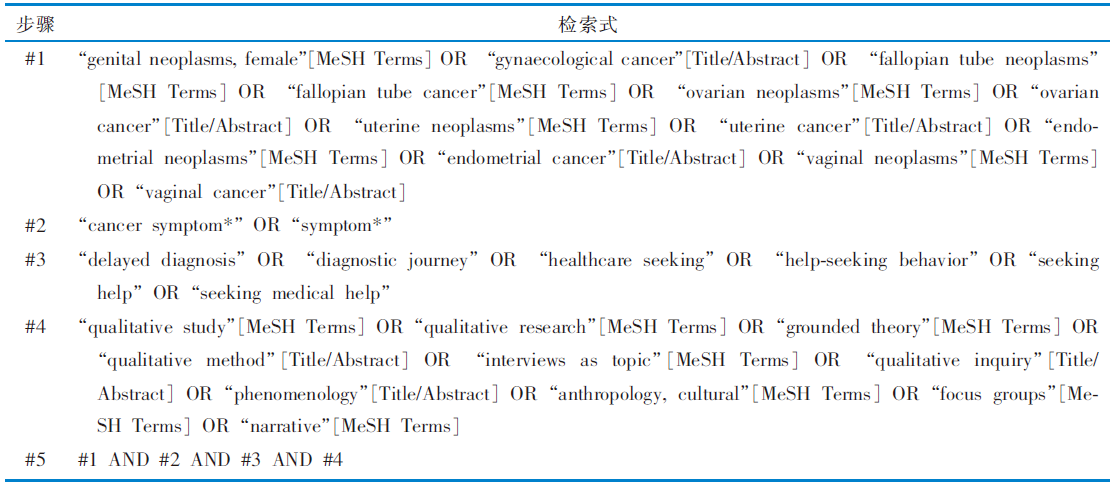 |
表1 PubMed检索策略
Table 1 PubMed search strategy
| |
| [1] |
McCluggage WG, Singh N, Gilks CB. Key changes to the World Health Organization(WHO) classification of female genital tu-mours introduced in the 5th edition(2020)[J]. Histopathology, 2022, 80(5):762-778.
DOI PMID |
| [2] |
Zhu BH, Gu H, Mao ZH, et al. Global burden of gynaecological cancers in 2022 and projections to 2050[J]. J Glob Health, 2024, 14:04155.
DOI PMID |
| [3] | Bray F, Laversanne M, Sung H, et al. Global cancer statistics 2022:GLOBOCAN estimates of incidence and mortality world-wide for 36 cancers in 185 countries[J]. CA Cancer J Clin, 2024, 74(3):229-263. |
| [4] |
Wright JD, Matsuo K, Huang YM, et al. Prognostic performance of the 2018 international federation of gynecology and obste-trics cervical cancer staging guidelines[J]. Obstet Gynecol, 2019, 134(1):49-57.
DOI PMID |
| [5] |
Lee SL, Shin YR, Kim H, et al. Comparative prognostic evalua-tion of the revised international federation of gynecology and obstetrics 2023 and 2009 staging systems in early endometrial cancer[J]. Cancers, 2025, 17(18):3017.
DOI URL |
| [6] |
Armstrong DK, Alvarez RD, Bakkum-Gamez JN, et al. Ovarian cancer,version 2.2020,NCCN clinical practice guidelines in oncology[J]. J Natl Compr Canc Netw, 2021, 19(2):191-226.
DOI URL |
| [7] |
Aguiar-Ibáñez R, Mbous YPV, Sharma S, et al. Assessing the clinical,humanistic,and economic impact of early cancer diag-nosis:a systematic literature review[J]. Front Oncol, 2025, 15:1546447.
DOI URL |
| [8] |
Petrova D, Špacírová Z, Fernández-Martínez NF, et al. The patient,diagnostic,and treatment intervals in adult patients with cancer from high and lower-income countries:a systema-tic review and meta-analysis[J]. PLoS Med, 2022, 19(10):e1004110.
DOI URL |
| [9] |
Momeni M, Rafii F. Help-seeking behaviour for cancer symp-toms:an evolutionary concept analysis[J]. Scand J Caring Sci, 2020, 34(4):807-817.
DOI URL |
| [10] | 孔含娇. 基于健康生态学模型的妇科肿瘤患者就医延迟影响因素研究[D]. 北京: 北京协和医学院, 2025. |
| Kong HJ. Study on influencing factors of medical care delay among gynecological tumor patients based on health ecologi-cal model[D]. Beijing: Peking Union Medical College, 2025. | |
| [11] |
Xiong JJ, Qian Y, Wang MS, et al. Factors associated with cervical cancer screening participation in Southwest China:a retrospective database-based cross-sectional study[J]. Front Med, 2026, 13:1740068.
DOI URL |
| [12] |
Michie S, van Stralen MM, West R. The behaviour change wheel:a new method for characterising and designing beha-viour change interventions[J]. Implement Sci, 2011, 6(1):42.
DOI URL |
| [13] |
Lockwood C, Munn Z, Porritt K. Qualitative research synthe-sis:methodological guidance for systematic reviewers utilizing meta-aggregation[J]. Int J Evid Based Healthc, 2015, 13(3):179-187.
DOI URL |
| [14] |
Stern C, Lizarondo L, Carrier J, et al. Methodological guidance for the conduct of mixed methods systematic reviews[J]. JBI Evid Implement, 2021, 19(2):120-129.
DOI PMID |
| [15] |
Brandner S, Müller-Nordhorn J, Stritter W, et al. Symptomiza-tion and triggering processes:ovarian cancer patients’ narrati-ves on pre-diagnostic sensation experiences and the initiation of healthcare seeking[J]. Soc Sci Med, 2014, 119:123-130.
DOI PMID |
| [16] |
Mwaka AD, Okello ES, Wabinga H, et al. Symptomatic presen-tation with cervical cancer in Uganda:a qualitative study assessing the pathways to diagnosis in a low-income country[J]. BMC Women’s Health, 2015, 15(1):15.
DOI URL |
| [17] |
Cook C, Brunton M, Pukepuke T, et al. Exploring communica-tion during the journey from noticing bodily changes to a diagnosis of endometrial cancer[J]. J Clin Nurs, 2018, 27(5/6):1262-1275.
DOI URL |
| [18] |
Mesafint Z, Berhane Y, Desalegn D. Health seeking behavior of patients diagnosed with cervical cancer in Addis Ababa,Ethiopia[J]. Ethiop J Health Sci, 2018, 28(2):111-116.
DOI PMID |
| [19] |
Vidal EA, Dubuc M, Bouati N, et al. Understanding lower gynae-cological cancer consultation delay and help-seeking behavior in patients over 65[J]. Bull Cancer, 2019, 106(9):747-758.
DOI URL |
| [20] |
Lawson-Michod KA, Watt MH, Grieshober L, et al. Pathways to ovarian cancer diagnosis:a qualitative study[J]. BMC Women’s Health, 2022, 22(1):430.
DOI |
| [21] |
Vela-Vallespín C, Medina-Perucha L, Jacques-Aviñó C, et al. Women’s experiences along the ovarian cancer diagnostic pathway in Catalonia:a qualitative study[J]. Health Expect, 2023, 26(1):476-487.
DOI URL |
| [22] |
Yin HN, Zha YJ, Zhou YX, et al. What are the barriers and facilitators to help-seeking behaviour for symptoms in patients with ovarian cancer in China? A qualitative study[J]. BMJ Open, 2024, 14(11):e087602.
DOI URL |
| [23] |
Dereje N, Addissie A, Worku A, et al. Barriers to early diag-nosis and treatment of cervical cancer in Addis Ababa,Ethiopia:qualitative study[J]. BMJ Open, 2025, 15(1):e087792.
DOI URL |
| [24] |
Fang J, Cheng YY, Liu Y, et al. How delays in seeking medi-cal care for cervical cancer patients are affected by their health-seeking behaviour:a qualitative study[J]. BMC Public Health, 2025, 25(1):2881.
DOI |
| [25] | Nogueira CM, Reis BS, de Figueiredo Pereira Meneses A, et al. Unveiling delays:understanding the diagnostic pathways of women with advanced cervical cancer[J]. Support Care Cancer, 2025, 33(9):826. |
| [26] | 顾晓霞, 尹海宁, 查莹娟, 等. 妇科恶性肿瘤患者癌症症状求助行为特征的质性研究[J]. 护理学杂志, 2024, 39(10):54-58. |
| Gu XX, Yin HN, Zha YJ, et al. Characteristics of help-seeking behavior for cancer symptoms in patients with gynecologic malignancies:a qualitative study[J]. J Nurs Sci, 2024, 39(10):54-58. | |
| [27] | 王素丹, 刘志颖, 田丽, 等. 宫颈癌患者癌症症状求助行为影响因素的质性研究[J]. 中国护理管理, 2025, 25(9):1328-1333. |
| Wang SD, Liu ZY, Tian L, et al. Factors influencing help-seeking behaviors for cancer symptoms in cervical cancer patients:a qualitative study[J]. Chin Nurs Manag, 2025, 25(9):1328-1333. | |
| [28] |
Petrova D, Okan Y, Salamanca-Fernández E, et al. Psychologi-cal factors related to time to help-seeking for cancer symp-toms:a meta-analysis across cancer sites[J]. Health Psychol Rev, 2020, 14(2):245-268.
DOI PMID |
| [29] |
Öztürk R, Bakir S, Kazankaya F, et al. Awareness about gyne-cologic cancers and related factors among healthy women:a cross-sectional study[J]. Soc Work Public Health, 2021, 36(7/8):847-856.
DOI URL |
| [30] |
Mili MA, Hossain MJ, Poli MA, et al. Impact of health educa-tion on knowledge and perception of cervical cancer and screening among rural women in Bangladesh[J]. Sci Rep, 2025, 15:36812.
DOI |
| [31] | Torrance N, Bright CJ, Hill HL, et al. Abdominal cancer symp-toms:evaluation of the impact of a regional public awareness campaign[J]. Eur J Cancer Care, 2021, 30(6):e13500. |
| [32] |
Dong YJ, Chen M, Wu YH. Effects of social norms and mes-sage framing on reducing the stigma of gynecological diseases:a cognitive-affective-behavioral model[J]. Appl Psychol Health Well Being, 2023, 15(4):1221-1236.
DOI URL |
| [33] |
郑智慧, 梅伶俐, 邹瑶, 等. 阴茎修复手术患儿父母参与疼痛管理困境及应对体验的纵向质性研究[J]. 中华护理杂志, 2026, 61(10):1395-1401.
DOI |
| Zheng ZH, Mei LL, Zou Y, et al. A qualitative study on the participation of parents of children undergoing penile repair surgery in pain management predicaments and coping expe-riences[J]. Chin J Nurs, 2026, 61(10):1395-1401. | |
| [34] |
Jacot-Guillarmod M, Mathevet P, Diserens C. Is there still a space for the vaginal examination in the gynecological consu-ltation?[J]. Rev Med Suisse, 2020, 16(712):2037-2041.
PMID |
| [35] |
肖婷婷, 许丽春, 郑卉, 等. 肺癌术后患者肺康复行为促进与障碍因素的Meta整合[J]. 中华护理杂志, 2025, 60(18):2279-2286.
DOI |
| Xiao TT, Xu LC, Zheng H, et al. Facilitators and barriers to pulmonary rehabilitation in postoperative lung cancer patients:a Meta-synthesis[J]. Chin J Nurs, 2025, 60(18):2279-2286. | |
| [36] |
Salampessy BH, Portrait FRM, Donker M, et al. How important is income in explaining individuals having forgone healthcare due to cost-sharing payments? Results from a mixed methods sequential explanatory study[J]. BMC Health Serv Res, 2022, 22(1):208.
DOI PMID |
| [37] |
Sohail AH, Afolaranmi O, Wuraola FO, et al. Evaluating the impact of financial navigation on financial catastrophe and distress for cancer care:a randomized control trial:COST-FIN[J]. Trials, 2026, 27(1):167.
DOI |
| [38] | 徐召鹏, 张录法. 空间邻近优势、互联网医疗与分级诊疗:基于长三角城市居民首诊医疗机构选择调查[J]. 浙江大学学报(人文社会科学版), 2025, 55(3):60-75. |
| Xu ZP, Zhang LF. Spatial proximity advantage,Internet medi-cal services and hierarchical medical system:a survey on the choice of first visit medical institutions for urban residents in Yangtze River Delta[J]. J Zhejiang Univ Humanit Soc Sci, 2025, 55(3):60-75. | |
| [39] |
孙尔鸿, 高宇, 叶旭春. 技术焦虑量表的汉化及其在老年群体中的信效度检验[J]. 中华护理杂志, 2022, 57(3):380-384.
DOI |
|
Sun EH, Gao Y, Ye XC. Validity and reliability of the Chinese version of the Technophobia Scale in older adults[J]. Chin J Nurs, 2022, 57(3):380-384.
DOI |
| [1] | 叶俊霜, 沈丽佳, 孟霞靓, 张玉姣, 蔡根莲, 邵碧云, 周亚辉, 张柳倩, 应金萍. 维持性血液透析患者对口腔衰弱认知和体验的质性研究[J]. 中华护理杂志, 2026, 61(9): 1215-1220. |
| [2] | 李艳桃, 杨连招, 龙秀红, 陈玲, 高慧, 覃文婷, 朱芳慧, 罗雪儿. HIV感染者/AIDS患者创伤后成长体验的Meta整合[J]. 中华护理杂志, 2026, 61(9): 1261-1268. |
| [3] | 刘幸, 范文祥, 周庭戌, 商临萍. 慢性阻塞性肺疾病患者戒烟行为促进与障碍因素的质性研究[J]. 中华护理杂志, 2026, 61(8): 1021-1027. |
| [4] | 舒适, 朱杉, 余艮珍, 张萍, 周晨曦, 彭维, 王珍. 特发性中枢性性早熟患儿患病体验与需求的质性研究[J]. 中华护理杂志, 2026, 61(8): 1074-1079. |
| [5] | 许国萍, 胡欢婷, 李丽, 金静芬, 蒋佳奖, 任英. 膝关节假体周围感染患者就医决策历程的质性研究[J]. 中华护理杂志, 2026, 61(8): 1101-1106. |
| [6] | 黄璇, 郭书萍, カルデナス暁東, 谢云影, 王瀚敏, 张玉美, 刘焘丽, 李莉. 银屑病患者自我报告结局评估工具测量学属性的评价及护理启示[J]. 中华护理杂志, 2026, 61(8): 1117-1124. |
| [7] | 张滢, 刘淑娟, 王婧瑞, 马千蓉. 轻度认知障碍患者对虚拟现实技术使用体验的Meta整合[J]. 中华护理杂志, 2026, 61(8): 1125-1131. |
| [8] | 韩林, 杨丽娟, 李太东, 郑晓丽, 程敏, 郭琛, 郑培培. ICU机械通气清醒患者沟通体验的Meta整合[J]. 中华护理杂志, 2026, 61(7): 901-908. |
| [9] | 王阳阳, 杨旻斐, 黄科儿, 姚晓月, 赵燕祥, 李佳麒, 尹娜, 黄凌, 张菊. 老年创伤性脑损伤合并衰弱患者早期运动康复照护促进与阻碍因素的质性研究[J]. 中华护理杂志, 2026, 61(7): 939-946. |
| [10] | 管颖慧, 谢鑑辉, 欧阳雅琦, 徐乐, 田佳琦, 王琼. 1型糖尿病青少年向成人医疗过渡体验的Meta整合[J]. 中华护理杂志, 2026, 61(7): 979-985. |
| [11] | 曾佳琳, 符冰, 杨泠韵, 江庆华. 头颈癌患者自我报告结局评估工具的评价及护理启示[J]. 中华护理杂志, 2026, 61(7): 986-994. |
| [12] | 王秀丽, 代春豪, 许梓婷, 李昊远, 冷敏敏, 张海博, 李晴, 杨丽娟. 运动干预在老年肌少性肥胖患者中应用的范围综述[J]. 中华护理杂志, 2026, 61(7): 995-1001. |
| [13] | 刘晓, 李丽, 施忠英. 青少年神经性厌食患者及其父母出院准备体验及需求的质性研究[J]. 中华护理杂志, 2026, 61(6): 814-821. |
| [14] | 朱金星, 顾招芹, 汤婷, 陈秋圆, 丁宁, 李方. 阻塞性睡眠呼吸暂停综合征患者疾病感知经历的质性研究[J]. 中华护理杂志, 2026, 61(5): 653-659. |
| [15] | 路梦新, 于晓燕, 张胜龙, 马璐, 王子瑜, 丁锦平, 辛婷婷, 张丙良. 肝移植患者不同阶段康复需求的纵向质性研究[J]. 中华护理杂志, 2026, 61(5): 660-666. |
| 阅读次数 | ||||||
|
全文 |
|
|||||
|
摘要 |
|
|||||
