

中华护理杂志 ›› 2025, Vol. 60 ›› Issue (14): 1778-1785.DOI: 10.3761/j.issn.0254-1769.2025.14.019
力晶( ), 毛秋婷(), 黄毅, 曾凡, 熊沫, 李倩倩, 周双红
收稿日期:2024-09-20
出版日期:2025-07-20
发布日期:2025-07-09
*通讯作者:
毛秋婷,E-mail:617064359@qq.com作者简介:力晶:女,本科,主管护师,E-mail:467854136@qq.com
基金资助:
LI Jing(), MAO Qiuting(), HUANG Yi, ZENG Fan, XIONG Mo, LI Qianqian, ZHOU Shuanghong
Received:2024-09-20
Online:2025-07-20
Published:2025-07-09
摘要:
目的 系统评价癌症化疗患者味觉改变的发生率及其影响因素,为医护人员制订针对性的预防措施提供依据。 方法 系统检索PubMed、Cochrane Library、Web of Science、CINAHL、Embase、中国生物医学文献数据库、中国知网、万方数据库和维普数据库,检索时限为建库至2024年8月1日。由2名研究者独立进行文献筛选、质量评价和资料提取,采用Stata 17.0软件进行统计分析。 结果 最终纳入18篇文献,包含4 686例患者。Meta分析结果显示,癌症化疗患者味觉改变发生率为73.46%,影响因素包括口腔黏膜炎(OR=1.98)、口干(OR=1.82)、恶心(OR=3.05)、食欲减退(OR=2.41)、使用三联止吐药(OR=2.45)、妇科肿瘤(OR=0.67)、肺癌(OR=0.57)、使用紫杉醇(OR=2.86)和吸烟(β=9.38)。 结论 癌症化疗患者味觉改变的发生率较高,受多种因素的综合影响。护士应动态评估患者的味觉变化,识别其危险因素,并采取个体化、精细化护理措施,以预防味觉改变的发生或延缓其发展。
力晶, 毛秋婷, 黄毅, 曾凡, 熊沫, 李倩倩, 周双红. 癌症化疗患者味觉改变发生率及影响因素的Meta分析[J]. 中华护理杂志, 2025, 60(14): 1778-1785.
LI Jing, MAO Qiuting, HUANG Yi, ZENG Fan, XIONG Mo, LI Qianqian, ZHOU Shuanghong. Systematic review and Meta-analysis of factors influencing taste alterations in cancer patients undergoing chemotherapy[J]. Chinese Journal of Nursing, 2025, 60(14): 1778-1785.
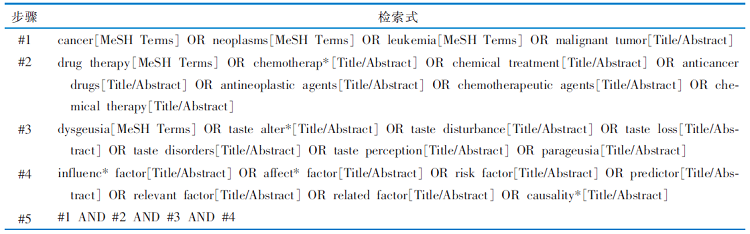 |
表1 共享护理门诊管理方案具体内容
Table 1 Specifics of the shared care clinic management programme
| |
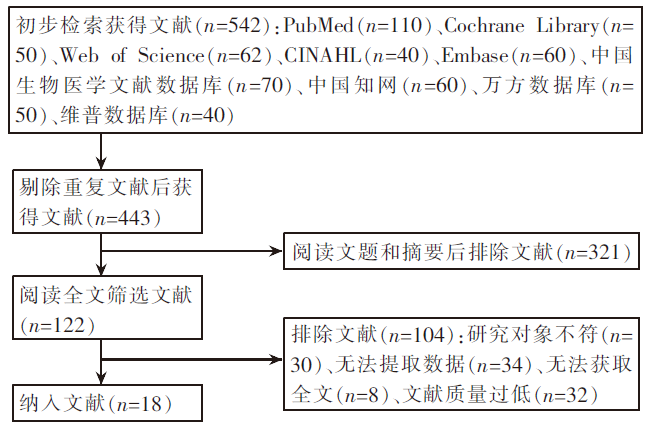
图1 文献筛选流程
Figure 1 Flow chart of literature screening
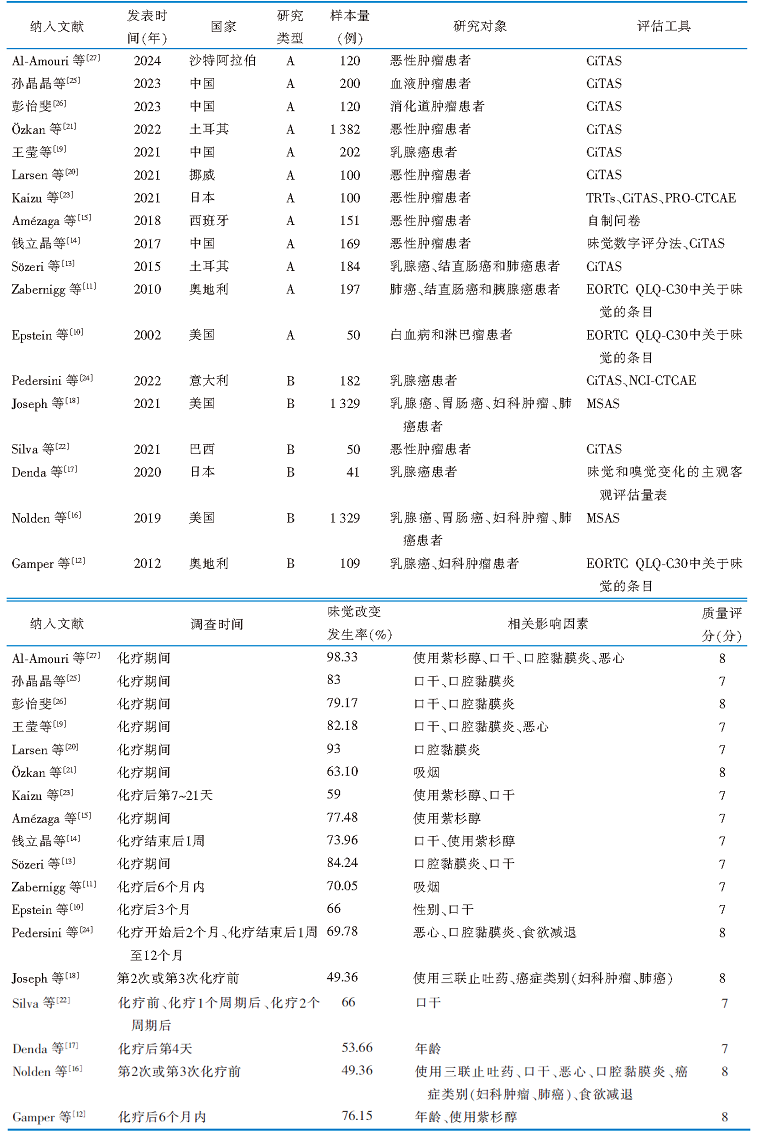 |
表2 纳入文献的基本特征及质量评价结果(n=18)
Table 2 Basic characteristics and quality evaluation results of the included literature(n=18)
| |
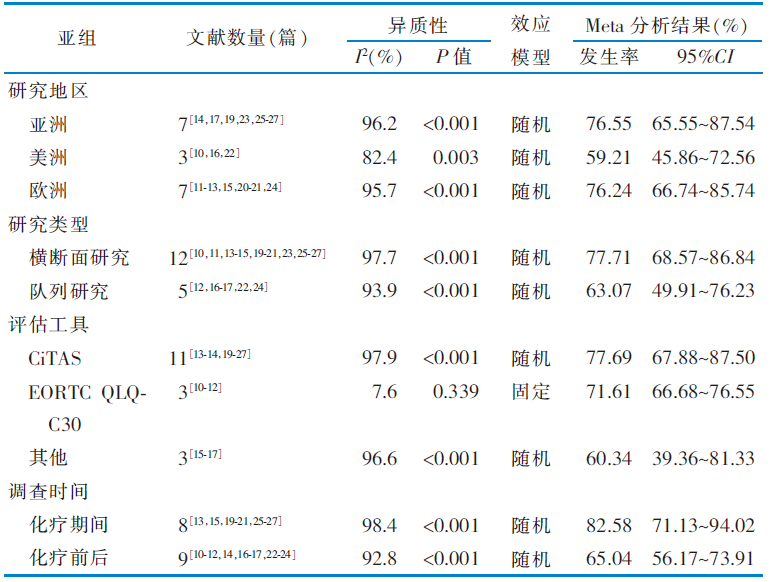 |
表3 癌症化疗患者味觉改变发生率的亚组分析结果(n=17)
Table 3 Subgroup analysis of taste alterations rate in cancer patients undergoing chemotherapy(n=17)
| |
| [6] |
邹炎铃, 李易, 张紫嫣, 等. 基于体质特征的胃癌化疗患者核心症状及影响因素研究[J]. 中华护理杂志, 2024, 59(18):2238-2243.
DOI |
| Zou YL, Li Y, Zhang ZY, et al. Examining core symptoms and influencing factors of patients with gastric cancer undergoing chemotherapy:the role of Traditional Chinese Medicine consti-tutional traits[J]. Chin J Nurs, 2024, 59(18):2238-2243. | |
| [7] |
Penna S. Chemotherapy-induced taste alteration[J]. Clin J Oncol Nurs, 2023, 27(5):479-485.
DOI PMID |
| [8] | 曾宪涛, 刘慧, 陈曦, 等. Meta分析系列之四:观察性研究的质量评价工具[J]. 中国循证心血管医学杂志, 2012, 4(4):297-299. |
| Zeng XT, Liu H, Chen X, et al. Meta-analysis series IV:quality evaluation tools for observational research[J]. Chin J Evid Based Cardiovasc Med, 2012, 4(4):297-299. | |
| [9] |
Stang A. Critical evaluation of the Newcastle-Ottawa Scale for the assessment of the quality of nonrandomized studies in meta-analyses[J]. Eur J Epidemiol, 2010, 25(9):603-605.
DOI PMID |
| [10] | Epstein JB, Phillips N, Parry J, et al. Quality of life,taste,olfactory and oral function following high-dose chemotherapy and allogeneic hematopoietic cell transplantation[J]. Bone Ma-rrow Transplant, 2002, 30(11):785-792. |
| [11] |
Zabernigg A, Gamper EM, Giesinger JM, et al. Taste alterations in cancer patients receiving chemotherapy:a neglected side effect?[J]. Oncologist, 2010, 15(8):913-920.
DOI PMID |
| [12] | Gamper EM, Giesinger JM, Oberguggenberger A, et al. Taste al-terations in breast and gynaecological cancer patients recei-ving chemotherapy:prevalence,course of severity,and quality of life correlates[J]. Acta Oncol, 2012, 51(4):490-496. |
| [13] | Sözeri E, Kutlutürkan S. Tastealteration inpatient sreceiving che-motherapy[J]. J Breast Health, 2015, 11(2):81-87. |
| [14] | 钱立晶, 路潜, 杨萍, 等. 肿瘤患者化疗相关性味觉改变调查分析[J]. 护理学杂志, 2017, 32(3):27-31. |
| Qian LJ, Lu Q, Yang P, et al. Chemotherapy-induced taste altera-tions among cancer patients[J]. J Nurs Sci, 2017, 32(3):27-31. | |
| [15] |
Amézaga J, Alfaro B, Ríos Y, et al. Assessing taste and smell alterations in cancer patients undergoing chemotherapy accor-ding to treatment[J]. Support Care Cancer, 2018, 26(12):4077-4086.
DOI PMID |
| [16] | Nolden A, Joseph PV, Kober KM, et al. Co-occurring gastroin-testinal symptoms are associated with taste changes in onco-logy patients receiving chemotherapy[J]. J Pain Symptom Man-age, 2019, 58(5):756-765. |
| [17] |
Denda Y, Niikura N, Satoh-Kuriwada S, et al. Taste alterations in patients with breast cancer following chemotherapy:a co-hort study[J]. Breast Cancer, 2020, 27(5):954-962.
DOI PMID |
| [18] | Joseph PV, Nolden A, Kober KM, et al. Fatigue,stress,and fun-ctional status are associated with taste changes in oncology patients receiving chemotherapy[J]. J Pain Symptom Manage, 2021, 62(2):373-382. |
| [19] | 王莹, 周听雨, 刘均娥, 等. 乳腺癌患者化疗相关性味觉改变现状及影响因素分析[J]. 中国护理管理, 2021, 21(10):1476-1480. |
| Wang Y, Zhou TY, Liu JE, et al. Chemotherapy-induced taste alterations and the influencing factors in breast cancer patients[J]. Chin Nurs Manag, 2021, 21(10):1476-1480. | |
| [20] |
Larsen AK, Thomsen C, Sanden M, et al. Taste alterations and oral discomfort in patients receiving chemotherapy[J]. Support Care Cancer, 2021, 29(12):7431-7439.
DOI PMID |
| [21] | Özkan I, Taylan S, Eroğlu N, et al. The relationship between malnutrition and subjective taste change experienced by patients with cancer receiving outpatient chemotherapy treat-ment[J]. Nutr Cancer, 2022, 74(5):1670-1679. |
| [22] | Silva IMV, Donaduzzi LC, Perini CC, et al. Association of xero-stomia and taste alterations of patients receiving antineo-plastic chemotherapy:a cause for nutritional concern[J]. Clin Nutr ESPEN, 2021,43:532-535. |
| [23] | Kaizu M, Komatsu H, Yamauchi H, et al. Characteristics of taste alterations in people receiving taxane-based chemothe-rapy and their association with appetite,weight,and quality of life[J]. Support Care Cancer, 2021, 29(9):5103-5114. |
| [24] |
Pedersini R, Zamparini M, Bosio S, et al. Taste alterations during neo/adjuvant chemotherapy and subsequent follow-up in breast cancer patients:a prospective single-center clinical study[J]. Support Care Cancer, 2022, 30(8):6955-6961.
DOI PMID |
| [25] | 孙晶晶, 王静, 朱丹, 等. 血液肿瘤病人化疗相关味觉改变及其影响因素[J]. 护理研究, 2023, 37(17):3064-3070. |
| Sun JJ, Wang J, Zhu D, et al. Analysis of chemotherapy-related taste changes and its influencing factors in patients with hematological malignancies[J]. Chin Nurs Res, 2023, 37(17):3064-3070. | |
| [26] | 彭怡斐. 消化道肿瘤患者化疗相关性味觉改变的影响状况调查及其护理干预[J]. 吉林医学, 2023, 44(7):2048-2051. |
| Peng YF. Investigation on the influence of chemotherapy-related taste changes in patients with digestive tract tumors and its nursing intervention[J]. Jilin Med J, 2023, 44(7):2048-2051. | |
| [27] | Al-Amouri FM, Badrasawi M. Taste alteration and its relation-ship with nutritional status among cancer patients receiving chemotherapy,cross-sectional study[J]. PLoS One, 2024, 19(5):e0302990. |
| [28] | Mastinu M, Melis M, Yousaf NY, et al. Emotional responses to taste and smell stimuli:self-reports,physiological measures,and a potential role for individual and genetic factors[J]. J Food Sci, 2023, 88(S1):65-90. |
| [29] | Enriquez JP, Archila-Godinez JC. Social and cultural influen-ces on food choices:a review[J]. Crit Rev Food Sci Nutr, 2022, 62(13):3698-3704. |
| [30] | Dominiak HSH, Hasselsteen SD, Nielsen SW, et al. Prevention of taste alterations in patients with cancer receiving pacli-taxel- or oxaliplatin-based chemotherapy:a pilot trial of can-nabidiol[J]. Nutrients, 2023, 15(13):3014. |
| [31] |
冯雯, 何细飞, 周华璐, 等. 血液系统恶性肿瘤患者化疗相关性口腔黏膜炎风险预测模型的构建与验证[J]. 中华护理杂志, 2024, 59(11):1301-1309.
DOI |
|
Feng W, He XF, Zhou HL, et al. Development and validation of a risk prediction model for chemotherapy-induced oral mucositis in patients with hematologic malignancies[J]. Chin J Nurs, 2024, 59(11):1301-1309.
DOI |
|
| [32] | Fábián TK, Beck A, Fejérdy P, et al. Molecular mechanisms of taste recognition:considerations about the role of saliva[J]. Int J Mol Sci, 2015, 16(3):5945-5974. |
| [33] | Hesketh PJ. Chemotherapy-induced nausea and vomiting[J]. N Engl J Med, 2008, 358(23):2482-2494. |
| [34] | Shields PG, Bierut L, Arenberg D, et al. Smoking cessation,version 3.2022,NCCN clinical practice guidelines in oncology[J]. J Natl Compr Canc Netw, 2023, 21(3):297-322. |
| [1] | Global cancer burden growing,amidst mounting need for services[J]. Saudi Med J, 2024, 45(3):326-327. |
| [2] | Miller KD, Nogueira L, Devasia T, et al. Cancer treatment and survivorship statistics,2022[J]. CA Cancer J Clin, 2022, 72(5):409-436. |
| [3] | Zhu M, Wang T, Sun J, et al. Heterogeneity of vulnerability and taste changes in older cancer patients undergoing chemo-therapy:a latent class analysis[J]. Support Care Cancer, 2023, 31(7):392. |
| [4] | Wang M, Xu YP, Wu YY, et al. Evaluating the efficacy of auri-cular acupuncture for chemotherapy-induced taste alterations:a pilot randomized controlled trial[J]. Eur J Oncol Nurs, 2023, 67:102458. |
| [5] | 钱立晶, 路潜. 肿瘤患者化疗相关性味觉改变的研究进展[J]. 中华护理杂志, 2016, 51(5):547-550. |
| Qian LJ, Lu Q. Research progress of chemotherapy induced taste alteration in patients with tumors[J]. Chin J Nurs, 2016, 51(5):547-550. |
| [1] | 郑煜琳, 刘晋宁, 张静, 郭会敏, 谷艳梅, 张莉莉. 酒精性肝病患者肝移植术后再饮酒现状及其影响因素分析[J]. 中华护理杂志, 2026, 61(9): 1208-1214. |
| [2] | 李艳桃, 杨连招, 龙秀红, 陈玲, 高慧, 覃文婷, 朱芳慧, 罗雪儿. HIV感染者/AIDS患者创伤后成长体验的Meta整合[J]. 中华护理杂志, 2026, 61(9): 1261-1268. |
| [3] | 李田田, 渠楠, 崔丽萍, 蔚玲, 张莉峰, 程伊薇, 孙双. 血液透析患者自体动静脉内瘘血栓形成风险预测模型的Meta分析[J]. 中华护理杂志, 2026, 61(9): 1269-1276. |
| [4] | 张莹, 杜若飞, 杨惠敏, 杜亚婷. 非霍奇金淋巴瘤患者化疗期衰弱轨迹的潜在类别及影响因素研究[J]. 中华护理杂志, 2026, 61(8): 1051-1058. |
| [5] | 李珊, 邵梦琪, 邱晨, 苏清清, 高远. 4 907例老年髋部骨折患者术后并发症发生现状及影响因素研究[J]. 中华护理杂志, 2026, 61(8): 1059-1065. |
| [6] | 黄璇, 郭书萍, カルデナス暁東, 谢云影, 王瀚敏, 张玉美, 刘焘丽, 李莉. 银屑病患者自我报告结局评估工具测量学属性的评价及护理启示[J]. 中华护理杂志, 2026, 61(8): 1117-1124. |
| [7] | 张滢, 刘淑娟, 王婧瑞, 马千蓉. 轻度认知障碍患者对虚拟现实技术使用体验的Meta整合[J]. 中华护理杂志, 2026, 61(8): 1125-1131. |
| [8] | 李琰, 许翠萍. 数字生物标志物在癌症患者中的应用进展及护理启示[J]. 中华护理杂志, 2026, 61(8): 1148-1152. |
| [9] | 韩林, 杨丽娟, 李太东, 郑晓丽, 程敏, 郭琛, 郑培培. ICU机械通气清醒患者沟通体验的Meta整合[J]. 中华护理杂志, 2026, 61(7): 901-908. |
| [10] | 张晴, 赵恺, 厉春林, 胡娜, 陆小燕. 神经外科肠内营养患者腹内压变化轨迹的潜在类别及影响因素研究[J]. 中华护理杂志, 2026, 61(7): 924-931. |
| [11] | 王丹丹, 吕会力, 李付华, 李慧, 张侠, 史小艳, 张苇. 三级医院硕士学历护士工作重塑的影响因素及路径分析[J]. 中华护理杂志, 2026, 61(7): 973-978. |
| [12] | 曾佳琳, 符冰, 杨泠韵, 江庆华. 头颈癌患者自我报告结局评估工具的评价及护理启示[J]. 中华护理杂志, 2026, 61(7): 986-994. |
| [13] | 王秀丽, 代春豪, 许梓婷, 李昊远, 冷敏敏, 张海博, 李晴, 杨丽娟. 运动干预在老年肌少性肥胖患者中应用的范围综述[J]. 中华护理杂志, 2026, 61(7): 995-1001. |
| [14] | 陈淑萍, 谢宝缘, 陈绵绵, 李美玲, 林翠芬. 淋巴瘤患者化疗随访方案的构建及应用研究[J]. 中华护理杂志, 2026, 61(6): 725-732. |
| [15] | 李春秀, 修红, 刘敏, 邹晓君, 王晴, 丁书凡, 赵志平, 李晓娟. 血液肿瘤患者营养不良风险预测模型的构建及验证[J]. 中华护理杂志, 2026, 61(6): 733-740. |
| 阅读次数 | ||||||
|
全文 |
|
|||||
|
摘要 |
|
|||||
