

Chinese Journal of Nursing ›› 2025, Vol. 60 ›› Issue (19): 2364-2370.DOI: 10.3761/j.issn.0254-1769.2025.19.009
• Specialist Nursing Practice and Research • Previous Articles Next Articles
XIE Qianming1, LIAO Chunyan( ), CHEN Guowei, PENG Yanhong, JIANG Guixiang, TANG Huihua
Received:2025-03-12
Online:2025-10-10
Published:2025-09-26
Contact:
LIAO Chunyan
谢倩明1, 廖春燕(), 陈国伟, 彭艳红, 蒋桂香, 唐慧华
通讯作者:
廖春燕
作者简介:谢倩明:女,本科(硕士在读),主管护师,E-mail:1472565516@qq.com
基金资助:XIE Qianming, LIAO Chunyan, CHEN Guowei, PENG Yanhong, JIANG Guixiang, TANG Huihua. Classification prediction of exercise perception in elderly hip arthroplasty patients and nursing implications[J]. Chinese Journal of Nursing, 2025, 60(19): 2364-2370.
谢倩明, 廖春燕, 陈国伟, 彭艳红, 蒋桂香, 唐慧华. 老年髋关节置换术患者运动感知的分型预测及护理启示[J]. 中华护理杂志, 2025, 60(19): 2364-2370.
Add to citation manager EndNote|Ris|BibTeX
URL: https://zh.zhhlzzs.com/EN/10.3761/j.issn.0254-1769.2025.19.009
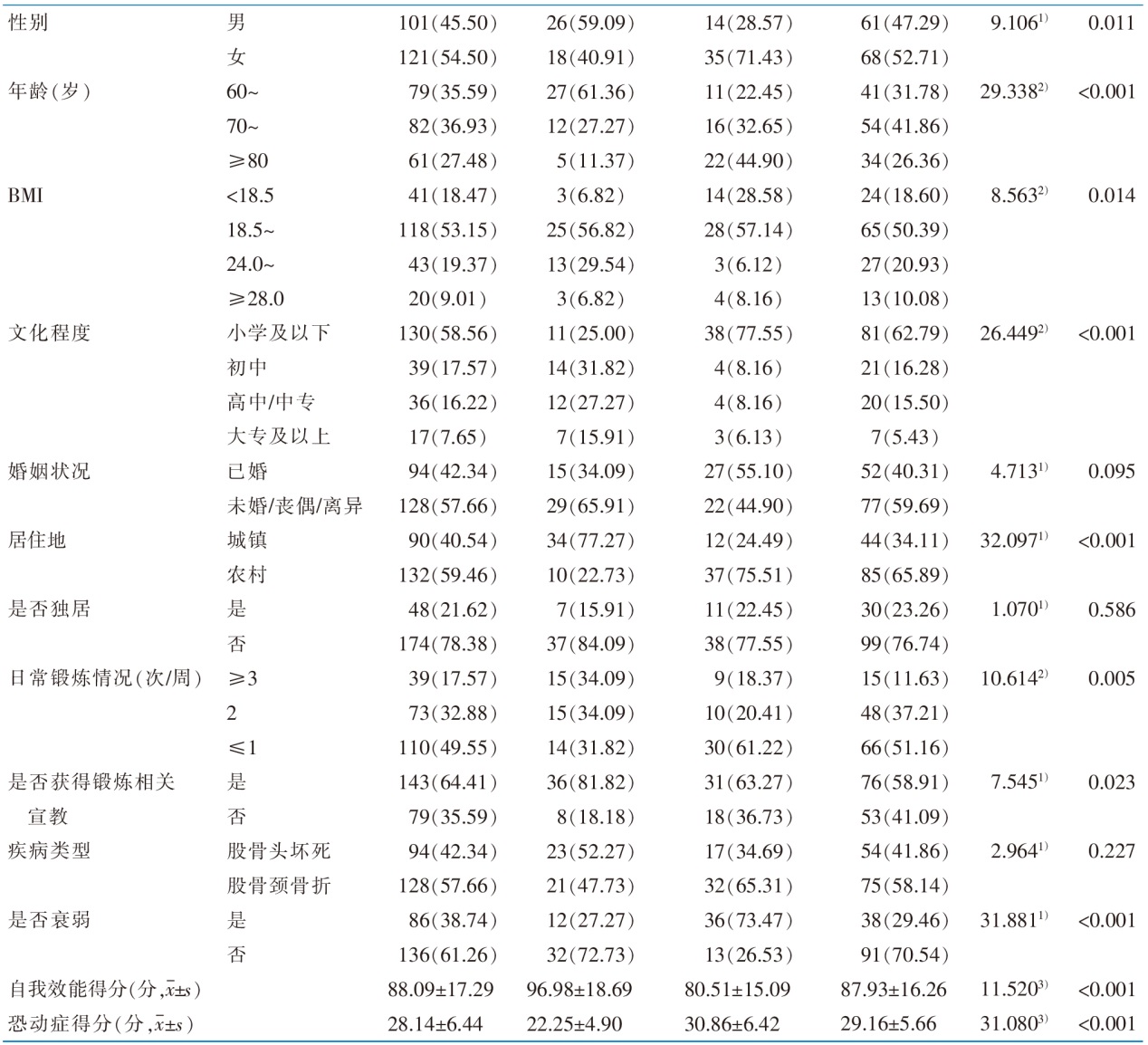 |
Table 1 The general information of the participants and univariate analysis of the potential profile of exercise perception[cases(percentage,%)]
| |
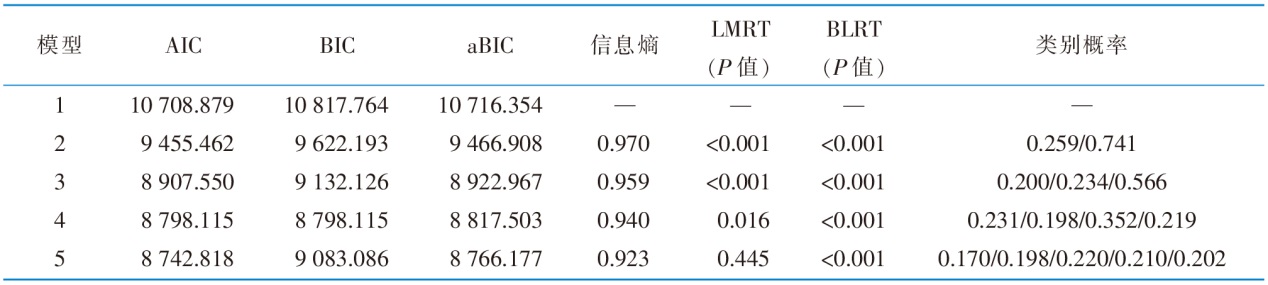 |
Table 2 Model fit information for latent profile analysis of exercise perception in elderly HA patients(n=222)
| |
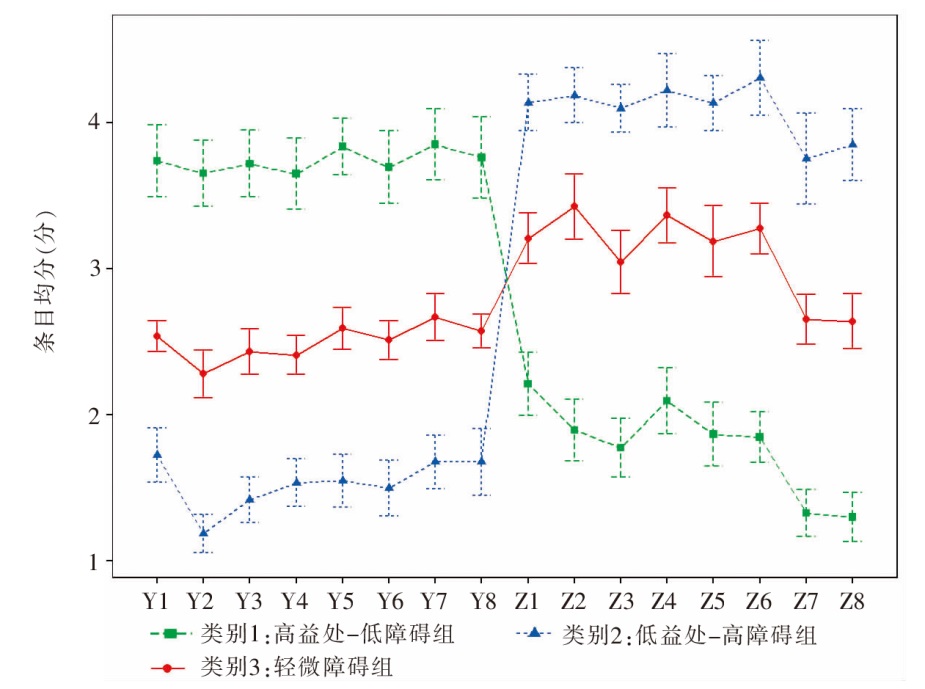
Figure 1 Latent profile of exercise perception in elderly HA patients
| [1] | 李川, 钱东阳, 王斌, 等. 中国髋关节置换入路选择临床实践指南(2021年版)[J/OL]. 中华关节外科杂志(电子版), 2021, 15(6):651-659. |
| Li C, Qian DY, Wang B, et al. Chinese clinical practice guidelines for total hip arthroplasty approach selection(2021 edition)[J/OL]. Chin J Jt Surg Electron Ed, 2021, 15(6):651-659. | |
| [2] | Frydendal T, Christensen R, Mechlenburg I, et al. Total hip replacement or resistance training for severe hip osteoarthritis[J]. N Engl J Med, 2024, 391(17):1610-1620. |
| [3] | Lenguerrand E, Ben-Shlomo Y, Rangan A, et al. Inequalities in provision of hip and knee replacement surgery for osteoarthritis by age,sex,and social deprivation in England between 2007-2017:a population-based cohort study of the National Joint Registry[J]. PLoS Med, 2023, 20(4):e1004210. |
| [4] | 苏亚平, 李瑞玲, 王园园. 老年髋关节置换病人护理敏感质量指标研究进展[J]. 护理研究, 2023, 37(5):850-854. |
| Su YP, Li RL, Wang YY. Research progress on nursing sensitive quality indicators in older patients with hip replacement[J]. Chin Nurs Res, 2023, 37(5):850-854. | |
| [5] | Kammerlander C, Gosch M, Kammerlander-Knauer U, et al. Long-term functional outcome in geriatric hip fracture patients[J]. Arch Orthop Trauma Surg, 2011, 131(10):1435-1444. |
| [6] | 刘彩, 王晓方, 李莹, 等. 健康信念模型演进与应用的可视化文献分析[J]. 中国健康教育, 2020, 36(2):167-170. |
| Liu C, Wang XF, Li Y, et al. Visualized literature analysis on evolution and application of health belief model[J]. Chin J Health Educ, 2020, 36(2):167-170. | |
| [7] |
郝永辉, 华慧娟, 何丽君. 终末期肾病患者运动行为感知潜在类别与运动行为改变的关系[J]. 中华护理杂志, 2024, 59(15):1840-1846.
DOI |
|
Hao YH, Hua HJ, He LJ. Latent profile analysis of exercise perception among end-stage renal disease patients and its relationship with change in physical activities[J]. Chin J Nurs, 2024, 59(15):1840-1846.
DOI |
|
| [8] |
王晶晶, 白晨晓, 张泽懿, 等. 老年慢性阻塞性肺疾病患者锻炼行为感知现状及影响因素分析[J]. 中华护理杂志, 2022, 57(1):36-42.
DOI |
|
Wang JJ, Bai CX, Zhang ZY, et al. The current status of exercise perception and its influencing factors in elderly patients with chronic obstructive pulmonary disease[J]. Chin J Nurs, 2022, 57(1):36-42.
DOI |
|
| [9] | Shajrawi A, Khalil H, Al-Sutry M, et al. Exercise self-efficacy,perceived benefits,and barriers to exercise among patients following acute myocardial infarction[J]. J Cardiovasc Nurs, 2021, 36(4):E11-E19. |
| [10] |
黄欣婷, 汪艳, 杨青. 糖尿病高危足患者足部护理知信行的分型预测及护理启示[J]. 中华护理杂志, 2024, 59(19):2326-2332.
DOI |
|
Huang XT, Wang Y, Yang Q. Prediction of foot care knowledge-attitude-practice about foot care in patients with diabetic high-risk feet and nursing insights[J]. Chin J Nurs, 2024, 59(19):2326-2332.
DOI |
|
| [11] | 李峥, 刘宇. 护理学研究方法[M]. 2版. 北京: 人民卫生出版社,2018:465. |
| Li Z, Liu Y. Nursing research methods[M]. 2nd ed. Beijing: People’s Medical Publishing House, 2018:465. | |
| [12] | 刘欢, 唐思齐, 吴红, 等. 全髋、全膝关节置换术后患者院内康复锻炼行为影响因素的质性研究[J]. 中国护理管理, 2024, 24(4):530-534. |
| Liu H, Tang SQ, Wu H, et al. Influencing factors of rehabilitation exercise during hospitalization in patients after total hip arthroplasty and total knee arthroplasty:a qualitative study[J]. Chin Nurs Manag, 2024, 24(4):530-534. | |
| [13] | 陈婷, 胡静文, 郑永智. 髋膝关节置换术病人锻炼益处及障碍感知量表的编制及信效度检验[J]. 护理研究, 2024, 38(5):820-826. |
| Chen T, Hu JW, Zheng YZ. Development and reliability and validity of Exercise Benefits and Barriers Perception Scale for Hip/Knee Throplasty Patients[J]. Chin Nurs Res, 2024, 38(5):820-826. | |
| [14] | 蔡立柏, 刘延锦, 徐秋露, 等. 恐动症评估简表中文版在全膝关节置换患者中应用的信效度研究[J]. 中华行为医学与脑科学杂志, 2019, 28(3):269-273. |
| Cai LB, Liu YJ, Xu QL, et al. Reliability and validity of the Chinese version of the Tampa Scale of Kinesiophobia in patients with total knee arthroplasty[J]. Chin J Behav Med Brain Sci, 2019, 28(3):269-273. | |
| [15] |
蔡立柏, 刘延锦, 李英, 等. 多学科协作干预方案在全膝关节置换术后恐动症患者中的应用研究[J]. 中华护理杂志, 2020, 55(4):494-499.
DOI |
|
Cai LB, Liu YJ, Li Y, et al. The effects of multidisciplinary teamwork intervention for total knee arthroplasty patients with kinesiophobia[J]. Chin J Nurs, 2020, 55(4):494-499.
DOI |
|
| [16] | Subramaniam S, Aalberg JJ, Soriano RP, et al. New 5-Factor Modified Frailty Index using American college of surgeons NSQIP data[J]. J Am Coll Surg, 2018, 226(2):173-181.e8. |
| [17] |
Kim AG, Grits D, Zhong J, et al. 5-Factor Modified Frailty Index as a predictor of outcomes after hemiarthroplasty or total hip arthroplasty for femoral neck fracture[J]. J Am Acad Orthop Surg, 2024, 32(13):e634-e641.
DOI PMID |
| [18] | 王海燕, 许燕玲, 胡三莲, 等. 中文版康复自我效能感量表的信效度评价[J]. 中华现代护理杂志, 2014, 20(3):268-270. |
| Wang HY, Xu YL, Hu SL, et al. Evaluation of the reliability and validity of Chinese version Self-efficacy for Rehabilitation Outcome Scale[J]. Chin J Mod Nurs, 2014, 20(3):268-270. | |
| [19] | 段煜, 郭张慧, 张洁, 等. 衰弱老年人运动锻炼促进与阻碍因素的Meta整合[J]. 中华护理杂志, 2025, 60(3):288-296. |
| Duan Y, Guo ZH, Zhang J, et al. Facilitators and barriers to the implementation of exercise for elderly patients with frailty:a qualitative Meta-synthesis[J]. Chin J Nurs, 2025, 60(3):288-296. | |
| [20] | Yan BZ, Sun WT, Wang W, et al. Prognostic significance of frailty in older patients with hip fracture:a systematic review and meta-analysis[J]. Int Orthop, 2022, 46(12):2939-2952. |
| [21] | Jiang L, Ding SL, Wang JX. The association between frailty and falls among individuals aged 60 years and older residing in community settings and experiencing hip fractures in China:a cross-sectional study[J]. Aging Male, 2025, 28(1):2442571. |
| [22] | 贾云洋, 梁小芹, 霍妍, 等. 老年髋部骨折围手术期衰弱护理管理专家共识(2024)[J]. 骨科临床与研究杂志, 2025, 10(2):65-71. |
| Jia YY, Liang XQ, Huo Y, et al. Expert consensus on perioperative frailty management of geriatric hip fracture patients(2024)[J]. J Clin Orthop Res, 2025, 10(2):65-71. | |
| [23] | Olsson LE, Hansson E, Ekman I. Evaluation of person-centred care after hip replacement:a controlled before and after study on the effects of fear of movement and self-efficacy compared to standard care[J]. BMC Nurs, 2016, 15(1):53. |
| [24] | Alshehri SHS, Reddy RS, Alshahrani MS, et al. Unraveling the impact of kinesiophobia on proprioception and balance:mediation by pain,mobility,and psychological wellbeing in post-total hip replacement recovery[J]. PLoS One, 2024, 19(12):e0314627. |
| [25] |
胡树菁, 孙菁, 王奕, 等. 肺移植受者居家肺康复锻炼促进与障碍因素的质性研究[J]. 中华护理杂志, 2024, 59(17):2070-2077.
DOI |
| Hu SJ, Sun J, Wang Y, et al. Facilitators and barriers of home pulmonary rehabilitation for lung transplant recipients:a qualitative study[J]. Chin J Nurs, 2024, 59(17):2070-2077. |
| [1] | HUANG Panpan, LI Liling, HU Xiaojing. Research progress of early exercise rehabilitation in infants with congenital heart disease [J]. Chinese Journal of Nursing, 2025, 60(9): 1050-1055. |
| [2] | CHEN Liou, ZHANG Wenting, LIU Junqi, WANG Yuncong, WANG Zhenlin, QI Sai, YANG Na. Study on the effect of pulmonary lobes surface projection localization combined with pulmonary segment drainage and sputum expectoration technique on airway clearance in patients with aspiration pneumonia [J]. Chinese Journal of Nursing, 2025, 60(9): 1056-1061. |
| [3] | YANG Nana, CHENG Chuanli, ZENG Hui, FU Dandan, WANG Yan, CHEN Yue, RAN Hongmin, FAN Hongjing, LONG Xia. Evaluation of the effect of graded exercise rehabilitation on patients with acute exacerbation of chronic obstructive pulmonary disease [J]. Chinese Journal of Nursing, 2025, 60(9): 1062-1067. |
| [4] | CAO Yun, SUN Guozhen, CHEN Feng, JI Xueli, YAN Mengwan, JING Lei, QIAN Kun. A study of modified ankle pump exercise in stroke patients [J]. Chinese Journal of Nursing, 2025, 60(9): 1068-1074. |
| [5] | XIE Min, QI Wenkai, YIN Ling, ZHANG Xuan, ZHAO Ruqin. Potential profile analysis and influencing factors of kinesiophobia in patients with peritoneal dialysis [J]. Chinese Journal of Nursing, 2025, 60(9): 1080-1086. |
| [6] | CHEN Bingqian, ZHAO Bin, SUN Jiarong, HAO Sifang, HOU Xiaoli. Oral health management dilemmas of chronic periodontitis patients with implant dentures:a qualitative study [J]. Chinese Journal of Nursing, 2025, 60(9): 1087-1092. |
| [7] | QIN Chunlan, WU Zhenyun, QIAN Hongying, ZHAO Qian, SUN Jinting. Experiences of disease self-control among patients with chronic obstructive pulmonary disease:a qualitative study [J]. Chinese Journal of Nursing, 2025, 60(9): 1093-1098. |
| [8] | LI Ziwei, FENG Lijuan, CHEN Xusheng, HUANG Yi, YANG Jie. Development and application of a Fear of Movement Assessment Scale for patients with peripherally inserted central catheters [J]. Chinese Journal of Nursing, 2025, 60(9): 1099-1106. |
| [9] | CHENG Zhiqiang, ZHANG Baozhen, TANG Liping, LI Jing, XIA Jiaoyun, WEI Xueyan, GONG Zhixian, ZHANG Meizhen, LI Lusi. Reliability and validity test of the Chinese version of the Urinary Incontinence Awareness and Attitude Scale [J]. Chinese Journal of Nursing, 2025, 60(9): 1107-1112. |
| [10] | SHI Meiqin, WU Jianfang, ZHANG Duo, WU Chunping, CHEN Ling, TAO Lei. Nursing care for postoperative laryngeal function rehabilitation in a patient undergoing primary voice prosthesis implantation after total laryngectomy [J]. Chinese Journal of Nursing, 2025, 60(9): 1120-1123. |
| [11] | GU Qian, HUANG Xi, SHI Weixiong, WU Jing, TAN Ruoming, WANG Feng. Nursing care for a patient with cytokine release syndrome following T-cell immunotherapy [J]. Chinese Journal of Nursing, 2025, 60(9): 1124-1127. |
| [12] | ZHOU Miao, CHEN Xing, PENG Fei, SUN Shangxue, LI Yangyang. Systematic review of risk prediction instruments for central line associated bloodstream infections in ICU patients [J]. Chinese Journal of Nursing, 2025, 60(9): 1132-1139. |
| [13] | PENG Yingjie, LIU Aihong, ZHU Wenli, MEI Yuxin, ZHOU Meng, GUAN Wenjing. Systematic review of readiness assessment tools for advance care planning in older adults [J]. Chinese Journal of Nursing, 2025, 60(9): 1146-1153. |
| [14] | RAN Lingxiao, WANG Dongmin, XU Ke, WANG Cong, CAO Hua, CUN Wei, JIANG Yan. Application of biomechanical simulation based on three-dimensional human body model in preventing pressure ulcers:a scoping review [J]. Chinese Journal of Nursing, 2025, 60(8): 1012-1018. |
| [15] | JIN Yujia, JIANG Hu, WANG Xiaoxuan, YI Jingna, MEI Yongxia, GUO Zhiting, ZHANG Zhenxiang, LIN Beilei. Application of information-based risk communication in primary prevention of cardiovascular diseases:a scoping review [J]. Chinese Journal of Nursing, 2025, 60(8): 1019-1025. |
| Viewed | ||||||
|
Full text |
|
|||||
|
Abstract |
|
|||||
