

Chinese Journal of Nursing ›› 2025, Vol. 60 ›› Issue (4): 418-424.DOI: 10.3761/j.issn.0254-1769.2025.04.005
• Specialist Nursing Practice and Research • Previous Articles Next Articles
GAO Chengfei( ), GU Jie, MA Qianyun, REN Ping, MENG Xianli, LU Xue, PENG Chunxue, CAO Jie()
Received:2024-05-09
Online:2025-02-20
Published:2025-02-26
Contact:
CAO Jie
高成菲(), 顾婕, 马倩云, 任凭, 孟宪丽, 陆雪, 彭春雪, 曹洁()
通讯作者:
曹洁
作者简介:高成菲:女,本科(硕士在读),护士,E-mail:gcf1492155415@163.com
基金资助:GAO Chengfei, GU Jie, MA Qianyun, REN Ping, MENG Xianli, LU Xue, PENG Chunxue, CAO Jie. Application study of pelvic floor muscle training combined with electromyographic biofeedback in urinary incontinence patients after radical prostatectomy[J]. Chinese Journal of Nursing, 2025, 60(4): 418-424.
高成菲, 顾婕, 马倩云, 任凭, 孟宪丽, 陆雪, 彭春雪, 曹洁. 盆底肌训练联合肌电生物反馈在前列腺癌根治术后尿失禁患者中的应用研究[J]. 中华护理杂志, 2025, 60(4): 418-424.
Add to citation manager EndNote|Ris|BibTeX
URL: https://zh.zhhlzzs.com/EN/10.3761/j.issn.0254-1769.2025.04.005
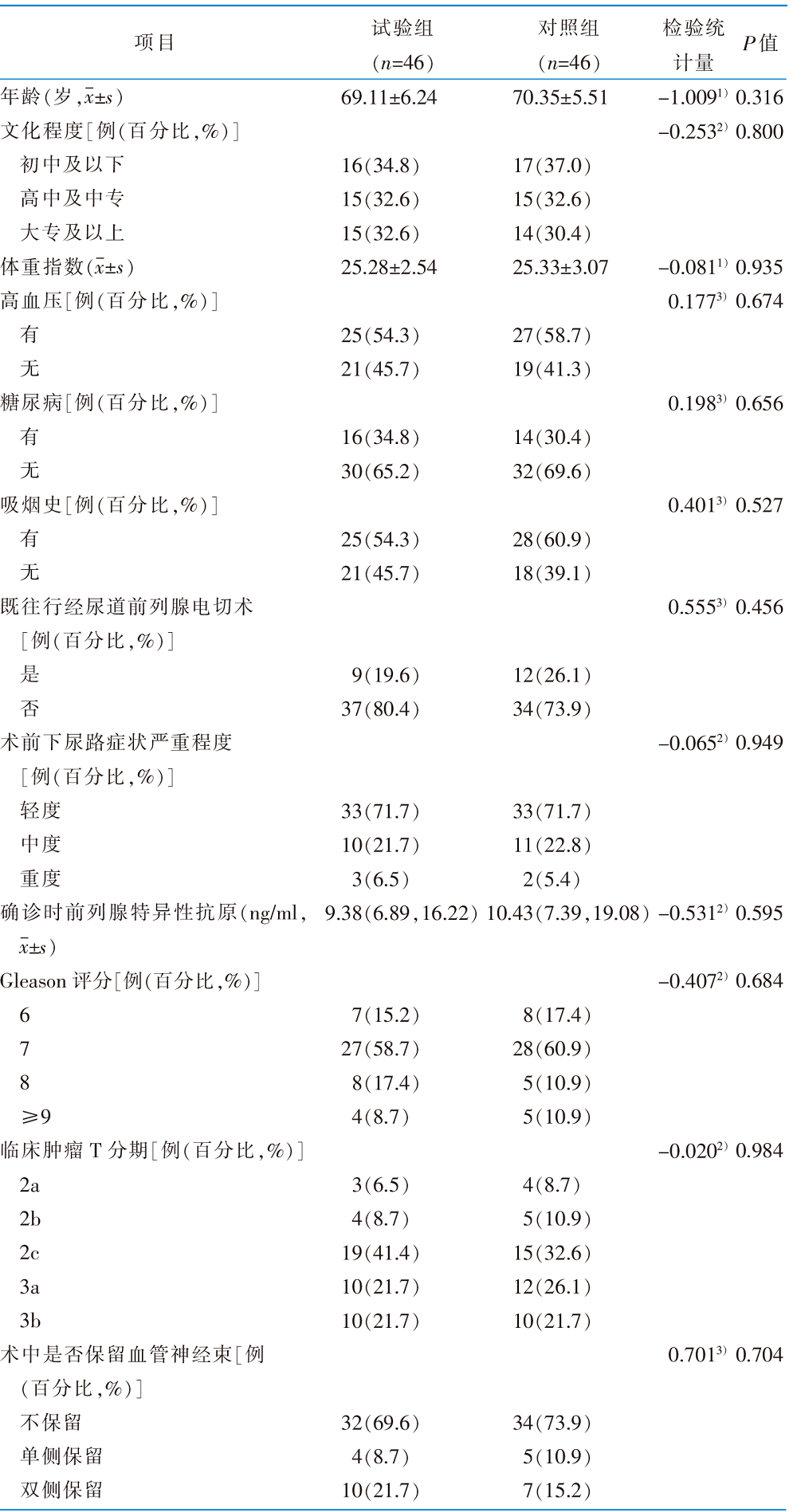 |
Table 1 Comparison of general data between the 2 groups
| |
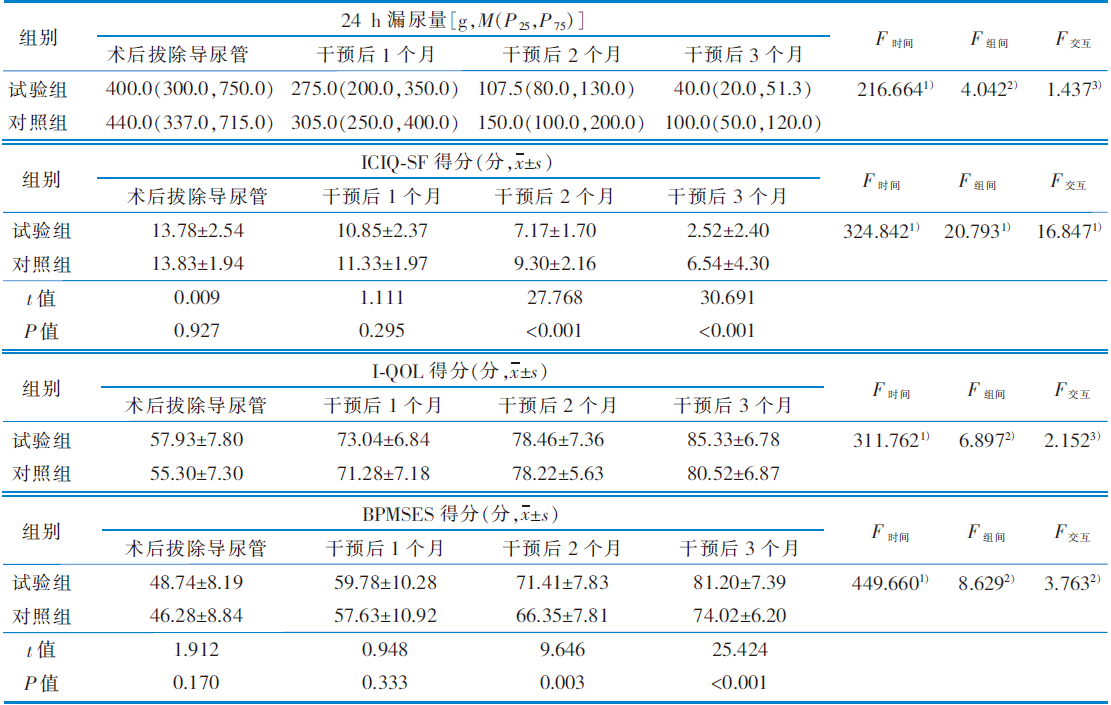 |
Table 2 Comparison of urine leakage in 24-hour, ICIQ-SF, I-QOL and BPMSES scores between the 2 groups at different time points
| |
| [1] |
Li X, Zhang H, Jia Z, et al. Urinary continence outcomes of four years of follow-up and predictors of early and late urinary continence in patients undergoing robot-assisted radical prostatectomy[J]. BMC Urol, 2020, 20(1):29.
DOI PMID |
| [2] |
Gacci M, Sakalis VI, Karavitakis M, et al. European association of urology guidelines on male urinary incontinence[J]. Eur Urol, 2022, 82(4):387-398.
DOI PMID |
| [3] | Wu XL, Zheng X, Yi XH, et al. Electromyographic biofeedback for stress urinary incontinence or pelvic floor dysfunction in women:a systematic review and meta-analysis[J]. Adv Ther, 2021, 38(8):4163-4177. |
| [4] |
顾婕, 马倩云, 高旭, 等. 前列腺癌术后尿失禁患者康复护理方案的构建及应用[J]. 中华护理杂志, 2023, 58(9):1029-1036.
DOI URL |
|
Gu J, Ma QY, Gao X, et al. Construction and application of a rehabilitation management programme for urinary incontinence after prostate cancer surgery[J]. Chin J Nurs, 2023, 58(9):1029-1036.
DOI URL |
|
| [5] | Wille S, Sobottka A, Heidenreich A, et al. Pelvic floor exercises,electrical stimulation and biofeedback after radical prostatectomy:results of a prospective randomized trial[J]. J Urol, 2003, 170(2 Pt 1):490-493. |
| [6] | Oh JJ, Kim JK, Lee H, et al. Effect of personalized extracorporeal biofeedback device for pelvic floor muscle training on urinary incontinence after robot-assisted radical prostatectomy:a randomized controlled trial[J]. Neurourol Urodyn, 2020, 39(2):674-681. |
| [7] | Johnson EE, Mamoulakis C, Stoniute A, et al. Conservative interventions for managing urinary incontinence after prostate surgery[J]. Cochrane Database Syst Rev, 2023, 4(4):CD014799. |
| [8] | 冯国双. 临床研究中重复测量资料组间比较的样本量估算[J]. 慢性病学杂志, 2022, 23(9):1323-1325,1330. |
| Feng GS. Estimation of sample size for comparing repeated measurements data between groups in clinical studies[J]. Chronic Pathematol J, 2022, 23(9):1323-1325,1330. | |
| [9] | Hagen S, Elders A, Stratton S, et al. Effectiveness of pelvic floor muscle training with and without electromyographic biofeedback for urinary incontinence in women:multicentre randomised controlled trial[J]. BMJ, 2020,371:m3719. |
| [10] | 许嘉维, 谢双怡, 蒋玉梅, 等, 前列腺癌根治术后尿失禁患者康复管理APP内容框架的构建[J]. 中华现代护理杂志, 2022, 28(6):776-777. |
| Xu JW, Xie SY, Jiang YM, et al. Construction of APP content framework for rehabilitation management of patients with urinary incontinence after radical prostatectomy[J]. Chin J ModNurs, 2022, 28(6):776-777. | |
| [11] | 黄健, 张旭. 中国泌尿外科和男科疾病诊断治疗指南:2022版[M]. 北京: 科学出版社,2022:1095. |
| Huang J, Zhang X. Chinese guidelines for diagnosis and treatment of urological and andrological diseases:2022 edition[M]. Beijing: Science Press,2022:1095. | |
| [12] | 陈泽波, 来永庆, 曹群朵, 等. ICIQ-SF问卷中文版与尿动力学检查的相关性研究[J]. 现代泌尿外科杂志, 2011, 16(5):403-405. |
| Chen ZB, Lai YQ, Cao QD, et al. The relevance study of Chinese Short Form of International Consultation on Incontinence Questionnaire(ICIQ-SF) and urodynamics[J]. J Mod Urol, 2011, 16(5):403-405. | |
| [13] | 王晓茜. 改良女性自我形象评价量表(MBIS)、尿失禁生活质量问卷(I-QOL)、子宫肌瘤症状及健康相关生活质量问卷(UFS-QOL)中文版本研制与中国人群验证[D]. 北京: 北京协和医学院, 2013. |
| Wang XQ. Development of Chinese versions of Modified Female Self-image Rating Scale(MBIS),Urinary Incontinence Quality of Life Questionnaire(I-QOL) and Uterine Leiomyoma Symptoms and Health-related Quality of Life Questionnaire(UFS-QOL) and its verification in China population[D]. Beijing: Peking Union Medical College, 2013. | |
| [14] |
白雪, 苏芳静, 李红玉. 中文版盆底肌肉锻炼自我效能量表的信效度评价[J]. 中国全科医学, 2015, 18(15):1857-1860.
DOI |
| Bai X, Su FJ, Li HY. Chinese version of the Broome Pelvic Muscle Self-Efficacy Scale:reliability and validity[J]. Chin Gen Pract, 2015, 18(15):1857-1860. | |
| [15] |
Kannan P, Winser SJ, Fung B, et al. Effectiveness of pelvic floor muscle training alone and in combination with biofeedback,electrical stimulation,or both compared to control for urinary incontinence in men following prostatectomy:systematic review and meta-analysis[J]. Phys Ther, 2018, 98(11):932-945.
DOI PMID |
| [16] | Hagen S, Bugge C, Dean SG, et al. Basic versus biofeedback-mediated intensive pelvic floor muscle training for women with urinary incontinence:the OPAL RCT[J]. Health Technol Assess, 2020, 24(70):1-144. |
| [17] | 徐雪芬, 冯素文, 胡引, 等. 音频指导居家盆底肌锻炼对压力性尿失禁孕妇产后盆底康复的效果评价[J]. 中华护理教育, 2021, 18(6):500-505. |
| Xu XF, Feng SW, Hu Y, et al. The effects of pelvic floor muscle training based on audio guidance on postpartum pelvic floor rehabilitation in primiparas with stress urinary incontinence[J]. Chin J Nurs Educ, 2021, 18((6):500-505. | |
| [18] |
司龙妹, 张佩英, 张萌, 等. 盆底肌训练防治前列腺癌根治术后尿失禁的最佳证据总结[J]. 中华护理杂志, 2020, 55(12):1859-1864.
DOI URL |
|
Si LM, Zhang PY, Zhang M, et al. Evidence summary of pelvic floor muscle training applied in prevention and treatment of post-prostatectomy incontinence[J]. Chin J Nurs, 2020, 55(12):1859-1864.
DOI URL |
|
| [19] |
乔文博, 侯思佳, 朱柯平, 等. 前列腺癌根治术患者盆底肌训练方案的构建及初步应用[J]. 中华护理杂志, 2024, 59(8):909-915.
DOI URL |
|
Qiao WB, Hou SJ, Zhu KP, et al. Construction and application of a pelvic floor muscle training program for patients with radical prostatectomy[J]. Chin J Nurs, 2024, 59(8):909-915.
DOI URL |
|
| [20] | 马彬彬, 木菁菁, 叶亦巍, 等. 盆底表面肌电下康复干预对初产妇产后康复质量的影响[J]. 中国妇幼保健, 2021, 36(23):5392-5396. |
| Ma BB, Mu JJ, Ye YW, et al. Effect of rehabilitation intervention under pelvic floor surface electromyography on rehabilitation quality of primiparous women[J]. Matern Child Health Care China, 2021, 36(23):5392-5396. | |
| [21] |
Kharaji G, ShahAli S, Ebrahimi-Takamjani I, et al. Supervised versus unsupervised pelvic floor muscle training in the treatment of women with urinary incontinence:a systematic review and meta-analysis[J]. Int Urogynecol J, 2023, 34(7):1339-1349.
DOI PMID |
| [1] | HUANG Panpan, LI Liling, HU Xiaojing. Research progress of early exercise rehabilitation in infants with congenital heart disease [J]. Chinese Journal of Nursing, 2025, 60(9): 1050-1055. |
| [2] | CHEN Liou, ZHANG Wenting, LIU Junqi, WANG Yuncong, WANG Zhenlin, QI Sai, YANG Na. Study on the effect of pulmonary lobes surface projection localization combined with pulmonary segment drainage and sputum expectoration technique on airway clearance in patients with aspiration pneumonia [J]. Chinese Journal of Nursing, 2025, 60(9): 1056-1061. |
| [3] | YANG Nana, CHENG Chuanli, ZENG Hui, FU Dandan, WANG Yan, CHEN Yue, RAN Hongmin, FAN Hongjing, LONG Xia. Evaluation of the effect of graded exercise rehabilitation on patients with acute exacerbation of chronic obstructive pulmonary disease [J]. Chinese Journal of Nursing, 2025, 60(9): 1062-1067. |
| [4] | CAO Yun, SUN Guozhen, CHEN Feng, JI Xueli, YAN Mengwan, JING Lei, QIAN Kun. A study of modified ankle pump exercise in stroke patients [J]. Chinese Journal of Nursing, 2025, 60(9): 1068-1074. |
| [5] | XIE Min, QI Wenkai, YIN Ling, ZHANG Xuan, ZHAO Ruqin. Potential profile analysis and influencing factors of kinesiophobia in patients with peritoneal dialysis [J]. Chinese Journal of Nursing, 2025, 60(9): 1080-1086. |
| [6] | CHEN Bingqian, ZHAO Bin, SUN Jiarong, HAO Sifang, HOU Xiaoli. Oral health management dilemmas of chronic periodontitis patients with implant dentures:a qualitative study [J]. Chinese Journal of Nursing, 2025, 60(9): 1087-1092. |
| [7] | QIN Chunlan, WU Zhenyun, QIAN Hongying, ZHAO Qian, SUN Jinting. Experiences of disease self-control among patients with chronic obstructive pulmonary disease:a qualitative study [J]. Chinese Journal of Nursing, 2025, 60(9): 1093-1098. |
| [8] | LI Ziwei, FENG Lijuan, CHEN Xusheng, HUANG Yi, YANG Jie. Development and application of a Fear of Movement Assessment Scale for patients with peripherally inserted central catheters [J]. Chinese Journal of Nursing, 2025, 60(9): 1099-1106. |
| [9] | CHENG Zhiqiang, ZHANG Baozhen, TANG Liping, LI Jing, XIA Jiaoyun, WEI Xueyan, GONG Zhixian, ZHANG Meizhen, LI Lusi. Reliability and validity test of the Chinese version of the Urinary Incontinence Awareness and Attitude Scale [J]. Chinese Journal of Nursing, 2025, 60(9): 1107-1112. |
| [10] | SHI Meiqin, WU Jianfang, ZHANG Duo, WU Chunping, CHEN Ling, TAO Lei. Nursing care for postoperative laryngeal function rehabilitation in a patient undergoing primary voice prosthesis implantation after total laryngectomy [J]. Chinese Journal of Nursing, 2025, 60(9): 1120-1123. |
| [11] | GU Qian, HUANG Xi, SHI Weixiong, WU Jing, TAN Ruoming, WANG Feng. Nursing care for a patient with cytokine release syndrome following T-cell immunotherapy [J]. Chinese Journal of Nursing, 2025, 60(9): 1124-1127. |
| [12] | ZHOU Miao, CHEN Xing, PENG Fei, SUN Shangxue, LI Yangyang. Systematic review of risk prediction instruments for central line associated bloodstream infections in ICU patients [J]. Chinese Journal of Nursing, 2025, 60(9): 1132-1139. |
| [13] | PENG Yingjie, LIU Aihong, ZHU Wenli, MEI Yuxin, ZHOU Meng, GUAN Wenjing. Systematic review of readiness assessment tools for advance care planning in older adults [J]. Chinese Journal of Nursing, 2025, 60(9): 1146-1153. |
| [14] | RAN Lingxiao, WANG Dongmin, XU Ke, WANG Cong, CAO Hua, CUN Wei, JIANG Yan. Application of biomechanical simulation based on three-dimensional human body model in preventing pressure ulcers:a scoping review [J]. Chinese Journal of Nursing, 2025, 60(8): 1012-1018. |
| [15] | JIN Yujia, JIANG Hu, WANG Xiaoxuan, YI Jingna, MEI Yongxia, GUO Zhiting, ZHANG Zhenxiang, LIN Beilei. Application of information-based risk communication in primary prevention of cardiovascular diseases:a scoping review [J]. Chinese Journal of Nursing, 2025, 60(8): 1019-1025. |
| Viewed | ||||||
|
Full text |
|
|||||
|
Abstract |
|
|||||
