

Chinese Journal of Nursing ›› 2026, Vol. 61 ›› Issue (22): 3066-3072.DOI: 10.3761/j.issn.0254-1769.2026.22.006
• Specialist Nursing Practice and Research • Previous Articles Next Articles
DONG Danhong1( ), TANG Leiwen2,*(), WANG Zhen1, LIU Jinghan1, FAN Hongyu1, WEI Meihao1
Received:2026-06-24
Online:2026-11-20
Published:2026-11-16
* Corresponding author:
TANG Leiwen,E-mail:tanglw@zju.edu.cn
董丹鸿1(), 汤磊雯2,*(), 王珍1, 刘静涵1, 范红雨1, 韦美皓1
通讯作者:
汤磊雯,E-mail:tanglw@zju.edu.cn作者简介:董丹鸿:女,本科(硕士在读),主管护师,E-mail:1067292673@qq.com董丹鸿:研究设计、资料收集、统计学分析、论文撰写与修改;汤磊雯:研究指导、论文审阅与修改;王珍、刘静涵、范红雨:数据收集;韦美皓:协调患者、研究指导
DONG Danhong, TANG Leiwen, WANG Zhen, LIU Jinghan, FAN Hongyu, WEI Meihao. Influencing factors and path analysis of fear of progression in patients with inflammatory bowel disease[J]. Chinese Journal of Nursing, 2026, 61(22): 3066-3072.
董丹鸿, 汤磊雯, 王珍, 刘静涵, 范红雨, 韦美皓. 炎症性肠病患者恐惧疾病进展的影响因素及路径分析[J]. 中华护理杂志, 2026, 61(22): 3066-3072.
Add to citation manager EndNote|Ris|BibTeX
URL: https://zh.zhhlzzs.com/EN/10.3761/j.issn.0254-1769.2026.22.006
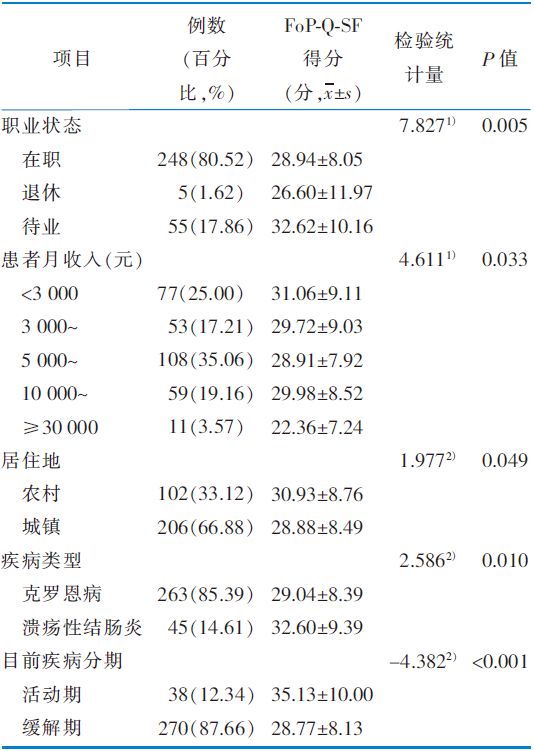 |
Table 1 General characteristics and univariate analysis of fear of progression in patients with inflammatory bowel disease(n=308)
| |
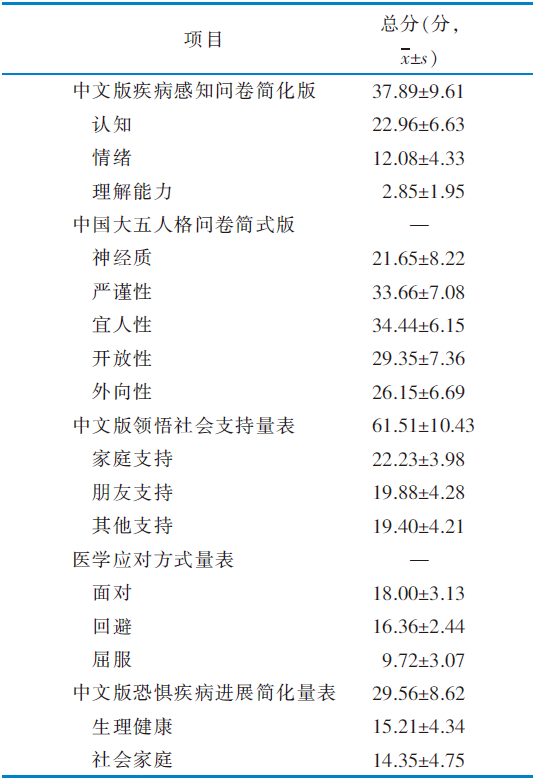 |
Table 2 Scores for illness perceptions,big five personality, perceived social support, coping styles, and fear of progression among patients with inflammatory bowel disease(n=308)
| |
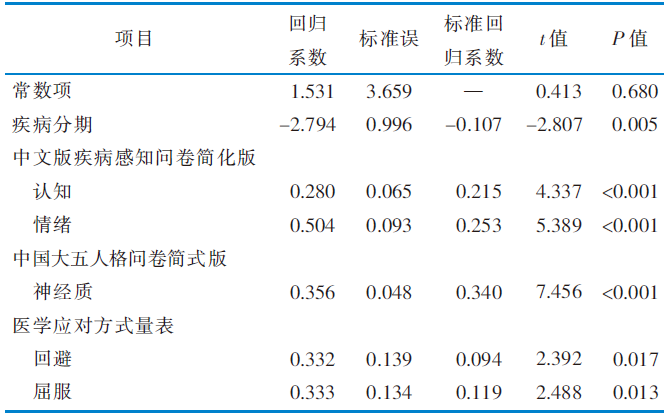 |
Table 3 Multiple linear regression analysis of factors associated with fear of progression in patients with inflammatory bowel disease(n=308)
| |
| [1] |
Catalan-Serra I, Sebastian S. Global inflammatory bowel disease:opportunities and challenges for a new era[J]. United European Gastroenterol J, 2025, 13(8):1410-1417.
DOI URL |
| [2] |
王清玉, 林征, 雷阳, 等. 炎症性肠病患者恐惧疾病进展潜在类别的影响因素分析及护理启示[J]. 中华护理杂志, 2024, 59(3):308-316.
DOI |
| Wang QY, Lin Z, Lei Y, et al. Influencing factors and nursing enlightenment of the fear of progression in patients with inflammatory bowel disease:a latent profile analysis[J]. Chin J Nurs, 2024, 59(3):308-316. | |
| [3] |
Dankert A, Duran G, Engst-Hastreiter U, et al. Fear of progression in patients with cancer,diabetes mellitus and chronic arthritis[J]. Rehabilitation, 2003, 42(3):155-163.
DOI PMID |
| [4] | 孟婷, 薛鲜敏, 樊晓辉, 等. 炎症性肠病患者恐惧疾病进展现状和生活质量分析[J]. 胃肠病学, 2021, 26(4):198-203. |
| Meng T, Xue XM, Fan XH, et al. Analysis of fear of progression and quality of life in patients with inflammatory bowel disease[J]. Chin J Gastroenterol, 2021, 26(4):198-203. | |
| [5] | 吕晨. 乳腺癌术后患者人格特质、认知评价与疾病进展恐惧的关系研究[D]. 开封: 河南大学, 2021. |
| Lü C. Study on the relationship among personality traits,illness perception and fear of progression in postoperative breast cancer patients[D]. Kaifeng: Henan University, 2021. | |
| [6] |
Guan XC, Zhu QY, Qian HL. Relationship between post-traumatic stress disorder and fear of progression in stroke patients:the mediating role of perceived social support and coping styles[J]. Top Stroke Rehabil, 2025, 32(5):544-552.
DOI URL |
| [7] |
Leventhal H, Phillips LA, Burns E. The Common-Sense Model of Self-Regulation(CSM):a dynamic framework for understanding illness self-management[J]. J Behav Med, 2016, 39(6):935-946.
DOI PMID |
| [8] | 中华医学会消化病学分会炎症性肠病学组, 中国炎症性肠病诊疗质量控制评估中心. 中国克罗恩病诊治指南(2023年·广州)[J]. 中华消化杂志, 2024, 44(2):100-132. |
| Inflammatory Bowel Disease Group, Chinese Society of Gastroenterology, Chinese Medical Association, Inflammatory Bowel Disease Quality Control Center of China. Chinese clinical practice guideline on the management of Crohn’s disease(2023,Guangzhou)[J]. Chin J Dig,2024, 44(2):100-132. | |
| [9] | 中华医学会消化病学分会炎症性肠病学组, 中国炎症性肠病诊疗质量控制评估中心. 中国溃疡性结肠炎诊治指南(2023年·西安)[J]. 中华消化杂志, 2024, 44(2):73-99. |
| Inflammatory Bowel Disease Group, Chinese Society of Gastroenterology, Chinese Medical Association, Inflammatory Bowel Disease Quality Control Center of China. Chinese clinical practice guideline on the management of ulcerative colitis(2023,Xi’an)[J]. Chin J Dig,2024, 44(2):73-99. | |
| [10] | 吴明隆. 结构方程模型:AMOS的操作与应用[M]. 重庆: 重庆大学出版社, 2009. |
| Wu ML. Structural equation model:operation and application of AMOS[M]. Chongqing: Chongqing University Press, 2009. | |
| [11] | 倪平, 陈京立, 刘娜. 护理研究中量性研究的样本量估计[J]. 中华护理杂志, 2010, 45(4):378-380. |
| Ni P, Chen JL, Liu N. The sample size estimation hi quantitative nursing research[J]. Chin J Nurs, 2010, 45(4):378-380. | |
| [12] | 王孟成, 戴晓阳, 姚树桥. 中国大五人格问卷的初步编制Ⅲ:简式版的制定及信效度检验[J]. 中国临床心理学杂志, 2011, 19(4):454-457. |
| Wang MC, Dai XY, Yao SQ. Development of the Chinese Big Five Personality Inventory(CBF-PI)Ⅲ:psychometric properties of CBF-PI brief version[J]. Chin J Clin Psychol, 2011, 19(4):454-457. | |
| [13] |
Broadbent E, Petrie KJ, Main J, et al. The Brief Illness Perception Questionnaire[J]. J Psychosom Res, 2006, 60(6):631-637.
DOI PMID |
| [14] | 梅雅琪, 李惠萍, 杨娅娟, 等. 中文版疾病感知问卷简化版在女性乳腺癌患者中的信效度检验[J]. 护理学报, 2015, 22(24):11-14. |
| Mei YQ, Li HP, Yang YJ, et al. Reliability and validity of Chinese version of the Brief Illness Perception Questionnaire in patients with breast cancer[J]. J Nurs(China), 2015, 22(24):11-14. | |
| [15] |
Feifel H, Strack S, Nagy VT. Coping strategies and associated features of medically ill patients[J]. Psychosom Med, 1987, 49(6):616-625.
DOI PMID |
| [16] | 沈晓红, 姜乾金. 医学应对方式问卷中文版701例测试报告[J]. 中国行为医学科学, 2000, 9(1):18-20. |
| Shen XH, Jiang QJ. Report on application of Chinese version of MCMQ in 701 patients[J]. Chin J Behav Med Sci, 2000, 9(1):18-20. | |
| [17] |
Zimet GD, Dahlem NW, Zimet SG, et al. The Multidimensional Scale of Perceived Social Support[J]. J Pers Assess, 1988, 52(1):30-41.
DOI URL |
| [18] | 姜乾金. 领悟社会支持量表[J]. 中国行为医学科学, 2001, 10(10):41-43. |
| Jiang QJ. Perceived Social Support Scale[J]. Chin J Behav Med Brain Sci, 2001, 10(10):41-43. | |
| [19] |
Mehnert A, Herschbach P, Berg P, et al. Fear of progression in breast cancer patients:validation of the Short Form of the Fear of Progression Questionnaire(FoP-Q-SF)[J]. Z Psychosom Med Psychother, 2006, 52(3):274-288.
DOI PMID |
| [20] | 吴奇云, 叶志霞, 李丽, 等. 癌症患者恐惧疾病进展简化量表的汉化及信效度分析[J]. 中华护理杂志, 2015, 50(12):1515-1519. |
| Wu QY, Ye ZX, Li L, et al. Reliability and validity of Chinese version of Fear of Progression Questionnaire-Short Form for Cancer Patients[J]. Chin J Nurs, 2015, 50(12):1515-1519. | |
| [21] |
Tian L, Tian Y, Sun P, et al. Social support and resilience as mediating factors in the link between illness perception and fear of progression among older patients with chronic heart failure:a multiple mediator model[J]. Geriatr Nurs, 2025, 65:103521.
DOI URL |
| [22] | 高兴, 底瑞青, 李星丹, 等. 慢性心力衰竭患者疾病感知对失志的影响:疾病进展恐惧和正性情绪的链式中介作用[J]. 中国实用护理杂志, 2024, 40(5):372-379. |
| Gao X, Di RQ, Li XD, et al. Effects of illness perception on demoralization in patients with chronic heart failure:chain mediating effect of fear of disease progression and positive emotion[J]. Chin J Pract Nurs, 2024, 40(5):372-379. | |
| [23] |
Winter DG, John OP, Stewart AJ, et al. Traits and motives:toward an integration of two traditions in personality research[J]. Psychol Rev, 1998, 105(2):230-250.
PMID |
| [24] |
Morgan S, Cooper B, Paul S, et al. Association of personality profiles with depressive,anxiety,and cancer-related symptoms in patients undergoing chemotherapy[J]. Pers Individ Dif, 2017, 117:130-138.
DOI URL |
| [25] | 许传英. 炎症性肠病患者人格特征与应对方式的相关性及心理干预措施[J]. 国际护理学杂志, 2022, 41(3):427-430. |
| Xu CY. Correlation between personality characteristics and coping styles in patients with inflammatory bowel disease and psychological intervention measures[J]. Int J Nurs, 2022, 41(3):427-430. | |
| [26] | 陈慈爱, 丁珊妮, 潘红英, 等. 注意偏向训练在慢性病管理中的应用进展[J]. 护理学杂志, 2025, 40(24):120-124. |
| Chen CA, Ding SN, Pan HY, et al. Advances in the application of attentional bias modification training for chronic disease management[J]. J Nurs Sci, 2025, 40(24):120-124. |
| [1] | Intravenous Infusion Therapy Committee of Chinese Nursing Association, Beijing Nursing Association, (Writing Committee:LI Jia, LI Xuying, QIN Huiying, CHEN Lifen, WU Zhenming, HU Zeyin, LUO Mengna, FAN Yuying, WU Jiahui, LIN Yuping, WANG Lei, SUN Wenyan, FENG Bilong, GAO Wei, LI Yanan, HOU Luoya, LI Chunyan, ). Expert consensus on nursing care of central venous access device removal [J]. Chinese Journal of Nursing, 2026, 61(9): 1157-1162. |
| [2] | HUANG Ping, LI Li, GUO Lili, XU Ying, YE Yun, JIANG Shufang. Construction and preliminary application of a risk assessment tool for central line associated bloodstream infections with needle-free connectors [J]. Chinese Journal of Nursing, 2026, 61(9): 1171-1179. |
| [3] | HE Juan, ZHAO Leilei, YE Guanjun, YU Yanfen, FU Xiaojun, ZHOU Qin. Nursing care of a patient with peripherally inserted central catheterization via the upper limb after bilateral innominate vein and superior vena cava artificial vascular replacement [J]. Chinese Journal of Nursing, 2026, 61(9): 1187-1191. |
| [4] | ZHENG Yulin, LIU Jinning, ZHANG Jing, GUO Huimin, GU Yanmei, ZHANG Lili. Analysis of relapse to alcohol drinking and its influencing factors in patients with alcoholic liver disease after liver transplantation [J]. Chinese Journal of Nursing, 2026, 61(9): 1208-1214. |
| [5] | YE Junshuang, SHEN Lijia, MENG Xialiang, ZHANG Yujiao, CAI Genlian, SHAO Biyun, ZHOU Yahui, ZHANG Liuqian, YING Jinping. A qualitative study on the cognition and experience of oral frailty in maintenance hemodialysis patients [J]. Chinese Journal of Nursing, 2026, 61(9): 1215-1220. |
| [6] | YANG Mingxia, AN Ran, ZANG Jinfeng, LI Chunmei. Correlation analysis between elderly-to-elder care capacity and self-neglect among older adults with chronic comorbidities and their caregivers [J]. Chinese Journal of Nursing, 2026, 61(9): 1230-1236. |
| [7] | XIA Yunfang, WANG Hong, CUI Dai, FU Zhenzhen, ZHU Min. Nursing care of an adolescent patient with Graves’ disease complicated by drug-induced hypersensitivity syndrome [J]. Chinese Journal of Nursing, 2026, 61(9): 1253-1256. |
| [8] | LI Yan, XU Cuiping. Application progress of chatbots in alleviating social isolation among the elderly and nursing implications [J]. Chinese Journal of Nursing, 2026, 61(9): 1291-1296. |
| [9] | YU Yunlong, LI Shuang, LUO Yao, ZHANG Suile, PENG Yueming. A study on the correlation between symptom burden and illness perception in patients with acute exacerbation of chronic obstructive pulmonary disease [J]. Chinese Journal of Nursing, 2026, 61(8): 1036-1042. |
| [10] | ZHANG Ying, DU Ruofei, YANG Huimin, DU Yating. Analysis of latent classes and influencing factors of frailty in patients with non-Hodgkin’s lymphoma during chemotherapy [J]. Chinese Journal of Nursing, 2026, 61(8): 1051-1058. |
| [11] | LI Shan, SHAO Mengqi, QIU Chen, SU Qingqing, GAO Yuan. Current status and influencing factors of postoperative complications in 4,907 elderly patients with hip fractures [J]. Chinese Journal of Nursing, 2026, 61(8): 1059-1065. |
| [12] | XIE Haiyan, CAO Miao, YAN Rui, LIU Sidi, XUE Rongna, XIE Dan. A mixed-method study of factors influencing quality of life in patients with Behçet’s Disease [J]. Chinese Journal of Nursing, 2026, 61(8): 1066-1073. |
| [13] | DU Qian, HU Hengyu, LI Zhen, CAO Jingwen, LIU Xingge, LIU Linli. A study of the effect of occupational therapy combined with vocational rehabilitation on the return to work of postoperative colorectal cancer patients [J]. Chinese Journal of Nursing, 2026, 61(8): 1080-1087. |
| [14] | XU Guoping, HU Huanting, LI Li, JIN Jingfen, JIANG Jiajiang, REN Ying. A qualitative study on the medical decision-making process of patients with periprosthetic joint infection of the knee [J]. Chinese Journal of Nursing, 2026, 61(8): 1101-1106. |
| [15] | CHEN Jianfen, ZHU Huidi, DONG Kimberly. Nursing care of a patient with complex intestinal fistula following radical gastrectomy for gastric cancer [J]. Chinese Journal of Nursing, 2026, 61(8): 1112-1116. |
| Viewed | ||||||
|
Full text |
|
|||||
|
Abstract |
|
|||||
