

中华护理杂志 ›› 2026, Vol. 61 ›› Issue (13): 1768-1775.DOI: 10.3761/j.issn.0254-1769.2026.13.006
张珊珊( ), 张梦瑶, 卢函琳, 张智华, 刘风侠*()
收稿日期:2026-01-09
出版日期:2026-07-10
发布日期:2026-07-01
*通讯作者:
刘风侠,E-mail:47400710@hebmu.edu.cn作者简介:张珊珊:女,本科(硕士在读),E-mail:yjshbgs2024@163.com张珊珊:文献检索、资料收集与分析、论文撰写;张梦瑶:文献检索、资料收集与分析;卢函琳、张智华:论文审阅与修改;刘风侠:选题设计、论文审阅与修改
ZHANG Shanshan(), ZHANG Mengyao, LU Hanlin, ZHANG Zhihua, LIU Fengxia*()
Received:2026-01-09
Online:2026-07-10
Published:2026-07-01
* Corresponding author:
LIU Fengxia,E-mail:47400710@hebmu.edu.cn摘要:
目的 对聊天机器人在乳腺癌患者支持性照护中的应用现状进行范围综述,为未来研究与临床实践提供参考。方法 系统检索PubMed、Embase、Web of Science、Cochrane Library、CINAHL、中国知网、万方数据库、维普数据库和中国生物医学文献数据库,检索时限为建库至2025年12月8日,对纳入文献进行汇总和分析。结果 共纳入11篇文献。其中,聊天机器人主要采用混合技术型(6项)、以纯文本交互方式(6项)为患者提供支持。干预内容聚焦信息支持(7项)、心理支持与情绪调节(3项)、症状监测与管理(3项)及生活方式指导(4项)。评价指标涵盖信息水平、心理状态、生理状态、自我管理、生活质量、满意度及可行性。结论 聊天机器人在乳腺癌患者支持性照护中显示出一定应用潜力,尤其在信息支持方面具有较高的可行性,但目前仍存在干预时长缺乏统一标准、评价指标与测量工具异质性较高等问题。未来可开展更高质量的分阶段、精细化研究,积极探索聊天机器人与线下支持性照护相结合的协同实施模式,更充分地发挥聊天机器人的潜在价值。
张珊珊, 张梦瑶, 卢函琳, 张智华, 刘风侠. 聊天机器人在乳腺癌患者支持性照护中应用的范围综述[J]. 中华护理杂志, 2026, 61(13): 1768-1775.
ZHANG Shanshan, ZHANG Mengyao, LU Hanlin, ZHANG Zhihua, LIU Fengxia. Chatbots in supportive care for breast cancer patients:a scoping review[J]. Chinese Journal of Nursing, 2026, 61(13): 1768-1775.
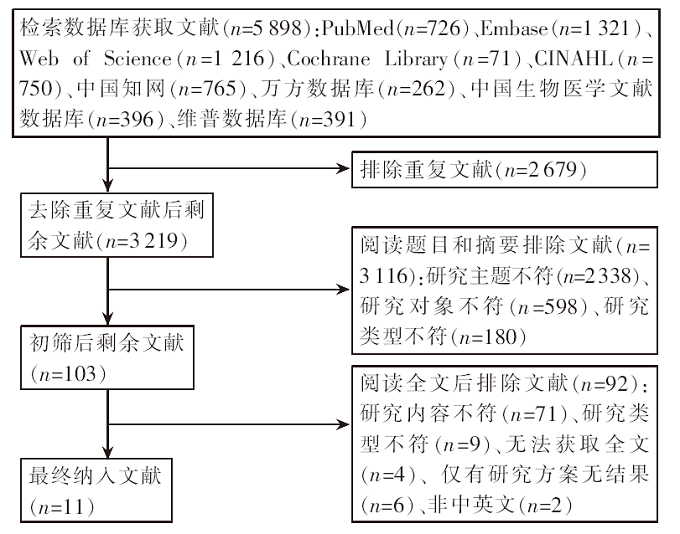
图1 文献筛选流程
Figure 1 Flow chart of literature screening
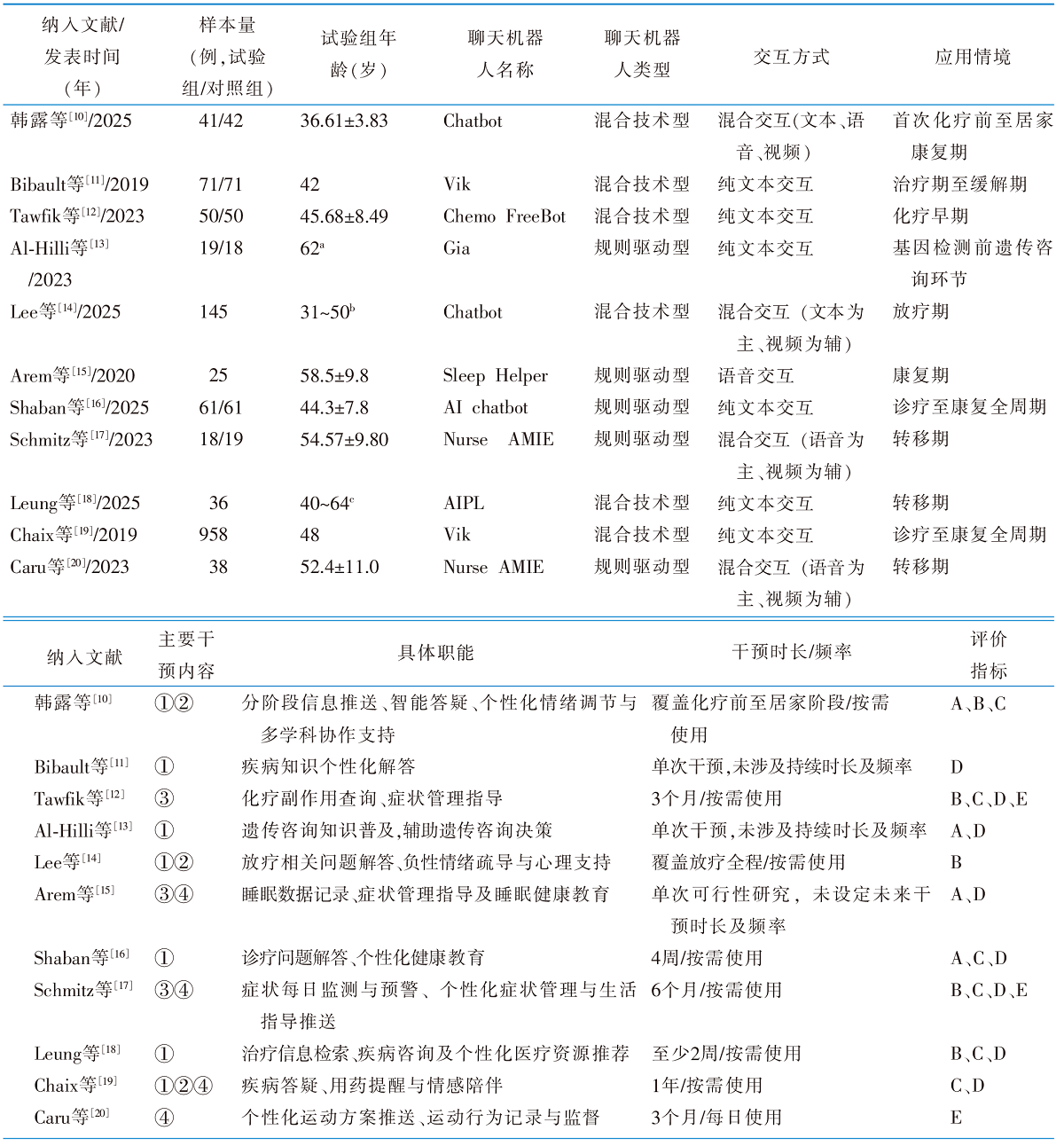 |
表1 纳入文献的基本特征(n=11)
Table 1 General characteristics of the included studies(n=11)
|
| [1] | Bray F, Laversanne M, Sung H, et al. Global cancer statistics 2022:GLOBOCAN estimates of incidence and mortality worldwide for 36 cancers in 185 countries[J]. CA Cancer J Clin, 2024, 74(3):229-263. |
| [2] |
Hui D, Hoge G, Bruera E. Models of supportive care in oncology[J]. Curr Opin Oncol, 2021, 33(4):259-266.
DOI PMID |
| [3] |
Lu XM, Geng WH, Liu FX, et al. Symptom clusters and sentinel symptoms in breast cancer survivors based on self-reported outcomes:a cross-sectional survey[J]. J Clin Nurs, 2025, 34(3):1072-1080.
DOI URL |
| [4] |
Miroševič Š, Prins J, Borštnar S, et al. Factors associated with a high level of unmet needs and their prevalence in the breast cancer survivors 1-5 years after post local treatment and(neo)adjuvant chemotherapy during the COVID-19:a cross-sectional study[J]. Front Psychol, 2022, 13:969918.
DOI URL |
| [5] |
Gomaa S, Posey J, Bashir B, et al. Feasibility of a text messaging-integrated and chatbot-interfaced self-management program for symptom control in patients with gastrointestinal cancer undergoing chemotherapy:pilot mixed methods study[J]. JMIR Form Res, 2023, 7:e46128.
DOI URL |
| [6] | McTear M. Conversational AI:dialogue systems,conversational agents,and chatbots[M]. Cham: Springer International Publishing, 2021. |
| [7] | Suppadungsuk S, Thongprayoon C, Miao J, et al. Exploring the potential of chatbots in critical care nephrology[J]. Medicines (Basel), 2023, 10(10):58. |
| [8] |
Wang A, Qian ZY, Briggs L, et al. The use of chatbots in oncological care:a narrative review[J]. Int J Gen Med, 2023, 16:1591-1602.
DOI URL |
| [9] |
Arksey H, O’Malley L. Scoping studies:towards a methodological framework[J]. Int J Soc Res Methodol, 2005, 8(1):19-32.
DOI URL |
| [10] | 韩露, 李金花, 陈婕君, 等. 聊天机器人生育指导在育龄期乳腺癌化疗患者中的应用效果[J]. 中国护理管理, 2025, 25(10):1567-1572. |
| Han L, Li JH, Chen JJ, et al. Application effect of chatbot fertility guidance in breast cancer patients of childbearing age undergoing chemotherapy[J]. Chin Nurs Manag, 2025, 25(10):1567-1572. | |
| [11] |
Bibault JE, Chaix B, Guillemassé A, et al. A chatbot versus physicians to provide information for patients with breast cancer:blind,randomized controlled noninferiority trial[J]. J Med Internet Res, 2019, 21(11):e15787.
DOI URL |
| [12] |
Tawfik E, Ghallab E, Moustafa A. A nurse versus a chatbot-the effect of an empowerment program on chemotherapy-related side effects and the self-care behaviors of women living with breast cancer:a randomized controlled trial[J]. BMC Nurs, 2023, 22(1):102.
DOI PMID |
| [13] |
Al-Hilli Z, Noss R, Dickard J, et al. A randomized trial comparing the effectiveness of pre-test genetic counseling using an artificial intelligence automated chatbot and traditional in-person genetic counseling in women newly diagnosed with breast cancer[J]. Ann Surg Oncol, 2023, 30(10):5990-5996.
DOI PMID |
| [14] |
Lee J, Byun HK, Kim YT, et al. A study on breast cancer patient care using chatbot and video education for radiation therapy:a randomized controlled trial[J]. Int J Radiat Oncol Biol Phys, 2025, 122(1):84-92.
DOI URL |
| [15] |
Arem H, Scott R, Greenberg D, et al. Assessing breast cancer survivors’ perceptions of using voice-activated technology to address insomnia:feasibility study featuring focus groups and in-depth interviews[J]. JMIR Cancer, 2020, 6(1):e15859.
DOI URL |
| [16] |
Shaban M, Osman YM, Mohamed NA, et al. Empowering breast cancer clients through AI chatbots:transforming knowledge and attitudes for enhanced nursing care[J]. BMC Nurs, 2025, 24(1):994.
DOI |
| [17] |
Schmitz KH, Kanski B, Gordon B, et al. Technology-based supportive care for metastatic breast cancer patients[J]. Support Care Cancer, 2023, 31(7):401.
DOI PMID |
| [18] |
Leung YW, So J, Sidhu A, et al. The extent to which artificial intelligence can help fulfill metastatic breast cancer patient healthcare needs:a mixed-methods study[J]. Curr Oncol, 2025, 32(3):145.
DOI URL |
| [19] |
Chaix B, Bibault JE, Pienkowski A, et al. When chatbots meet patients:one-year prospective study of conversations between patients with breast cancer and a chatbot[J]. JMIR Cancer, 2019, 5(1):e12856.
DOI URL |
| [20] |
Caru M, Abdullah S, Qiu L, et al. Women with metastatic breast cancer don’t just follow step-count trends,they exceed them:an exploratory study[J]. Breast Cancer Res Treat, 2023, 200(2):265-270.
DOI |
| [21] |
Wrightson-Hester AR, Anderson G, Dunstan J, et al. A rule-based conversational agent for mental health and well-being in young people:formative case series during the rise of generative AI[J]. JMIR Form Res, 2025, 9:e69841.
DOI URL |
| [22] |
Moore K, Zhong SJ, He Z, et al. A comprehensive solution to retrieval-based chatbot construction[J]. Comput Speech Lang, 2024, 83:101522.
DOI URL |
| [23] |
Modi ND, Menz BD, Awaty AA, et al. Assessing the system-instruction vulnerabilities of large language models to malicious conversion into health disinformation chatbots[J]. Ann Intern Med, 2025, 178(8):1172-1180.
DOI PMID |
| [24] |
Eriksson P, Gabrielsson-Järhult F, Thorold Nylin H, et al. Patients’ experiences with using a digital platform for chat-based consultation in primary health care in Sweden:qualitative study[J]. J Med Internet Res, 2025, 27:e77478.
DOI URL |
| [25] |
Rzepka C, Berger B, Hess T. Voice assistant vs. chatbot-examining the fit between conversational agents’ interaction modalities and information search tasks[J]. Inf Syst Front, 2022, 24(3):839-856.
DOI |
| [26] |
潘宸, 杨林宁, 杨艳. 乳腺癌患者健康信息需求的研究进展[J]. 中华护理杂志, 2022, 57(20):2547-2554.
DOI |
|
Pan C, Yang LN, Yang Y. Research progress on health information needs of breast cancer patients[J]. Chin J Nurs, 2022, 57(20):2547-2554.
DOI |
|
| [27] |
铁万琴, 张曦, 王永琦, 等. 乳腺癌患者化疗前后症状特征的潜在转变分析及护理对策[J]. 中华护理杂志, 2025, 60(2):193-200.
DOI |
|
Tie WQ, Zhang X, Wang YQ, et al. Analysis of potential changes in symptom characteristics of breast cancer patients before and after chemotherapy and nursing countermeasures[J]. Chin J Nurs, 2025, 60(2):193-200.
DOI |
|
| [28] |
Marziliano A, Miller SM, Fleisher LG, et al. Examining the impact of a multimedia intervention on decisional conflict and psychological distress among early-stage breast cancer patients:results from a nationwide RCT[J]. Transl Behav Med, 2023, 13(10):727-735.
DOI PMID |
| [29] |
徐雪芬, 王红燕, 郭萍萍, 等. 人工智能在慢性病患者健康管理中的应用进展[J]. 中华护理杂志, 2023, 58(9):1063-1067.
DOI |
| Xu XF, Wang HY, Guo PP, et al. Progress in the application of artificial intelligence in chronic disease health management[J]. Chin J Nurs, 2023, 58(9):1063-1067. |
| [1] | 李艳桃, 杨连招, 龙秀红, 陈玲, 高慧, 覃文婷, 朱芳慧, 罗雪儿. HIV感染者/AIDS患者创伤后成长体验的Meta整合[J]. 中华护理杂志, 2026, 61(9): 1261-1268. |
| [2] | 蔡卫新, 孙卫格, 张冉, 陈玮琪, 王毓盈, 王伊龙. 肌萎缩侧索硬化患者支持性照护需求的研究进展[J]. 中华护理杂志, 2026, 61(9): 1277-1283. |
| [3] | 李琰, 许翠萍. 聊天机器人在降低老年人社会疏离感中的应用进展及护理启示[J]. 中华护理杂志, 2026, 61(9): 1291-1296. |
| [4] | 黄璇, 郭书萍, カルデナス暁東, 谢云影, 王瀚敏, 张玉美, 刘焘丽, 李莉. 银屑病患者自我报告结局评估工具测量学属性的评价及护理启示[J]. 中华护理杂志, 2026, 61(8): 1117-1124. |
| [5] | 张滢, 刘淑娟, 王婧瑞, 马千蓉. 轻度认知障碍患者对虚拟现实技术使用体验的Meta整合[J]. 中华护理杂志, 2026, 61(8): 1125-1131. |
| [6] | 李秋桦, 傅桂芬, 蒋建华, 尹丹, 左静, 刘艳群. 可穿戴设备在炎症性肠病患者动态监测与管理中应用的范围综述[J]. 中华护理杂志, 2026, 61(8): 1132-1140. |
| [7] | 韩林, 杨丽娟, 李太东, 郑晓丽, 程敏, 郭琛, 郑培培. ICU机械通气清醒患者沟通体验的Meta整合[J]. 中华护理杂志, 2026, 61(7): 901-908. |
| [8] | 曾佳琳, 符冰, 杨泠韵, 江庆华. 头颈癌患者自我报告结局评估工具的评价及护理启示[J]. 中华护理杂志, 2026, 61(7): 986-994. |
| [9] | 王秀丽, 代春豪, 许梓婷, 李昊远, 冷敏敏, 张海博, 李晴, 杨丽娟. 运动干预在老年肌少性肥胖患者中应用的范围综述[J]. 中华护理杂志, 2026, 61(7): 995-1001. |
| [10] | 贺敬婷, 应燕萍, 陆秋芳, 赵慧函, 刘丽颖, 马含章, 张程. 多模态数据在护理领域中应用的范围综述[J]. 中华护理杂志, 2026, 61(7): 1002-1008. |
| [11] | 武玲, 吴波, 陈红, 古晨茜, 刘洋, 张春谨, 陈梦琪, 章青. 基于机器学习算法的成人术中低体温预测模型的范围综述[J]. 中华护理杂志, 2026, 61(6): 844-851. |
| [12] | 陈静, 王君君, 魏晓琼, 何欢, 孙秋怡, 唐莹, 韩莹, 何华云. 运动干预在幼年特发性关节炎患儿中应用的范围综述[J]. 中华护理杂志, 2026, 61(6): 858-864. |
| [13] | 温佳, 郭慧芳, 郭晶晶, 田云霞, 杨玥, 刘波. 维持性血液透析患者社会疏离感的范围综述[J]. 中华护理杂志, 2026, 61(5): 605-611. |
| [14] | 旷婉, 祝敏, 胡露红. 简短的正念干预在围手术期患者中应用的范围综述[J]. 中华护理杂志, 2026, 61(5): 707-714. |
| [15] | 中华医学会骨科学分会护理学组 执笔:梅迎雪, 韩梦月, 潘韩丽, 韩冰, 杨旭. 骨科大手术患者静脉血栓栓塞症预防专家共识[J]. 中华护理杂志, 2026, 61(4): 437-441. |
| 阅读次数 | ||||||
|
全文 |
|
|||||
|
摘要 |
|
|||||
