

中华护理杂志 ›› 2026, Vol. 61 ›› Issue (8): 1021-1027.DOI: 10.3761/j.issn.0254-1769.2026.08.002
刘幸( ), 范文祥, 周庭戌, 商临萍*()
收稿日期:2025-10-24
出版日期:2026-04-20
发布日期:2026-04-22
*通讯作者:
商临萍,E-mail:shanglp2017@sxmu.edu.cn作者简介:刘幸:女,硕士(博士在读),护士,E-mail:1363222062@qq.com刘幸:研究设计、资料收集与分析、论文撰写及修改;范文祥、周庭戌:资料收集与分析、论文修改;商临萍:研究指导、基金支持、论文审阅和修改
基金资助:
LIU Xing(), FAN Wenxiang, ZHOU Tingxu, SHANG Linping*()
Received:2025-10-24
Online:2026-04-20
Published:2026-04-22
* Corresponding author:
SHANG Linping,E-mail:shanglp2017@sxmu.edu.cnFunding program:摘要:
目的 探究慢性阻塞性肺疾病患者戒烟行为的促进与障碍因素,为构建精准化戒烟干预策略提供参考依据。 方法 采用目的抽样法,基于能力-机会-动机-行为模型,于2025年6—9月对山西省某三级甲等医院呼吸科接受治疗的21例慢性阻塞性肺疾病患者进行半结构式访谈,并采用Colaizzi 7步分析法进行资料分析。 结果 共提炼出2个主题及14个亚主题。慢性阻塞性肺疾病患者戒烟行为促进因素主要包括以下3个方面:能力因素为自我调节能力,机会因素为约束性环境、家庭支持,动机因素为疾病严重性感知、戒烟益处感知。障碍因素主要包括以下3个方面:能力因素为戒烟知识缺乏、改变既往习惯的自我效能匮乏,机会因素为社交压力、烟草环境暴露、职场压力,动机因素为疾病威胁感知弱化、戒烟认知偏差、消极心态、决策权衡。 结论 慢性阻塞性肺疾病患者戒烟行为相关影响因素复杂多样,医护人员需综合评估影响慢性阻塞性肺疾病患者戒烟行为改变的多方面因素,并据此制订针对性策略,以促进其戒烟行为的改变。
刘幸, 范文祥, 周庭戌, 商临萍. 慢性阻塞性肺疾病患者戒烟行为促进与障碍因素的质性研究[J]. 中华护理杂志, 2026, 61(8): 1021-1027.
LIU Xing, FAN Wenxiang, ZHOU Tingxu, SHANG Linping. Facilitators and barriers of smoking cessation in patients with chronic obstructive pulmonary disease:a qualitative study[J]. Chinese Journal of Nursing, 2026, 61(8): 1021-1027.
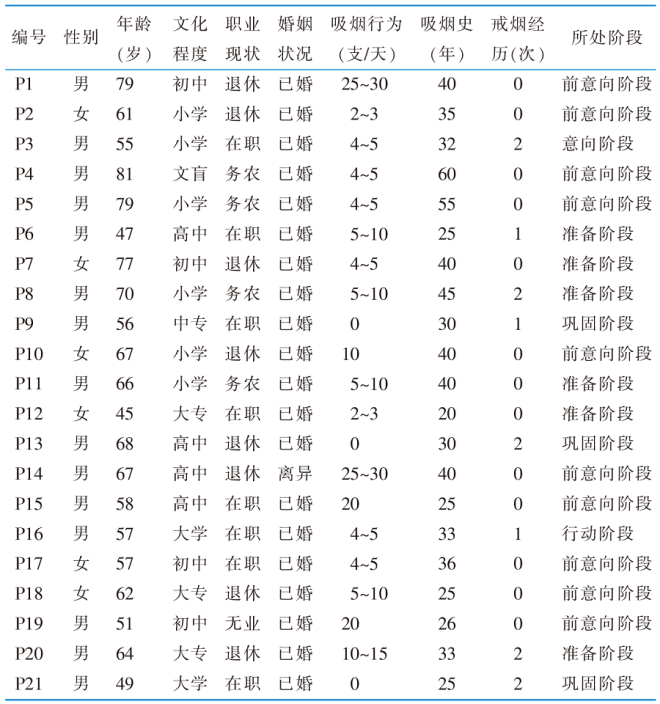 |
表1 受访者的一般资料(n=21)
Table 1 The characteristics of interviewees(n=21)
| |
| [1] |
Safiri S, Carson-Chahhoud K, Noori M, et al. Burden of chronic obstructive pulmonary disease and its attributable risk factors in 204 countries and territories,1990-2019:results from the glo-bal burden of disease study 2019[J]. BMJ, 2022, 378:e069679.
DOI URL |
| [2] |
Chen SM, Kuhn M, Prettner K, et al. The global economic bur-den of chronic obstructive pulmonary disease for 204 countries and territories in 2020-50:a health-augmented macroeconomic modelling study[J]. Lancet Glob Health, 2023, 11(8):e1183-e1193.
DOI URL |
| [3] | Global Initiative for Chronic Obstructive Lung Disease(GOLD). Global strategy for the diagnosis,managementand prevention of chronic obstructive pulmonary disease:2024 report[EB/OL].(2024-03-05)[2025-12-01]. https://goldcopd.org/2024-gold-report/. |
| [4] |
Pezzuto A, Stellato M, Catania G, et al. Short-term benefit of smoking cessation along with glycopirronium on lung function and respiratory symptoms in mild COPD patients:a retros-pective study[J]. J Breath Res, 2018, 12(4):046007.
DOI URL |
| [5] | 谢娜, 黎倩伶, 李勇辉. 戒烟干预对慢性阻塞性肺病的影响[J]. 中国药物依赖性杂志, 2021, 30(6):401-406. |
| Xie N, Li QL, Li YH. Effect of smoking cessation intervention on chronic obstructive pulmonary disease[J]. Chin J Drug De-pend, 2021, 30(6):401-406. | |
| [6] |
Liu C, Cheng W, Zeng YQ, et al. Different characteristics of ex-smokers and current smokers with COPD:a cross-sectional study in China[J]. Int J Chron Obstruct Pulmon Dis, 2020, 15:1613-1619.
DOI URL |
| [7] |
Bokemeyer F, Kiefer P, Schmidt L, et al. Facilitators and bar-riers to smoking cessation:a qualitative study among health professionals in Germany[J]. BMC Health Serv Res, 2025, 25(1):483.
DOI |
| [8] |
Fan MY, Fang YJ, Chen JN, et al. Investigation of smoking cessation status and its influencing factors in patients with chronic obstructive pulmonary disease[J]. Int J Chron Obstruct Pulmon Dis, 2024, 19:2763-2773.
DOI URL |
| [9] |
Michie S, van Stralen MM, West R. The behaviour change wheel:a new method for characterising and designing behaviour change interventions[J]. Implement Sci, 2011, 6:42.
DOI URL |
| [10] |
Qiu X, Liang JG, Luo L, et al. Patterns of social participation among older adults with chronic multimorbidity in the community:a qualitative study[J]. Int J Nurs Stud, 2025, 174:105279.
DOI URL |
| [11] |
王凤燕, 张冬莹, 梁振宇, 等. 面向全科医生的《慢性阻塞性肺疾病诊治指南(2021年修订版)》解读[J]. 中国全科医学, 2021, 24(29):3660-3663,3677.
DOI |
| Wang FY, Zhang DY, Liang ZY, et al. Interpretation of gui-deline for the diagnosis and treatment of COPD(2021 revi-sion) for general practitioners[J]. Chin Gen Pract, 2021, 24(29):3660-3663,3677. | |
| [12] | 田正, 何静春, 刘大军, 等. 慢性阻塞性肺疾病患者戒烟的促进和阻碍因素的质性研究[J]. 中国实用护理杂志, 2024, 40(26):2034-2040. |
| Tian Z, He JC, Liu DJ, et al. A qualitative study of facilitators and hindrances of smoking cessation in patients with chronic obstructive pulmonary disease[J]. Chin J Prac Nurs, 2024, 40(26):2034-2040. | |
| [13] | 刘明. Colaizzi七个步骤在现象学研究资料分析中的应用[J]. 护理学杂志, 2019, 34(11):90-92. |
| Liu M. Using an example to illustrate Colaizzi’s phenomeno-logical data analysis method[J]. J Nurs Sci, 2019, 34(11):90-92. | |
| [14] | 徐天梦, 赵洁, 常红, 等. 中青年脑卒中住院患者戒烟行为影响因素的质性研究[J]. 护理学杂志, 2018, 33(5):28-31. |
| Xu TM, Zhao J, Chang H, et al. A qualitative study on facilitators and barriers to smoking cessation among young-to-middle-aged stroke patients[J]. J Nurs Sci, 2018, 33(5):28-31. | |
| [15] |
Zhang YY, Tang WT, Zhang H, et al. Barriers and facilitators for smoking cessation in Chinese smokers with chronic obs-tructive pulmonary disease:a qualitative study[J]. Int J Chron Obstruct Pulmon Dis, 2022, 17:1107-1120.
DOI URL |
| [16] |
Jiang YY, Zhao Y, Tang PP, et al. The role of nurses in smoking cessation interventions for patients:a scoping review[J]. BMC Nurs, 2024, 23(1):803.
DOI |
| [17] |
Guo Y, Liu DY, Wang YJ, et al. Family functioning and nico-tine dependence among smoking fathers:a cross-sectional study[J]. BMC Public Health, 2023, 23(1):658.
DOI PMID |
| [18] | 向邱, 徐素琴, 张梦. 慢性阻塞性肺疾病患者基于计划行为理论的戒烟干预[J]. 护理学杂志, 2025, 40(7):1-6. |
| Xiang Q, Xu SQ, Zhang M. Application of smoking cessation intervention based on the Theory of Planned Behavior for patients with chronic obstructive pulmonary disease[J]. J Nurs Sci, 2025, 40(7):1-6. | |
| [19] | 施丽莎, 何菁, 杨经玉, 等. 基于COM-B框架从慢性阻塞性肺病患者视角探讨减少戒烟复吸的研究[J]. 医学信息, 2024, 37(3):40-47,60. |
| Shi LS, He J, Yang JY, et al. Study on reducing relapse from the perspective of patients with chronic obstructive pulmo-nary disease based on the COM-B framework[J]. J Med Inf, 2024, 37(3):40-47,60. | |
| [20] |
向邱, 张春瑾, 徐素琴, 等. 基于时机理论的戒烟干预对慢性阻塞性肺疾病患者的影响[J]. 中华护理杂志, 2020, 55(5):684-689.
DOI URL |
|
Xiang Q, Zhang CJ, Xu SQ, et al. Effects of a smoking cessation intervention based on Timing It Right in patients with chronic obstructive pulmonary disease[J]. Chin J Nurs, 2020, 55(5):684-689.
DOI URL |
|
| [21] |
Han MJ, Fu YP, Ji QY, et al. The effectiveness of theory-based smoking cessation interventions in patients with chronic obs-tructive pulmonary disease:a meta-analysis[J]. BMC Public Health, 2023, 23(1):1510.
DOI |
| [22] |
肖润希, 周英凤. 妊娠期糖尿病患者孕期参与体力活动促进及障碍因素的质性研究[J]. 中华护理杂志, 2025, 60(14):1683-1689.
DOI URL |
| Xiao RX, Zhou YF. Facilitators and barriers of physical activity participation among women with gestational diabetes mellitus during pregnancy:a qualitative study[J]. Chin J Nurs, 2025, 60(14):1683-1689. | |
| [23] |
秦春兰, 吴振云, 钱红英, 等. 慢性阻塞性肺疾病患者疾病自我控制体验的质性研究[J]. 中华护理杂志, 2025, 60(9):1093-1099.
DOI URL |
| Qin CL, Wu ZY, Qian HY, et al. Experiences of disease self-control among patients with chronic obstructive pulmonary disease:a qualitative study[J]. Chin J Nurs, 2025, 60(9):1093-1099. | |
| [24] |
张明月, 田玉梅, 高娥, 等. 慢性阻塞性肺疾病患者居家肺康复维持现状及影响因素研究[J]. 中华护理杂志, 2024, 59(17):2077-2083.
DOI URL |
|
Zhang MY, Tian YM, Gao E, et al. The study of the current status and influencing factors of the long-term maintenance of home-based pulmonary rehabilitation among COPD patients[J]. Chin J Nurs, 2024, 59(17):2077-2083.
DOI URL |
|
| [25] |
Stanczyk NE, Crutzen R, Bolman C, et al. Influence of delivery strategy on message-processing mechanisms and future adhe-rence to a Dutch computer-tailored smoking cessation inter-vention[J]. J Med Internet Res, 2013, 15(2):e28.
DOI URL |
| [26] |
Gagne SM, Fintelmann FJ, Flores EJ, et al. Evaluation of the informational content and readability of US lung cancer screening program websites[J]. JAMA Netw Open, 2020, 3(1):e1920431.
DOI URL |
| [27] | Hosler AS, Done DH, Michaels IH, et al. Longitudinal trends in tobacco availability,tobacco advertising,and ownership changes of food stores,Albany,New York,2003-2015[J]. Prev Chronic Dis, 2016, 13:E62. |
| [28] | 陈骁. 情绪效价对吸烟者抑制控制的影响[D]. 金华: 浙江师范大学, 2021. |
| Chen X. Influence of emotional valence on smokers’ inhibition and control[D]. Jinhua: Zhejiang Normal University, 2021. | |
| [29] |
单亚维, 陈维佳, 金丽娟, 等. 全膝关节置换术后患者康复行为演变的质性研究[J]. 中华护理杂志, 2020, 55(10):1470-1475.
DOI URL |
| Shan YW, Chen WJ, Jin LJ, et al. The development of rehabilitation behaviors of patients with total knee arthro-plasty:a qualitative study[J]. Chin J Nurs, 2020, 55(10):1470-1475. |
| [1] | 叶俊霜, 沈丽佳, 孟霞靓, 张玉姣, 蔡根莲, 邵碧云, 周亚辉, 张柳倩, 应金萍. 维持性血液透析患者对口腔衰弱认知和体验的质性研究[J]. 中华护理杂志, 2026, 61(9): 1215-1220. |
| [2] | 李艳桃, 杨连招, 龙秀红, 陈玲, 高慧, 覃文婷, 朱芳慧, 罗雪儿. HIV感染者/AIDS患者创伤后成长体验的Meta整合[J]. 中华护理杂志, 2026, 61(9): 1261-1268. |
| [3] | 冯丽, 郭沛然, 程蓉, 熊楚琴, 张志霞. 基于时机理论的运动康复方案在慢性阻塞性肺疾病患者中的应用效果评价[J]. 中华护理杂志, 2026, 61(8): 1013-1020. |
| [4] | 孙雪英, 李君, 李玉峰, 崔学芬, 李东盼, 程兆晶, 李响, 孙秀杰. 慢性阻塞性肺疾病患者健康管理旅程地图的研究[J]. 中华护理杂志, 2026, 61(8): 1028-1035. |
| [5] | 于云龙, 李双, 罗瑶, 张遂乐, 彭粤铭. 慢性阻塞性肺疾病急性加重期患者症状负担与疾病感知的相关性研究[J]. 中华护理杂志, 2026, 61(8): 1036-1042. |
| [6] | 舒适, 朱杉, 余艮珍, 张萍, 周晨曦, 彭维, 王珍. 特发性中枢性性早熟患儿患病体验与需求的质性研究[J]. 中华护理杂志, 2026, 61(8): 1074-1079. |
| [7] | 谭远俏, 刘伟宸, 王露秀, 张乐, 衡清漪, 凌瑛. 肺癌患者化疗前后社会支持变化对身体活动的影响研究[J]. 中华护理杂志, 2026, 61(8): 1088-1094. |
| [8] | 许国萍, 胡欢婷, 李丽, 金静芬, 蒋佳奖, 任英. 膝关节假体周围感染患者就医决策历程的质性研究[J]. 中华护理杂志, 2026, 61(8): 1101-1106. |
| [9] | 张滢, 刘淑娟, 王婧瑞, 马千蓉. 轻度认知障碍患者对虚拟现实技术使用体验的Meta整合[J]. 中华护理杂志, 2026, 61(8): 1125-1131. |
| [10] | 韩林, 杨丽娟, 李太东, 郑晓丽, 程敏, 郭琛, 郑培培. ICU机械通气清醒患者沟通体验的Meta整合[J]. 中华护理杂志, 2026, 61(7): 901-908. |
| [11] | 王阳阳, 杨旻斐, 黄科儿, 姚晓月, 赵燕祥, 李佳麒, 尹娜, 黄凌, 张菊. 老年创伤性脑损伤合并衰弱患者早期运动康复照护促进与阻碍因素的质性研究[J]. 中华护理杂志, 2026, 61(7): 939-946. |
| [12] | 管颖慧, 谢鑑辉, 欧阳雅琦, 徐乐, 田佳琦, 王琼. 1型糖尿病青少年向成人医疗过渡体验的Meta整合[J]. 中华护理杂志, 2026, 61(7): 979-985. |
| [13] | 刘晓, 李丽, 施忠英. 青少年神经性厌食患者及其父母出院准备体验及需求的质性研究[J]. 中华护理杂志, 2026, 61(6): 814-821. |
| [14] | 韩朝颖, 赵雅宁, 刘瑶, 李雪梅, 常学优, 李建民. 社区慢性病老年人内在能力与社会衰弱的相关性研究[J]. 中华护理杂志, 2026, 61(6): 829-835. |
| [15] | 徐晓静, 尚茜, 李娟, 张培培, 史素玲. 中青年肺癌化疗患者家庭参与式多模态运动干预方案的构建及应用研究[J]. 中华护理杂志, 2026, 61(5): 622-629. |
| 阅读次数 | ||||||
|
全文 |
|
|||||
|
摘要 |
|
|||||
