

中华护理杂志 ›› 2026, Vol. 61 ›› Issue (8): 1013-1020.DOI: 10.3761/j.issn.0254-1769.2026.08.001
• 慢性阻塞性肺疾病护理专题 • 下一篇
冯丽1( ), 郭沛然2, 程蓉2, 熊楚琴2, 张志霞2,*()
收稿日期:2025-12-09
出版日期:2026-04-20
发布日期:2026-04-22
*通讯作者:
张志霞,E-mail:zhangzhixia5827@126.com作者简介:冯丽:女,硕士,主管护师,E-mail:651286695@qq.com冯丽:研究设计与实施、论文撰写修改;郭沛然:文献整理、数据收集与整理;程蓉:统计学分析;熊楚琴:数据整理;张志霞:方案构建、研究指导、基金支持、论文审阅
基金资助:
FENG Li1(), GUO Peiran2, CHENG Rong2, XIONG Chuqin2, ZHANG Zhixia2,*()
Received:2025-12-09
Online:2026-04-20
Published:2026-04-22
* Corresponding author:
ZHANG Zhixia,E-mail:zhangzhixia5827@126.comFunding program:摘要:
目的 探索基于时机理论的运动康复方案在慢性阻塞性肺疾病患者中的应用效果,为开展精准化康复护理提供参考。 方法 采用便利抽样法,选取2024年11月—2025年7月在武汉市某三级甲等综合医院呼吸内科与老年科住院的84例患者为研究对象,按科室分为试验组与对照组,每组各42例患者。试验组在常规康复护理的基础上实施基于时机理论的运动康复方案,对照组接受常规康复护理,干预时长为3个月。比较干预前后两组的肺功能、运动耐力和干预前、干预1、3个月的自我护理水平和生活质量差异。 结果 试验组和对照组各40例患者完成研究。干预3个月后,试验组肺功能与运动耐力均优于对照组,差异具有统计学意义(P<0.05)。重复测量方差分析结果显示,两组干预前、干预1、3个月的自我护理水平与生活质量比较,组间和时间存在交互作用(P<0.001);简单效应分析结果显示,试验组干预1、3个月时的自我护理水平和生活质量均优于对照组,差异具有统计学意义(P<0.001)。 结论 实施基于时机理论的运动康复方案可改善慢性阻塞性肺疾病患者的肺功能,提升运动耐力与自我护理水平,从而进一步提高其生活质量。
冯丽, 郭沛然, 程蓉, 熊楚琴, 张志霞. 基于时机理论的运动康复方案在慢性阻塞性肺疾病患者中的应用效果评价[J]. 中华护理杂志, 2026, 61(8): 1013-1020.
FENG Li, GUO Peiran, CHENG Rong, XIONG Chuqin, ZHANG Zhixia. Evaluation of the application effect of an exercise rehabilitation program based on Timing It Right Theory in patients with chronic obstructive pulmonary disease[J]. Chinese Journal of Nursing, 2026, 61(8): 1013-1020.
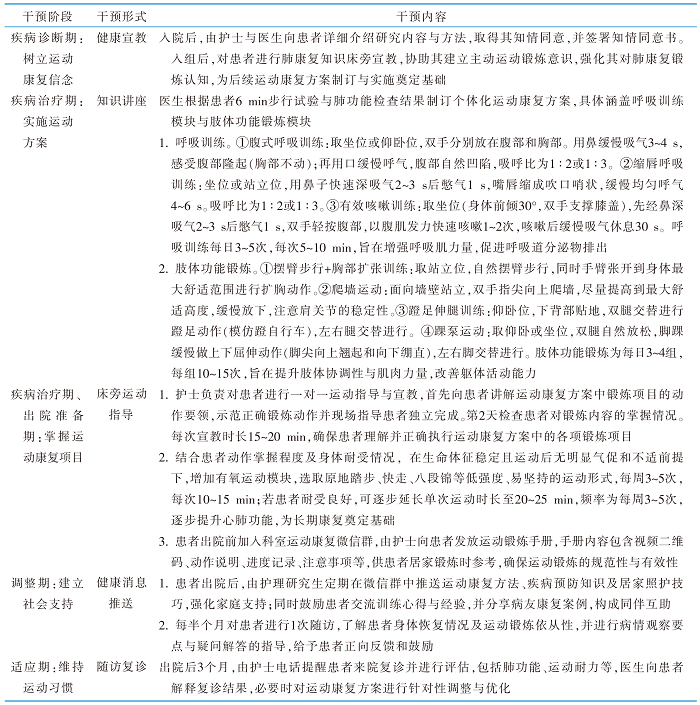 |
表1 基于时机理论的慢阻肺患者运动康复方案
Table 1 The exercise rehabilitation program for COPD patients based on Timing It Right theory
| |
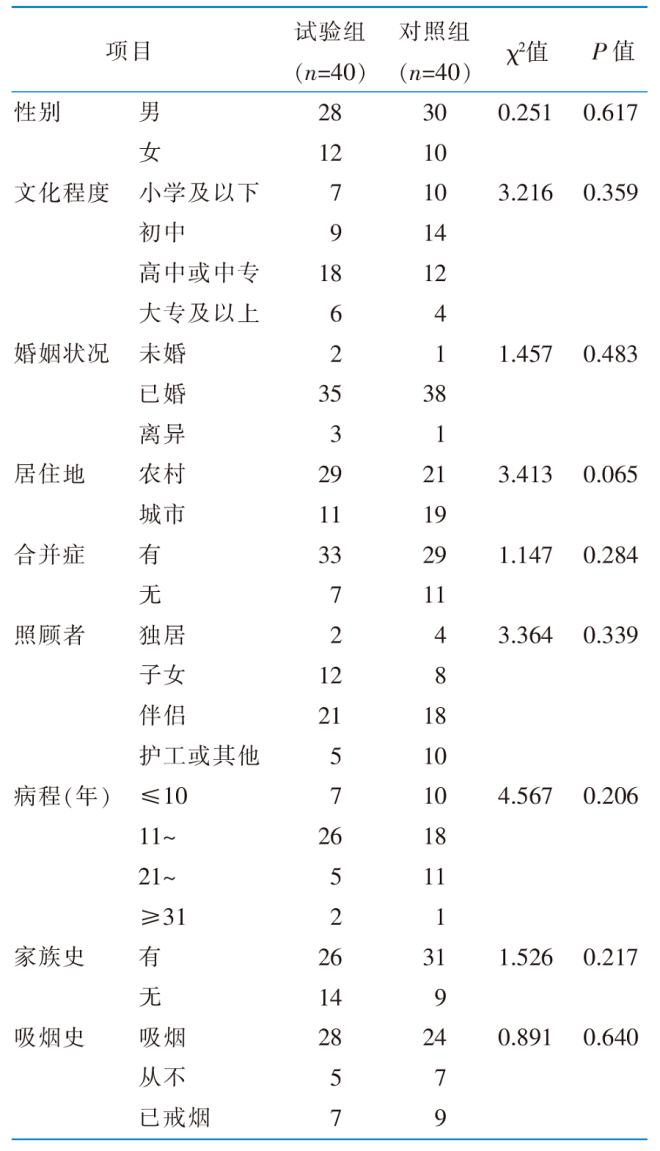 |
表2 两组一般资料的比较(例)
Table 2 Comparison of general information of 2 groups of patients(cases)
| |
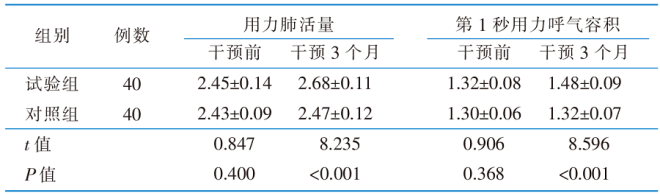 |
表3 两组肺功能的比较(L,$\bar{x}\pm s$)
Table 3 Comparison of pulmonary function levels between 2 groups of patients(L,$\bar{x}\pm s$)
| |
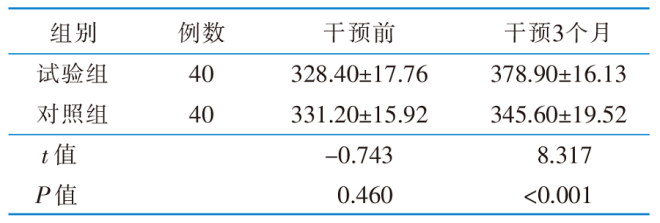 |
表4 两组6 min步行试验距离的比较(m,$\bar{x}\pm s$)
Table 4 Comparison of 6-minute walking distances of 2 groups of patients(m,$\bar{x}\pm s$)
| |
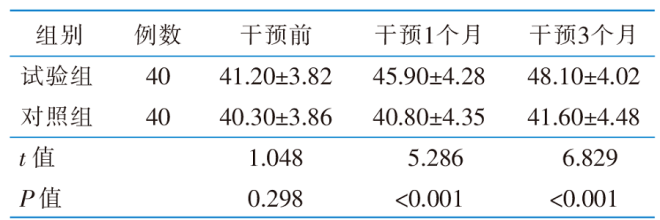 |
表5 两组干预前、干预1、3个月自我护理水平的比较(分,$\bar{x}\pm s$)
Table 5 Comparison of the self-care levels of 2 groups before the intervention,1 month after the intervention,and 3 months after the intervention(score,$\bar{x}\pm s$)
| |
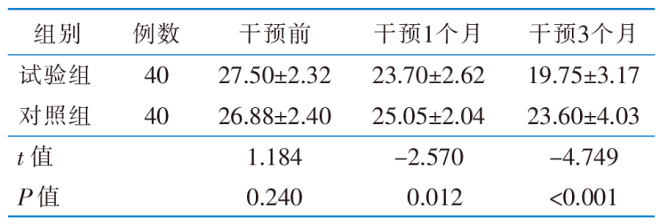 |
表6 两组干预前、干预1、3个月生活质量的比较(分,$\bar{x}\pm s$)
Table 6 Comparison of the quality of life between 2 groups before the intervention,1 month after the intervention,and 3 months after the intervention(score,$\bar{x}\pm s$)
| |
| [1] |
Agustí A, Celli BR, Criner GJ, et al. Global initiative for chro-nic obstructive lung disease 2023 report:gold executive sum-mary[J]. Eur Respir J, 2023, 61(4):2300239.
DOI URL |
| [2] |
GBD 2021 Causes of Death Collaborators. Global burden of 288 causes of death and life expectancy decomposition in 204 countries and territories and 811 subnational locations,1990-2021:a systematic analysis for the Global Burden of Disease Study 2021[J]. Lancet, 2024, 403(10440):2100-2132.
DOI URL |
| [3] |
Singh D, Agusti A, Anzueto A, et al. Global strategy for the diagnosis,management,and prevention of chronic obstructive lung disease:the GOLD science committee report 2019[J]. Eur Respir J, 2019, 53(5)1900164.
DOI URL |
| [4] | 乔晓笑, 王银萍, 李历涛, 等. 稳定期COPD合并肌少症患者多模式运动方案的构建及应用[J]. 护理学杂志, 2024, 39(16):1-7. |
| Qiao XX, Wang YP, Li LT, et al. Construction and application of a multi-component exercise program for stable COPD patients with sarcopenia[J]. J Nurs Sci, 2024, 39(16):1-7. | |
| [5] |
Jacobs DM, Noyes K, Zhao JW, et al. Early hospital readmis-sions after an acute exacerbation of chronic obstructive pulmonary disease in the nationwide readmissions database[J]. Ann Am Thorac Soc, 2018, 15(7):837-845.
DOI PMID |
| [6] |
张明月, 田玉梅, 高娥, 等. 慢性阻塞性肺疾病患者居家肺康复维持现状及影响因素研究[J]. 中华护理杂志, 2024, 59(17):2077-2083.
DOI URL |
|
Zhang MY, Tian YM, Gao E, et al. The study of the current status and influencing factors of the long-term maintenance of home-based pulmonary rehabilitation among COPD patients[J]. Chin J Nurs, 2024, 59(17):2077-2083.
DOI URL |
|
| [7] |
Cameron JI, Gignac MAM. “Timing it right”:a conceptual fra-mework for addressing the support needs of family caregivers to stroke survivors from the hospital to the home[J]. Patient Educ Couns, 2008, 70(3):305-314.
DOI PMID |
| [8] |
张梦月, 施颖辉, 章晓贤, 等. 基于时机理论的糖尿病视网膜病变手术患者护理干预方案的构建[J]. 中华护理杂志, 2023, 58(24):2957-2963.
DOI URL |
| Zhang MY, Shi YH, Zhang XX, et al. Construction of an inter-vention program for diabetic retinopathy patients undergoing surgery based on the theory of timing it right[J]. Chin J Nurs, 2023, 58(24):2957-2963. | |
| [9] | 陈佳洁, 朱渊, 沈兰. 以时机理论为基础的家庭护理干预对急性心肌梗死患者生活质量的影响[J]. 实用临床医药杂志, 2021, 25(11):101-105. |
| Chen JJ, Zhu Y, Shen L. Influence of family nursing interven-tion based on timing theory on quality of life in patients with acute myocardial infarction[J]. J Clin Med Pract, 2021, 25(11):101-105. | |
| [10] | 中华医学会呼吸病学分会慢性阻塞性肺疾病学组, 中国医师协会呼吸医师分会慢性阻塞性肺疾病工作委员会. 慢性阻塞性肺疾病诊治指南(2021年修订版)[J]. 中华结核和呼吸杂志, 2021, 44(3):170-205. |
| Chronic Obstructive Pulmonary Disease Group of the Respi-ratory Medicine Branch of the Chinese Medical Association, Chronic Obstructive Pulmonary Disease Working Committee of the Respiratory Medicine Branch of the Chinese Medical Association. Guidelines for the diagnosis and management of chronic obstructive pulmonary disease (revised version 2021)[J]. Chin J Tuberc Respir Dis, 2021, 44(3):170-205. | |
| [11] | 陈烁, 王琦, 王思敏, 等. 稳定期COPD病人肺康复锻炼依从性干预方案的构建及可行性研究[J]. 护理研究, 2024, 38(17):3024-3030. |
| Chen S, Wang Q, Wang SM, et al. Construction and feasibility study of pulmonary rehabilitation exercise compliance inter-vention program for patients with stable COPD[J]. Chin Nurs Res, 2024, 38(17):3024-3030. | |
| [12] |
谢琼华, 骆尹, 郝富杰, 等. 慢性阻塞性肺疾病患者家庭呼吸康复护理的最佳证据总结[J]. 中华护理杂志, 2023, 58(7):857-863.
DOI URL |
|
Xie QH, Luo Y, Hao FJ, et al. Best evidence summary for home-based pulmonary rehabilitation measures in patients with chronic obstructive pulmonary disease[J]. Chin J Nurs, 2023, 58(7):857-863.
DOI URL |
|
| [13] |
陈小瑜, 吴红霞, 赵倩, 等. 慢性阻塞性肺疾病患者抗阻运动的最佳证据总结[J]. 中华护理杂志, 2022, 57(17):2088-2094.
DOI URL |
|
Chen XY, Wu HX, Zhao Q, et al. Summary of best evidence of the resistance training in patients with chronic obstructive pulmonary disease[J]. Chin J Nurs, 2022, 57(17):2088-2094.
DOI URL |
|
| [14] |
汤婷, 刘扣英, 窦蓓, 等. 慢性阻塞性肺疾病患者自我护理量表的构建及信效度检验[J]. 中华护理杂志, 2021, 56(2):233-238.
DOI URL |
|
Tang T, Liu KY, Dou B, et al. Development of a Self-care Scale for Patients with Chronic Obstructive Pulmonary Disease and the test of its reliability and validity[J]. Chin J Nurs, 2021, 56(2):233-238.
DOI URL |
|
| [15] | 柴晶晶, 柳涛, 蔡柏蔷. 慢性阻塞性肺疾病评估测试中文版临床应用意义的评价[J]. 中华结核和呼吸杂志, 2011, 34(4):256-258. |
| Chai JJ, Liu T, Cai BQ. Evaluation of clinical significance of Chronic Obstructive Pulmonary Disease Assessment Test[J]. Chin J Tuberc Respir Dis, 2011, 34(4):256-258. | |
| [16] |
Liu K, Yu XJ, Cui XF, et al. Effects of proprioceptive neuro-muscular facilitation stretching combined with aerobic training on pulmonary function in COPD patients:a randomized controlled trial[J]. Int J Chron Obstruct Pulmon Dis, 2021, 16:969-977.
DOI URL |
| [17] |
Qian Y, Cai CT, Sun MQ, et al. Analyses of factors associated with acute exacerbations of chronic obstructive pulmonary disease:a review[J]. Int J Chron Obstruct Pulmon Dis, 2023, 18:2707-2723.
DOI URL |
| [18] |
范莹莹, 吕鹏鹏, 陈学昂, 等. 间断性抗阻锻炼在老年慢性阻塞性肺疾病患者中实施的效果评价[J]. 中华护理杂志, 2025, 60(15):1797-1803.
DOI URL |
|
Fan YY, Lü PP, Chen XA, et al. Application of fragmented resistance exercise in exercise rehabilitation of elderly patients with chronic obstructive pulmonary disease[J]. Chin J Nurs, 2025, 60(15):1797-1803.
DOI URL |
|
| [19] | 郎蔓, 李培君, 王婷, 等. 运动对慢性阻塞性肺疾病患者通气功能障碍的影响[J]. 中国老年学杂志, 2023, 43(1):205-211. |
| Lang M, Li PJ, Wang T, et al. Effect of exercise on ventilation dysfunction in patients with chronic obstructive pulmonary disease[J]. Chin J Gerontol, 2023, 43(1):205-211. | |
| [20] |
Marillier M, Bernard AC, Vergès S, et al. Locomotor muscles in COPD:the rationale for rehabilitative exercise training[J]. Front Physiol, 2020, 10:1590.
DOI URL |
| [21] |
Chen XM, Wen NY, Liu J, et al. Self-management and COPD:a qualitative study to explore the perceived barriers and recommendations to improve COPD management using the information-motivation-behavioral skills model[J]. NPJ Prim Care Respir Med, 2025, 35(1):34.
DOI |
| [22] |
Liu YY, Li YJ, Lu HB, et al. Effectiveness of Internet-based self-management interventions on pulmonary function in pa-tients with chronic obstructive pulmonary disease:a systematic review and meta-analysis[J]. J Adv Nurs, 2023, 79(8):2802-2814.
DOI URL |
| [23] |
Cravo A, Attar D, Freeman D, et al. The importance of self-management in the context of personalized care in COPD[J]. Int J Chron Obstruct Pulmon Dis, 2022, 17:231-243.
DOI URL |
| [1] | 刘幸, 范文祥, 周庭戌, 商临萍. 慢性阻塞性肺疾病患者戒烟行为促进与障碍因素的质性研究[J]. 中华护理杂志, 2026, 61(8): 1021-1027. |
| [2] | 孙雪英, 李君, 李玉峰, 崔学芬, 李东盼, 程兆晶, 李响, 孙秀杰. 慢性阻塞性肺疾病患者健康管理旅程地图的研究[J]. 中华护理杂志, 2026, 61(8): 1028-1035. |
| [3] | 于云龙, 李双, 罗瑶, 张遂乐, 彭粤铭. 慢性阻塞性肺疾病急性加重期患者症状负担与疾病感知的相关性研究[J]. 中华护理杂志, 2026, 61(8): 1036-1042. |
| [4] | 刘素玲, 蒋伟红, 李晓艳, 唐晓敏. 1例完全型Shone综合征合并重度肺动脉高压患儿的康复护理[J]. 中华护理杂志, 2026, 61(8): 1107-1111. |
| [5] | 刘晓, 李丽, 施忠英. 青少年神经性厌食患者及其父母出院准备体验及需求的质性研究[J]. 中华护理杂志, 2026, 61(6): 814-821. |
| [6] | 陈静, 王君君, 魏晓琼, 何欢, 孙秋怡, 唐莹, 韩莹, 何华云. 运动干预在幼年特发性关节炎患儿中应用的范围综述[J]. 中华护理杂志, 2026, 61(6): 858-864. |
| [7] | 中国抗癌协会肿瘤康复整合护理专业委员会, (执笔:钟就娣, 王影新, 刘飞, 潜艳, 康璐, 颜红艳, 杨明雪, 廖洋洋, 刘群红. 老年肺癌患者术后分级运动的专家共识[J]. 中华护理杂志, 2026, 61(5): 616-621. |
| [8] | 刘宁宁, 万玉峰, 田小红, 王英, 刘文君, 高丽莹. 老年慢性阻塞性肺疾病患者稳定期晨间症状的网络分析[J]. 中华护理杂志, 2026, 61(5): 646-652. |
| [9] | 黄静文, 叶桂连, 杨红, 钟美华, 周华青. 1例保留自主呼吸非气管插管麻醉下行心肺联合移植术患儿的早期康复护理[J]. 中华护理杂志, 2026, 61(5): 697-701. |
| [10] | 陈丹露, 陈茹, 单亚维, 施春香, 沈中鸣. 远程医疗技术在全膝关节置换患者术后运动康复中应用的范围综述[J]. 中华护理杂志, 2026, 61(4): 467-474. |
| [11] | 宋艳如, 杜云红, 岳圆圆, 陈小杰, 吴瑞芝, 王莉. 慢性阻塞性肺疾病患者社会隔离现状及影响因素的混合研究[J]. 中华护理杂志, 2026, 61(3): 353-360. |
| [12] | 蒋伟红, 唐晓敏, 周军, 朱佳佳, 金泓丞, 陈梦怡, 诸纪华. 4例心脏移植患儿的运动康复护理[J]. 中华护理杂志, 2026, 61(2): 249-253. |
| [13] | 中华护理学会呼吸护理专业委员会(执笔:曾妃, 兰美娟, 蔡凌云, 顾培培, 朱岩, 王衍蝶, 梁江淑渊). 儿童肺移植术后肺康复护理专家共识[J]. 中华护理杂志, 2026, 61(1): 46-52. |
| [14] | 廖荣荣, 许旺, 郑洲雪, 覃慧敏, 吴文, 唐丹喆. 1例脑机接口引导的主动康复在脑卒中恢复期偏瘫患者中的护理实践[J]. 中华护理杂志, 2026, 61(1): 121-124. |
| [15] | 阎寅至, 闻芳, 王敏, 周雪梅, 马金玲, 吴惠芳, 姚文英. 造血干细胞移植患儿运动康复分级护理方案的构建与应用研究[J]. 中华护理杂志, 2025, 60(9): 1036-1042. |
| 阅读次数 | ||||||
|
全文 |
|
|||||
|
摘要 |
|
|||||
