

中华护理杂志 ›› 2026, Vol. 61 ›› Issue (5): 598-604.DOI: 10.3761/j.issn.0254-1769.2026.05.003
庄珊珊*( ), 徐超凡, 施亚凤, 曹越秀, 吕颖
收稿日期:2025-07-31
出版日期:2026-03-10
发布日期:2026-03-05
*通讯作者:
庄珊珊,女,本科,主管护师,E-mail:zhuangss7174@163.com作者简介:本文作者:庄珊珊
基金资助:
ZHUANG Shanshan*(), XU Chaofan, SHI Yafeng, CAO Yuexiu, LÜ Ying
Received:2025-07-31
Online:2026-03-10
Published:2026-03-05
* Corresponding author:
ZHUANG Shanshan,E-mail:zhuangss7174@163.comFunding program:摘要:
目的 分析维持性血液透析(maintenance hemodialysis,MHD)患者社会疏离感的发展轨迹,并识别危险因素,为早期识别高危人群及制订个性化护理干预方案提供参考。方法 便利选取2022年6月—2024年12月在宁波市某三级甲等综合医院进行治疗的320例MHD患者作为调查对象。采用一般疏离感量表评估MHD患者的社会疏离感水平,分别于透析第1周和透析第1、3、6个月时进行测量,通过潜变量混合增长模型分析最优潜在类别模型数并进行分类命名,采用多因素Logistic回归分析潜在类别间的独立影响因素。 结果 最终回收有效问卷300份。社会疏离感分为3个潜在类别,即社会疏离感缓慢下降型(36.00%)、社会疏离感持续上升型(38.00%)及高社会疏离感持续型(26.00%)。多因素Logistic回归分析结果显示,年龄、婚姻状况、居住地、透析龄、合并慢性病、社会影响、疾病接受度、家庭关怀度为MHD患者社会疏离感发展轨迹的独立影响因素(均P<0.05)。 结论 MHD患者的社会疏离感发展轨迹存在异质性,提示临床医护人员可精准识别高危轨迹并实施差异化干预,减轻MHD患者的社会疏离感。
庄珊珊, 徐超凡, 施亚凤, 曹越秀, 吕颖. 维持性血液透析患者社会疏离感发展轨迹及其影响因素的研究[J]. 中华护理杂志, 2026, 61(5): 598-604.
ZHUANG Shanshan, XU Chaofan, SHI Yafeng, CAO Yuexiu, LÜ Ying. Identification and strategic analysis of risk factors for social alienation in maintenance hemodialysis patients based on latent variable mixed growth model[J]. Chinese Journal of Nursing, 2026, 61(5): 598-604.
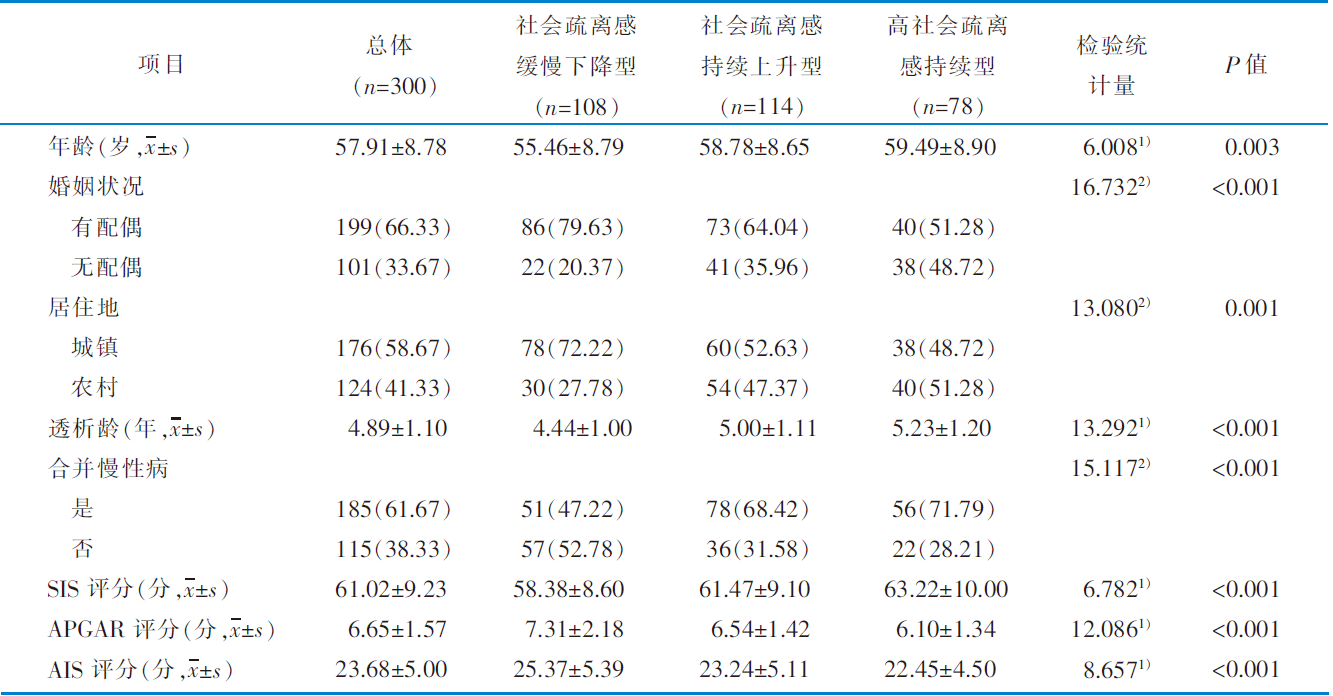 |
表1 调查对象的一般资料及社会疏离感发展轨迹的单因素分析(n=300)
Table 1 Univariate analysis of general data of respondents and developmental trajectory of social alienation(n=300)
| |
 |
表2 维持性血液透析患者社会疏离感发展的潜在类别拟合结果(n=300)
Table 2 Fitting results of latent classes for the development of social alienation in MHD patients(n=300)
| |
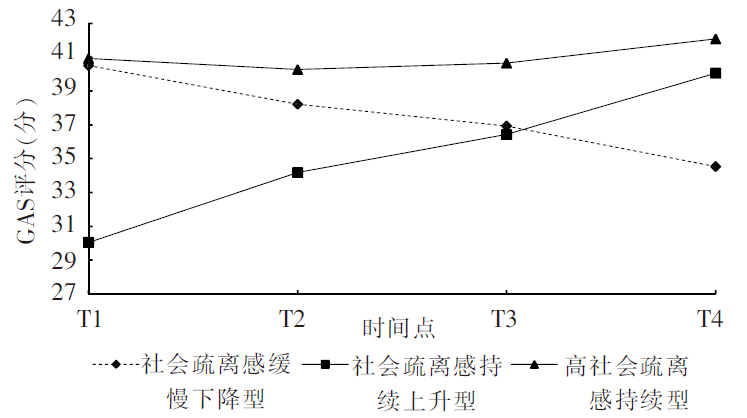
图1 维持性血液透析患者社会疏离感发展轨迹 注:T1为透析1周,T2~T4分别为透析1、3、6个月。GAS为一般疏离感量表。
Figure 1 Developmental trajectory diagram of social alienation in MHD patients
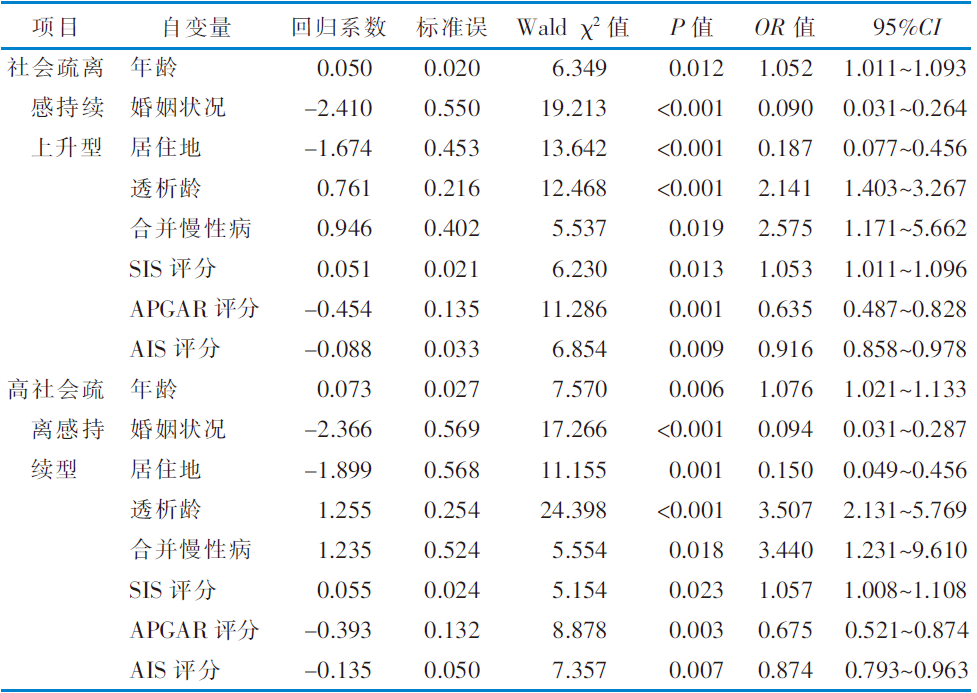 |
表3 维持性血液透析患者社会疏离感发展轨迹的多因素Logistic回归分析(n=300)
Table 3 Multivariate Logistic regression analysis of the developmental trajectory of social alienation in MHD patients(n=300)
| |
| [1] |
尹艳茹, 周洪昌, 刘梦如, 等. 老年维持性血液透析患者社会隔离现状的调查研究[J]. 中华护理杂志, 2023, 58(7):822-829.
DOI |
|
Yin YR, Zhou HC, Liu MR, et al. Status and influencing factors of social isolation in elderly patients with maintenance hemodialysis[J]. Chin J Nurs, 2023, 58(7):822-829.
DOI |
|
| [2] | 徐亚南, 栗文娟, 赵淑芹, 等. 中青年缓解期精神分裂症患者社会疏离体验的质性研究[J]. 中国全科医学, 2024, 27(9):1088-1094. |
| Xu YN, Li WJ, Zhao SQ, et al. A qualitative study on the social isolation experience of young and middle-aged patients with schizophrenia in remission[J]. Chin Gen Pract, 2024, 27(9):1088-1094. | |
| [3] | 刘忆冰, 张庆庆, 赵阳, 等. 维持性血液透析患者孤独感状况及影响因素分析[J]. 护理学杂志, 2022, 37(18):94-97. |
| Liu YB, Zhang QQ, Zhao Y, et al. Loneliness status and its influencing factors among maintenance hemodialysis patients[J]. J Nurs Sci, 2022, 37(18):94-97. | |
| [4] | 居丹丹, 贺娟凤, 曾铁英, 等. 社会疏离在中青年脑卒中患者领悟社会支持与负性情绪间的中介效应[J]. 现代临床护理, 2023, 22(7):1-7. |
| Ju DD, He JF, Zeng TY, et al. Mediating effect of social alienation on the perceived social support and negative emotion in young and middle-aged stroke patients[J]. Mod Clin Nurs, 2023, 22(7):1-7. | |
| [5] | 杨艳, 康福霞, 吴东娟, 等. 中老年前列腺癌根治术后患者社会疏离现状及其影响因素分析[J]. 现代临床护理, 2021, 20(3):22-26. |
| Yang Y, Kang FX, Wu DJ, et al. Social alienation and the influencing factors in old and middle-aged patients after radical prostatectomy[J]. Mod Clin Nurs, 2021, 20(3):22-26. | |
| [6] |
曾豪洁, 赵莉, 张陈, 等. 维持性血液透析患者自我调节疲劳的影响因素及路径分析[J]. 中华护理杂志, 2024, 59(2):156-164.
DOI |
|
Zeng HJ, Zhao L, Zhang C, et al. Analysis of influencing factors and pathway of self-regulatory fatigue in maintenance hemodialysis patients[J]. Chin J Nurs, 2024, 59(2):156-164.
DOI |
|
| [7] | 何丽芳, 李倩倩, 甘香. 病耻感对中青年维持性血液透析患者心理痛苦的影响[J]. 中华护理杂志, 2022, 57(21):2585-2591. |
| He LF, Li QQ, Gan X. Influence of stigma on psychological distress among young and middle-aged maintenance hemodialysis patients[J]. Chin J Nurs, 2022, 57(21):2585-2591. | |
| [8] |
上海慢性肾脏病早发现及规范化诊治与示范项目专家组, 高翔, 梅长林. 慢性肾脏病筛查诊断及防治指南[J]. 中国实用内科杂志, 2017, 37(1):28-34.
DOI |
| Expert Group on Early Detection,Diagnosis and Treatment System Construction of Chronic Kidney Disease in Shanghai, Gao X, Mei CL. Guideline for screening,diagnosis,prevention and treatment of chronic kidney disease[J]. Chin J Pract Intern Med, 2017, 37(1):28-34. | |
| [9] | 王家良. 临床流行病学:临床科研设计、测量与评价[M]. 4版. 上海: 上海科学技术出版社,2014:157-159. |
| Wang JL. Clinical epidemiology:design,measurement and evaluation of clinical scientific research[M]. 4th ed. Shanghai: Shanghai Scientific & Technical Publishers,2014:157-159. | |
| [10] |
Maddi SR, Kobasa SC, Hoover M. An alienation test[J]. J Humanist Psychol, 1979, 19(4):73-76.
DOI URL |
| [11] | 吴霜, 李彦章, 赵小淋, 等. 一般疏离感量表在老年人中的信度和效度分析[J]. 成都医学院学报, 2015, 10(6):751-754. |
| Wu S, Li YZ, Zhao XL, et al. Reliability and validity of the Generalized Social of Alienation Scale among the elderly[J]. J Chengdu Med Coll, 2015, 10(6):751-754. | |
| [12] |
Pan AW, Chung L, Fife BL, et al. Evaluation of the psychometrics of the Social Impact Scale:a measure of stigmatization[J]. Int J Rehabil Res, 2007, 30(3):235-238.
DOI URL |
| [13] | Smilkstein G. The family APGAR:a proposal for a family function test and its use by physicians[J]. J Fam Pract, 1978, 6(6):1231-1239. |
| [14] | 吕繁, 曾光, 刘松暖, 等. 家庭关怀度指数问卷测量脑血管病病人家庭功能的信度和效度研究[J]. 中国公共卫生, 1999, 15(11):987-988. |
| Lü F, Zeng G, Liu SN, et al. A study on validity and reliability of the family APGAR[J]. China Public Health, 1999, 15(11):987-988. | |
| [15] | 赵雯雯. 中文版疾病接受度量表的信效度评价[J]. 中华现代护理杂志, 2018, 24(22):2652-2655. |
| Zhao WW. Reliability and validity evaluation of the Chinese version of the Acceptance of Illness Scale[J]. Chin J Mod Nurs, 2018, 24(22):2652-2655. | |
| [16] |
董永泽, 许秀君, 沈华娟, 等. 维持性血液透析患者动静脉血管通路穿刺管理的最佳证据总结[J]. 中华护理杂志, 2023, 58(9):1135-1141.
DOI |
|
Dong YZ, Xu XJ, Shen HJ, et al. Summary of the best evidence for the management of arteriovenous access cannulation in maintenance hemodialysis patients[J]. Chin J Nurs, 2023, 58(9):1135-1141.
DOI |
|
| [17] | 陶颖, 焦成. 维持性血液透析患者社会疏离感现状及影响因素分析[J]. 上海护理, 2024, 24(11):43-46. |
| Tao Y, Jiao C. Analysis of current social alienation and its influencing factors in patients on maintenance hemodialysis[J]. Shanghai Nurs, 2024, 24(11):43-46. | |
| [18] | 郭晓晗, 马万里, 王冬燕, 等. 维持性血液透析患者社会疏离感的调查研究[J]. 护理学杂志, 2024, 39(4):79-82. |
| Guo XH, Ma WL, Wang DY, et al. A study of social alienation in maintenance hemodialysis patients[J]. J Nurs Sci, 2024, 39(4):79-82. | |
| [19] | Zhong HW, Zhang MB, Su XY, et al. Time-dependent factors influencing cardiocerebral vascular events in chronic hemodialysis patients:insights from a longitudinal study[J]. Med Sci Monit, 2023, 29:e941553. |
| [20] | 张连云, 朱蓓蓓, 刘红霞. 银屑病患者自我表露与社会疏离感和心理社会适应的相关性及其影响因素分析[J]. 中国医药导报, 2022, 19(19):94-97. |
| Zhang LY, Zhu BB, Liu HX. Correlation between self-disclosure and social alienation,psychosocial adjustment in patients with psoriasis and its influencing factors analysis[J]. Chin Med Her, 2022, 19(19):94-97. | |
| [21] | 吴红伦, 钟颖嫦, 王海燕, 等. 老年糖尿病患者社会疏离感现状及其影响因素研究[J]. 中华护理教育, 2023, 20(5):594-598. |
| Wu HL, Zhong YC, Wang HY, et al. Current status and influencing factors of social isolation in elderly diabetic patients[J]. Chin J Nurs Educ, 2023, 20(5):594-598. | |
| [22] |
杨凯文, 姜岳, 赵付英. 家庭访视在以家庭为单位的健康照顾中的实施效果研究[J]. 中国全科医学, 2021, 24(22):2880-2884.
DOI |
| Yang KW, Jiang Y, Zhao FY. Implementation effect of home care:a case report and exploratory home follow-up study[J]. Chin Gen Pract, 2021, 24(22):2880-2884. | |
| [23] | 郑寒, 易伟, 沈江山. 老年糖尿病肾病血液透析患者病耻感与家庭关怀度的关系[J]. 透析与人工器官, 2022, 33(1):96-98,108. |
| Zheng H, Yi W, Shen JS. The relationship between stigma and family care in elderly hemodialysis patients with diabetic nephropathy[J]. Chin J Dial Artif Organs, 2022, 33(1):96-98,108. | |
| [24] |
Mehrizi FZ, Bagherian S, Bahramnejad A, et al. The impact of logo-therapy on disease acceptance and self-awareness of patients undergoing hemodialysis;a pre-test-post-test research[J]. BMC Psychiatry, 2022, 22(1):670.
DOI |
| [25] | 田喜梅, 刘慧珍, 王俊霞, 等. 农村腹膜透析患者自我超越现状及影响因素分析[J]. 实用医技杂志, 2021, 28(8):959-962. |
| Tian XM, Liu HZ, Wang JX, et al. A survey of self-transcendence in rural patients undergoing peritoneal dialysis[J]. J Pract Med Tech, 2021, 28(8):959-962. |
| [1] | 中华护理学会静脉输液治疗专业委员会, 北京护理学会, (执笔:李佳, 李旭英, 覃惠英, 陈利芬, 吴珍明, 胡泽吟, 罗梦娜, 范育英, 吴嘉慧, 林宇萍, 王蕾, 孙文彦, 冯毕龙, 高伟, 李亚南, 侯罗娅, 李春燕. 中心静脉通路装置拔除护理专家共识[J]. 中华护理杂志, 2026, 61(9): 1157-1162. |
| [2] | 周霞, 马艳艳, 师正坤, 于海霞, 周艳, 胡红玲, 李莜, 陈思思, 张京慧. 隧道式经股静脉PICC置入术在困难静脉通路婴幼儿中的应用研究[J]. 中华护理杂志, 2026, 61(9): 1163-1170. |
| [3] | 黄萍, 李黎, 郭骊莉, 徐莹, 叶赟, 江淑芳. 与无针输液接头相关的导管相关性血流感染风险评估工具的构建与初步应用[J]. 中华护理杂志, 2026, 61(9): 1171-1179. |
| [4] | 李佳, 张玉玲, 邢乐, 张利峰, 牛秀峰, 许莉. 早产儿经上肢置入PICC尖端继发性异位风险预测模型的建立与验证[J]. 中华护理杂志, 2026, 61(9): 1180-1186. |
| [5] | 何娟, 赵蕾蕾, 叶冠军, 余艳芬, 傅晓君, 周琴. 1例双侧无名静脉及上腔静脉人工血管置换术后患者经上肢置入PICC的护理[J]. 中华护理杂志, 2026, 61(9): 1187-1191. |
| [6] | 梁江淑渊, 曾妃, 何鹏, 谢梦珊, 江悦, 蒋宗恒, 王建茗. 静脉-静脉体外膜肺氧合患者早期活动风险等级评估系统的构建及应用研究[J]. 中华护理杂志, 2026, 61(9): 1192-1199. |
| [7] | 陈晨, 顾肖, 郭凡, 王敏, 倪兴梅, 黄琴, 程念开. 3种衰弱评估工具对急诊老年创伤患者不良结局的预测价值[J]. 中华护理杂志, 2026, 61(9): 1200-1207. |
| [8] | 郑煜琳, 刘晋宁, 张静, 郭会敏, 谷艳梅, 张莉莉. 酒精性肝病患者肝移植术后再饮酒现状及其影响因素分析[J]. 中华护理杂志, 2026, 61(9): 1208-1214. |
| [9] | 叶俊霜, 沈丽佳, 孟霞靓, 张玉姣, 蔡根莲, 邵碧云, 周亚辉, 张柳倩, 应金萍. 维持性血液透析患者对口腔衰弱认知和体验的质性研究[J]. 中华护理杂志, 2026, 61(9): 1215-1220. |
| [10] | 王芸姣, 杨玉金, 郑春艳, 彭菲津, 王淑贞, 蒋喜露, 周为民, 王薇, 张娜. 糖尿病下肢动脉硬化闭塞症患者介入术后康复护理方案的构建及应用研究[J]. 中华护理杂志, 2026, 61(9): 1221-1229. |
| [11] | 杨明霞, 安冉, 臧金凤, 李春梅. 老年慢性病共病患者及照护者老老照护能力与自我忽视的相关性分析[J]. 中华护理杂志, 2026, 61(9): 1230-1236. |
| [12] | 梁和静, 许鹊, 史云霞, 祖金美, 黄文静, 杨春旭, 郭明华, 王磊. 颈动脉内膜剥脱术围手术期护理质量评价指标的构建[J]. 中华护理杂志, 2026, 61(9): 1237-1244. |
| [13] | 韩媛媛, 石玉竹, 尚文涵, 么莉. 870所三级甲等医院老年住院患者跌倒伤害发生现状与影响因素分析[J]. 中华护理杂志, 2026, 61(9): 1245-1252. |
| [14] | 夏云芳, 王洪, 崔岱, 付真真, 朱敏. 1例弥漫性毒性甲状腺肿合并超敏反应综合征青少年患者的护理[J]. 中华护理杂志, 2026, 61(9): 1253-1256. |
| [15] | 周益飞, 王海苹, 胡益环, 应莉, 罗松娜. 1例氢氟酸中毒并发呼吸心搏骤停患者的急救护理[J]. 中华护理杂志, 2026, 61(9): 1257-1260. |
| 阅读次数 | ||||||
|
全文 |
|
|||||
|
摘要 |
|
|||||
