

中华护理杂志 ›› 2026, Vol. 61 ›› Issue (5): 605-611.DOI: 10.3761/j.issn.0254-1769.2026.05.004
温佳1( ), 郭慧芳1,*(), 郭晶晶2, 田云霞1, 杨玥1, 刘波1
收稿日期:2025-07-08
出版日期:2026-03-10
发布日期:2026-03-05
*通讯作者:
郭慧芳,E-mail:guohuifang1223@163.com作者简介:温佳:女,本科(硕士在读),护士,E-mail:2431639241@qq.com
WEN Jia1(), GUO Huifang1,*(), GUO Jingjing2, TIAN Yunxia1, YANG Yue1, LIU Bo1
Received:2025-07-08
Online:2026-03-10
Published:2026-03-05
* Corresponding author:
GUO Huifang,E-mail:guohuifang1223@163.com摘要:
目的 对维持性血液透析患者社会疏离感心理体验、影响因素及干预方案进行范围综述,为后续深入研究和临床实践提供参考。 方法 依据范围综述研究框架,系统检索国内外维持性血液透析患者社会疏离感相关文献,检索时限为建库至2025年9月3日,对最终纳入文献进行汇总分析。 结果 共纳入16篇文献,其中质性研究3篇、横断面研究11篇、干预性研究2篇。体验主要为社交逃避、自我封闭、角色弱化及医疗体系中的孤立感;影响因素涵盖人口学资料、疾病相关资料、心理社会等多维度因素,不同研究结果之间存在异质性;干预方案涉及家庭参与式接受与实现疗法和小组式正念减压干预,两者均可缓解社会疏离并改善心理状态。 结论 维持性血液透析患者社会疏离感的研究仍处于起步阶段,影响因素复杂且机制尚不清晰,干预方案较为单一。未来需开发特异性评估工具,建立早期识别模型,拓展纵向与干预性研究,为维持性血液透析患者重返社会和改善生活质量提供依据。
温佳, 郭慧芳, 郭晶晶, 田云霞, 杨玥, 刘波. 维持性血液透析患者社会疏离感的范围综述[J]. 中华护理杂志, 2026, 61(5): 605-611.
WEN Jia, GUO Huifang, GUO Jingjing, TIAN Yunxia, YANG Yue, LIU Bo. Social isolation in maintenance hemodialysis patients:a scoping review[J]. Chinese Journal of Nursing, 2026, 61(5): 605-611.
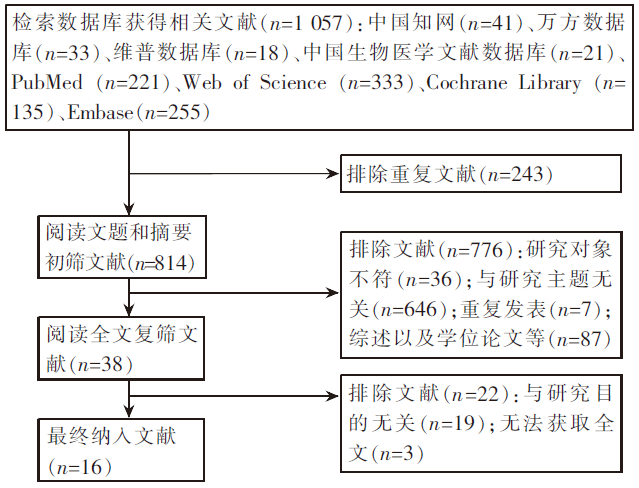
图1 文献筛选流程
Figure 1 Flow chart of literature screening
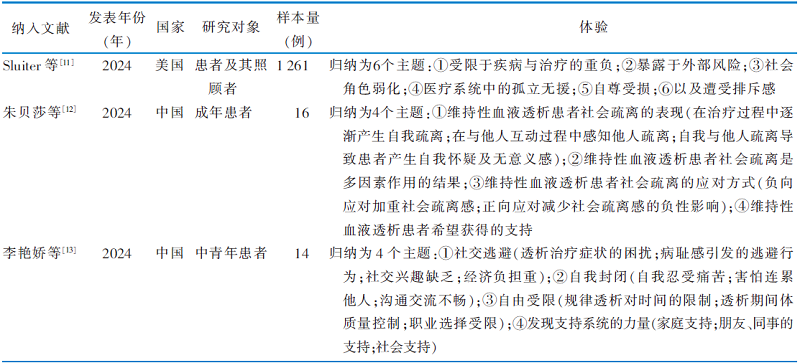 |
表1 MHD患者社会疏离感体验纳入文献特征(n=3)
Table 1 Characteristics of included studies on social isolation experiences among MHD patients(n=3)
| |
 |
表2 维持性血液透析患者社会疏离感影响因素纳入文献特征(n=11)
Table 2 Characteristics of included studies on factors influencing social isolation among MHD patients(n=11)
| |
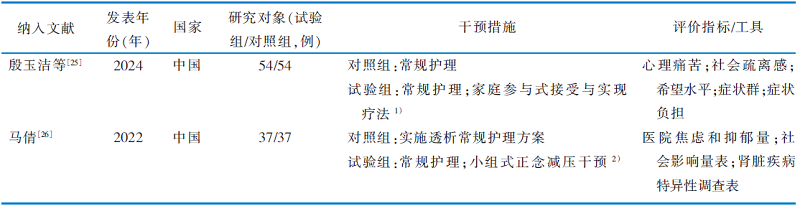 |
表3 维持性血液透析患者社会疏离感干预措施纳入文献特征(n=2)
Table 3 Characteristics of included studies on interventions for social isolation among MHD patients(n=2)
| |
| [1] | 张东洋, 张宁. 高通量血液透析在终末期肾病治疗中的临床效果及对炎性因子的影响[J]. 临床研究, 2024, 32(7):15-18. |
| Zhang DY, Zhang N. Clinical effect of high-flux hemodialysis and its impact on inflammatory factors in the treatment of end-stage renal disease[J]. Clin Res, 2024, 32(7):15-18. | |
| [2] |
张程, 王霄一, 杨文娟, 等. 双向社会支持在老年维持性血液透析患者中的应用研究[J]. 中华护理杂志, 2025, 60(7):813-819.
DOI |
|
Zhang C, Wang XY, Yang WJ, et al. Application of bidirectional social support in elderly patients with maintenance hemodialysis[J]. Chin J Nurs, 2025, 60(7):813-819.
DOI |
|
| [3] | Chen TG, Sun XF, Yang RR, et al. Care for end-stage kidney disease in China:progress,challenges,and recommendations[J]. Lancet Reg Health West Pac, 2025, 54(1):101268. |
| [4] | 王迪, 王鹏程, 张萍, 等. 终末期肾脏病维持性血液透析患者疾痛体验的研究[J]. 中国护理管理, 2023, 23(1):32-37. |
| Wang D, Wang PC, Zhang P, et al. Illness experience of maintenance hemodialysis patients with end-stage renal disease[J]. Chin Nurs Manag, 2023, 23(1):32-37. | |
| [5] | 吴宗壁, 徐明明, 韩晓苇, 等. 中青年维持性血液透析患者自我管理的研究进展[J]. 中华现代护理杂志, 2022, 28(20):2780-2785. |
| Wu ZB, Xu MM, Han XW, et al. Research progress on self-management of young and middle-aged maintenance hemodialysis patients[J]. Chin J Mod Nurs, 2022, 28(20):2780-2785. | |
| [6] | 龚爱萍, 徐骏, 吉小静, 等. 中青年血液透析患者重返工作准备度现状及影响因素分析[J]. 中华现代护理杂志, 2023, 29(36):4939-4944. |
| Gong AP, Xu J, Ji XJ, et al. Current status and influencing factors of readiness for young and middle-aged hemodialysis patients to return to work[J]. Chin J Mod Nurs, 2023, 29(36):4939-4944. | |
| [7] |
Qiu Y, Huang YY, Wang YX, et al. The role of socioeconomic status,family resilience,and social support in predicting psychological resilience among Chinese maintenance hemodialysis patients[J]. Front Psychiatry, 2021, 12:723344.
DOI URL |
| [8] |
董朝晖, 卢惠娟, 陆箴琦, 等. 癌症患者社会疏离体验的质性研究[J]. 中华护理杂志, 2023, 58(6):670-675.
DOI |
| Dong ZH, Lu HJ, Lu ZQ, et al. Experiences of social isolation in cancer patients:a qualitative research[J]. Chin J Nurs, 2023, 58(6):670-675. | |
| [9] |
王喜益, 叶志弘, 汤磊雯. 范围综述在护理领域的应用进展[J]. 中华护理杂志, 2019, 54(8):1259-1263.
DOI |
| Wang XY, Ye ZH, Tang LW. An integrative review of scoping review applied in nursing literature[J]. Chin J Nurs, 2019, 54(8):1259-1263. | |
| [10] | 仇如霞, 顾艳荭. 范围综述报告规范(PRISMA-ScR)的解读[J]. 中国循证医学杂志, 2022, 22(6):722-730. |
| Qiu RX, Gu YH. Interpretation of the PRISMA extension for scoping review(PRISMA-ScR)[J]. Chin J Evid Based Med, 2022, 22(6):722-730. | |
| [11] |
Sluiter A, Cazzolli R, Jaure A, et al. Experiences of social isolation and loneliness in chronic kidney disease:a secondary qualitative analysis[J]. Clin J Am Soc Nephrol, 2024, 19(11):1405-1416.
DOI URL |
| [12] | 朱贝莎, 吕思雨, 吴杭, 等. 维持性血液透析病人社会疏离体验的质性研究[J]. 护理研究, 2024, 38(9):1578-1584. |
| Zhu BS, Lü SY, Wu H, et al. Experience of social alienation in maintenance hemodialysis patients:a qualitative study[J]. Chin Nurs Res, 2024, 38(9):1578-1584. | |
| [13] | 李艳娇, 常立阳, 田荣荣, 等. 中青年维持性血液透析患者社会疏离体验的研究[J]. 中国护理管理, 2024, 24(8):1187-1192. |
| Li YJ, Chang LY, Tian RR, et al. Social alienation experience of young and middle-aged patients with maintenance hemodialysis:a qualitative study[J]. Chin Nurs Manag, 2024, 24(8):1187-1192. | |
| [14] | 杨小杰, 李春燕, 董万里, 等. 中青年维持性血液透析患者社会疏离的影响因素及路径分析[J]. 中国实用护理杂志, 2025, 41(21):1637-1645. |
| Yang XJ, Li CY, Dong WL, et al. Analysis of influencing factors and pathways of social alienation in young and middle-aged maintenance haemodialysis patients[J]. Chin J Pract Nurs, 2025, 41(21):1637-1645. | |
| [15] |
何娟. 维持性血液透析患者社会疏离现状及其影响因素分析[J]. 心理月刊, 2025, 20(7):66-69.
DOI |
| He J. Analysis of the current situation and influencing factors of social isolation in maintenance hemodialysis patients[J]. Psychol Mon, 2025, 20(7):66-69. | |
| [16] |
Wang GN, Dong J, Zhu N, et al. Development and validation of a social alienation predictive model for older maintenance hemodialysis patients based on latent profile analysis:a cross-sectional study[J]. BMC Geriatr, 2024, 24(1):495.
DOI |
| [17] | 徐滢佳, 谢松洪, 卢燕, 等. 维持性血液透析患者社会疏离感现状及影响因素研究[J]. 护理学杂志, 2024, 39(7):86-90. |
| Xu YJ, Xie SH, Lu Y, et al. Social alienation and its influencing factors among patients undergoing maintenance hemodialysis[J]. J Nurs Sci, 2024, 39(7):86-90. | |
| [18] | 郭晓晗, 马万里, 王冬燕, 等. 维持性血液透析患者社会疏离感的调查研究[J]. 护理学杂志, 2024, 39(4):79-82. |
| Guo XH, Ma WL, Wang DY, et al. A study of social alienation in maintenance hemodialysis patients[J]. J Nurs Sci, 2024, 39(4):79-82. | |
| [19] | 曹婷, 张莉, 刘俏玲, 等. 维持性血液透析病人社会疏离感现状及其影响因素分析[J]. 全科护理, 2024, 22(21):4137-4141. |
| Cao T, Zhang L, Liu QL, et al. Analysis of social alienation and its influencing factors in maintenance hemodialysis patients[J]. Chin Gen Pract Nurs, 2024, 22(21):4137-4141. | |
| [20] | 陶颖, 焦成. 维持性血液透析患者社会疏离感现状及影响因素分析[J]. 上海护理, 2024, 24(11):43-46. |
| Tao Y, Jiao C. Analysis of current social alienation and its influencing factors in patients on maintenance hemodialysis[J]. Shanghai Nurs, 2024, 24(11):43-46. | |
| [21] | 纪静, 温美玲, 刘云. 青岛市某医院长期血液透析患者社会疏离的调查研究[J]. 齐鲁护理杂志, 2024, 30(13):78-81. |
| Ji J, Wen ML, Liu Y. Investigation on social alienation of long-term hemodialysis patients in a hospital in Qingdao[J]. Qilu J Nurs, 2024, 30(13):78-81. | |
| [22] |
尹艳茹, 周洪昌, 刘梦如, 等. 老年维持性血液透析患者社会隔离现状的调查研究[J]. 中华护理杂志, 2023, 58(7):822-829.
DOI |
|
Yin YR, Zhou HC, Liu MR, et al. Status and influencing factors of social isolation in elderly patients with maintenance hemodialysis[J]. Chin J Nurs, 2023, 58(7):822-829.
DOI |
|
| [23] | 刘忆冰, 侯铭, 蒋宇, 等. 维持性血液透析患者社会隔离现状及影响因素分析[J]. 中国实用护理杂志, 2023, 39(19):1463-1469. |
| Liu YB, Hou M, Jiang Y, et al. Analysis of the current situation and factors influencing social isolation of maintenance hemodialysis patients[J]. Chin J Pract Nurs, 2023, 39(19):1463-1469. | |
| [24] | 秦金雪, 宗晓佳, 高宏华. 维持性血液透析患者社会疏离感现状及与自我表露、社会支持的相关性分析[J]. 中国实用护理杂志, 2023, 39(2):119-125. |
| Qin JX, Zong XJ, Gao HH. Investigation on the status quo of social alienation in maintenance hemodialysis patients and its correlation with self disclosure and social support[J]. Chin J Pract Nurs, 2023, 39(2):119-125. | |
| [25] | 殷玉洁, 张甜, 郭田田, 等. 家庭参与式接受与实现疗法对维持性血液透析终末期肾病患者的影响[J]. 河南医学研究, 2024, 33(20):3821-3824. |
| Yin YJ, Zhang T, Guo TT, et al. The impact of family-participatory acceptance and realization therapy on patients with end-stage renal disease undergoing maintenance hemodialysis[J]. Henan Med Res, 2024, 33(20):3821-3824. | |
| [26] | 马倩. 小组式正念减压干预在维持性血液透析患者中的应用效果探讨[J]. 中国临床新医学, 2022, 15(8):761-764. |
| Ma Q. Exploration on the application effect of group-based mindfulness-based stress reduction intervention in maintenance hemodialysis patients[J]. Chin J New Clin Med, 2022, 15(8):761-764. | |
| [27] |
Charlson ME, Carrozzino D, Guidi J, et al. Charlson comorbidity index:a critical review of clinimetric properties[J]. Psychother Psychosom, 2022, 91(1):8-35.
DOI PMID |
| [28] |
Godfrey E, Wileman V, Galea Holmes M, et al. Physical therapy informed by acceptance and commitment therapy(PACT) versus usual care physical therapy for adults with chronic low back pain:a randomized controlled trial[J]. J Pain, 2020, 21(1/2):71-81.
DOI URL |
| [29] |
Hu XS, Beard K, Sherbel MC, et al. Brain mechanisms of virtual reality breathing versus traditional mindful breathing in pain modulation:observational functional near-infrared spectroscopy study[J]. J Med Internet Res, 2021, 23(10):e27298.
DOI URL |
| [30] | 陆艳, 马婧, 虞慧君, 等. 正念减压疗法在胎儿异常引产孕产妇及其配偶中的应用[J]. 中华现代护理杂志, 2023, 29(8):1089-1092. |
| Lu Y, Ma J, Yu HJ, et al. Effects of mindfulness-based stress reduction in pregnant women with abnormal fetal induced labor and their spouses[J]. Chin J Mod Nurs, 2023, 29(8):1089-1092. | |
| [31] |
Wang Y, Qiu Y, Ren L, et al. Social support,family resilience and psychological resilience among maintenance hemodialysis patients:a longitudinal study[J]. BMC Psychiatry, 2024, 24(1):76.
DOI |
| [1] | 中华护理学会静脉输液治疗专业委员会, 北京护理学会, (执笔:李佳, 李旭英, 覃惠英, 陈利芬, 吴珍明, 胡泽吟, 罗梦娜, 范育英, 吴嘉慧, 林宇萍, 王蕾, 孙文彦, 冯毕龙, 高伟, 李亚南, 侯罗娅, 李春燕. 中心静脉通路装置拔除护理专家共识[J]. 中华护理杂志, 2026, 61(9): 1157-1162. |
| [2] | 周霞, 马艳艳, 师正坤, 于海霞, 周艳, 胡红玲, 李莜, 陈思思, 张京慧. 隧道式经股静脉PICC置入术在困难静脉通路婴幼儿中的应用研究[J]. 中华护理杂志, 2026, 61(9): 1163-1170. |
| [3] | 黄萍, 李黎, 郭骊莉, 徐莹, 叶赟, 江淑芳. 与无针输液接头相关的导管相关性血流感染风险评估工具的构建与初步应用[J]. 中华护理杂志, 2026, 61(9): 1171-1179. |
| [4] | 李佳, 张玉玲, 邢乐, 张利峰, 牛秀峰, 许莉. 早产儿经上肢置入PICC尖端继发性异位风险预测模型的建立与验证[J]. 中华护理杂志, 2026, 61(9): 1180-1186. |
| [5] | 何娟, 赵蕾蕾, 叶冠军, 余艳芬, 傅晓君, 周琴. 1例双侧无名静脉及上腔静脉人工血管置换术后患者经上肢置入PICC的护理[J]. 中华护理杂志, 2026, 61(9): 1187-1191. |
| [6] | 梁江淑渊, 曾妃, 何鹏, 谢梦珊, 江悦, 蒋宗恒, 王建茗. 静脉-静脉体外膜肺氧合患者早期活动风险等级评估系统的构建及应用研究[J]. 中华护理杂志, 2026, 61(9): 1192-1199. |
| [7] | 陈晨, 顾肖, 郭凡, 王敏, 倪兴梅, 黄琴, 程念开. 3种衰弱评估工具对急诊老年创伤患者不良结局的预测价值[J]. 中华护理杂志, 2026, 61(9): 1200-1207. |
| [8] | 郑煜琳, 刘晋宁, 张静, 郭会敏, 谷艳梅, 张莉莉. 酒精性肝病患者肝移植术后再饮酒现状及其影响因素分析[J]. 中华护理杂志, 2026, 61(9): 1208-1214. |
| [9] | 叶俊霜, 沈丽佳, 孟霞靓, 张玉姣, 蔡根莲, 邵碧云, 周亚辉, 张柳倩, 应金萍. 维持性血液透析患者对口腔衰弱认知和体验的质性研究[J]. 中华护理杂志, 2026, 61(9): 1215-1220. |
| [10] | 王芸姣, 杨玉金, 郑春艳, 彭菲津, 王淑贞, 蒋喜露, 周为民, 王薇, 张娜. 糖尿病下肢动脉硬化闭塞症患者介入术后康复护理方案的构建及应用研究[J]. 中华护理杂志, 2026, 61(9): 1221-1229. |
| [11] | 杨明霞, 安冉, 臧金凤, 李春梅. 老年慢性病共病患者及照护者老老照护能力与自我忽视的相关性分析[J]. 中华护理杂志, 2026, 61(9): 1230-1236. |
| [12] | 梁和静, 许鹊, 史云霞, 祖金美, 黄文静, 杨春旭, 郭明华, 王磊. 颈动脉内膜剥脱术围手术期护理质量评价指标的构建[J]. 中华护理杂志, 2026, 61(9): 1237-1244. |
| [13] | 韩媛媛, 石玉竹, 尚文涵, 么莉. 870所三级甲等医院老年住院患者跌倒伤害发生现状与影响因素分析[J]. 中华护理杂志, 2026, 61(9): 1245-1252. |
| [14] | 夏云芳, 王洪, 崔岱, 付真真, 朱敏. 1例弥漫性毒性甲状腺肿合并超敏反应综合征青少年患者的护理[J]. 中华护理杂志, 2026, 61(9): 1253-1256. |
| [15] | 周益飞, 王海苹, 胡益环, 应莉, 罗松娜. 1例氢氟酸中毒并发呼吸心搏骤停患者的急救护理[J]. 中华护理杂志, 2026, 61(9): 1257-1260. |
| 阅读次数 | ||||||
|
全文 |
|
|||||
|
摘要 |
|
|||||
