

中华护理杂志 ›› 2026, Vol. 61 ›› Issue (14): 1930-1938.DOI: 10.3761/j.issn.0254-1769.2026.14.008
王沙沙( ), 郭辉, 陈景, 李德宇*()
收稿日期:2026-01-27
出版日期:2026-07-20
发布日期:2026-07-17
*通讯作者:
李德宇,E-mail:hnrmyy018@163.com作者简介:王沙沙:女,本科,主管护师,E-mail:sanmenxialusi123@163.com王沙沙:研究设计及实施、数据收集、论文撰写及修改;郭辉:研究实施、数据收集、统计分析;陈景:数据收集、论文修改;李德宇:研究指导、技术或材料支持、论文审阅
WANG Shasha(), GUO Hui, CHEN Jing, LI Deyu*()
Received:2026-01-27
Online:2026-07-20
Published:2026-07-17
* Corresponding author:
LI Deyu,E-mail:hnrmyy018@163.com摘要:
目的 探讨沉浸式虚拟现实可视化健康教育在择期肝切除术患者中的应用效果,为改善围手术期患者术前焦虑提供参考。 方法 采用便利抽样法,选取2024年4月—2025年7月在郑州市某三级甲等医院肝胆胰腺外科行择期肝切除术的112例患者作为研究对象,将其按入院时间分成试验组(2024年12月—2025年7月)和对照组(2024年4—11月),每组各纳入56例。试验组开展沉浸式虚拟现实可视化健康教育,对照组开展常规术前健康教育。比较干预后两组术前焦虑、生理应激指标、术后疼痛程度、术后运动恐惧程度及术后早期康复相关指标的差异。 结果 试验组最终纳入54例,对照组最终纳入55例。试验组术前30 min焦虑评分低于对照组,麻醉诱导前平均动脉压及心率低于对照组,差异均有统计学意义(P<0.05)。试验组首次下床时间短于对照组,术后24 h、48 h、5 d静息时疼痛评分及48 h镇痛泵按压次数均低于对照组,术后48 h、5 d运动恐惧评分均低于对照组,差异均有统计学意义(P<0.05)。 结论 开展沉浸式虚拟现实可视化健康教育可缓解择期肝切除术患者术前焦虑与生理应激反应,降低术后疼痛及运动恐惧,缩短首次下床时间。
王沙沙, 郭辉, 陈景, 李德宇. 沉浸式虚拟现实可视化健康教育在择期肝切除术患者中的应用研究[J]. 中华护理杂志, 2026, 61(14): 1930-1938.
WANG Shasha, GUO Hui, CHEN Jing, LI Deyu. Application of immersive virtual reality visualization health education in patients undergoing elective hepatectomy[J]. Chinese Journal of Nursing, 2026, 61(14): 1930-1938.
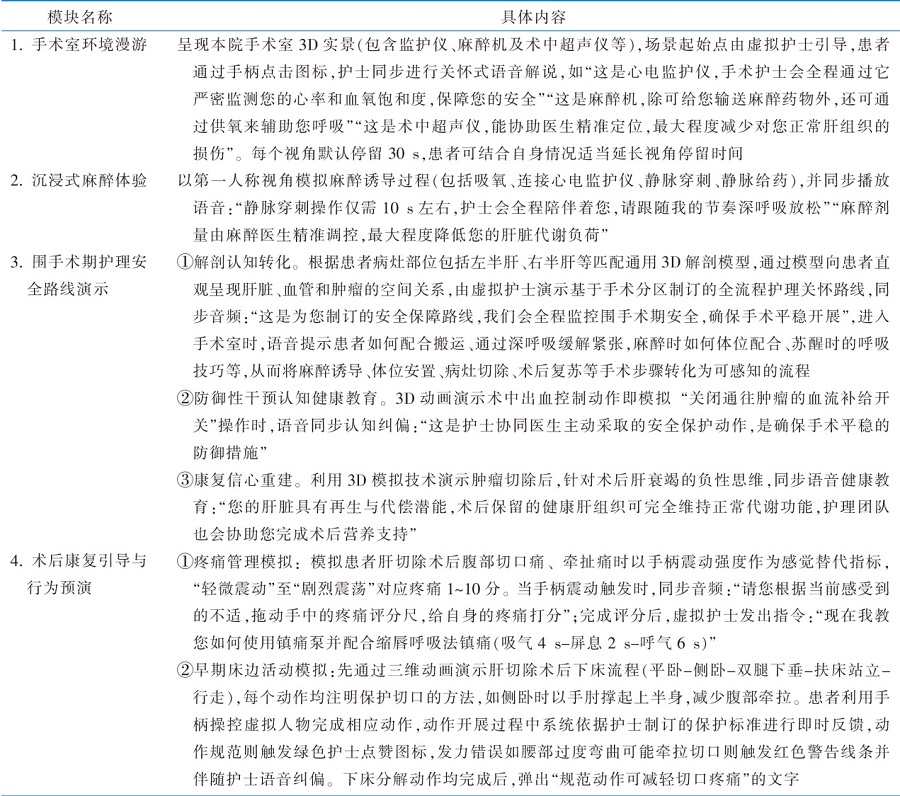 |
表1 沉浸式虚拟现实可视化健康教育模块
Table 1 The modules of immersive virtual reality visualized health education
| |
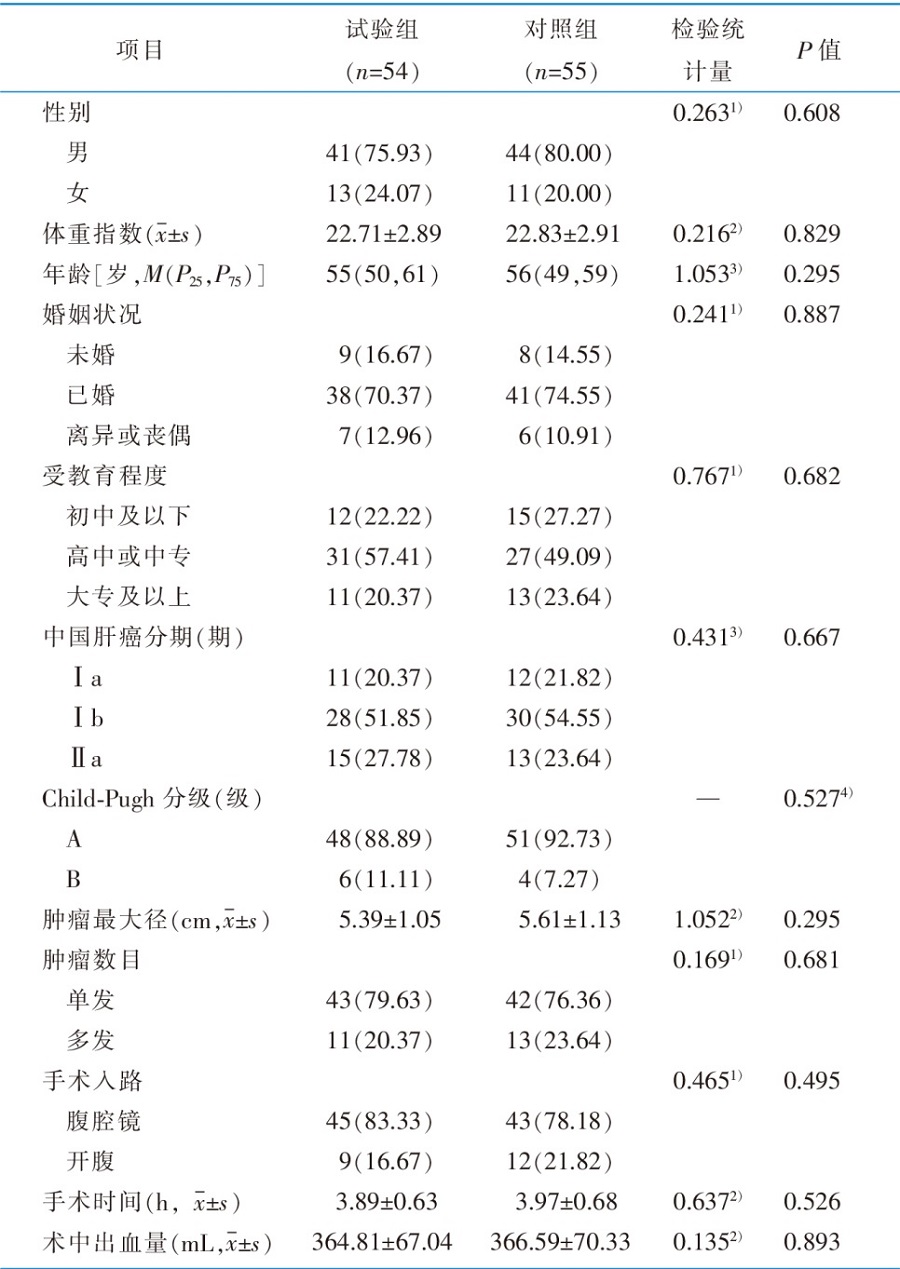 |
表2 两组一般资料及手术基线资料的比较
Table 2 Comparison of general data and surgical baseline data between the 2 groups
| |
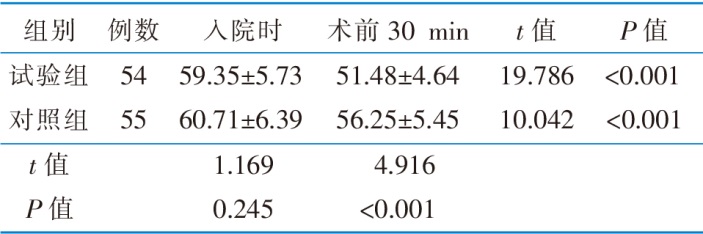 |
表3 两组术前焦虑评分的比较(分,$\bar{x} \pm s$)
Table 3 Comparison of preoperative anxiety scores between the 2 groups(scores,$\bar{x} \pm s$)
| |
 |
表4 两组术前生理应激指标的比较($\bar{x} \pm s$)
Table 4 Comparison of preoperative physiological stress indicators between the 2 groups($\bar{x} \pm s$)
| |
 |
表5 两组术后疼痛程度的比较($\bar{x} \pm s$)
Table 5 Comparison of postoperative pain between the 2 groups($\bar{x} \pm s$)
| |
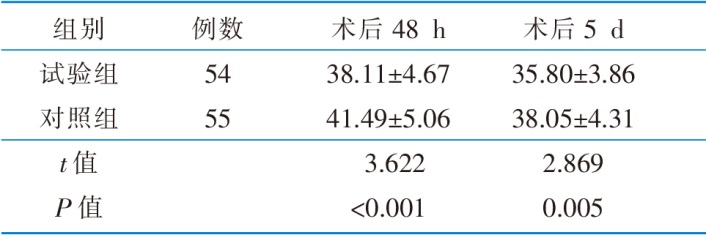 |
表6 两组术后运动恐惧评分的比较(分,$\bar{x} \pm s$)
Table 6 Comparison of postoperative kinesiophobia scores between the 2 groups(scores,$\bar{x} \pm s$)
| |
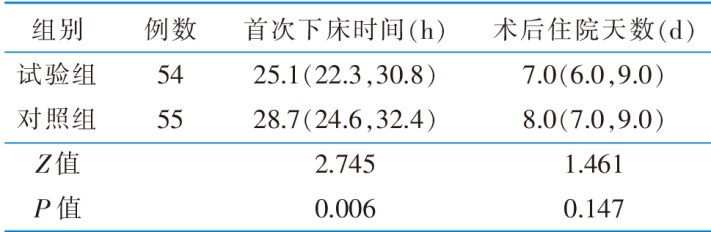 |
表7 两组术后早期康复相关指标的比较[M(P25,P75)]
Table 7 Comparison of early postoperative rehabilitation related indicators between the 2 groups [M(P25,P75)]
| |
| [1] |
Ivascu R, Torsin LI, Hostiuc L, et al. The surgical stress response and anesthesia:a narrative review[J]. J Clin Med, 2024, 13(10):3017-3029.
DOI URL |
| [2] | Chiu PL, Li H, Yap KY, et al. Virtual reality-based intervention to reduce preoperative anxiety in adults undergoing elective surgery:a randomized clinical trial[J]. JAMA Netw Open, 2023, 6(10):234-245. |
| [3] | 刘慧, 柳莹, 施海彬. 肝癌介入术后癌因性疲乏与术前焦虑抑郁的相关性[J]. 国际精神病学杂志, 2025, 52(3):948-974. |
| Liu H, Liu Y, Shi HB. Hepatocellular carcinoma after interventional cancer-related fatigue and correlation analysis of preoperative anxiety depression[J]. Int J Psychiatry, 2025, 52(3):948-974. | |
| [4] |
Yu JW, Zhang YL, Yu T, et al. Preoperative anxiety in Chinese adult patients undergoing elective surgeries:a multicenter cross-sectional study[J]. World J Surg, 2022, 46(12):2927-2938.
DOI URL |
| [5] | 高朝辉. 基于巢式病例对照研究设计低中心静脉压肝切除术后谵妄发病风险预测模型[D]. 兰州: 兰州大学, 2025. |
| Gao ZH. Establishing a predictive model for the risk of postoperative delirium utilizing a nested case-control design in low central venous pressure liver resection[D]. Lanzhou: Lanzhou University, 2025. | |
| [6] |
Yang J, Rhu J, Lim S, et al. Impact of virtual reality education on disease-specific knowledge and anxiety for hepatocellular carcinoma patient scheduled for liver resection:a randomized controlled study[J]. Int J Surg, 2024, 110(5):2810-2817.
DOI URL |
| [7] | 曹晖, 陈亚进, 顾小萍, 等. 中国加速康复外科临床实践指南(2021版)[J]. 中国实用外科杂志, 2021, 41(9):961-992. |
| Cao H, Chen YJ, Gu XP, et al. Clinical practice guidelines for enhanced recovery after surgery in China(2021 edition)[J]. Chin J Pract Surg, 2021, 41(9):961-992. | |
| [8] |
Abbasnia F, Aghebati N, Miri HH, et al. Effects of patient education and distraction approaches using virtual reality on pre-operative anxiety and post-operative pain in patients undergoing laparoscopic cholecystectomy[J]. Pain Manag Nurs, 2023, 24(3):280-288.
DOI PMID |
| [9] |
孙慧慧, 庄金珊, 程莉洁, 等. 虚拟现实辅助下肝移植患者术后运动干预方案的构建及应用研究[J]. 中华护理杂志, 2025, 60(21):2565-2572.
DOI |
|
Sun HH, Zhuang JS, Cheng LJ, et al. Construction and application research of a virtual reality-assisted exercise intervention program for liver transplantation[J]. Chin J Nurs, 2025, 60(21):2565-2572.
DOI |
|
| [10] | 海峡两岸医药卫生交流协会肿瘤防治专家委员会. 肝癌肝切除围手术期管理中国专家共识(2021年版)[J]. 中华肿瘤杂志, 2021, 43(4):414-430. |
| Cancer Prevention and Treatment Expert Committee,Cross-Straits Medicine Exchange Association. Chinese expert consensus on the peri-operative management of hepatectomy for liver cancer(2021 edition)[J]. Chin J Oncol, 2021, 43(4):414-430. | |
| [11] | 李玲, 陈亚丽, 张淑利, 等. 非沉浸式虚拟现实技术在妇科达芬奇机器人手术患者术前访视中的应用[J]. 中国实用护理杂志, 2023, 39(31):2407-2412. |
| Li L, Chen YL, Zhang SL, et al. Application of non-immersive virtual reality technology in preoperative visit of patients undergoing gynecological Da Vinci robotic surgery[J]. Chin J Pract Nurs, 2023, 39(31):2407-2412. | |
| [12] |
叶磊, 荣芸, 丁洁芳, 等. 基于虚拟现实技术的干预对减轻成人患者术前焦虑效果的Meta分析[J]. 中华护理杂志, 2022, 57(11):1310-1317.
DOI |
| Ye L, Rong Y, Ding JF, et al. The effect of virtual reality intervention on improving preoperative anxiety in adult patients:a meta-analysis[J]. Chin J Nurs, 2022, 57(11):1310-1317. | |
| [13] |
Wang SS, Sun J, Yin X, et al. Effect of virtual reality technology as intervention for people with kinesiophobia:a meta-analysis of randomised controlled trials[J]. J Clin Nurs, 2023, 32(13):3074-3086.
DOI URL |
| [14] | 王志静. 虚拟现实技术对老年患者腹腔镜结直肠手术后谵妄的影响[D]. 沈阳: 中国医科大学, 2024. |
| Wang ZJ. Effect of virtual reality technology on delirium in elderly patients after laparoscopic colorectal surgery[D]. Shen-yang: China Medical University, 2024. | |
| [15] | 行博荣, 李育玲, 王嵘, 等. 沉浸式虚拟现实技术对肝动脉化疗栓塞术患者术中焦虑与疼痛的影响[J]. 现代临床护理, 2023, 22(8):32-37. |
| Xing BR, Li YL, Wang R, et al. Effect of immersive virtual reality on intraoperative anxiety and pain in patients undergoing hepatic arterial chemoembolization[J]. Mod Clin Nurs, 2023, 22(8):32-37. | |
| [16] |
豆丽园, 蒋秋玲, 申文佳, 等. 晚期肺癌患者疼痛危象发生现状及影响因素研究[J]. 中华护理杂志, 2024, 59(11):1353-1359.
DOI |
|
Dou LY, Jiang QL, Shen WJ, et al. Status quo and influencing factors of pain crisis in advanced lung cancer patients[J]. Chin J Nurs, 2024, 59(11):1353-1359.
DOI |
|
| [17] | 刘婷婷, 赵鸽, 白瑞平, 等. 以每搏量变异度为指导的目标导向液体治疗对肝癌手术患者血流动力学、应激反应及肝肾功能的影响[J]. 现代生物医学进展, 2022, 22(22):4285-4289. |
| Liu TT, Zhao G, Bai RP, et al. Effects of target guided fluid therapy guided by stroke volume variability on hemodynamics,stress response and liver and kidney function in patients with liver cancer undergoing surgery[J]. Prog Mod Biomed, 2022, 22(22):4285-4289. | |
| [18] | 王丽梅, 李露, 李玉霞, 等. 糖尿病周围神经病理性疼痛患者运动恐惧现状及影响因素分析[J]. 中华护理杂志, 2024, 59(9): 1051-1057. |
| Wang LM, Li L, Li YX, et al. The status and influencing factors of kinesiophobia in patients with diabetic peripheral neuropathic pain[J]. Chin J Nurs, 2024, 59(9):1051-1057. | |
| [19] |
周惠玲, 杨志玉, 严靖雯, 等. 肝移植患者体力活动现状及影响因素研究[J]. 中华护理杂志, 2024, 59(10):1212-1218.
DOI |
|
Zhou HL, Yang ZY, Yan JW, et al. Status and influencing factors of physical activity among liver transplant patients[J]. Chin J Nurs, 2024, 59(10):1212-1218.
DOI |
|
| [20] | Gao LL, Chen W, Qin SX, et al. The impact of preoperative interview and prospective nursing on perioperative psychological stress and postoperative complications in patients undergoing TACE intervention for hepatocellular carcinoma[J]. Medi-cine, 2024, 103(2):359-367. |
| [21] |
巩晓珊, 林安琪, 秦玉, 等. 术前虚拟现实场景模拟训练对老年肺癌患者术后谵妄的干预效果研究[J]. 中华护理杂志, 2026, 61(3):332-339.
DOI |
|
Gong XS, Lin AQ, Qin Y, et al. Study on the intervention effect of preoperative virtual reality scene simulation training on postoperative delirium in elderly lung cancer patients[J]. Chin J Nurs, 2026, 61(3):332-339.
DOI |
|
| [22] | Chen XJ, Li HY, Wang SY, et al. Effects of quantitative nursing combined with psychological intervention in operating room on stress response,psychological state,and prognosis of patients undergoing laparoscopic endometrial cancer surgery[J]. Comput Math Methods Med, 2022, 2022(1):673-681. |
| [23] | 苏丹丹, 赵倩文, 汪美如, 等. 基于虚拟现实技术的术前宣教对乳腺癌病人术前焦虑与术后疼痛的影响[J]. 安徽医药, 2025, 29(9):1773-1777. |
| Su DD, Zhao QW, Wang MR, et al. Effect of virtual reality based preoperative education on preoperative anxiety and postoperative pain of patients undergoing breast neoplasms surgery[J]. Anhui Med Pharm J, 2025, 29(9):1773-1777. | |
| [24] | Pekcan YO, Tuncal B, Erol V. Effect of preoperative anxiety level on postoperative pain,analgesic consumption in patients undergoing laparoscopic sleeve gastrectomy:an observational cohort study[J]. Braz J Anesthesiol, 2023, 73(1):85-90. |
| [25] |
Gulsen M, Arslan S, Ceren E, et al. The effect of pain on fear of movement in the early period after open heart surgery according to the fear-avoidance model:the role of moderating factors[J]. BMC Nurs, 2025, 24(1):413-421.
DOI |
| [26] | Czech O, Matkowski R, Skorniak J, et al. Effects of immersive virtual therapy on psychological and physical wellbeing in women with breast cancer at different stages of disease and treatment conditions:an experimental comparative study[J]. Front Oncol, 2025, 15(8):158-164. |
| [1] | 张滢, 刘淑娟, 王婧瑞, 马千蓉. 轻度认知障碍患者对虚拟现实技术使用体验的Meta整合[J]. 中华护理杂志, 2026, 61(8): 1125-1131. |
| [2] | 范娜, 张璇, 杜华娟, 胡嘉清, 杨燕飞. 先天性心脏病患儿围手术期游戏化护理方案的构建与效果评价[J]. 中华护理杂志, 2026, 61(7): 909-916. |
| [3] | 冯霖佳, 韩小云, 张成欢, 张庆庆. 剖宫产产妇术中低体温预防管理方案的构建与初步应用[J]. 中华护理杂志, 2026, 61(7): 917-923. |
| [4] | 卢露, 朱林, 周晓, 李哲, 卢芳燕. 1例行双心室辅助装置植入术患者的围手术期护理[J]. 中华护理杂志, 2026, 61(5): 702-706. |
| [5] | 黄慧红, 刘金莲, 王子睿, 李金璐, 史莉, 杨蕊. 体外受精-胚胎移植患者取卵术后疼痛水平的影响因素及路径分析[J]. 中华护理杂志, 2026, 61(3): 310-317. |
| [6] | 巩晓珊, 林安琪, 秦玉, 王玲. 术前虚拟现实场景模拟训练对老年肺癌患者术后谵妄的干预效果研究[J]. 中华护理杂志, 2026, 61(3): 332-339. |
| [7] | 程凤, 王贺, 王金龙, 付红. 1例产后合并高血氨脑病患者行肝移植的护理[J]. 中华护理杂志, 2026, 61(3): 401-405. |
| [8] | 孙瑜, 王慧美, 徐昱璐, 叶明, 张惠锋, 诸冰雪, 陆恺, 顾莺. 1例主动脉闭锁合并室间隔缺损患儿行Yasui手术的围手术期护理[J]. 中华护理杂志, 2026, 61(14): 1987-1991. |
| [9] | 黄富东, 万晓菲, 周鑫, 叶少军, 潘丽. 1例垂体柄阻断综合征合并肝硬化行肝移植患者的护理[J]. 中华护理杂志, 2026, 61(13): 1849-1853. |
| [10] | 中华护理学会呼吸护理专业委员会, 国家儿童医学中心儿科护理联盟小儿呼吸(哮喘)学组, 湖南省护理学会儿科专业委员会(执笔:刘花艳, 曾珊, 成守珍, 梁湘, 安照辉, 谢鑑辉, 刘玉琳, 宋楠, 李德丽, 周金艳, 胡艳军, ). 儿童气道狭窄球囊扩张术围手术期护理专家共识[J]. 中华护理杂志, 2026, 61(12): 1628-1636. |
| [11] | 高艺, 徐亦虹, 张晓洁, 吴卫利, 何英, 杨志超, 王佳楠, 庞睿, 李浩芬, 潘红英. 虚拟步行干预在下肢肢体残疾患者康复训练中的应用进展[J]. 中华护理杂志, 2026, 61(12): 1704-1709. |
| [12] | 张琪, 邹双, 赵飞. 20例经皮置入左心室辅助装置患者行冠状动脉介入治疗的护理[J]. 中华护理杂志, 2026, 61(11): 1535-1539. |
| [13] | 许采颉, 潘爱红, 徐佩丽, 刘红艳, 张昀, 吴俣. 结直肠癌造口患者围手术期主动健康行为干预方案的构建及应用研究[J]. 中华护理杂志, 2026, 61(10): 1301-1309. |
| [14] | 中华医学会神经外科学分会(执笔:仲丽芸, 李京连, 赵东红, 陈璐, 袁巧玲, 胡秀兰, 任亚娟, ). 脑血管疾病复合手术围手术期护理专家共识[J]. 中华护理杂志, 2026, 61(10): 1347-1353. |
| [15] | 王艳, 潘文彦, 程立宏, 周子琳, 胡彦成, 张晓云. 1例行“废弃肝”移植联合肝脏分隔和门静脉结扎二步肝切除术患者的护理[J]. 中华护理杂志, 2025, 60(9): 1128-1131. |
| 阅读次数 | ||||||
|
全文 |
|
|||||
|
摘要 |
|
|||||
