

中华护理杂志 ›› 2025, Vol. 60 ›› Issue (3): 347-354.DOI: 10.3761/j.issn.0254-1769.2025.03.013
赵蕊( ), 范文琪, 刘晓夏, 葛莉娜()
收稿日期:2024-04-08
出版日期:2025-02-10
发布日期:2025-01-22
*通讯作者:
葛莉娜,E-mail:geln@sj-hospital.org作者简介:赵蕊:女,硕士,护师,E-mail:Zrui651394@163.com
基金资助:
ZHAO Rui(), FAN Wenqi, LIU Xiaoxia, GE Lina()
Received:2024-04-08
Online:2025-02-10
Published:2025-01-22
摘要:
目的 基于机器学习构建3种妇产科护士共情疲劳的风险预测模型,比较不同模型的预测性能。方法 采用便利抽样法,于2022年12月—2023年3月选取9个城市11所三级甲等医院的1 323名妇产科护士作为调查对象,按照7∶3的比例随机分为训练集和测试集,采用同情疲劳量表、五因素正念度量表及情绪智力量表进行调查。基于机器学习构建妇产科护士共情疲劳的Logistic回归模型、决策树模型和随机森林模型3种风险预测模型,比较各模型的准确率、精确率、灵敏度、F1指数和受试者工作特征(receiver operating characteristic,ROC)曲线下面积(area under the curve,AUC),评价模型的预测性能。结果 最终1 276名妇产科护士完成调查。3种模型均显示,正念水平、情绪智力、用工性质和工作年限是妇产科护士共情疲劳的影响因素(P<0.05)。Logistic回归模型、决策树模型和随机森林模型的准确率分别为0.804、0.806、0.796,精确率分别为0.821、0.827、0.823,灵敏度分别为0.956、0.949、0.939,F1指数分别为0.883、0.884、0.877,AUC分别为0.704(95%CI为0.701~0.713)、0.760(95%CI为0.751~0.771)、0.742(95%CI为0.723~0.762)。结论 通过决策树构建的妇产科护士共情疲劳风险预测模型性能优于随机森林模型和Logistic回归模型,多模型有效结合预测妇产科护士共情疲劳的发生风险、多维度探索影响因素交互作用,可为共情疲劳的早期识别和预防、相关干预措施的制订提供参考。
赵蕊, 范文琪, 刘晓夏, 葛莉娜. 基于机器学习的3种妇产科护士共情疲劳风险预测模型的构建与比较[J]. 中华护理杂志, 2025, 60(3): 347-354.
ZHAO Rui, FAN Wenqi, LIU Xiaoxia, GE Lina. Establishment and comparison of 3 compassion fatigue risk prediction models for obstetrics and gynaecology nurses based on machine learning[J]. Chinese Journal of Nursing, 2025, 60(3): 347-354.
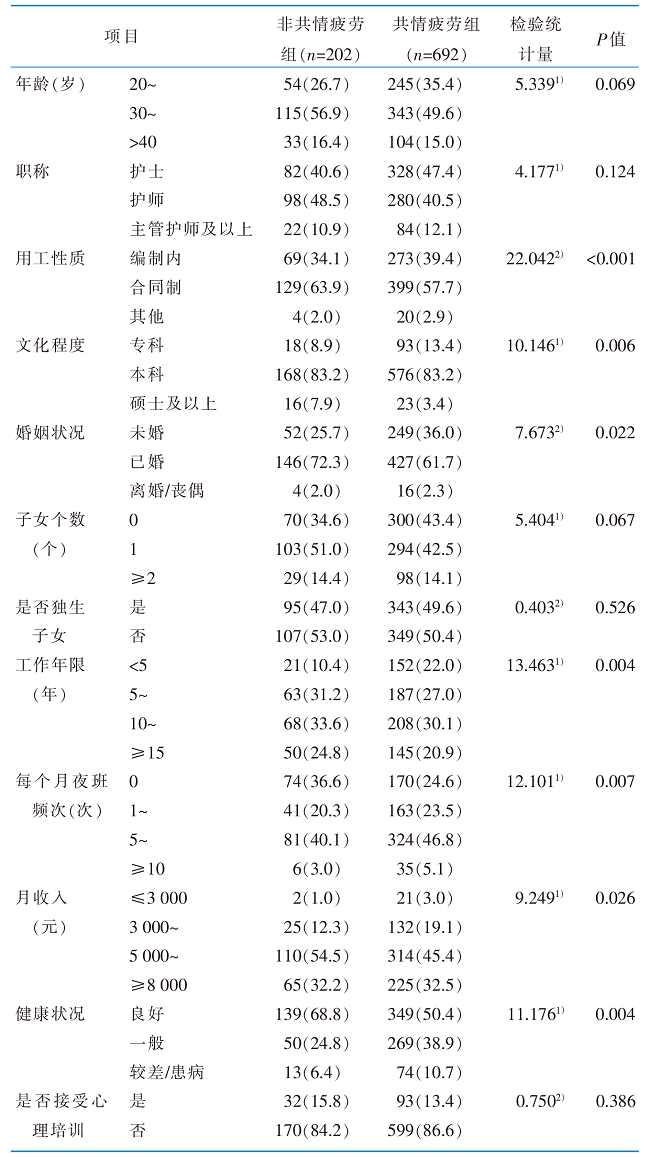 |
表1 妇产科护士共情疲劳的单因素分析[n=894,名(百分比,%)]
Table 1 Univariate analysis of compassion fatigue in obstetrics and gynecology nurses[n=894,case(percentage,%)]
| |
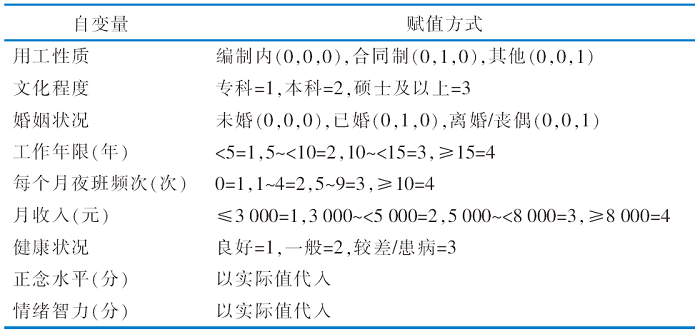 |
表2 自变量赋值方式
Table 2 Independent-variable assignment method
| |
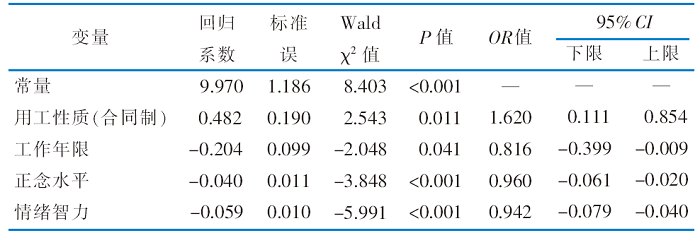 |
表3 妇产科护士共情疲劳Logistic回归分析结果(n=894)
Table 3 Logistic regression analysis of compassion fatigue in obstetrics and gynecology nurses(n=894)
| |
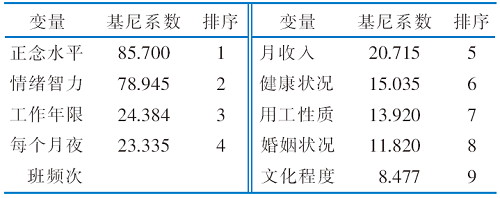 |
表4 妇产科护士共情疲劳随机森林模型中变量重要性排序
Table 4 Importance score of variables in random forest model in obstetrics and gynecology nurses
| |
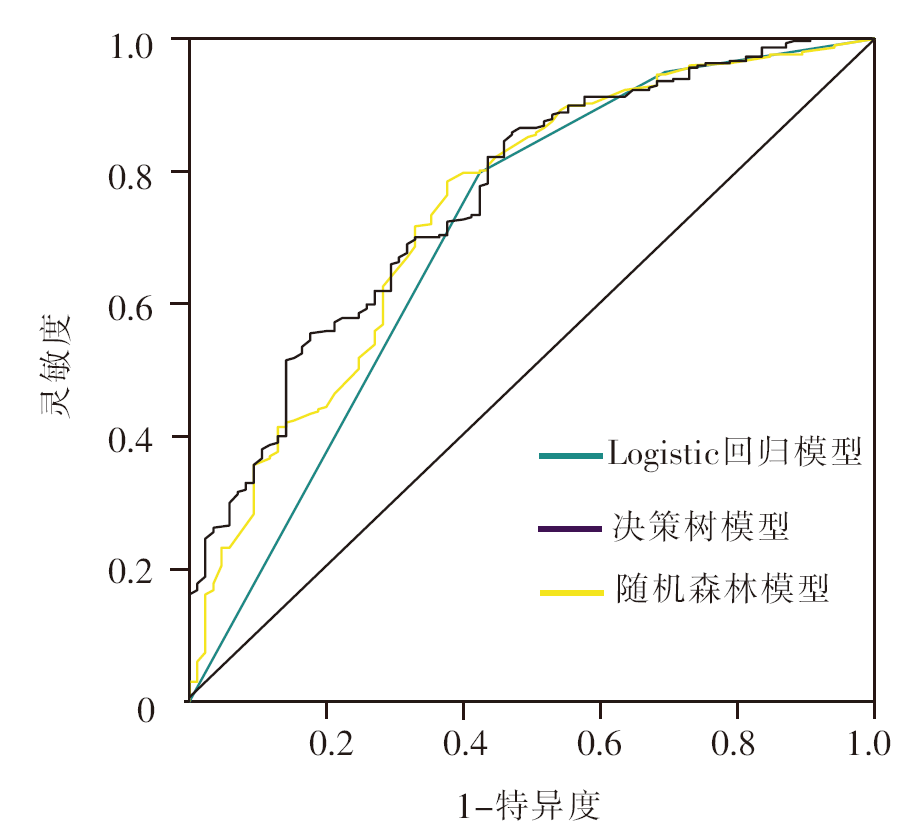
图1 3种风险预测模型预测妇产科护士共情疲劳的受试者工作特征曲线
Figure 1 Receiver operating characteristic curve of 3 risk assessment models predicting compassion fatigue in obstetrics and gynecology nurses
| [1] | Ondrejková N, Halamová J. Prevalence of compassion fatigue among helping professions and relationship to compassion for others,self-compassion and self-criticism[J]. Health Soc Care Com-munity, 2022, 30(5):1680-1694. |
| [2] | 田梅梅, 范霖, 施雁, 等. 临床护士共情疲劳的现状及其影响因素分析[J]. 中华护理杂志, 2018, 53(1):76-82. |
| Tian MM, Fan L, Shi Y, et al. The current status and influencing factors of compassion fatigue in clinical nurses[J]. Chin J Nurs, 2018, 53(1):76-82. | |
| [3] | Favrod C, Jan du Chêne L, Martin Soelch C, et al. Mental health symptoms and work-related stressors in hospital midwives and NICU nurses:a mixed methods study[J]. Front Psychiatry, 2018, 9:364. |
| [4] | Wang J, Su M, Chang WZ, et al. Factors associated with com-passion fatigue and compassion satisfaction in obstetrics and gynaecology nurses:a cross-sectional study[J]. Nurs Open, 2023, 10(8):5509-5520. |
| [5] | Labrague LJ, de Los Santos JAA. Resilience as a mediator bet-ween compassion fatigue,nurses’ work outcomes,and quality of care during the COVID-19 pandemic[J]. Appl Nurs Res, 2021, 61:151476. |
| [6] |
丛胜楠, 张爱霞, 刘颖, 等. 江苏省妇产专科医院护士共情疲劳的影响因素及路径分析[J]. 中华护理杂志, 2022, 57(8):977-984.
DOI URL |
|
Cong SN, Zhang AX, Liu Y, et al. Analysis of influencing factors and impact path of compassion fatigue in nurses from maternity hospitals in Jiangsu[J]. Chin J Nurs, 2022, 57(8):977-984.
DOI URL |
|
| [7] |
曲超然, 王青, 韩琳, 等. 机器学习算法在压力性损伤管理中的应用进展[J]. 中华护理杂志, 2021, 56(2):212-217.
DOI URL |
|
Qu CR, Wang Q, Han L, et al. A literature review on the application of machine learning algorithms in pressure injury management[J]. Chin J Nurs, 2021, 56(2):212-217.
DOI URL |
|
| [8] | Stamm BH. The Concise ProQOL Manual:the concise manual for the Professional Quality of Life Scale[M]. 2nd ed. East-woods, 2010. |
| [9] | 陈华英, 王卫红. 中文版同情疲劳量表的信度、效度研究[J]. 中国护理管理, 2013, 13(4):39-41. |
| Chen HY, Wang WH. Reliability and validity of the Chinese version of the Compassion Fatigue Scale[J]. Chin Nurs Manag, 2013, 13(1):39-41 | |
| [10] | Baer RA, Smith GT, Hopkins J, et al. Using self-report assess-ment methods to explore facets of mindfulness[J]. Assessment, 2006, 13(1):27-45. |
| [11] | Deng YQ, Liu XH, Rodriguez MA, et al. The Five Facet Mind-fulness Questionnaire:psychometric properties of the Chinese version[J]. Mindfulness, 2011, 2(2):123-128. |
| [12] | Salovey P, Mayer JD. Emotional intelligence[J]. Imagin Cogn Pers, 1990, 9(3):185-211. |
| [13] | Wong CS, Law KS, Wong PM. Development and validation of a forced choice emotional intelligence measure for Chinese respondents in Hong Kong[J]. Asia Pac J Manag, 2004, 21(4):535-559. |
| [14] | Xie WQ, Liu ML, Okoli CTC, et al. Construction and evalua-tion of a predictive model for compassion fatigue among emergency department nurses:a cross-sectional study[J]. Int J Nurs Stud, 2023, 148:104613. |
| [15] | Algamdi M. Prevalence of oncology nurses’ compassion sati-sfaction and compassion fatigue:systematic review and meta-analysis[J]. Nurs Open, 2022, 9(1):44-56. |
| [16] | Guo SJ, Chang YL, Chang HW, et al. Patient satisfaction with nurses’ care is positively related to the nurse-patient relation-ship in Chinese hospitals:a multicentre study[J]. Front Public Health, 2022, 10:1109313. |
| [17] | Kartsonaki MG, Georgopoulos D, Kondili E, et al. Prevalence and factors associated with compassion fatigue,compassion satisfaction,burnout in health professionals[J]. Nurs Crit Care, 2023, 28(2):225-235. |
| [18] | 张宇婷, 刘瑞云, 焦雪萍. 肿瘤科护士关怀能力、职业倦怠与护理缺失的相关性[J]. 护理研究, 2021, 35(11):2046-2049. |
| Zhang YT, Liu RY, Jiao XP. Correlation among caring ability,job burnout and missed nursing care in oncology nurses[J]. Chin Nurs Res, 2021, 35(11):2046-2049. | |
| [19] | İlter SM, Ovayolu Ö, Serçe S, et al. An investigation of the relationship between compassion fatigue and moral sensitivity of intensive care nurses[J]. Omega, 2022:302228221107976. |
| [20] |
廖俪雯, 王琳. 护士心理弹性干预的研究进展[J]. 中华护理杂志, 2023, 58(8):942-949.
DOI URL |
| Liao LW, Wang L. Research progress on resilience interven-tion for nurses[J]. Chin J Nurs, 2023, 58(8):942-949. | |
| [21] | 陈莉莉, 寇红艳, 李霜, 等. 川东北地区手术室护士共情疲劳现状及主客观影响因素分析[J]. 卫生职业教育, 2023, 41(6):135-139. |
| Chen LL, Kou HY, Li S, et al. Analysis of compassion fatigue status and subjective and objective influencing factors of operating room nurses in northeast Sichuan[J]. Health Vocat Educ, 2023, 41(6):135-139. | |
| [22] | 姚雪, 谢仙萍, 张晓红, 等. 某新建三甲医院护士离职状况研究[J]. 中国药物与临床, 2019, 19(21):3701-3703. |
| Yao X, Xie XP, Zhang XH, et al. A study on the resignation of nurses in a newly built tertiary hospital[J]. Chin Remedies Clin, 2019, 19(21):3701-3703. | |
| [23] |
Shahar I, Asher I, Ben Natan M. Compassion fatigue among nurses working in a long-term care facility:the Israeli expe-rience[J]. Nurs Health Sci, 2019, 21(3):291-296.
DOI PMID |
| [24] | O’Mahony S, Ziadni M, Hoerger M, et al. Compassion fatigue among palliative care clinicians:findings on personality factors and years of service[J]. Am J Hosp Palliat Care, 2018, 35(2):343-347. |
| [25] | Green AA, Kinchen EV. The effects of mindfulness meditation on stress and burnout in nurses[J]. J Holist Nurs, 2021, 39(4):356-368. |
| [26] | Wu XX, Hayter M, Lee AJ, et al. Nurses’ experiences of the effects of mindfulness training:a narrative review and qualita-tive meta-synthesis[J]. Nurse Educ Today, 2021, 100:104830. |
| [27] | Watts KJ, O’Connor M, Johnson CE, et al. Mindfulness-based compassion training for health professionals providing end-of-life care:impact,feasibility,and acceptability[J]. J Palliat Med, 2021, 24(9):1364-1374. |
| [28] | Maillet S, Read E. Work environment characteristics and emo-tional intelligence as correlates of nurses’ compassion satisfa-ction and compassion fatigue:a cross-sectional survey study[J]. Nurs Rep, 2021, 11(4):847-858. |
| [29] | Dugué M, Sirost O, Dosseville F. A literature review of emo-tional intelligence and nursing education[J]. Nurse Educ Pract, 2021, 54:103124. |
| [30] | Amir K, Betty A, Kenneth AM. Emotional intelligence as pre-dictor of compassion fatigue among mental health practitio-ners[J]. OALib, 2019, 6(5):1-10. |
| [31] | 刘晓玲, 赵华, 鲁闻燕, 等. 慢性阻塞性肺疾病患者30天再入院风险预测模型的研究进展[J]. 中华急危重症护理杂志, 2023, 4(12):1142-1146. |
| Liu XL, Zhao H, Lu WY, et al. Research progress on risk prediction models for 30-day readmission of patients with chronic obstructive pulmonary disease[J]. Chin J Emerg Crit Care Nurs, 2023, 4(12):1142-1146. | |
| [32] | Christodoulou E, Ma J, Collins GS, et al. A systematic review shows no performance benefit of machine learning over logis-tic regression for clinical prediction models[J]. J Clin Epide-miol, 2019, 110:12-22. |
| [33] | Wallace ML, Mentch L, Wheeler BJ, et al. Use and misuse of random forest variable importance metrics in medicine:demonstrations through incident stroke prediction[J]. BMC Med Res Methodol, 2023, 23(1):144. |
| [34] | Yun K, Lee YJ. Factors influencing depression in older adults according to family structure(older adults living with adult children,a spouse,or alone):data from the 2020 national older Koreans data[J]. J Korean Gerontol Nurs, 2022, 24(1):1-12. |
| [1] | 郑煜琳, 刘晋宁, 张静, 郭会敏, 谷艳梅, 张莉莉. 酒精性肝病患者肝移植术后再饮酒现状及其影响因素分析[J]. 中华护理杂志, 2026, 61(9): 1208-1214. |
| [2] | 梁和静, 许鹊, 史云霞, 祖金美, 黄文静, 杨春旭, 郭明华, 王磊. 颈动脉内膜剥脱术围手术期护理质量评价指标的构建[J]. 中华护理杂志, 2026, 61(9): 1237-1244. |
| [3] | 张莹, 杜若飞, 杨惠敏, 杜亚婷. 非霍奇金淋巴瘤患者化疗期衰弱轨迹的潜在类别及影响因素研究[J]. 中华护理杂志, 2026, 61(8): 1051-1058. |
| [4] | 李珊, 邵梦琪, 邱晨, 苏清清, 高远. 4 907例老年髋部骨折患者术后并发症发生现状及影响因素研究[J]. 中华护理杂志, 2026, 61(8): 1059-1065. |
| [5] | 张晴, 赵恺, 厉春林, 胡娜, 陆小燕. 神经外科肠内营养患者腹内压变化轨迹的潜在类别及影响因素研究[J]. 中华护理杂志, 2026, 61(7): 924-931. |
| [6] | 王丹丹, 吕会力, 李付华, 李慧, 张侠, 史小艳, 张苇. 三级医院硕士学历护士工作重塑的影响因素及路径分析[J]. 中华护理杂志, 2026, 61(7): 973-978. |
| [7] | 李春秀, 修红, 刘敏, 邹晓君, 王晴, 丁书凡, 赵志平, 李晓娟. 血液肿瘤患者营养不良风险预测模型的构建及验证[J]. 中华护理杂志, 2026, 61(6): 733-740. |
| [8] | 朱静, 孙艳, 司惠芳, 李秀娟, 加米娜·瓦合甫, 常海霞. 成人急性白血病患者化疗期间心理弹性的变化轨迹及影响因素研究[J]. 中华护理杂志, 2026, 61(6): 741-748. |
| [9] | 张莹, 杜若飞, 杨惠敏, 徐晓霞, 李黎明, 杜亚婷. 初诊血液肿瘤老年患者的衰弱现状及影响因素研究[J]. 中华护理杂志, 2026, 61(6): 749-756. |
| [10] | 顾培培, 王衍蝶, 曾妃, 梁江淑渊, 蔡凌云, 朱岩, 赵淑华. 肺移植等候期患者肌少症影响因素分析及护理对策[J]. 中华护理杂志, 2026, 61(6): 790-796. |
| [11] | 覃文婷, 杨连招, 龙秀红, 陈玲, 高慧, 桑树林. 老年HIV感染者心理社会适应的潜在剖面分析及影响因素研究[J]. 中华护理杂志, 2026, 61(6): 797-805. |
| [12] | 张柔, 贺方园, 杨晓宇, 陈冬笋, 李根霞, 孙可盈, 赵晶, 郭晓丽. 双胎孕妇营养素养的影响因素分析及护理启示[J]. 中华护理杂志, 2026, 61(6): 822-828. |
| [13] | 武玲, 吴波, 陈红, 古晨茜, 刘洋, 张春谨, 陈梦琪, 章青. 基于机器学习算法的成人术中低体温预测模型的范围综述[J]. 中华护理杂志, 2026, 61(6): 844-851. |
| [14] | 中华护理学会人文护理专业委员会, 中华护理学会急诊护理专业委员会, (执笔:刘义兰, 汪唯, 甘秀妮, 朱陈萍, 杨霞, 熊莉娟, 朱丽辉, 徐翠荣, 郭舒婕, 张洁, 金晓燕, 李君, 李丽, 黄素芳, 王晓洁, 周晨曦, 李映兰. 对急诊科护士的人文关怀策略专家共识[J]. 中华护理杂志, 2026, 61(5): 612-615. |
| [15] | 崔一凡, 张明名, 张晓雪, 郑煜琳, 王文爽, 王欣然. 老年腹部大手术患者肌肉状况及影响因素的纵向研究[J]. 中华护理杂志, 2026, 61(5): 667-673. |
| 阅读次数 | ||||||
|
全文 |
|
|||||
|
摘要 |
|
|||||
