

中华护理杂志 ›› 2025, Vol. 60 ›› Issue (24): 3000-3006.DOI: 10.3761/j.issn.0254-1769.2025.24.008
平凌( ), 罗彩凤(), 孙炜怡, 李倩, Natsuko K.Wood, 周洁玉, 许俊, 卢红艳
收稿日期:2025-03-25
出版日期:2025-12-20
发布日期:2025-12-19
*通讯作者:
罗彩凤,E-mail:lcf0105@163.com作者简介:平凌:女,本科(硕士在读),主管护师,E-mail:pinglingapple@qq.com
基金资助:
PING Ling(), LUO Caifeng(), SUN Weiyi, LI Qian, Natsuko K.Wood, ZHOU Jieyu, XU Jun, LU Hongyan
Received:2025-03-25
Online:2025-12-20
Published:2025-12-19
摘要:
目的 探讨产后6个月内母婴喂养互动现状及潜在剖面,分析不同类别母婴喂养互动水平的影响因素,为制订针对性干预措施促进纯母乳喂养提供参考。 方法 采用便利抽样法,于2024年11—12月,选取江苏省7所三级甲等医院542名产后6个月内的产妇为调查对象,使用一般资料调查表、母乳喂养关系量表、母乳喂养自我效能简式量表进行调查。对产后6个月内母婴喂养互动水平进行潜在剖面分析,并通过单因素分析和Logistic回归分析探究不同剖面的影响因素。 结果 最终纳入468名产妇,其母乳喂养关系量表条目均分为(4.13±0.54)分。产后6个月内母婴喂养互动关系可分为“联结薄弱型”(55.13%)、“同步失调型”(11.32%)、“高效协同型”(33.55%)3个潜在剖面。Logistic回归分析结果显示,居住地、产后照顾者、母乳喂养方式、喂养类型、母乳喂养自我效能是产后6个月内母婴喂养互动水平的影响因素(均P<0.05)。 结论 产后6个月内母婴喂养互动处于中等偏上水平且存在异质性,可分为3个潜在剖面。医护人员应重点关注“联结薄弱型”和“同步失调型”母婴,根据不同潜在剖面的影响因素对母婴进行干预,以提高其母乳喂养水平。
平凌, 罗彩凤, 孙炜怡, 李倩, Natsuko K.Wood, 周洁玉, 许俊, 卢红艳. 产后6个月内母婴喂养互动现状及潜在剖面分析[J]. 中华护理杂志, 2025, 60(24): 3000-3006.
PING Ling, LUO Caifeng, SUN Weiyi, LI Qian, Natsuko K.Wood, ZHOU Jieyu, XU Jun, LU Hongyan. Current status and latent profile analysis of mother-infant feeding interaction within 6 months postpartum[J]. Chinese Journal of Nursing, 2025, 60(24): 3000-3006.
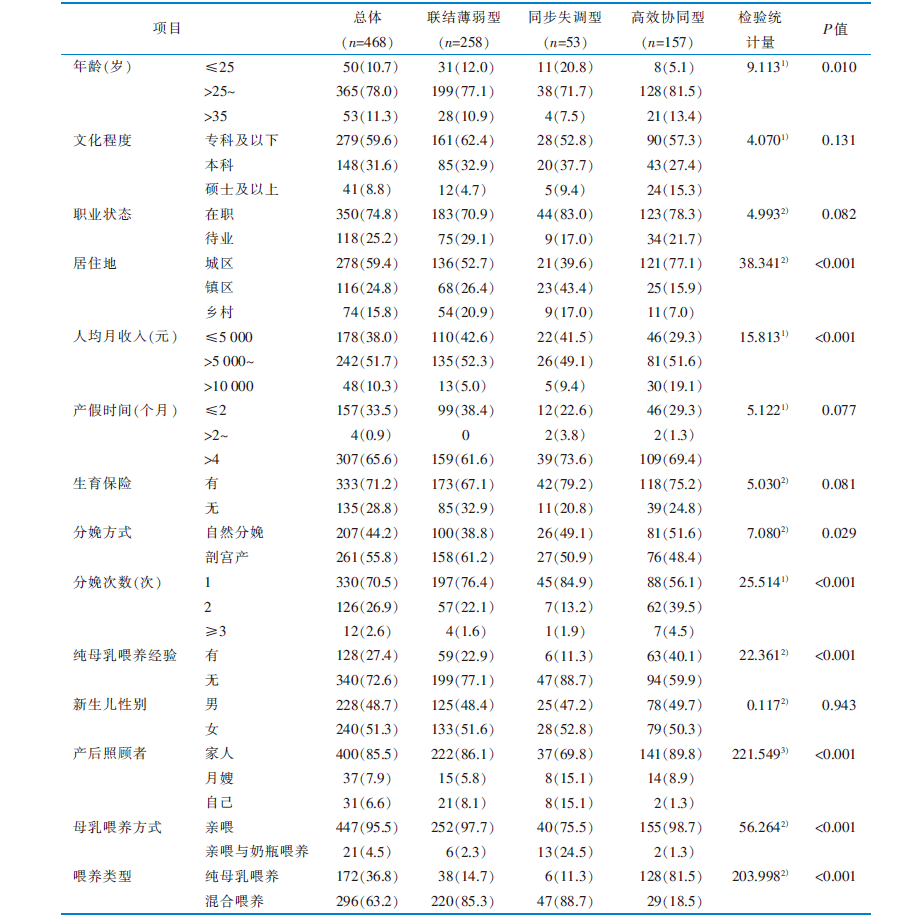 |
表1 调查对象的一般资料及母婴喂养互动水平3个潜在剖面的单因素分析结果[名(百分比,%)]
Table 1 Univariate analysis of 3 potential profiles of survey participants, general information and the feeding interaction[cases(percentage,%)]
|
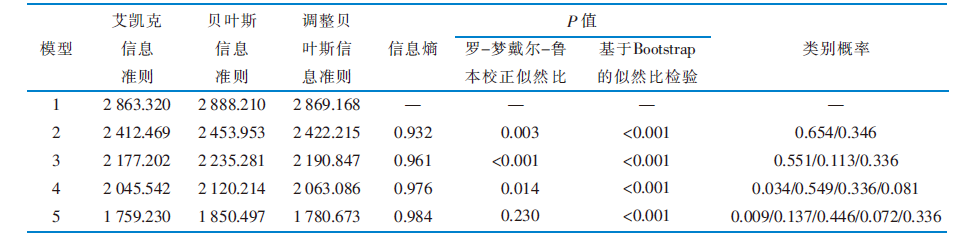 |
表2 母婴喂养互动水平潜在剖面模型拟合指标
Table 2 Potential categories of the mother-infant feeding interaction
|
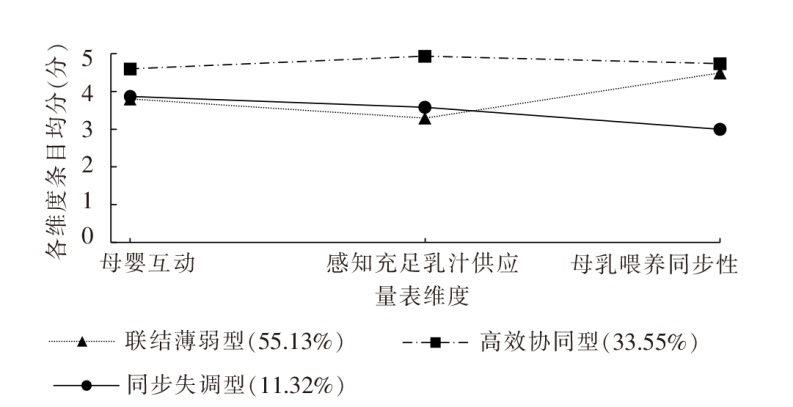
图1 产后6个月内母婴喂养互动水平的潜在剖面分布特征
Figure 1 Potential distribution characteristics of mother-infant feeding interaction within 6 months postpartum
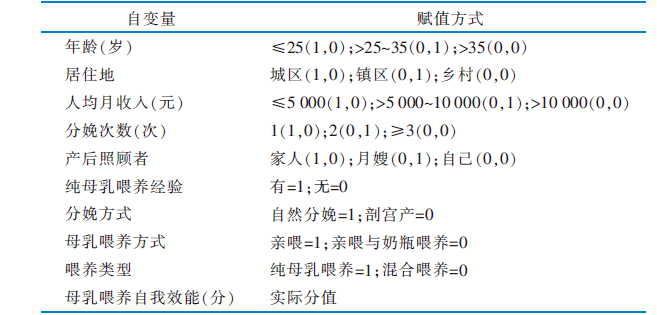 |
表3 自变量赋值方式
Table 3 Assignment of independent variables
|
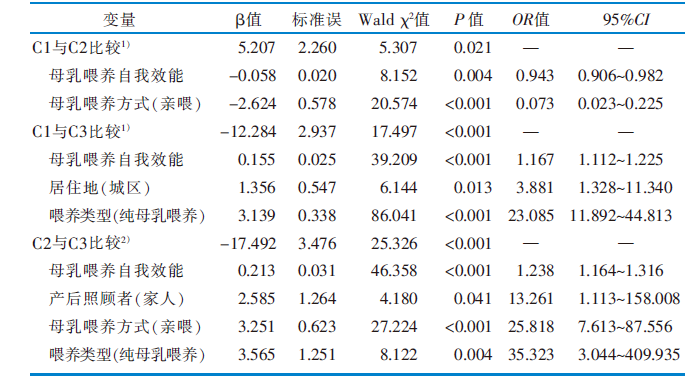 |
表4 产后6个月内母婴喂养互动水平潜在剖面的多元Logistic回归分析结果(n=468)
Table 4 Multivariate logistic regression analyses of potential profiles of the mother-infant feeding interaction in the first 6 months postpartum(n=468)
|
| [1] | 国务院办公厅. 关于印发母乳喂养促进行动计划(2021-2025年)的通知[EB/OL].(2021-11-15)[2025-02-03]. https://www.gov.cn/zhengce/zhengceku/2021-11/24/content_5653169.htm. |
| General Office of the State Council. Circular on the issuance of the breastfeeding promotion action plan(2021-2025)[EB/OL].(2021-11-15)[2025-02-03]. https://www.gov.cn/zhengce/zheng-ceku/2021-11/24/content_5653169.htm. | |
| [2] | UNICEF,WHO. Global breastfeeding scorecard 2024:meeting the global target for breastfeeding requires bold commitments and accelerated action by governments and donors[EB/OL].(2024)[2025-06-20]. https://www.globalbreastfeedingcollective.org/media/2856/file. |
| [3] |
Farwell AL. Integrative review of breastfeeding duration and influencing factors among women serving active duty in the U.S. military[J]. J Obstet Gynecol Neonatal Nurs, 2017, 46(2):171-181.
DOI URL |
| [4] | 欧阳婧, 周维敏, 汪柏云. 杭州市二胎产妇纯母乳喂养状况及影响因素分析[J]. 中国妇幼保健, 2025, 40(2):318-321. |
| Ouyang J, Zhou WM, Wang BY. Analysis of exclusive breast-feeding status and influencing factors of second-born women in Hangzhou[J]. Matern Child Health Care China, 2025, 40(2):318-321. | |
| [5] | 汪维, 王欲晓, 屠蕾. 0-9月龄婴儿母乳喂养现状及母乳中断影响因素分析[J]. 中国妇幼保健, 2021, 36(9):2117-2119. |
| Wang W, Wang YX, Tu L. Analysis on the current situation of breast-feeding and the influencing factors of breast-feeding interruption in infants aged 0-9 months[J]. Matern Child Health Care China, 2021, 36(9):2117-2119. | |
| [6] |
Newby RM, Davies PW. Why do women stop breast-feeding? Results from a contemporary prospective study in a cohort of Australian women[J]. Eur J Clin Nutr, 2016, 70(12):1428-1432.
DOI PMID |
| [7] |
Safon C, Keene D, Guevara WJU, et al. Determinants of percei-ved insufficient milk among new mothers in León,Nicaragua[J]. Matern Child Nutr, 2017, 13(3):e12369.
DOI URL |
| [8] |
Horta BL, Loret de Mola C, Victora CG. Long-term consequen-ces of breastfeeding on cholesterol,obesity,systolic blood pre-ssure and type 2 diabetes:a systematic review and meta-analy-sis[J]. Acta Paediatr, 2015, 104(467):30-37.
DOI URL |
| [9] |
Chowdhury R, Sinha B, Sankar MJ, et al. Breastfeeding and ma-ternal health outcomes:a systematic review and meta-analysis[J]. Acta Paediatr, 2015, 104(467):96-113.
DOI URL |
| [10] |
Wood NK, Barbosa-Leiker C, Odom-Maryon T, et al. Instrument development and psychometric validation using confirmatory factor analysis of the Breastfeeding Relationship Scale[J]. J Nurs Meas, 2022, 30(3):449-463.
DOI URL |
| [11] |
Wood NK, Barbosa-Leiker C, Odom-Maryon T. Determinants of exclusive direct breastfeeding using constructs from the Breast-feeding Relationship Scale[J]. J Reprod Infant Psychol, 2024, 42(5):949-963.
DOI URL |
| [12] | Little TD. The Oxford Handbook of quantitative methods in psychology:vol 2:statistical analysis[M]. Oxford: Oxford Univer-sity Press, 2013. |
| [13] | 倪平, 陈京立, 刘娜. 护理研究中量性研究的样本量估计[J]. 中华护理杂志, 2010, 45(4):378-380. |
| Ni P, Chen JL, Liu N. The sample size estimation in quantita-tive nursing research[J]. Chin J Nurs, 2010, 45(4):378-380. | |
| [14] | 蒲江锋, 王婉儿, 李格格, 等. 护士组织支持感现状及潜在剖面分析[J]. 中华护理杂志, 2025, 60(3):340-347. |
| Pu JF, Wang WE, Li GG, et al. Study on the current situation and latent profile analysis of nurses’ perceived organizational support[J]. Chin J Nurs, 2025, 60(3):340-347. | |
| [15] |
Dennis CL. The breastfeeding self-efficacy scale:psychometric assessment of the short form[J]. J Obstet Gynecol Neonatal Nurs, 2003, 32(6):734-744.
DOI URL |
| [16] | 刘延锦, 王敏, 董小方. 中文版母乳喂养自我效能简式量表的信效度研究[J]. 中国实用护理杂志, 2016, 32 (18):1361-1364. |
| Liu YJ, Wang M, Dong XF. Reliability and validity of Chinese version of the Breastfeeding Self-efficacy Scale short form[J]. Chin J Pract Nurs, 2016, 32 (18):1361-1364. | |
| [17] | 江苏省委办公厅. 江苏省关于优化生育政策促进人口长期均衡发展实施方案[EB/OL].(2022-03-01)[2025-02-12]. https://www.zgjssw.gov.cn/fabuting/shengweiwenjian/202203/t20-220301_7446842.sht. |
| General Office of CPC Jiangsu Provincial Committee. Jiangsu Province issued the implementation plan of Jiangsu Province on optimizing birth policy and promoting long-term balanced development of population[EB/OL].(2022-03-01)[2025-02-12]. https://www.zgjssw.gov.cn/fabuting/shengweiwenjian/202203/t20-220301_7446842.sht. | |
| [18] | Kelly JF, Barnard KE. Assessment of parent-child interaction:implications for early intervention[M]//Handbook of Early Childhood Intervention. Cambridge: Cambridge University Press, 2000:258-289. |
| [19] |
钟娜, 胡琼燕, 梁旭霞, 等. 医院-社区母乳喂养链式管理模式的应用及效果评价[J]. 中华护理杂志, 2022, 57(14):1669-1675.
DOI URL |
| Zhong N, Hu QY, Liang XX, et al. Application and effect evaluation of a hospital-community breastfeeding chain mana-gement model[J]. Chin J Nurs, 2022, 57(14):1669-1675. | |
| [20] | 刘维, 温燕. 产后早期家庭照顾者认知与行为干预对初产妇母乳喂养的影响[J]. 中国计划生育学杂志, 2022, 30(11):2522-2525. |
| Liu W, Wen Y. Effects of cognitive and behavioral interven-tion of family caregivers for early postpartum primiparas on the breastfeeding[J]. Chin J Fam Plan, 2022, 30(11):2522-2525. | |
| [21] | 邢翠, 舒晓芬, 刘莉. 家庭赋权护理对初产妇母乳喂养的影响[J]. 护理学杂志, 2022, 37(4):1-4. |
| Xing C, Shu XF, Liu L. Effect of family empowerment based nursing intervention on breastfeeding behavior of primiparous women[J]. J Nurs Sci, 2022, 37(4):1-4. | |
| [22] | 裘梦凡, 胡晓静. 母乳亲喂婴儿吸吮-吞咽-呼吸机制的研究进展[J]. 四川大学学报(医学版), 2023, 54(6):1306-1311. |
| Qiu MF, Hu XJ. Latest findings on the suck-swallow-breathe mechanism of direct breastfeeding from the breast to an infant[J]. J Sichuan Univ Med Sci, 2023, 54(6):1306-1311. | |
| [23] |
Higley E, Dozier M. Nighttime maternal responsiveness and infant attachment at one year[J]. Attach Hum Dev, 2009, 11(4):347-363.
DOI PMID |
| [24] |
Smith JM. Breastfeeding and language outcomes:a review of the literature[J]. J Commun Disord, 2015, 57:29-40.
DOI URL |
| [25] | Sinha B, Chowdhury R, Sankar MJ, et al. Interventions to im-prove breastfeeding outcomes:a systematic review and meta-analysis[J]. Acta Paediatr, 2015, 104(467):114-134. |
| [26] | 赖雅君, 黄娟, 黄菲菲, 等. 母乳喂养自我效能感的研究进展[J]. 解放军护理杂志, 2016, 33(22):33-36. |
| Lai YJ, Huang J, Huang FF, et al. Research progress on breast-feeding self-efficacy[J]. Nurs J Chin PLA, 2016, 33(22):33-36. | |
| [27] |
Bandura A. Human agency in social cognitive theory[J]. Am Psychol, 1989, 44(9):1175-1184.
DOI PMID |
| [1] | 谭远俏, 刘伟宸, 王露秀, 张乐, 衡清漪, 凌瑛. 肺癌患者化疗前后社会支持变化对身体活动的影响研究[J]. 中华护理杂志, 2026, 61(8): 1088-1094. |
| [2] | 朱凯, 闫梦梦, 张慧君, 宋红. 低血糖感知受损的糖尿病患者内在感受现状及潜在剖面分析[J]. 中华护理杂志, 2026, 61(7): 932-938. |
| [3] | 叶惠林, 邬小容, 唐维荣, 殷云睿, 李跃荣. 减重代谢手术后患者治疗依从性现状及影响因素分析[J]. 中华护理杂志, 2026, 61(5): 674-681. |
| [4] | 芦凤娟, 解子惠, 关银银, 裴晓莉, 房玉霞. 骨科护士疼痛共情的现状及影响因素研究[J]. 中华护理杂志, 2026, 61(4): 549-556. |
| [5] | 田凤美, 李惠玲, 安清, 王金悦, 谭丽萍, 赵丽爽. 中晚期结直肠癌患者症状负担的潜在剖面及影响因素研究[J]. 中华护理杂志, 2026, 61(3): 368-376. |
| [6] | 李雪梅, 李永琦, 刘颖, 李俊英, 时瑾瑾, 张兰, 江会. 母婴分离产妇母乳喂养集束化护理干预方案的构建及应用研究[J]. 中华护理杂志, 2026, 61(2): 220-228. |
| [7] | 吴萍, 于宛辰, 柳嘉怡, 尹思文, 王汕珊. 养老护理员死亡认知及应对能力的潜在剖面分析[J]. 中华护理杂志, 2026, 61(2): 229-236. |
| [8] | 李奎, 潘爱红, 徐佩丽, 许采颉, 任汝南, 王春. 维持性血液透析患者容量管理行为潜在剖面分析及影响因素研究[J]. 中华护理杂志, 2026, 61(1): 113-120. |
| [9] | 谢敏, 漆文凯, 殷玲, 张旋, 赵如琴. 腹膜透析患者恐动症潜在剖面分析及影响因素研究[J]. 中华护理杂志, 2025, 60(9): 1080-1086. |
| [10] | 李红颐, 李雪, 范宇莹, 赵一莎, 李京淑. ICU患者创伤心理反应的潜在剖面及影响因素的混合研究[J]. 中华护理杂志, 2025, 60(7): 842-848. |
| [11] | 刘博文, 王珊珊, 孙倩倩, 梅永霞, 林蓓蕾, 刘腊梅, 张振香. 脑卒中患者及其配偶二元心理资本的潜在剖面分析及护理对策[J]. 中华护理杂志, 2025, 60(3): 332-339. |
| [12] | 蒲江锋, 王婉儿, 李格格, 谢章浩, 许怡璇, 詹宁静, 黄惠根. 护士组织支持感现状及潜在剖面分析[J]. 中华护理杂志, 2025, 60(3): 340-346. |
| [13] | 徐雅萍, 贾云洋, 易祖玲, 许蕊凤, 佟冰度, 鲁雪梅. 老年髋部骨折患者出院准备度的潜在剖面分析及护理对策[J]. 中华护理杂志, 2025, 60(24): 2956-2963. |
| [14] | 陆沁怡, 陆程倩, 聂奕轩, 金学勤. 老年维持性血液透析患者习得性无助感潜在剖面及影响因素分析[J]. 中华护理杂志, 2025, 60(23): 2872-2879. |
| [15] | 杨晓霞, 于子夫, 王芳, 侯亚丽, 朱礼敬, 吕利明. 结直肠癌患者社会疏离的潜在剖面分析及护理启示[J]. 中华护理杂志, 2025, 60(20): 2499-2506. |
| 阅读次数 | ||||||
|
全文 |
|
|||||
|
摘要 |
|
|||||
