

中华护理杂志 ›› 2025, Vol. 60 ›› Issue (24): 2993-2999.DOI: 10.3761/j.issn.0254-1769.2025.24.007
孙菊( ), 孙慧慧, 庄金珊, 郝小晨, 孟凡娟, 程莉洁, 张胜龙, 张丙良()
收稿日期:2024-12-25
出版日期:2025-12-20
发布日期:2025-12-19
*通讯作者:
张丙良,E-mail:zbl861217@163.com作者简介:孙菊:女,硕士,护士,E-mail:daisy880317@126.com
基金资助:
SUN Ju(), SUN Huihui, ZHUANG Jinshan, HAO Xiaochen, MENG Fanjuan, CHENG Lijie, ZHANG Shenglong, ZHANG Bingliang()
Received:2024-12-25
Online:2025-12-20
Published:2025-12-19
摘要:
目的 探究肝移植患者衰弱变化轨迹及影响因素,为开展肝移植患者衰弱管理提供依据。 方法 采用便利抽样法,选取2021年10月—2023年1月在青岛市某三级甲等医院肝移植科的210例肝移植患者为调查对象,采用一般资料调查表、肝脏衰弱指数、国际体力活动问卷、微型营养评定量表简表、领悟社会支持量表、匹兹堡睡眠质量指数、医院焦虑抑郁量表、心理弹性量表收集患者资料,结合潜类别增长模型识别衰弱变化轨迹类别并分析其影响因素。 结果 回收有效问卷201份,有效问卷回收率为95.53%。T1~T6衰弱得分分别为(7.39±1.53)(9.27±2.80)(9.52±2.88)(6.96±2.10)(4.98±1.37)(3.17±1.31)分,识别出低水平缓慢下降组(68.16%)和高水平快速下降组(31.84%)2条衰弱变化轨迹。Logistic回归分析显示,年龄、原发病、糖尿病、多重用药、术后并发症数量、术前1周的营养状况、术后第2周的睡眠质量、术后1个月的躯体活动、术后3个月的焦虑水平是肝移植患者衰弱变化轨迹的影响因素(P<0.05)。 结论 肝移植患者衰弱变化轨迹呈现显著群体异质性,护士应重视年龄较大、合并糖尿病、并发症多、营养状况差、睡眠质量差、躯体活动少、焦虑水平高的患者的衰弱评估,并给予针对性的衰弱干预措施。
孙菊, 孙慧慧, 庄金珊, 郝小晨, 孟凡娟, 程莉洁, 张胜龙, 张丙良. 肝移植患者衰弱变化轨迹及影响因素研究[J]. 中华护理杂志, 2025, 60(24): 2993-2999.
SUN Ju, SUN Huihui, ZHUANG Jinshan, HAO Xiaochen, MENG Fanjuan, CHENG Lijie, ZHANG Shenglong, ZHANG Bingliang. Analysis of latent classes and influencing factors of frailty trajectories in liver transplant recipients[J]. Chinese Journal of Nursing, 2025, 60(24): 2993-2999.
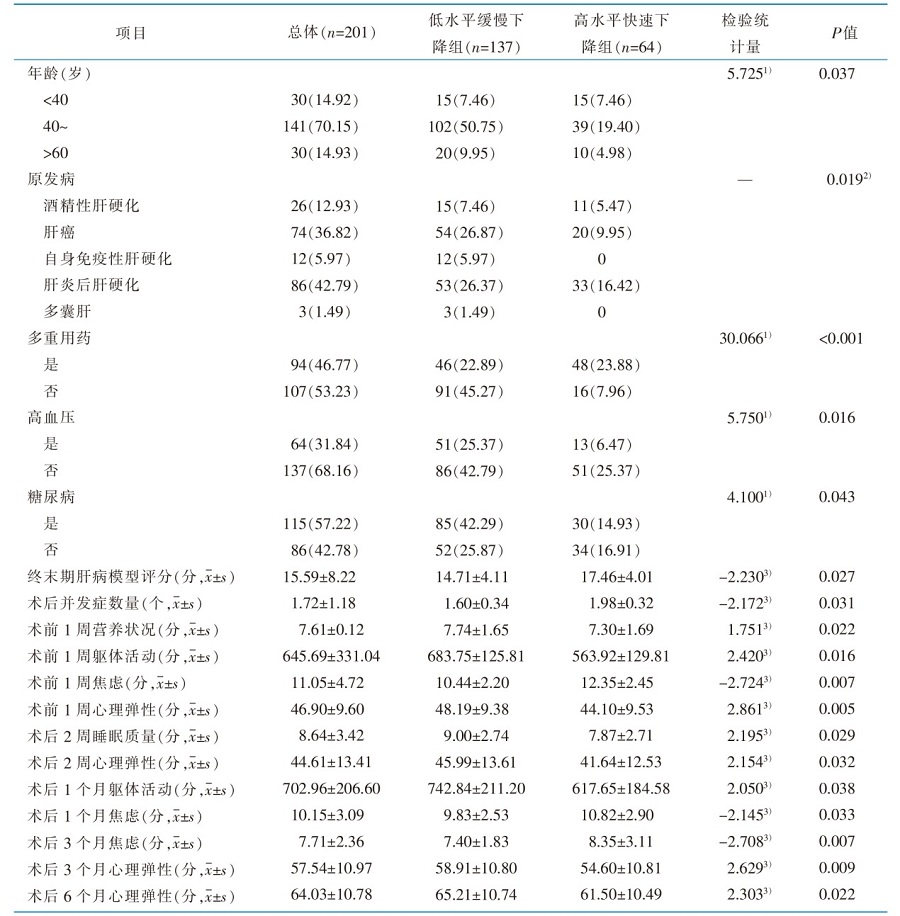 |
表1 肝移植患者衰弱变化潜在类别的单因素分析(n=201,$\bar{x}±s$)
Table 1 Univariate analysis of potential categories of frailty in liver transplant recipients(n=201,$\bar{x}±s$)
|
 |
表2 肝移植患者衰弱变化轨迹潜类别增长模型拟合指标(n=201)
Table 2 LCGM fitting index of trajectory of frailty in liver transplant recipients(n=201)
|
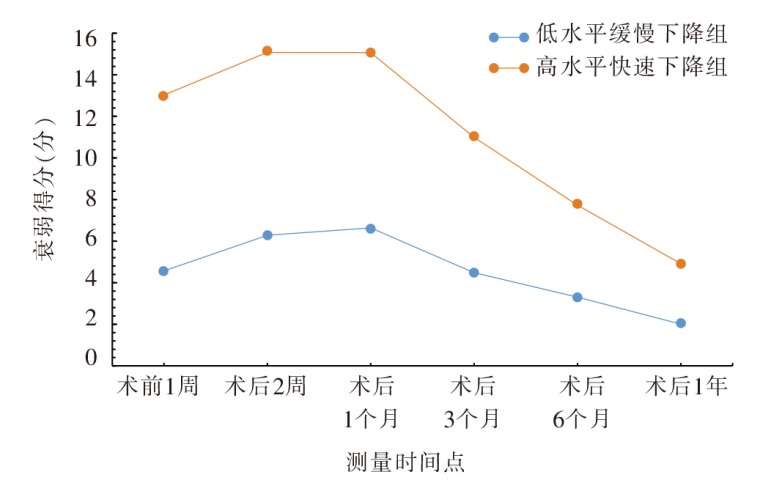
图1 肝移植患者衰弱变化潜类别增长模型轨迹
Figure 1 LCGM frailty trajectory in liver transplant recipients
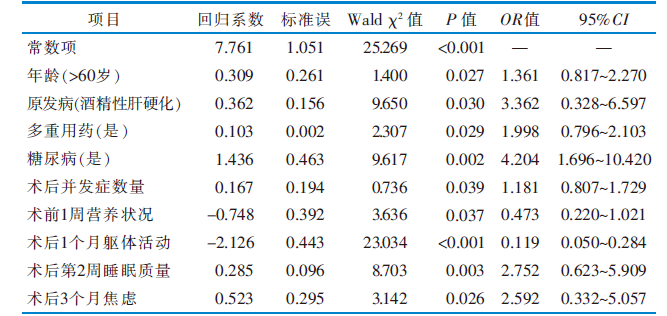 |
表3 肝移植患者衰弱变化轨迹Logistic回归分析(n=201)
Table 3 Results of binary Logistic regression analysis of the classes of frailty trajectory in liver transplant recipients(n=201)
|
| [1] |
McAdams-DeMarco MA, Law A, King E, et al. Frailty and mor-tality in kidney transplant recipients[J]. Am J Transplant, 2015, 15(1):149-154.
DOI PMID |
| [2] |
Ghelichi-Ghojogh M, Rajabi A, Mohammadizadeh F, et al. Survi-val rate of liver transplantation in Asia:a systematic review and meta-analysis[J]. Iran J Public Health, 2022, 51(10):2207-2220.
DOI PMID |
| [3] |
Mokdad AA, Lopez AD, Shahraz S, et al. Liver cirrhosis morta-lity in 187 countries between 1980 and 2010:a systematic analysis[J]. BMC Med, 2014, 12:145.
DOI PMID |
| [4] |
Ayorinde T, Panayotova G, Sharma A, et al. Clinical and bio-marker assessment of frailty in liver transplantation[J]. Curr Opin Organ Transplant, 2021, 26(5):488-497.
DOI URL |
| [5] |
Dolgin NH, Martins PNA, Movahedi B, et al. Functional status predicts postoperative mortality after liver transplantation[J]. Clin Transplant, 2016, 30(11):1403-1410.
DOI PMID |
| [6] |
Lai JC, Dodge JL, Kappus MR, et al. Changes in frailty are associated with waitlist mortality in patients with cirrhosis[J]. J Hepatol, 2020, 73(3):575-581.
DOI PMID |
| [7] |
Lai JC, Segev DL, McCulloch CE, et al. Physical frailty after liver transplantation[J]. Am J Transplant, 2018, 18(8):1986-1994.
DOI PMID |
| [8] |
Bhanji RA, Narayanan P, Moynagh MR, et al. Differing impact of sarcopenia and frailty in nonalcoholic steatohepatitis and alcoholic liver disease[J]. Liver Transpl, 2019, 25(1):14-24.
DOI URL |
| [9] |
Victor DW 3rd, Zanetto A, Montano-Loza AJ, et al. The role of preoperative optimization of the nutritional status on the improvement of short-term outcomes after liver transplantation? A review of the literature and expert panel recommendations[J]. Clin Transplant, 2022, 36(10):e14647.
DOI URL |
| [10] |
Tandon P, Tangri N, Thomas L, et al. A rapid bedside screen to predict unplanned hospitalization and death in outpatients with cirrhosis:a prospective evaluation of the clinical frailty scale[J]. Am J Gastroenterol, 2016, 111(12):1759-1767.
DOI URL |
| [11] |
王璐, 卢芳燕, 吕斐翠, 等. 肝移植受者术前衰弱现状及影响因素研究[J]. 中华护理杂志, 2024, 59(22):2710-2715.
DOI URL |
| Wang L, Lu FY, Lü FC, et al. The current status and inf-luencing factors analysis of frailty in liver transplant candi-dates[J]. Chin J Nurs, 2024, 59(22):2710-2715. | |
| [12] |
郭利敏, 孟萌, 关玉珠, 等. 肝移植受者衰弱的研究进展[J]. 中华护理杂志, 2020, 55(8):1265-1270.
DOI URL |
| Guo LM, Meng M, Guan YZ, et al. Frailty in liver transplant recipients:a literature review[J]. Chin J Nurs, 2020, 55(8):1265-1270. | |
| [13] |
孙慧慧, 孙菊, 程莉洁, 等. 肝移植受者术前预康复的研究进展[J]. 护理学报, 2022, 29(15):39-44.
DOI |
| Sun HH, Sun J, Cheng LJ, et al. Research progress on preope-rative rehabilitation of liver transplant recipients[J]. J Nurs China, 2022, 29(15):39-44. | |
| [14] | 方积乾. 生物医学研究的统计方法[M]. 北京: 高等教育出版社, 2007. |
| Fang JQ. Statistical methods for biomedical research[M]. Bei-jing: Higher Education Press, 2007. | |
| [15] |
Lai JC, Covinsky KE, McCulloch CE, et al. The liver frailty index improves mortality prediction of the subjective clinician assessment in patients with cirrhosis[J]. Am J Gastroenterol, 2018, 113(2):235-242.
DOI PMID |
| [16] | 屈宁宁, 李可基. 国际体力活动问卷中文版的信度和效度研究[J]. 中华流行病学杂志, 2004, 25(3):87-90. |
| Qu NN, Li KJ. Study on the reliability and validity of the Chinese version of International Physical Activity Question-naire[J]. Chin J Epidemiol, 2004, 25(3):87-90. | |
| [17] |
Rubenstein LZ, Harker JO, Salvà A, et al. Screening for un-dernutrition in geriatric practice:developing the short-form mini-nutritional assessment(MNA-SF)[J]. J Gerontol A Biol Sci Med Sci, 2001, 56(6):M366-M372.
DOI URL |
| [18] | 刘贤臣, 唐茂芹, 胡蕾, 等. 匹兹堡睡眠质量指数的信度和效度研究[J]. 中华精神科杂志, 1996, 29(2):103-107. |
| Liu XC, Tang MQ, Hu L, et al. Reliability and validity of the Pittsburgh sleep quality index[J]. Chin J Psychiatry, 1996, 29(2):103-107. | |
| [19] |
Zigmond AS, Snaith RP. The hospital anxiety and depression scale[J]. Acta Psychiatr Scand, 1983, 67(6):361-370.
DOI URL |
| [20] | 张帆, 朱树贞, 邓平基. 领悟社会支持量表在国内住院病人社会支持研究中的应用评价[J]. 护理研究, 2018, 32(13):2048-2052. |
| Zhang F, Zhu SZ, Deng PJ. Evaluation of the application of perceived social support scale in the study of social support for inpatients in China[J]. J Nurs Res, 2018, 32(13):2048-2052. | |
| [21] | 于肖楠, 张建新. 自我韧性量表与Connor-Davidson韧性量表的应用比较[J]. 心理科学, 2007, 30(5):1169-1171. |
| Yu XN, Zhang JX. A comparison between the Chinese version of Ego-Resiliency Scale and Connor-Davidson Resilience Scale[J]. Psychol Sci, 2007, 30(5):1169-1171. | |
| [22] | 中华医学会肝病学分会, 中华医学会消化病学分会. 终末期肝病临床营养指南[J]. 临床医学研究与实践, 2019, 4(19):201. |
| Chinese Society of Hepatology,Chinese Medical Association; Chinese Society of Gastroenterology,Chinese Medical Associa-tion. Clinical guidelines on nutrition in end-stage liver disease[J]. Clin Res Pract, 2019, 4(19):201. | |
| [23] |
Burkhalter H, Sereika SM, Engberg S, et al. Validity of 2 sleep quality items to be used in a large cohort study of kidney transplant recipients[J]. Prog Transplant, 2011, 21(1):27-35.
DOI PMID |
| [24] |
路梦新, 徐晓玮, 程莉洁, 等. 成人肝移植患者术后自我管理问题提示列表的构建及应用研究[J]. 中华护理杂志, 2025, 60(14):1709-1715.
DOI URL |
|
Lu MX, Xu XW, Cheng LJ, et al. Construction and preliminary application of a self-management question prompt list in adult liver transplant recipients[J]. Chin J Nurs, 2025, 60 (14):1709-1715.
DOI URL |
|
| [25] |
Paka P, Lieber SR, Lee RA, et al. Perioperative glucose mana-gement and outcomes in liver transplant recipients:a quali-tative systematic review[J]. World J Transplant, 2018, 8(3):75.
DOI URL |
| [1] | 中华护理学会静脉输液治疗专业委员会, 北京护理学会, (执笔:李佳, 李旭英, 覃惠英, 陈利芬, 吴珍明, 胡泽吟, 罗梦娜, 范育英, 吴嘉慧, 林宇萍, 王蕾, 孙文彦, 冯毕龙, 高伟, 李亚南, 侯罗娅, 李春燕. 中心静脉通路装置拔除护理专家共识[J]. 中华护理杂志, 2026, 61(9): 1157-1162. |
| [2] | 周霞, 马艳艳, 师正坤, 于海霞, 周艳, 胡红玲, 李莜, 陈思思, 张京慧. 隧道式经股静脉PICC置入术在困难静脉通路婴幼儿中的应用研究[J]. 中华护理杂志, 2026, 61(9): 1163-1170. |
| [3] | 黄萍, 李黎, 郭骊莉, 徐莹, 叶赟, 江淑芳. 与无针输液接头相关的导管相关性血流感染风险评估工具的构建与初步应用[J]. 中华护理杂志, 2026, 61(9): 1171-1179. |
| [4] | 李佳, 张玉玲, 邢乐, 张利峰, 牛秀峰, 许莉. 早产儿经上肢置入PICC尖端继发性异位风险预测模型的建立与验证[J]. 中华护理杂志, 2026, 61(9): 1180-1186. |
| [5] | 何娟, 赵蕾蕾, 叶冠军, 余艳芬, 傅晓君, 周琴. 1例双侧无名静脉及上腔静脉人工血管置换术后患者经上肢置入PICC的护理[J]. 中华护理杂志, 2026, 61(9): 1187-1191. |
| [6] | 梁江淑渊, 曾妃, 何鹏, 谢梦珊, 江悦, 蒋宗恒, 王建茗. 静脉-静脉体外膜肺氧合患者早期活动风险等级评估系统的构建及应用研究[J]. 中华护理杂志, 2026, 61(9): 1192-1199. |
| [7] | 陈晨, 顾肖, 郭凡, 王敏, 倪兴梅, 黄琴, 程念开. 3种衰弱评估工具对急诊老年创伤患者不良结局的预测价值[J]. 中华护理杂志, 2026, 61(9): 1200-1207. |
| [8] | 郑煜琳, 刘晋宁, 张静, 郭会敏, 谷艳梅, 张莉莉. 酒精性肝病患者肝移植术后再饮酒现状及其影响因素分析[J]. 中华护理杂志, 2026, 61(9): 1208-1214. |
| [9] | 叶俊霜, 沈丽佳, 孟霞靓, 张玉姣, 蔡根莲, 邵碧云, 周亚辉, 张柳倩, 应金萍. 维持性血液透析患者对口腔衰弱认知和体验的质性研究[J]. 中华护理杂志, 2026, 61(9): 1215-1220. |
| [10] | 王芸姣, 杨玉金, 郑春艳, 彭菲津, 王淑贞, 蒋喜露, 周为民, 王薇, 张娜. 糖尿病下肢动脉硬化闭塞症患者介入术后康复护理方案的构建及应用研究[J]. 中华护理杂志, 2026, 61(9): 1221-1229. |
| [11] | 杨明霞, 安冉, 臧金凤, 李春梅. 老年慢性病共病患者及照护者老老照护能力与自我忽视的相关性分析[J]. 中华护理杂志, 2026, 61(9): 1230-1236. |
| [12] | 梁和静, 许鹊, 史云霞, 祖金美, 黄文静, 杨春旭, 郭明华, 王磊. 颈动脉内膜剥脱术围手术期护理质量评价指标的构建[J]. 中华护理杂志, 2026, 61(9): 1237-1244. |
| [13] | 韩媛媛, 石玉竹, 尚文涵, 么莉. 870所三级甲等医院老年住院患者跌倒伤害发生现状与影响因素分析[J]. 中华护理杂志, 2026, 61(9): 1245-1252. |
| [14] | 夏云芳, 王洪, 崔岱, 付真真, 朱敏. 1例弥漫性毒性甲状腺肿合并超敏反应综合征青少年患者的护理[J]. 中华护理杂志, 2026, 61(9): 1253-1256. |
| [15] | 周益飞, 王海苹, 胡益环, 应莉, 罗松娜. 1例氢氟酸中毒并发呼吸心搏骤停患者的急救护理[J]. 中华护理杂志, 2026, 61(9): 1257-1260. |
| 阅读次数 | ||||||
|
全文 |
|
|||||
|
摘要 |
|
|||||
