

中华护理杂志 ›› 2026, Vol. 61 ›› Issue (16): 2245-2252.DOI: 10.3761/j.isson.0254-1769.2026.16.012
侯晓飞( ), 靳杨, 唐启群*(), 胡惠菊, 佟长颖
收稿日期:2026-03-29
出版日期:2026-08-20
发布日期:2026-08-14
*通讯作者:
唐启群,E-mail:jwctang2008@163.com作者简介:侯晓飞:女,本科(硕士在读),护士,E-mail:houxiaofei116@163.com侯晓飞:研究设计、干预实施、论文撰写与修改、统计学分析;靳杨:协助招募研究对象与组织认知刺激疗法活动;唐启群:研究设计、质量控制、方案调整、修订与培训、基金支持;胡惠菊、佟长颖:数据收集与整理
基金资助:
HOU Xiaofei(), JIN Yang, TANG Qiqun*(), HU Huiju, TONG Changying
Received:2026-03-29
Online:2026-08-20
Published:2026-08-14
* Corresponding author:
TANG Qiqun,E-mail:jwctang2008@163.comFunding program:摘要:
目的 探讨认知刺激疗法在养老机构轻度认知障碍老年人中的干预效果,为提升其认知功能提供参考。 方法 采用便利抽样法,于2025年9—11月,选取唐山市某2所养老机构中的轻度认知障碍老年人为研究对象。按照编号随机法,将2所养老机构中2个疗养区的轻度认知障碍老年人设为试验组(34例),将另外2个疗养区的轻度认知障碍老年人设为对照组(34例)。试验组在日常照护的基础上实施为期12周的认知刺激疗法干预,对照组给予养老机构常规照护及个性化健康教育。干预后,比较两组的认知功能、心理状态、平衡功能及日常生活活动能力等方面的差异。 结果 干预过程中无样本丢失。干预12周后,试验组蒙特利尔认知评估量表评分、简版老年抑郁量表评分、Berg平衡量表评分及日常生活活动能力量表评分均优于对照组,差异有统计学意义(P<0.05)。 结论 对养老机构轻度认知障碍老年人实施认知刺激疗法能够有效改善其认知功能,缓解抑郁症状,提升平衡功能与日常生活活动能力,对提高其生活质量具有积极意义。
侯晓飞, 靳杨, 唐启群, 胡惠菊, 佟长颖. 认知刺激疗法对养老机构轻度认知障碍老年人的干预效果研究[J]. 中华护理杂志, 2026, 61(16): 2245-2252.
HOU Xiaofei, JIN Yang, TANG Qiqun, HU Huiju, TONG Changying. A study on the intervention effect of cognitive stimulation therapy on elderly people with mild cognitive impairment in elderly care institutions[J]. Chinese Journal of Nursing, 2026, 61(16): 2245-2252.
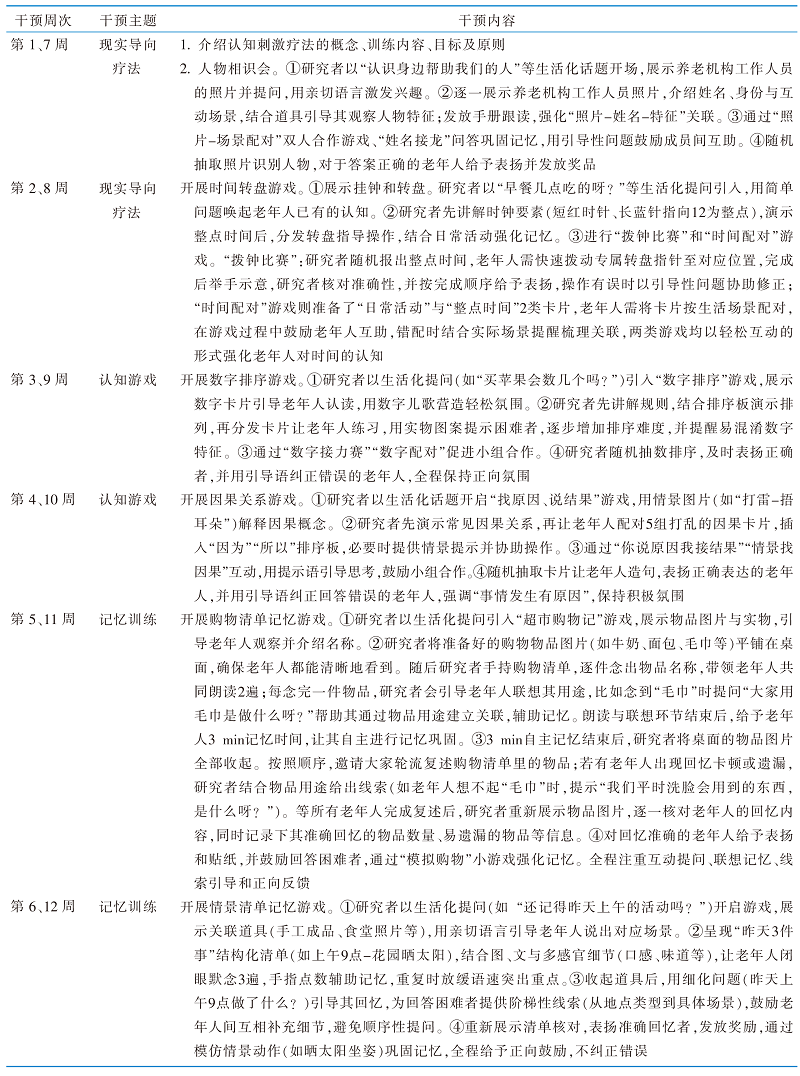 |
表1 认知刺激疗法干预方案
Table 1 Cognitive stimulation therapy intervention measures
| |
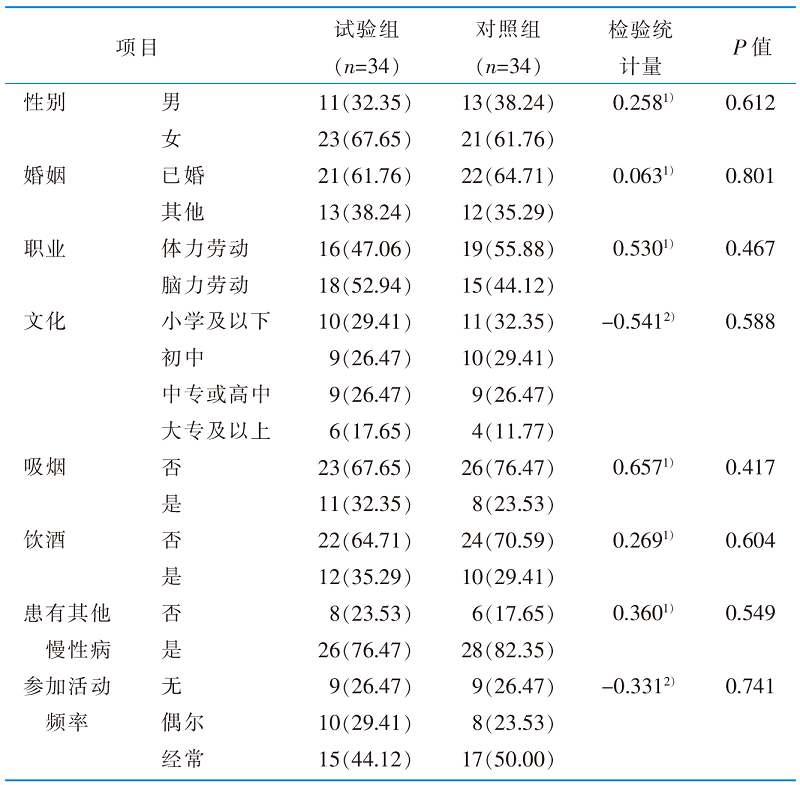 |
表2 两组一般资料的比较[例(百分比,%)]
Table 2 Comparison of general data between the 2 groups[cases(percentage,%)]
| |
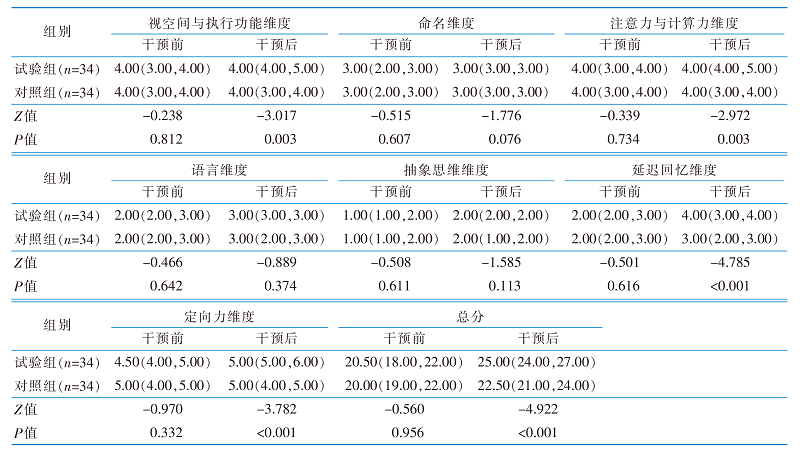 |
表3 干预前后两组认知功能的比较[分,M(P25,P75)]
Table 3 Comparison of cognitive function between the 2 groups before and after the intervention[score,M(P25,P75)]
| |
 |
表4 干预前后两组心理状态、平衡功能、日常生活活动能力的比较(分,$\bar{x}\pm s$)
Table 4 Comparison of psychological state,balance function and activities of daily living between the 2 groups before and after the intervention(score,$\bar{x}\pm s$)
| |
| [1] | 国家统计局. 新时代高质量发展的人口机遇和挑战——第七次全国人口普查公报解读[EB/OL].(2021-05-12)[2026-01-05]. https://www.stats.gov.cn/sj/sjjd/202302/t20230202_1896484.html. |
| National Bureau of Statistics. Interpretation of the seventh national population census bulletin: population opportunities and challenges for high-quality development in the new era[EB/OL].(2021-05-12)[2026-01-05]. https://www.stats.gov.cn/sj/sjjd/202302/t20230202_1896484.html. | |
| [2] | 续晓倩, 岳寿伟. 轻度认知障碍的全球患病率[J]. 中国康复, 2023, 38(1):8. |
| Xu XQ, Yue SW. Global prevalence of mild cognitive impair-ment[J]. Chin J Rehabil, 2023, 38(1):8. | |
| [3] | Alzheimer’s Disease International. World Alzheimer Report 2024[EB/OL].(2024-09-20)[2026-01-05]. https://www.alzint.org/re-source/world-alzheimer-report-2024/. |
| [4] |
Poe AA, Vance DE, Patrician PA, et al. Resilience in the con-text of dementia family caregiver mental health:a concept ana-lysis[J]. Arch Psychiatr Nurs, 2023, 45:143-151.
DOI URL |
| [5] |
Cheng ST. Cognitive reserve and the prevention of dementia:the role of physical and cognitive activities[J]. Curr Psychiatry Rep, 2016, 18(9):85.
DOI URL |
| [6] |
Saragih ID, Tonapa SI, Saragih IS, et al. Effects of cognitive stimulation therapy for people with dementia:a systematic review and meta-analysis of randomized controlled studies[J]. Int J Nurs Stud, 2022, 128:104181.
DOI URL |
| [7] | 郭军, 麻琦, 龚怡琳, 等. 认知刺激干预失智症患者有效性的系统评价再评价[J]. 军事护理, 2024, 41(10):101-105. |
| Guo J, Ma Q, Gong YL, et al. Effectiveness of cognitive stimu-lation intervention in patients with dementia:an overview of systematic reviews[J]. Mil Nurs, 2024, 41(10):101-105. | |
| [8] | 姜凯慧, 张建薇, 孟丽君, 等. 认知刺激疗法结合重塑吞咽功能训练对阿尔兹海默症患者认知能力以及吞咽障碍的影响[J]. 海军医学杂志, 2023, 44(1):69-73. |
| Jiang KH, Zhang JW, Meng LJ, et al. Effects of cognitive stimulation therapy combined with reshaping swallowing fun-ction training on cognitive ability and swallowing disorder in patients with Alzheimer’s disease[J]. J Navy Med, 2023, 44(1):69-73. | |
| [9] | 吴秀娟, 邓玮瑜, 覃强, 等. 认知刺激疗法对鼻咽癌放射治疗后轻度认知障碍患者的影响[J]. 中外医学研究, 2023, 21(10):127-130. |
| Wu XJ, Deng WY, Qin Q, et al. Effect of cognitive stimulation therapy on patients with mild cognitive disorder after radiothe-rapy for nasopharyngeal carcinoma[J]. Chin Foreign Med Res, 2023, 21(10):127-130. | |
| [10] | 中国痴呆与认知障碍诊治指南写作组, 中国医师协会神经内科医师分会认知障碍疾病专业委员会. 2018中国痴呆与认知障碍诊治指南(五):轻度认知障碍的诊断与治疗[J]. 中华医学杂志, 2018, 98(17):1294-1301. |
| Writing Group of Chinese Guidelines for the Diagnosis and Treatment of Dementia and Cognitive Impairment, Cognitive Impairment Diseases Committee of Neurology Branch of Chinese Medical Doctor Association. Chinese guidelines for the diagnosis and treatment of dementia and cognitive im-pairment(5):diagnosis and treatment of mild cognitive im-pairment(2018)[J]. Nat Med J China, 2018, 98(17):1294-1301. | |
| [11] | 王炜, 王鲁宁. “蒙特利尔认知评估量表” 在轻度认知损伤患者筛查中的应用[J]. 中华内科杂志, 2007, 46(5):414-416. |
| Wang W, Wang LN. Application of Montreal Cognitive Assess-ment scale in screening patients with mild cognitive impair-ment[J]. Chin J Intern Med, 2007, 46(5):414-416. | |
| [12] |
Rai H, Yates L, Orrell M. Cognitive stimulation therapy for dementia[J]. Clin Geriatr Med, 2018, 34(4):653-665.
DOI PMID |
| [13] | 张立秀, 刘雪琴. 蒙特利尔认知评估量表中文版的信效度研究[J]. 护理研究, 2007, 21(31):2906-2907. |
| Zhang LX, Liu XQ. A study on reliability and validity of MoCA scale of Chinese version[J]. Chin Nurs Res, 2007, 21(31):2906-2907. | |
| [14] | 唐丹. 简版老年抑郁量表(GDS-15)在中国老年人中的使用[J]. 中国临床心理学杂志, 2013, 21(3):402-405. |
| Tang D. Application of short form Geriatric Depression Scale (GDS-15) in Chinese elderly[J]. Chin J Clin Psychol, 2013, 21(3):402-405. | |
| [15] | 金冬梅, 燕铁斌. Berg平衡量表及其临床应用[J]. 中国康复理论与实践, 2002, 8(3):155-157. |
| Jin DM, Yan TB. Berg Balance Scale and its clinical applica-tion[J]. Chin J Rehabil Theory Pract, 2002, 8(3):155-157. | |
| [16] | 瓮长水, 王军, 王刚, 等. Berg平衡量表在脑卒中患者中的内在信度和同时效度[J]. 中国康复医学杂志, 2007, 22(8):688-690,717. |
| Weng CS, Wang J, Wang G, et al. Assessments of internal re-liability and concurrent validity of Berg Balance Scale in stroke patients[J]. Chin J Rehabil Med, 2007, 22(8):688-690, 717. | |
| [17] | Lawton MP, Brody EM. Assessment of older people:self-main-taining and instrumental activities of daily living[J]. Geronto-logist, 1969, 9(3 Part 1):179-186. |
| [18] | 张明园, 何燕玲. 精神科评定量表手册[M]. 长沙: 湖南科学技术出版社, 2015. |
| Zhang MY, He YL. Handbook of psychiatric rating scales[M]. Changsha: Hunan Science and Technology Press, 2015. | |
| [19] |
Pashmdarfard M, Azad A. Assessment tools to evaluate Activi-ties of Daily Living(ADL) and Instrumental Activities of Daily Living(IADL) in older adults:a systematic review[J]. Med J Islam Repub Iran, 2020, 34:33.
DOI PMID |
| [20] |
严菁菁, 宋玉磊, 殷海燕, 等. 触觉技术在轻度认知障碍老年人认知功能评估与康复训练中的应用进展[J]. 中华护理杂志, 2025, 60(22):2805-2810.
DOI |
|
Yan JJ, Song YL, Yin HY, et al. Progress in the application of haptic technology in the assessment of cognitive function and rehabilitation training for older adults with mild cognitive impairment[J]. Chin J Nurs, 2025, 60(22):2805-2810.
DOI |
|
| [21] | 肖海钢. 养老机构老年人抑郁症状现况调查及正念干预效果的研究[D]. 武汉: 华中师范大学, 2024. |
| Xiao HG. Investigation on the depression symptoms of the elderly in the nursing home and the mindfulness intervention study[D]. Wuhan: Central China Normal University, 2024. | |
| [22] | 魏娇娇, 谢晖, 汪晨晨, 等. 社区老年人基本心理需要满足、自我决定动机与体育锻炼行为的关系[J]. 护理研究, 2020, 34(21):3791-3795. |
| Wei JJ, Xie H, Wang CC, et al. Analysis of relationship among satisfaction of basic psychological need,self-determination motivation and physical exercise behavior of the elderly in community[J]. Chin Nurs Res, 2020, 34(21):3791-3795. | |
| [23] |
郝雨晴, 胡慧秀, 赵雅洁, 等. 老年人社交活动与认知功能关系的研究进展及护理启示[J]. 中华护理杂志, 2025, 60(2):251-256.
DOI |
| Hao YQ, Hu HX, Zhao YJ, et al. Research progress and nurs-ing inspiration on the relationship between social activities and cognitive function in older adults[J]. Chin J Nurs, 2025, 60(2):251-256. | |
| [24] | 邓青, 张业廷, 牟向前, 等. 身体活动与神经可塑性领域热点主题动态演化的可视化分析[J]. 中国组织工程研究, 2026, 30(22):5859-5866. |
| Deng Q, Zhang YT, Mou XQ, et al. Visualization analysis of dynamic evolution of hot topics in the field of physical activity and neural plasticity[J]. Chin J Tissue Eng Res, 2026, 30(22):5859-5866. |
| [1] | 中华护理学会静脉输液治疗专业委员会, 北京护理学会, (执笔:李佳, 李旭英, 覃惠英, 陈利芬, 吴珍明, 胡泽吟, 罗梦娜, 范育英, 吴嘉慧, 林宇萍, 王蕾, 孙文彦, 冯毕龙, 高伟, 李亚南, 侯罗娅, 李春燕. 中心静脉通路装置拔除护理专家共识[J]. 中华护理杂志, 2026, 61(9): 1157-1162. |
| [2] | 周霞, 马艳艳, 师正坤, 于海霞, 周艳, 胡红玲, 李莜, 陈思思, 张京慧. 隧道式经股静脉PICC置入术在困难静脉通路婴幼儿中的应用研究[J]. 中华护理杂志, 2026, 61(9): 1163-1170. |
| [3] | 黄萍, 李黎, 郭骊莉, 徐莹, 叶赟, 江淑芳. 与无针输液接头相关的导管相关性血流感染风险评估工具的构建与初步应用[J]. 中华护理杂志, 2026, 61(9): 1171-1179. |
| [4] | 李佳, 张玉玲, 邢乐, 张利峰, 牛秀峰, 许莉. 早产儿经上肢置入PICC尖端继发性异位风险预测模型的建立与验证[J]. 中华护理杂志, 2026, 61(9): 1180-1186. |
| [5] | 何娟, 赵蕾蕾, 叶冠军, 余艳芬, 傅晓君, 周琴. 1例双侧无名静脉及上腔静脉人工血管置换术后患者经上肢置入PICC的护理[J]. 中华护理杂志, 2026, 61(9): 1187-1191. |
| [6] | 梁江淑渊, 曾妃, 何鹏, 谢梦珊, 江悦, 蒋宗恒, 王建茗. 静脉-静脉体外膜肺氧合患者早期活动风险等级评估系统的构建及应用研究[J]. 中华护理杂志, 2026, 61(9): 1192-1199. |
| [7] | 陈晨, 顾肖, 郭凡, 王敏, 倪兴梅, 黄琴, 程念开. 3种衰弱评估工具对急诊老年创伤患者不良结局的预测价值[J]. 中华护理杂志, 2026, 61(9): 1200-1207. |
| [8] | 郑煜琳, 刘晋宁, 张静, 郭会敏, 谷艳梅, 张莉莉. 酒精性肝病患者肝移植术后再饮酒现状及其影响因素分析[J]. 中华护理杂志, 2026, 61(9): 1208-1214. |
| [9] | 叶俊霜, 沈丽佳, 孟霞靓, 张玉姣, 蔡根莲, 邵碧云, 周亚辉, 张柳倩, 应金萍. 维持性血液透析患者对口腔衰弱认知和体验的质性研究[J]. 中华护理杂志, 2026, 61(9): 1215-1220. |
| [10] | 王芸姣, 杨玉金, 郑春艳, 彭菲津, 王淑贞, 蒋喜露, 周为民, 王薇, 张娜. 糖尿病下肢动脉硬化闭塞症患者介入术后康复护理方案的构建及应用研究[J]. 中华护理杂志, 2026, 61(9): 1221-1229. |
| [11] | 杨明霞, 安冉, 臧金凤, 李春梅. 老年慢性病共病患者及照护者老老照护能力与自我忽视的相关性分析[J]. 中华护理杂志, 2026, 61(9): 1230-1236. |
| [12] | 梁和静, 许鹊, 史云霞, 祖金美, 黄文静, 杨春旭, 郭明华, 王磊. 颈动脉内膜剥脱术围手术期护理质量评价指标的构建[J]. 中华护理杂志, 2026, 61(9): 1237-1244. |
| [13] | 韩媛媛, 石玉竹, 尚文涵, 么莉. 870所三级甲等医院老年住院患者跌倒伤害发生现状与影响因素分析[J]. 中华护理杂志, 2026, 61(9): 1245-1252. |
| [14] | 夏云芳, 王洪, 崔岱, 付真真, 朱敏. 1例弥漫性毒性甲状腺肿合并超敏反应综合征青少年患者的护理[J]. 中华护理杂志, 2026, 61(9): 1253-1256. |
| [15] | 周益飞, 王海苹, 胡益环, 应莉, 罗松娜. 1例氢氟酸中毒并发呼吸心搏骤停患者的急救护理[J]. 中华护理杂志, 2026, 61(9): 1257-1260. |
| 阅读次数 | ||||||
|
全文 |
|
|||||
|
摘要 |
|
|||||
