

中华护理杂志 ›› 2026, Vol. 61 ›› Issue (20): 2748-2756.DOI: 10.3761/j.issn.0254-1769.2026.20.002
王俊( ), 江珉*()
收稿日期:2026-04-07
出版日期:2026-10-20
发布日期:2026-10-12
*通讯作者:
江珉,E-mail:5519125@qq.com作者简介:王俊:女,硕士,主管护师,E-mail:564555190@qq.com王俊:查阅整理文献、研究设计、方案构建、研究实施、数据收集与整理、统计学分析、论文撰写;江珉:研究指导、监督方案实施、论文审阅和修改、经费支持
基金资助:
WANG Jun(), JIANG Min*()
Received:2026-04-07
Online:2026-10-20
Published:2026-10-12
* Corresponding author:
JIANG Min,E-mail:5519125@qq.comFunding program:摘要:
目的 构建老年髋部骨折合并肌少症患者术后渐进性抗阻训练方案,并验证其有效性和可行性,为此类患者术后功能锻炼提供临床实践依据。方法 通过文献回顾及专家会议法,构建老年髋部骨折合并肌少症患者渐进性抗阻训练方案。采用便利抽样法,选取2024年7—12月在云南省某三级甲等医院老年医学科行单侧髋关节置换术的老年髋部骨折合并肌少症患者80例作为研究对象,采用随机数字表法,将随机数中的奇数设为试验组,偶数设为对照组,两组各40例患者。试验组接受12周渐进性抗阻训练和常规骨科康复护理,对照组接受常规骨科康复护理,比较两组术后7 d、1个月、3个月的最大握力、患侧下肢肌力、骨骼肌质量指数(Skeletal Muscle Index,SMI)、起立-行走计时测试(Timed Up and Go Test,TUGT)时间、Harris髋关节功能评分及康复自我效能得分的差异。结果 试验组38例、对照组39例完成研究。干预后,两组的最大握力、SMI、TUGT时间、康复自我效能得分的时间效应及时间与组间的交互效应差异具有统计学意义(P<0.001),Harris髋关节功能评分的组间、时间及时间与组间的交互效应差异具有统计学意义(P<0.05),两组患侧下肢肌力的时间效应和组间效应差异具有统计学意义(P<0.05)。简单效应分析显示,术后3个月时试验组最大握力、SMI、康复自我效能得分、Harris髋关节功能评分及患侧下肢肌力均高于对照组,试验组的TUGT时间短于对照组,差异均具有统计学意义(P<0.05)。结论 实施该渐进性抗阻训练方案可在一定程度上改善老年髋部骨折合并肌少症患者的肌肉质量与肌力,促进髋关节及下肢功能恢复,提高康复自我效能与日常生活能力。
王俊, 江珉. 老年髋部骨折合并肌少症患者渐进性抗阻训练方案的构建与应用[J]. 中华护理杂志, 2026, 61(20): 2748-2756.
WANG Jun, JIANG Min. Construction and application of a progressive resistance training program for elderly patients with hip fracture complicated with sarcopenia[J]. Chinese Journal of Nursing, 2026, 61(20): 2748-2756.
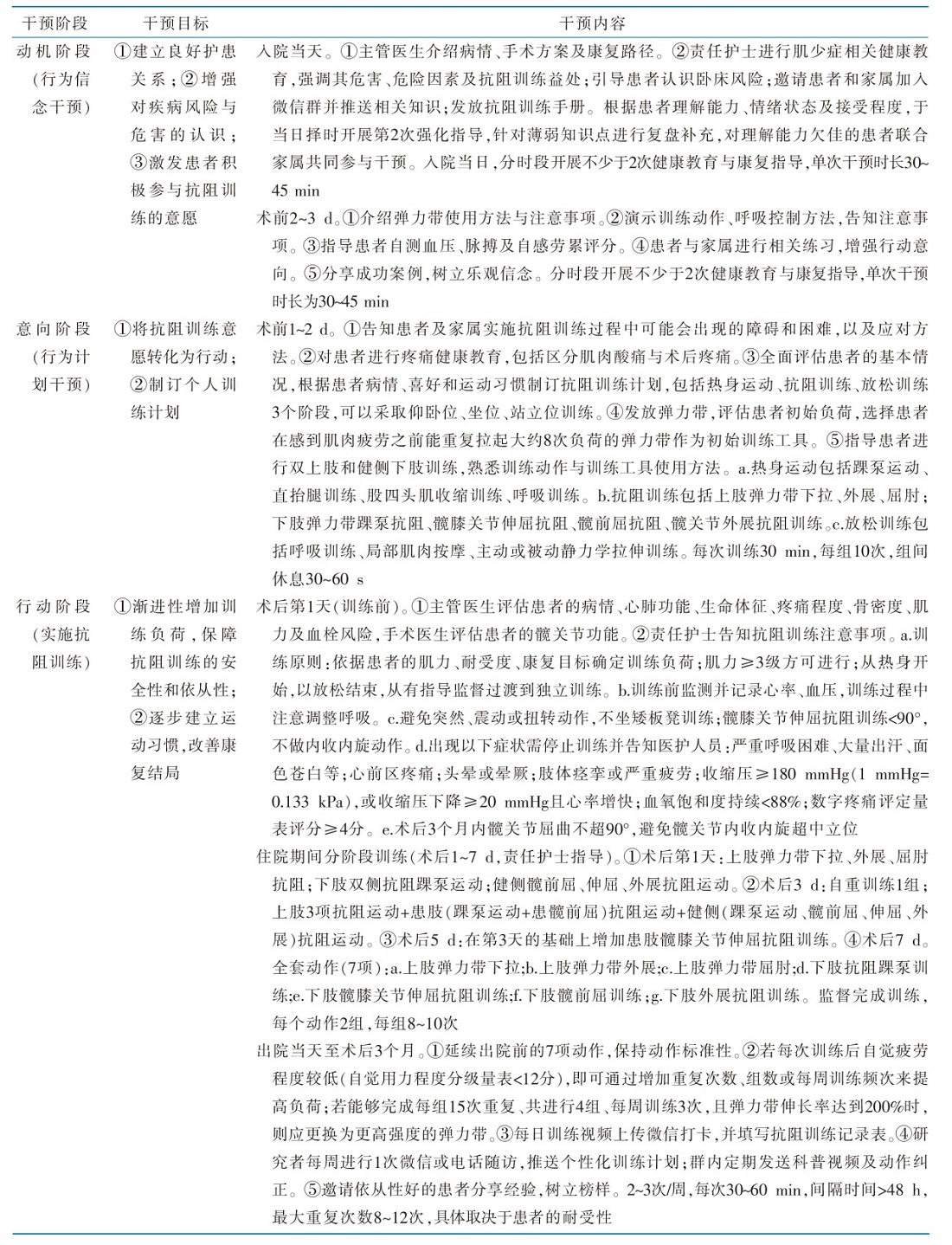 |
表1 老年髋部骨折合并肌少症患者渐进性抗阻训练方案
Table 1 Progressive resistance training program for elderly patients with hip fracture complicated with sarcopenia
| |
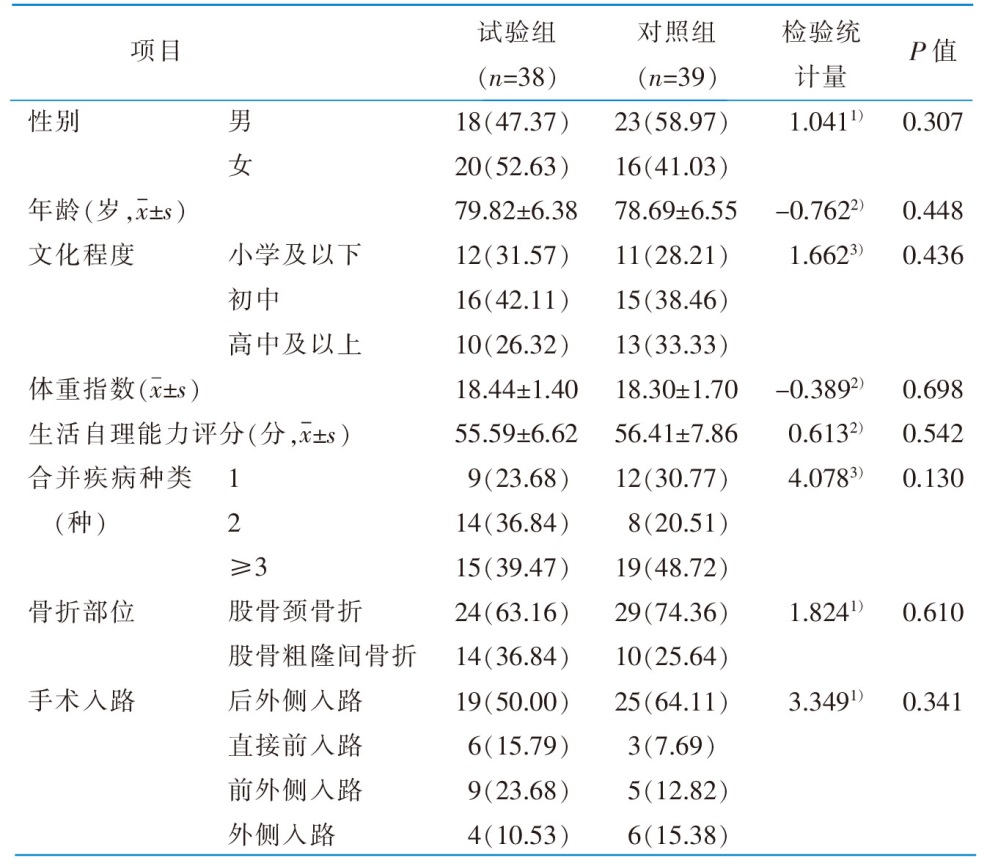 |
表2 两组一般资料的比较
Table 2 Comparison of general data between the 2 groups
| |
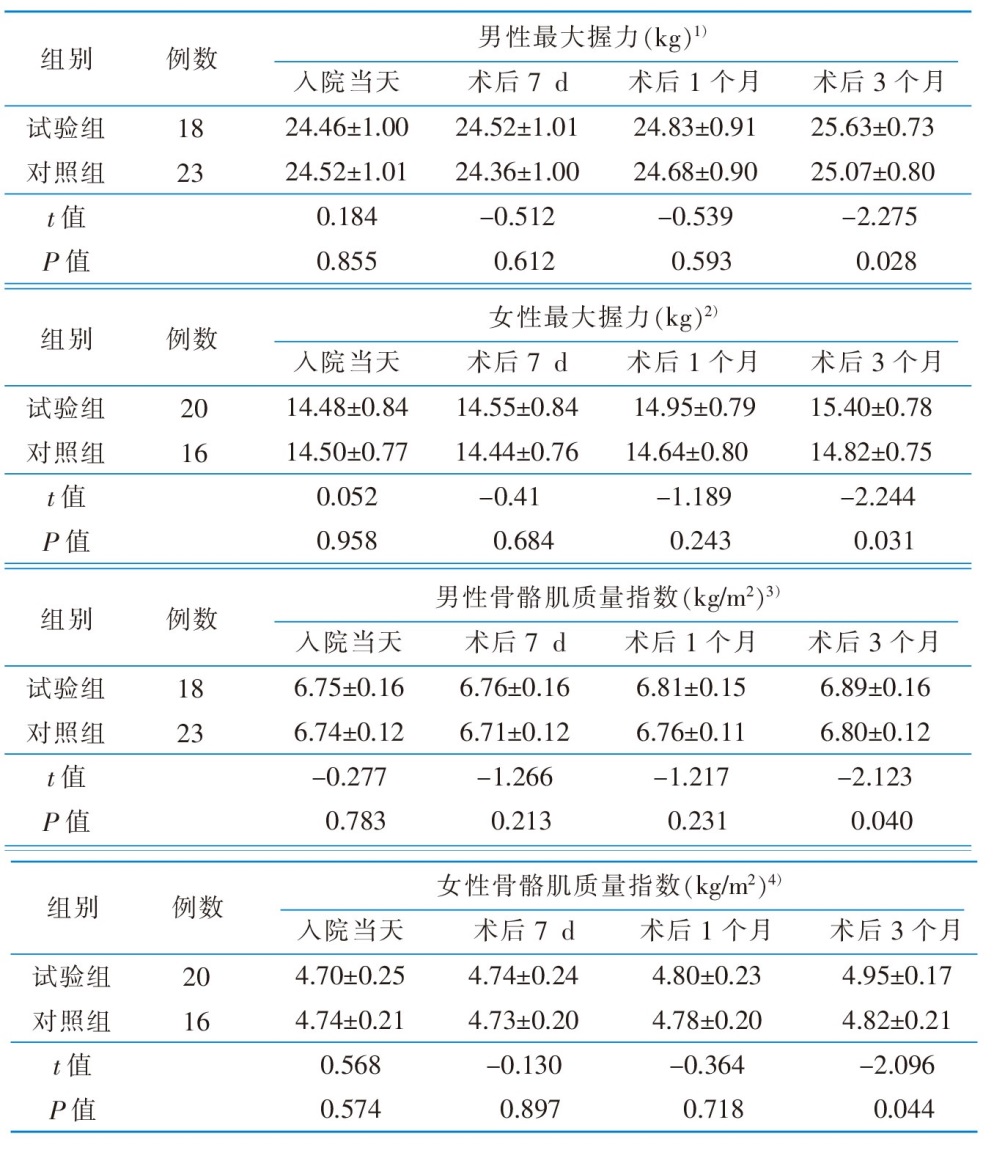 |
表3 两组最大握力和骨骼肌质量指数的比较($\bar{x}±s$)
Table 3 Comparison of maximum grip strength and skeletal muscle mass index between the 2 groups($\bar{x}±s$)
| |
 |
表4 两组Harris髋关节功能评分和患侧下肢肌力得分的比较[分,M(P25,P75)]
Table 4 Comparison of Harris hip scores and affected lower limb muscle strength between the 2 groups[scores,M(P25,P75)]
| |
 |
表5 两组起立-行走计时测试时间和康复自我效能得分的比较($\bar{x}±s$)
Table 5 Comparison of Timed Up and Go Test and rehabilitation self-efficacy scores between the 2 groups($\bar{x}±s$)
| |
| [1] | 田楚伟, 谢添, 石柳, 等. 中国老年髋部骨折报告2025[J]. 重庆医科大学学报, 2026, 51(1):1-12. |
| Tian CW, Xie T, Shi L, et al. China geriatric hip fracture report,2025[J]. J Chongqing Med Univ, 2026, 51(1):1-12. | |
| [2] | 李兴国, 邓叶龙, 刘朝晖, 等. 中国老年髋部骨折流行性病学特征分析[J]. 实用骨科杂志, 2021, 27(7):601-606. |
| Li XG, Deng YL, Liu CH, et al. The epidemiology of hip fractures of the elderly in China[J]. J Pract Orthop, 2021, 27(7):601-606. | |
| [3] |
Chen LK, Woo J, Assantachai P, et al. Asian working group for sarcopenia:2019 consensus update on sarcopenia diagnosis and treatment[J]. J Am Med Dir Assoc, 2020, 21(3):300-307.e2.
DOI URL |
| [4] |
王鑫, 徐慧萍, 黄倩, 等. 髋关节置换患者躯体功能变化轨迹的潜在类别及影响因素分析[J]. 中华护理杂志, 2026, 61(4):460-467.
DOI |
| Wang X, Xu HP, Huang Q, et al. Analysis of latent classes and influencing factors of physical function change trajectories in patients undergoing hip replacement[J]. Chin J Nurs, 2026, 61(4):460-467. | |
| [5] |
Chen G, Yu DD, Wang YC, et al. A prospective randomized controlled trial assessing the impact of preoperative combined with postoperative progressive resistance training on muscle strength,gait,balance and function in patients undergoing total hip arthroplasty[J]. Clin Interv Aging, 2024, 19:745-760.
DOI PMID |
| [6] |
Dent E, Morley JE, Cruz-Jentoft AJ, et al. International clinical practice guidelines for sarcopenia(ICFSR):screening,diagnosis and management[J]. J Nutr Health Aging, 2018, 22(10):1148-1161.
DOI PMID |
| [7] |
Soro-García P, González-Gálvez N. Effects of progressive resistance training after hip fracture:a systematic review[J]. J Funct Morphol Kinesiol, 2025, 10(1):54.
DOI URL |
| [8] |
谷斌, 陈绪娜, 张千坤, 等. 全髋关节置换术后患者渐进式平衡训练方案的制订与应用[J]. 中华护理杂志, 2020, 55(10):1458-1464.
DOI |
|
Gu B, Chen XN, Zhang QK, et al. Formulation and application of a progressive balance training program after total hip arthroplasty[J]. Chin J Nurs, 2020, 55(10):1458-1464.
DOI |
|
| [9] | 沙文娜, 陈美红, 宁丽, 等. 基于健康行动过程取向理论的老年肌少症患者健康管理方案的构建及应用[J]. 中华全科医学, 2023, 21(7):1188-1191,1258. |
| Sha WN, Chen MH, Ning L, et al. Construction and application of health management program based on HAPA for elderly patients with sarcopenia[J]. Chin J Gen Pract, 2023, 21(7):1188-1191,1258. | |
| [10] |
Foster MJ, Shurtz S. Making the critical appraisal for summaries of evidence(CASE) for evidence-based medicine (EBM):critical appraisal of summaries of evidence[J]. J Med Libr Assoc, 2013, 101(3):192-198.
DOI URL |
| [11] |
唐佳怡, 唐桂清, 张娜, 等. 慢加急性肝衰竭患者营养管理的最佳证据总结[J]. 中华护理杂志, 2025, 60(5):581-589.
DOI |
| Tang JY, Tang GQ, Zhang N, et al. Summary of best evidence for nutritional management in patients with acute on chronic liver failure[J]. Chin J Nurs, 2025, 60(5):581-589. | |
| [12] | 顾莺, 张慧文, 周英凤, 等. JBI循证卫生保健中心关于不同类型研究的质量评价工具:系统评价的方法学质量评价[J]. 护士进修杂志, 2018, 33(8):701-703. |
| Gu Y, Zhang HW, Zhou YF, et al. JBI evidence-based health center’s quality assessment tool for different types of research:the quality evaluation of diagnostic and economic evaluation[J]. J Nurses Train, 2018, 33(8):701-703. | |
| [13] | 荆凤, 何梦雪, 胡雁. 基于AGREEⅡ的儿童用药安全指南质量评价[J]. 循证护理, 2022, 8(6):718-725. |
| Jing F, He MX, Hu Y. Quality evaluation of children’s medication safety guidelines based on AGREE Ⅱ[J]. Chin Evid Based Nurs, 2022, 8(6):718-725. | |
| [14] | 罗家洪, 郭秀花. 卫生统计学:案例版[M]. 2版. 北京: 科学出版社, 2015. |
| Luo JH, Guo XH. Health statistics:case edition[M]. 2nd ed. Beijing: Science Press, 2015. | |
| [15] | 张莹莹. 渐进性局部抗阻训练对老年COPD并发肌少症高危患者的干预效果研究[D]. 湖州: 湖州师范学院, 2021. |
| Zhang YY. Effect of progressive resistance training on elderly COPD patients complicated with high risk of sarcopenia[D]. Huzhou: Huzhou Normal University, 2021. | |
| [16] |
Le XF, Wei Y, Hao DJ, et al. Psychometric properties of the Chinese version of the Sarcopenia and Quality of Life,a quality of life questionnaire specific for sarcopenia[J]. Calcif Tissue Int, 2021, 109(4):415-422.
DOI |
| [17] |
Lee RC, Wang Z, Heo M, et al. Total-body skeletal muscle mass:development and cross-validation of anthropometric prediction models[J]. Am J Clin Nutr, 2000, 72(3):796-803.
DOI PMID |
| [18] | 鲍春蓉, 吴绪波, 卞邹吉, 等. 计时起立-行走测试应用于社区老年人的信效度[J]. 中国老年学杂志, 2021, 41(23):5407-5410. |
| Bao CR, Wu XB, Bian ZJ, et al. Reliability and validity of Timed Stand-Up-Walking Test for the elderly in community[J]. Chin J Gerontol, 2021, 41(23):5407-5410. | |
| [19] | Söderman P, Malchau H. Is the Harris Hip Score System useful to study the outcome of total hip replacement?[J]. Clin Orthop Relat Res, 2001(384):189-197. |
| [20] | 唐丽, 余晓艳, 晏显会, 等. 强化股四头肌锻炼在半月板损伤行膝关节术后康复护理患者中的应用及对美国特种外科医院膝关节功能评分的影响[J]. 山西医药杂志, 2023, 52(9):709-712. |
| Tang L, Yu XY, Yan XH, et al. Application of intensive quadriceps exercise in postoperative rehabilitation nursing for patients with meniscus injury and its effect on the Hospital for Special Surgery Knee Score[J]. Shanxi Med J, 2023, 52(9):709-712. | |
| [21] | 王海燕, 许燕玲, 胡三莲, 等. 中文版康复自我效能感量表的信效度评价[J]. 中华现代护理杂志, 2014, 20(3):268-270. |
| Wang HY, Xu YL, Hu SL, et al. Evaluation of the reliability and validity of Chinese version Self-Efficacy for Rehabilitation Outcome Scale[J]. Chin J Mod Nurs, 2014, 20(3):268-270. | |
| [22] | Sullivan J. Strength training for health in adults:terminology,principles,benefits,and risks[EB/OL]. (2023-11-13)[2026-06-25]. https://www.up-to-date.cn/contents/strength-training-for-health-in-adults-terminology-principles-benefits-and-risks. |
| [23] |
Chien YH, Tsai CJ, Wang DC, et al. Effects of 12-week progressive sandbag exercise training on glycemic control and muscle strength in patients with type 2 diabetes mellitus combined with possible sarcopenia[J]. Int J Environ Res Public Health, 2022, 19(22):15009.
DOI URL |
| [24] | 杜宇, 马欣昕, 段晶晶, 等. 应用起立行走计时测试评估中国老年人群运动功能及其与睡眠状况的相关性研究[J]. 中华老年医学杂志, 2024, 43(1):29-33. |
| Du Y, Ma XX, Duan JJ, et al. Study on evaluating motor function of Chinese elderly by Timed Up and Go test and its correlation with sleep status[J]. Chin J Geriatrics, 2024, 43(1):29-33. | |
| [25] |
Oh MK, Yoo JI, Byun H, et al. Efficacy of combined antigravity treadmill and conventional rehabilitation after hip fracture in patients with sarcopenia[J]. J Gerontol A Biol Sci Med Sci, 2020, 75(10):e173-e181.
DOI URL |
| [26] |
Cheng ST, Leung CMC, Chan KL, et al. The relationship of self-efficacy to catastrophizing and depressive symptoms in community-dwelling older adults with chronic pain:a moderated mediation model[J]. PLoS One, 2018, 13(9):e0203964.
DOI URL |
| [1] | 中华护理学会静脉输液治疗专业委员会, 北京护理学会, (执笔:李佳, 李旭英, 覃惠英, 陈利芬, 吴珍明, 胡泽吟, 罗梦娜, 范育英, 吴嘉慧, 林宇萍, 王蕾, 孙文彦, 冯毕龙, 高伟, 李亚南, 侯罗娅, 李春燕. 中心静脉通路装置拔除护理专家共识[J]. 中华护理杂志, 2026, 61(9): 1157-1162. |
| [2] | 周霞, 马艳艳, 师正坤, 于海霞, 周艳, 胡红玲, 李莜, 陈思思, 张京慧. 隧道式经股静脉PICC置入术在困难静脉通路婴幼儿中的应用研究[J]. 中华护理杂志, 2026, 61(9): 1163-1170. |
| [3] | 黄萍, 李黎, 郭骊莉, 徐莹, 叶赟, 江淑芳. 与无针输液接头相关的导管相关性血流感染风险评估工具的构建与初步应用[J]. 中华护理杂志, 2026, 61(9): 1171-1179. |
| [4] | 李佳, 张玉玲, 邢乐, 张利峰, 牛秀峰, 许莉. 早产儿经上肢置入PICC尖端继发性异位风险预测模型的建立与验证[J]. 中华护理杂志, 2026, 61(9): 1180-1186. |
| [5] | 何娟, 赵蕾蕾, 叶冠军, 余艳芬, 傅晓君, 周琴. 1例双侧无名静脉及上腔静脉人工血管置换术后患者经上肢置入PICC的护理[J]. 中华护理杂志, 2026, 61(9): 1187-1191. |
| [6] | 梁江淑渊, 曾妃, 何鹏, 谢梦珊, 江悦, 蒋宗恒, 王建茗. 静脉-静脉体外膜肺氧合患者早期活动风险等级评估系统的构建及应用研究[J]. 中华护理杂志, 2026, 61(9): 1192-1199. |
| [7] | 陈晨, 顾肖, 郭凡, 王敏, 倪兴梅, 黄琴, 程念开. 3种衰弱评估工具对急诊老年创伤患者不良结局的预测价值[J]. 中华护理杂志, 2026, 61(9): 1200-1207. |
| [8] | 郑煜琳, 刘晋宁, 张静, 郭会敏, 谷艳梅, 张莉莉. 酒精性肝病患者肝移植术后再饮酒现状及其影响因素分析[J]. 中华护理杂志, 2026, 61(9): 1208-1214. |
| [9] | 叶俊霜, 沈丽佳, 孟霞靓, 张玉姣, 蔡根莲, 邵碧云, 周亚辉, 张柳倩, 应金萍. 维持性血液透析患者对口腔衰弱认知和体验的质性研究[J]. 中华护理杂志, 2026, 61(9): 1215-1220. |
| [10] | 王芸姣, 杨玉金, 郑春艳, 彭菲津, 王淑贞, 蒋喜露, 周为民, 王薇, 张娜. 糖尿病下肢动脉硬化闭塞症患者介入术后康复护理方案的构建及应用研究[J]. 中华护理杂志, 2026, 61(9): 1221-1229. |
| [11] | 杨明霞, 安冉, 臧金凤, 李春梅. 老年慢性病共病患者及照护者老老照护能力与自我忽视的相关性分析[J]. 中华护理杂志, 2026, 61(9): 1230-1236. |
| [12] | 梁和静, 许鹊, 史云霞, 祖金美, 黄文静, 杨春旭, 郭明华, 王磊. 颈动脉内膜剥脱术围手术期护理质量评价指标的构建[J]. 中华护理杂志, 2026, 61(9): 1237-1244. |
| [13] | 韩媛媛, 石玉竹, 尚文涵, 么莉. 870所三级甲等医院老年住院患者跌倒伤害发生现状与影响因素分析[J]. 中华护理杂志, 2026, 61(9): 1245-1252. |
| [14] | 夏云芳, 王洪, 崔岱, 付真真, 朱敏. 1例弥漫性毒性甲状腺肿合并超敏反应综合征青少年患者的护理[J]. 中华护理杂志, 2026, 61(9): 1253-1256. |
| [15] | 周益飞, 王海苹, 胡益环, 应莉, 罗松娜. 1例氢氟酸中毒并发呼吸心搏骤停患者的急救护理[J]. 中华护理杂志, 2026, 61(9): 1257-1260. |
| 阅读次数 | ||||||
|
全文 |
|
|||||
|
摘要 |
|
|||||
