

Chinese Journal of Nursing ›› 2026, Vol. 61 ›› Issue (12): 1612-1620.DOI: 10.3761/j.issn.0254-1769.2026.12.004
• Special Planning——Multidimensional Nursing of Orthopedic Pa?tients • Previous Articles Next Articles
WANG Liulin1( ), WANG Lei2, WANG Yu3, LÜ Shuangshuang2, XU Huiping4, LI Xing5,*()
Received:2025-11-03
Online:2026-06-20
Published:2026-06-12
* Corresponding author:
LI Xing,E-mail:lixing57316@126.comFunding program:
王刘琳1(), 王蕾2, 王宇3, 吕双双2, 徐慧萍4, 李星5,*()
通讯作者:
李星,E-mail:lixing57316@126.com作者简介:王刘琳:女,硕士,主管护师,E-mail:709216926@qq.com王刘琳:资料收集与分析、论文撰写;王蕾:经费支持、论文审阅与修改;王宇、徐慧萍、李星:研究指导、论文审阅与修改;吕双双:资料收集
基金资助:WANG Liulin, WANG Lei, WANG Yu, LÜ Shuangshuang, XU Huiping, LI Xing. A study on the multifactorial mechanisms of fear of falling in older patients following hip fracture surgery[J]. Chinese Journal of Nursing, 2026, 61(12): 1612-1620.
王刘琳, 王蕾, 王宇, 吕双双, 徐慧萍, 李星. 老年髋部骨折患者术后跌倒恐惧的现状及影响因素研究[J]. 中华护理杂志, 2026, 61(12): 1612-1620.
Add to citation manager EndNote|Ris|BibTeX
URL: https://zh.zhhlzzs.com/EN/10.3761/j.issn.0254-1769.2026.12.004
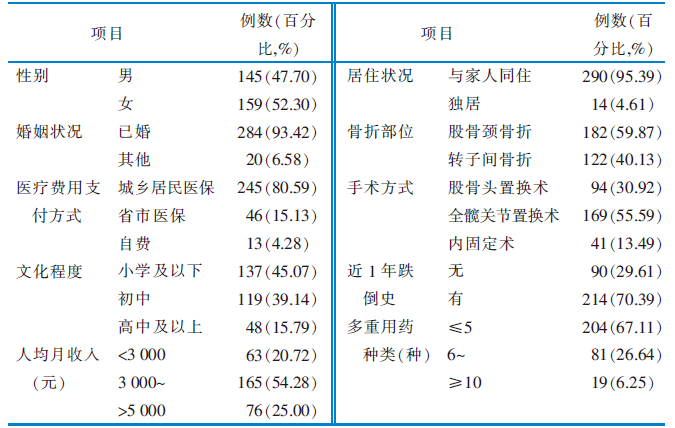 |
Table 1 General information of the respondents(n=304)
|
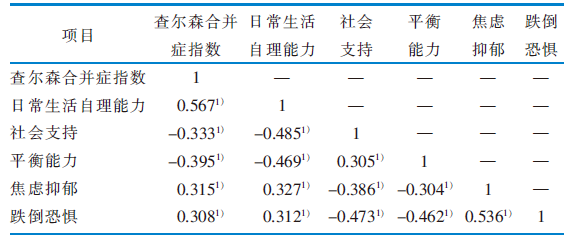 |
Table 2 Correlation analysis among comorbidity index,self-care ability,social support,balance ability,anxiety and depression,and fear of falling
|
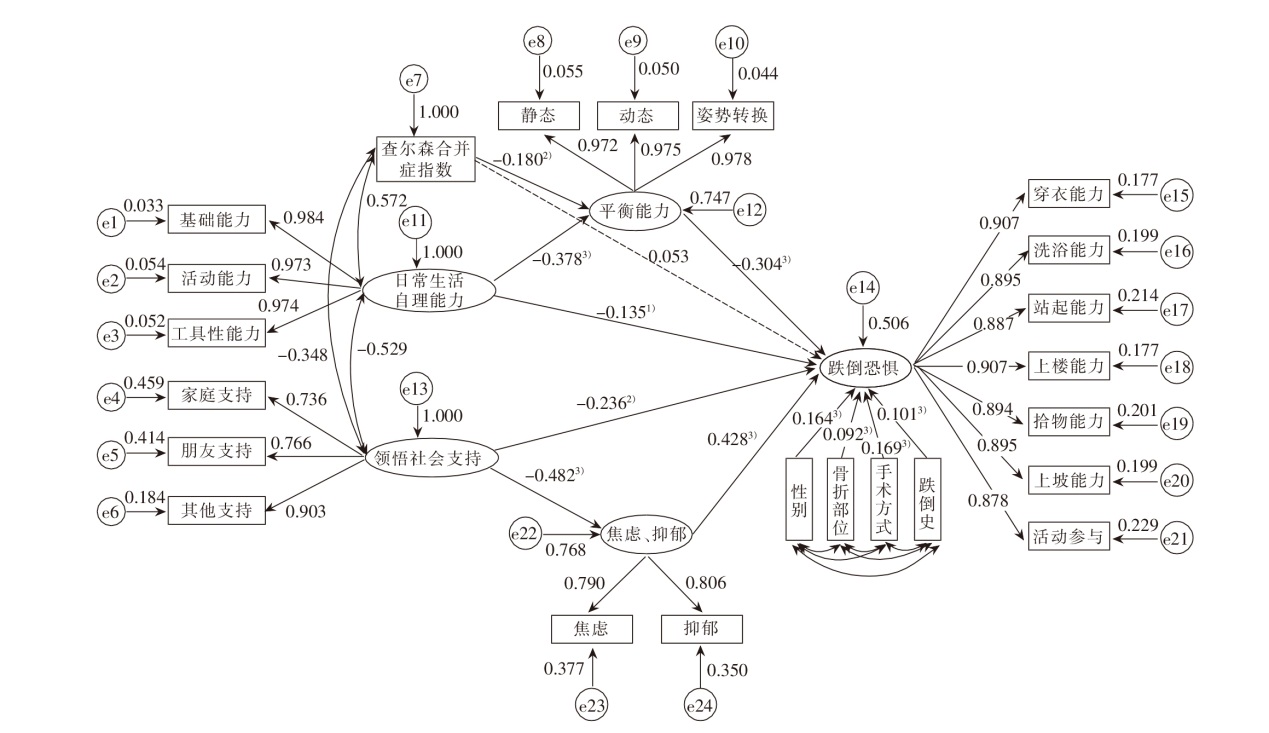
Figure 1 Structural equation modeling of factors affecting fear of falling in older patients after hip fracture surgery
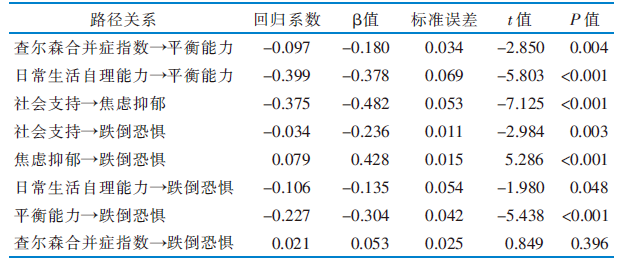 |
Table 3 Path relationships of the influencing factor model of fear of falling in older patients after hip fracture surgery(n=304)
|
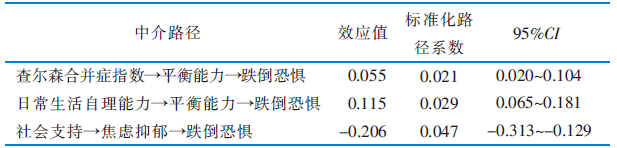 |
Table 4 Test of the mediating pathway effects of Charlson Comorbidity Index, self-care ability, and perceived social support on fear of falling(n=304)
|
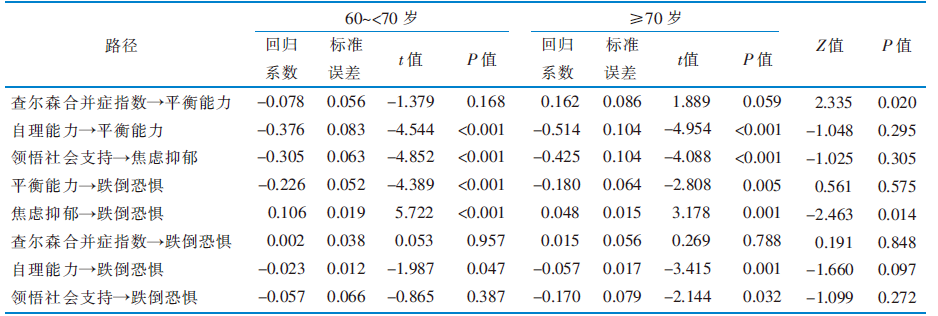 |
Table 5 Multi-group analysis results of structural equation model path coefficients across different age groups of elderly postoperative hip fracture patients(n=304)
|
| [1] |
Feng JN, Zhang CG, Li BH, et al. Global burden of hip fracture:the global burden of disease study[J]. Osteoporos Int, 2024, 35(1):41-52.
DOI |
| [2] |
Hua YW, Li Y, Zhou JC, et al. Mortality following fragility hip fracture in China:a record linkage study[J]. Arch Osteoporos, 2023, 18(1):105.
DOI |
| [3] | 韦玮, 李剑, 黄林海, 等. 全膝或全髋关节置换后老年人首次活动时跌倒恐惧的影响因素[J]. 中国组织工程研究, 2021, 25(9):1351-1355. |
| Wei W, Li J, Huang LH, et al. Factors affecting fall fear in the first movement of elderly patients after total knee or hip arthroplasty[J]. Chin J Tissue Eng Res, 2021, 25(9):1351-1355. | |
| [4] |
张华果, 司文腾, 何宇迪, 等. 老年髋部骨折术后患者跌倒恐惧心理体验的质性研究[J]. 中华护理杂志, 2021, 56(4):527-533.
DOI |
| Zhang HG, Si WT, He YD, et al. Experiences of fear of falling in elderly patients following hip fracture surgery:a qualitative descriptive study[J]. Chin J Nurs, 2021, 56(4):527-533. | |
| [5] | 王昱, 程馨慧, 王盼盼, 等. 老年髋部骨折患者跌倒恐惧、焦虑和抑郁的交叉滞后分析[J]. 现代预防医学, 2024, 51(3):495-499,506. |
| Wang Y, Cheng XH, Wang PP, et al. Cross-lagged analysis of fall fear,anxiety,and depression in elderly patients with hip fracture[J]. Mod Prev Med, 2024, 51(3):495-499,506. | |
| [6] | 兰云霞, 易梦思, 王晓明, 等. 基于恐惧-回避模型的康复护理方案在老年慢性心力衰竭患者中的应用[J]. 护理学杂志, 2024, 39(11):96-100. |
| Lan YX, Yi MS, Wang XM, et al. Application of rehabilitation nursing care based on fear-avoidance model of pain in older patients with chronic heart failure[J]. J Nurs Sci, 2024, 39(11):96-100. | |
| [7] | 曹发奇, 闫晨晨, 薛航, 等. 中国老年髋部骨折病人行微创手术治疗专家共识[J]. 临床外科杂志, 2022, 30(4):394-400. |
| Cao FQ, Yan CC, Xue H, et al. Expert consensus on minimally invasive surgery for elderly patients with hip fracture in China[J]. J Clin Surg, 2022, 30(4):394-400. | |
| [8] | 侯杰泰, 温忠麟, 成子娟. 结构方程模型及其应用[M]. 北京: 教育科学出版社, 2004. |
| Hou JT, Wen ZL, Cheng ZJ. Structural equation model and their applications[M]. Beijing: Educational Science Publishing House, 2004. | |
| [9] |
Charlson ME, Pompei P, Ales KL, et al. A new method of classifying prognostic comorbidity in longitudinal studies:development and validation[J]. J Chronic Dis, 1987, 40(5):373-383.
DOI PMID |
| [10] |
Lawton MP, Brody EM. Assessment of older people:self-maintaining and instrumental activities of daily living[J]. Gerontologist, 1969, 9(3):179-186.
PMID |
| [11] |
柳蕊, 周春兰, 刘宇霞, 等. 4种平衡功能测试方法在慢性阻塞性肺疾病患者中应用的比较[J]. 中华护理杂志, 2022, 57(1):23-29.
DOI |
|
Liu R, Zhou CL, Liu YX, et al. Comparison of 4 balance function assessments in patients with chronic obstructive pulmonary disease[J]. Chin J Nurs, 2022, 57(1):23-29.
DOI |
|
| [12] |
Zigmond AS, Snaith RP. The Hospital Anxiety and Depression Scale[J]. Acta Psychiatr Scand, 1983, 67(6):361-370.
DOI URL |
| [13] |
Zimet GD, Dahlem NW, Zimet SG, et al. The multidimensional scale of perceived social support[J]. J Pers Assess, 1988, 52(1):30-41.
DOI URL |
| [14] |
Kempen GI, Yardley L, van Haastregt JC, et al. The Short FES-I:a shortened version of the falls efficacy scale-international to assess fear of falling[J]. Age Ageing, 2008, 37(1):45-50.
DOI URL |
| [15] |
Delbaere K, Close JCT, Mikolaizak AS, et al. The Falls Efficacy Scale International(FES-I). A comprehensive longitudinal validation study[J]. Age Ageing, 2010, 39(2):210-216.
DOI PMID |
| [16] | 卞璐. 老年髋部骨折患者术后早期康复阶段跌倒恐惧现状及影响因素分析[D]. 无锡: 江南大学, 2023. |
| Bian L. The status and influencing factors of fear of falling in elderly patients with hip fracture during early postoperative rehabilitation stage[D]. Wuxi: Jiangnan University, 2023. | |
| [17] |
李汶静, 王莹, 赵福云, 等. 老年髋部骨折患者术后居家运动康复体验的质性研究[J]. 中华护理杂志, 2025, 60(10):1171-1176.
DOI |
| Li WJ, Wang Y, Zhao FY, et al. Experiences of postoperative home-based exercise rehabilitation in elderly patients with hip fracture:a qualitative study[J]. Chin J Nurs, 2025, 60(10):1171-1176. | |
| [18] | 汪步春, 魏明, 郭倩玲, 等. 老年髋关节置换术患者跌倒恐惧现状及其与衰弱、心理弹性的关系[J]. 联勤军事医学, 2025, 39(6):488-492. |
| Wang BC, Wei M, Guo QL, et al. Current situation of fall fear and its relationship with frailty and mental resilience in elderly patients undergoing hip replacement[J]. Mil Med Jt Logist, 2025, 39(6):488-492. | |
| [19] |
Jilili M, Liu LP. Examining the impact of functional disability and cognitive impairment on mental health of Chinese elderly[J]. Soc Work Health Care, 2022, 61(5):338-352.
DOI PMID |
| [20] | Tam TL, Tsang KK, Lee KB. Development of a prognostic model to predict post-operative mobility of patients with fragility hip fractures:a retrospective cohort study[J]. Int J Orthop Trauma Nurs, 2020, 38:100770. |
| [21] |
Pengpid S, Peltzer K. Tridirectional association between probable depression,fear of falling and falls among middle-aged and older adults in Thailand[J]. Arch Gerontol Geriatr, 2023, 109:104955.
DOI URL |
| [22] |
Elmer T, Wolf M, Snippe E, et al. A social support just-in-time adaptive intervention for individuals with depressive symptoms:feasibility study with a microrandomized trial design[J]. JMIR Ment Health, 2025, 12:e74103.
DOI URL |
| [23] |
Toyoda H, Hayashi C, Okano T. Associations between physical function,falls,and the fear of falling among older adults participating in a community-based physical exercise program:a longitudinal multilevel modeling study[J]. Arch Gerontol Geriatr, 2022, 102:104752.
DOI URL |
| [24] |
Yoryuenyong C, Jitpanya C, Sasat S. Factors influencing mobility among people post-surgery for hip fractures:a cross-sectional study[J]. Belitung Nurs J, 2023, 9(4):349-358.
DOI URL |
| [25] |
De Roza JG, Ng DWL, Mathew BK, et al. Factors influencing fear of falling in community-dwelling older adults in Singapore:a cross-sectional study[J]. BMC Geriatr, 2022, 22(1):186.
DOI |
| [26] | 卢安宁, 秦德春, 徐云, 等. 阶段式康复计划联合普拉提运动在老年全膝关节置换术后病人功能锻炼中的应用[J]. 护理研究, 2025, 39(13):2205-2211. |
| Lu AN, Qin DC, Xu Y, et al. Application of staged rehabilitation program combined with Pilates exercise in functional exercise for elderly patients after total knee arthroplasty[J]. Chin Nurs Res, 2025, 39(13):2205-2211. | |
| [27] |
Gerards M, Marcellis R, Senden R, et al. The effect of perturbation-based balance training on balance control and fear of falling in older adults:a single-blind randomised controlled trial[J]. BMC Geriatr, 2023, 23(1):305.
DOI |
| [28] |
Vo THM, Nakamura K, Seino K, et al. Fear of falling and cognitive impairment in elderly with different social support levels:findings from a community survey in Central Vietnam[J]. BMC Geriatr, 2020, 20(1):141.
DOI |
| [29] | 彭梦婷, 张昕悦, 吴梅利洋, 等. 老年人跌倒恐惧质性研究的Meta整合[J]. 护理学杂志, 2025, 40(10):92-97. |
| Peng MT, Zhang XY, Wu MLY, et al. Experiences of fear of falling in older adults:a qualitative meta-synthesis[J]. J Nurs Sci, 2025, 40(10):92-97. | |
| [30] |
毛文平, 骆金铠, 王力华, 等. 智能交互出院随访平台的构建与应用研究[J]. 中华护理杂志, 2024, 59(15):1812-1817.
DOI |
|
Mao WP, Luo JK, Wang LH, et al. Construction and application of an intelligent interactive discharge follow-up platform[J]. Chin J Nurs, 2024, 59(15):1812-1817.
DOI |
|
| [31] |
Zhang Y, Ye MZ, Wang XQ, et al. Age differences in factors affecting fear of falling among community-dwelling older adults:a cross-sectional study[J]. Geriatr Nurs, 2023, 49:74-80.
DOI URL |
| [32] |
Mikkelsen MB, O’Toole MS, Lyby MS, et al. Emotional reactivity and interoceptive sensitivity:exploring the role of age[J]. Psychon Bull Rev, 2019, 26(4):1440-1448.
DOI |
| [1] | Intravenous Infusion Therapy Committee of Chinese Nursing Association, Beijing Nursing Association, (Writing Committee:LI Jia, LI Xuying, QIN Huiying, CHEN Lifen, WU Zhenming, HU Zeyin, LUO Mengna, FAN Yuying, WU Jiahui, LIN Yuping, WANG Lei, SUN Wenyan, FENG Bilong, GAO Wei, LI Yanan, HOU Luoya, LI Chunyan, ). Expert consensus on nursing care of central venous access device removal [J]. Chinese Journal of Nursing, 2026, 61(9): 1157-1162. |
| [2] | HUANG Ping, LI Li, GUO Lili, XU Ying, YE Yun, JIANG Shufang. Construction and preliminary application of a risk assessment tool for central line associated bloodstream infections with needle-free connectors [J]. Chinese Journal of Nursing, 2026, 61(9): 1171-1179. |
| [3] | HE Juan, ZHAO Leilei, YE Guanjun, YU Yanfen, FU Xiaojun, ZHOU Qin. Nursing care of a patient with peripherally inserted central catheterization via the upper limb after bilateral innominate vein and superior vena cava artificial vascular replacement [J]. Chinese Journal of Nursing, 2026, 61(9): 1187-1191. |
| [4] | CHEN Chen, GU Xiao, GUO Fan, WANG Min, NI Xingmei, HUANG Qin, CHENG Niankai. Predictive value of 3 frailty assessment tools for adverse outcomes in elderly trauma patients in an emergency department [J]. Chinese Journal of Nursing, 2026, 61(9): 1200-1207. |
| [5] | ZHENG Yulin, LIU Jinning, ZHANG Jing, GUO Huimin, GU Yanmei, ZHANG Lili. Analysis of relapse to alcohol drinking and its influencing factors in patients with alcoholic liver disease after liver transplantation [J]. Chinese Journal of Nursing, 2026, 61(9): 1208-1214. |
| [6] | YE Junshuang, SHEN Lijia, MENG Xialiang, ZHANG Yujiao, CAI Genlian, SHAO Biyun, ZHOU Yahui, ZHANG Liuqian, YING Jinping. A qualitative study on the cognition and experience of oral frailty in maintenance hemodialysis patients [J]. Chinese Journal of Nursing, 2026, 61(9): 1215-1220. |
| [7] | YANG Mingxia, AN Ran, ZANG Jinfeng, LI Chunmei. Correlation analysis between elderly-to-elder care capacity and self-neglect among older adults with chronic comorbidities and their caregivers [J]. Chinese Journal of Nursing, 2026, 61(9): 1230-1236. |
| [8] | HAN Yuanyuan, SHI Yuzhu, SHANG Wenhan, YAO Li. Analysis of incidence and influencing factors of fall injuries among elderly inpatients across 870 hospitals [J]. Chinese Journal of Nursing, 2026, 61(9): 1245-1252. |
| [9] | XIA Yunfang, WANG Hong, CUI Dai, FU Zhenzhen, ZHU Min. Nursing care of an adolescent patient with Graves’ disease complicated by drug-induced hypersensitivity syndrome [J]. Chinese Journal of Nursing, 2026, 61(9): 1253-1256. |
| [10] | LI Yan, XU Cuiping. Application progress of chatbots in alleviating social isolation among the elderly and nursing implications [J]. Chinese Journal of Nursing, 2026, 61(9): 1291-1296. |
| [11] | YU Yunlong, LI Shuang, LUO Yao, ZHANG Suile, PENG Yueming. A study on the correlation between symptom burden and illness perception in patients with acute exacerbation of chronic obstructive pulmonary disease [J]. Chinese Journal of Nursing, 2026, 61(8): 1036-1042. |
| [12] | LI Ying, MIN Yudi, LUO Wei, GAO Xuan, ZHAO Shengnan. Development and application study of a structured health education program for elderly patients with dentition defects [J]. Chinese Journal of Nursing, 2026, 61(8): 1043-1050. |
| [13] | ZHANG Ying, DU Ruofei, YANG Huimin, DU Yating. Analysis of latent classes and influencing factors of frailty in patients with non-Hodgkin’s lymphoma during chemotherapy [J]. Chinese Journal of Nursing, 2026, 61(8): 1051-1058. |
| [14] | LI Shan, SHAO Mengqi, QIU Chen, SU Qingqing, GAO Yuan. Current status and influencing factors of postoperative complications in 4,907 elderly patients with hip fractures [J]. Chinese Journal of Nursing, 2026, 61(8): 1059-1065. |
| [15] | XIE Haiyan, CAO Miao, YAN Rui, LIU Sidi, XUE Rongna, XIE Dan. A mixed-method study of factors influencing quality of life in patients with Behçet’s Disease [J]. Chinese Journal of Nursing, 2026, 61(8): 1066-1073. |
| Viewed | ||||||
|
Full text |
|
|||||
|
Abstract |
|
|||||
