

中华护理杂志 ›› 2026, Vol. 61 ›› Issue (13): 1800-1808.DOI: 10.3761/j.issn.0254-1769.2026.13.010
毛雯雯( ), 陈冲, 刘寒雪, 陆箴琦*()
收稿日期:2025-10-20
出版日期:2026-07-10
发布日期:2026-07-01
*通讯作者:
陆箴琦,E-mail:luzhenqi1972@163.com作者简介:毛雯雯:女,本科(硕士在读),E-mail:maowenwen1747@foxmail.com毛雯雯:研究设计、数据收集与录入、数据整理与分析、论文撰写与修改;陈冲、刘寒雪:质量控制、数据收集、论文审校与修改、经费支持;陆箴琦:研究设计与指导、质量控制、论文审校
基金资助:
MAO Wenwen(), CHEN Chong, LIU Hanxue, LU Zhenqi*()
Received:2025-10-20
Online:2026-07-10
Published:2026-07-01
* Corresponding author:
LU Zhenqi,E-mail:luzhenqi1972@163.comFunding program:摘要:
目的 调查食管癌术后经口进食患者的营养状况,并应用健康生态学模型探究其影响因素,为制订干预策略提供依据。方法 采用便利抽样法,选取2024年12月至2025年9月在上海市1所三级甲等肿瘤专科医院门诊复诊的186例食管癌根治术术后患者作为调查对象。使用患者主观整体营养状况评估工具以及人体成分、实验室指标评估食管癌术后经口进食患者的营养状况,并分析其影响因素。结果 最终纳入患者181例,其中营养良好或可疑营养不良30例(16.57%),中度营养不良53例(29.28%),重度营养不良98例(54.14%)。多因素分析结果显示,年龄、术后天数、饮食类型、饮食频率、热量摄入、体力活动水平、心理健康状况为食管癌术后经口进食患者营养状况的影响因素(P<0.05)。结论 食管癌术后经口进食患者中、重度营养不良发生率较高。年龄≥65岁、术后天数较短、半流质饮食、饮食频率低、热量摄入不达标、低体力活动水平、心理健康状况较差是营养不良的独立危险因素。医护人员应早期识别食管癌术后经口进食患者营养不良的危险因素,实施针对性的干预措施,从而降低术后营养不良的发生风险。
毛雯雯, 陈冲, 刘寒雪, 陆箴琦. 食管癌术后经口进食患者营养状况及其影响因素研究[J]. 中华护理杂志, 2026, 61(13): 1800-1808.
MAO Wenwen, CHEN Chong, LIU Hanxue, LU Zhenqi. Nutritional status and influencing factors in patients with oral intake following esophagectomy[J]. Chinese Journal of Nursing, 2026, 61(13): 1800-1808.
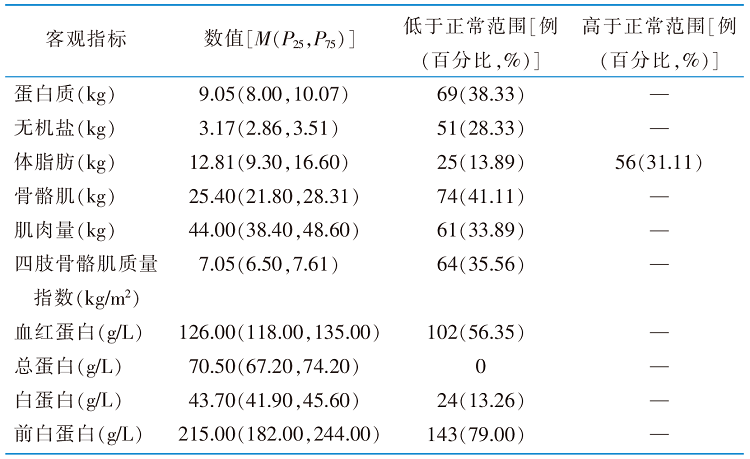 |
表1 调查对象的客观营养指标评估结果(n=181)
Table 1 Summary of objective nutrition indicators of the respondents(n=181)
|
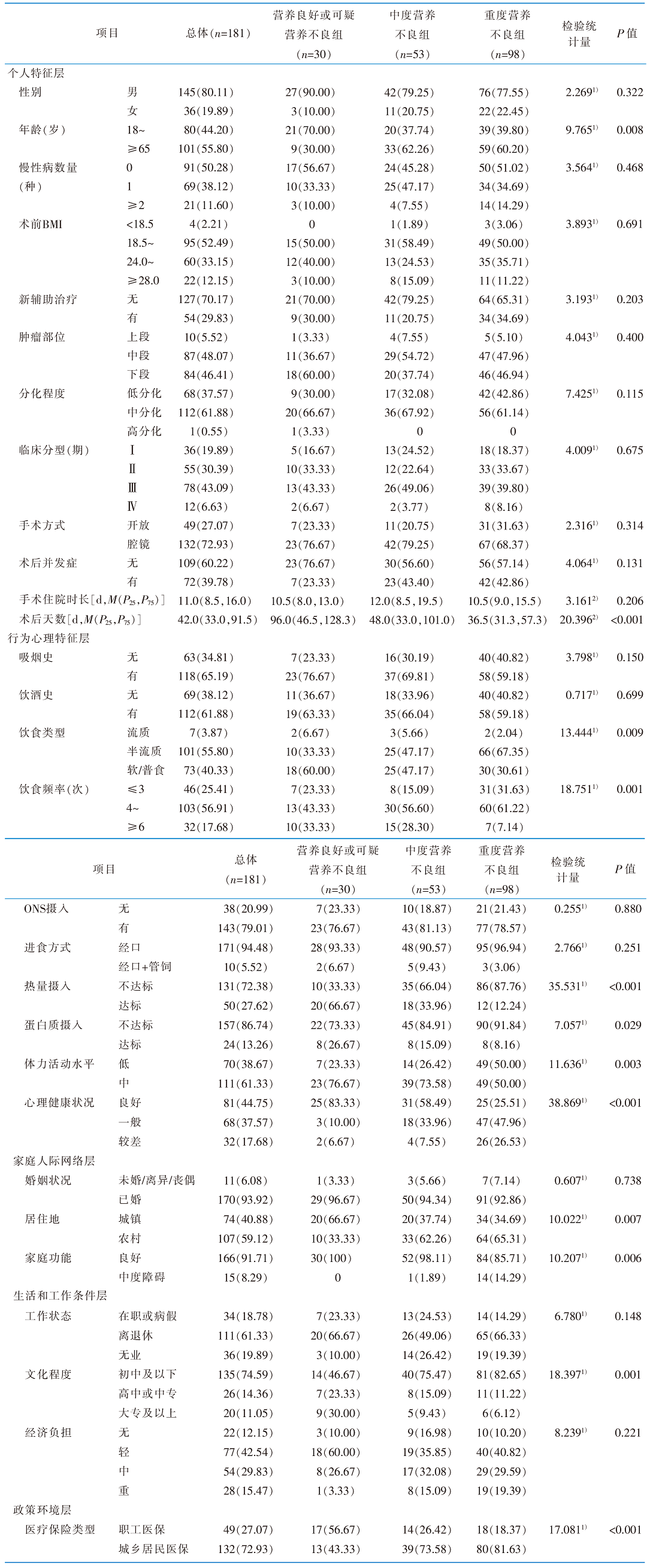 |
表2 调查对象的一般资料及营养状况单因素分析结果(n=181)
Table 2 General information of the respondents and results of univariate analysis on the influencing factors of nutritional status(n=181)
|
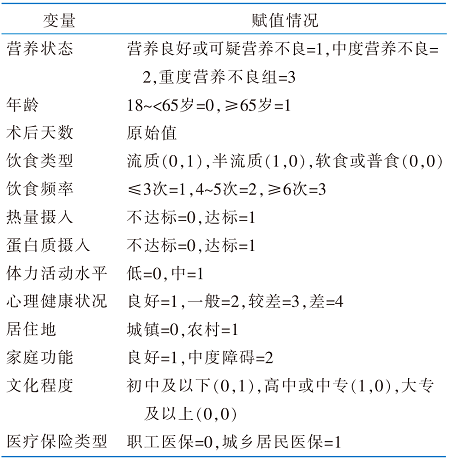 |
表3 变量赋值情况
Table 3 Assignment of independent variables
| |
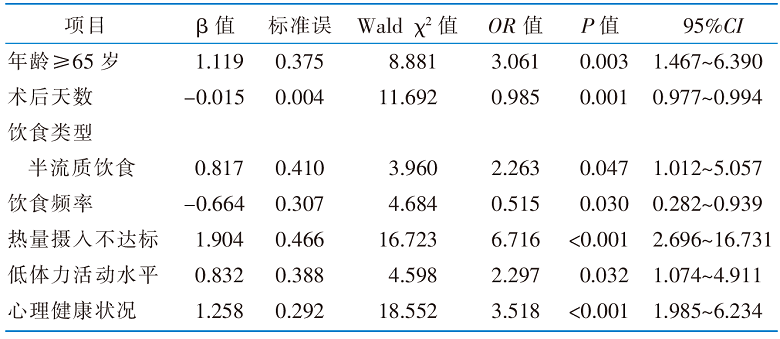 |
表4 食管癌术后经口进食患者营养状况Logistic回归分析结果(n=181)
Table 4 Ordinal Logistic regression analysis of the influencing factors of nutritional status in patients with oral intake following esophagectomy(n=181)
| |
| [1] | Bray F, Laversanne M, Sung H, et al. Global cancer statistics 2022:GLOBOCAN estimates of incidence and mortality worldwide for 36 cancers in 185 countries[J]. CA Cancer J Clin, 2024, 74(3):229-263. |
| [2] | 中华人民共和国国家卫生健康委员会医政医管局. 食管癌诊疗指南(2022年版)[J]. 中华消化外科杂志, 2022, 21(10):1247-1268. |
| Medical Administration and Supervision Bureau, National Health Commission of the People’s Republic of China. Guidelines for the diagnosis and treatment of esophageal cancer(2022 edition)[J]. Chin J Dig Surg, 2022, 21(10):1247-1268. | |
| [3] | He Y, Wu YY, Wei W, et al. Dietary habits and nutrition status in esophageal cancer patients after esophageal reconstruction[J]. J Thoracic Dis, 2024, 16(2):1118-1127. |
| [4] |
程慕习, 廖慧艳, 黎辉, 等. 食管癌患者对影响营养的症状体验研究[J]. 中华护理杂志, 2025, 60(19):2378-2383.
DOI |
|
Cheng MX, Liao HY, Li H, et al. A qualitative study on the experiences of nutrition impact symptoms in esophageal cancer patients[J]. Chin J Nurs, 2025, 60(19):2378-2383.
DOI |
|
| [5] |
Cao J, Xu H, Li W, et al. Nutritional assessment and risk factors associated to malnutrition in patients with esophageal cancer[J]. Curr Probl Cancer, 2021, 45(1):100638.
DOI URL |
| [6] |
Aoyama T, Hashimoto I, Maezawa Y, et al. The prognostic immune and nutritional indices are independent prognostic factors for esophageal cancer patients who receive curative treatment[J]. Anticancer Res, 2024, 44(5):2185-2192.
DOI PMID |
| [7] |
Kudou K, Saeki H, Nakashima Y, et al. Postoperative development of sarcopenia is a strong predictor of a poor prognosis in patients with adenocarcinoma of the esophagogastric junction and upper gastric cancer[J]. Am J Surg, 2019, 217(4):757-763.
DOI PMID |
| [8] | 程飞儿, 卜黎静, 张议丹, 等. 食管癌术后居家病人营养现状及影响因素分析[J]. 肠外与肠内营养, 2024, 31(5):300-305,311. |
| Cheng FE, Bu LJ, Zhang YD, et al. Nutritional status and influencing factors among home-based patients after esophagectomy[J]. Parenter Enteral Nutr, 2024, 31(5):300-305,311. | |
| [9] |
Marmot M, Friel S, Bell R, et al. Closing the gap in a generation:health equity through action on the social determinants of health[J]. Lancet, 2008, 372(9650):1661-1669.
DOI URL |
| [10] |
Ottery FD. Rethinking nutritional support of the cancer patient:the new field of nutritional oncology[J]. Semin Oncol, 1994, 21(6):770-778.
PMID |
| [11] |
Bauer J, Capra S, Ferguson M. Use of the scored Patient-Generated Subjective Global Assessment(PG-SGA) as a nutrition assessment tool in patients with cancer[J]. Eur J Clin Nutr, 2002, 56(8):779-785.
DOI PMID |
| [12] | 国家卫生和计划生育委员会. 肿瘤患者主观整体营养评估(WS/T555-2017)[S/OL]. 北京: 中国标准出版社, 2017:1-7[2025-12-25]. http://www.nhc.gov.cn/wjw/yingyang/201708/fb23-588e8ea64da7ae93c8d81b1fa663.shtml. |
| National Health and Family Planning Commission of the Peo-ple’s Republic of China. Subjective nutrition assessment for cancer patients(WS/T555-2017)[S/OL]. Beijing: China Standard Press, 2017:1-7[2025-12-25]. http://www.nhc.gov.cn/wjw/yingyang/201708/fb23588e8ea64da7ae93c8d81b1fa663.shtml. | |
| [13] | 石汉平, 李薇, 王昆华. 肿瘤病人营养状况评估操作手册:PG-SGA[M]. 北京: 人民卫生出版社, 2013. |
| Shi HP, Li W, Wang KH. Operation manual for nutritional status assessment of cancer patients:PG-SGA[M]. Beijing: People’s Medical Publishing House, 2013. | |
| [14] | Olendzki B. Dietary assessment in adults[EB/OL]. (2025-11-11)[2025-12-25]. https://sso.uptodate.com/contents/dietary-asses-sment-in-adults. |
| [15] | 李涛, 李宝生, 吕家华, 等. 食管癌患者营养治疗指南[J]. 肿瘤代谢与营养电子杂志, 2020, 7(1):32-42. |
| Li T, Li BS, Lü JH, et al. Guidelines for nutritional treatment of esophageal cancer patients[J]. Electron J Metab Nutr Cancer, 2020, 7(1):32-42. | |
| [16] |
Cora LC, Alison LM, Michael S, et al. International Physical Ac-tivity Questionnaire:12-country reliability and validity[J]. Med Sci Sports Exerc, 2003, 35(8):1396.
DOI URL |
| [17] | 屈宁宁, 李可基. 国际体力活动问卷中文版的信度和效度研究[J]. 中华流行病学杂志, 2004, 25(3):87-90. |
| Qu NN, Li KJ. Reliability and validity of the Chinese version of the International Physical Activity Questionnaire[J]. Chin J Epidemiol, 2004, 25(3):87-90. | |
| [18] |
Kessler R, Andrews G, Colpe L, et al. Short screening scales to monitor population prevalences and trends in non-specific psychological distress[J]. Psychol Med, 2002, 32(6):959-976.
DOI PMID |
| [19] | 周成超, 楚洁, 王婷, 等. 简易心理状况评定量表Kessler10中文版的信度和效度评价[J]. 中国临床心理学杂志, 2008, 16(6):627-629. |
| Zhou CC, Chu J, Wang T, et al. Reliability and validity of the Chinese version of the Kessler Psychological Distress Scale (K10)[J]. Chin J Clin Psychol, 2008, 16(6):627-629. | |
| [20] | Good MJD, Smilkstein G, Good BJ, et al. The Family APGAR Index:a study of construct validity[J]. J Fam Pract, 1979, 8(3):577-582. |
| [21] | 吕繁, 曾光, 刘松暖, 等. 家庭关怀度指数问卷测量脑血管病病人家庭功能的信度和效度研究[J]. 中国公共卫生, 1999, 15(11):27-28. |
| Lü F, Zeng G, Liu SN, et al. Reliability and validity of the Family APGAR Index in patients with cerebrovascular disease[J]. Chin J Public Health, 1999, 15(11):27-28. | |
| [22] |
Song C, Cao J, Zhang F, et al. Nutritional risk assessment by scored patient-generated subjective global assessment associ-ated with demographic characteristics in 23,904 common malignant tumors patients[J]. Nutr Cancer, 2019, 71(1):50-60.
DOI URL |
| [23] |
Vandewoude MFJ. Nutritional assessment in oncogeriatrics[J]. Tijdschr Gerontol Geriatr, 2010, 41(5):214-220.
PMID |
| [24] |
Laky B, Janda M, Cleghorn G, et al. Comparison of different nutritional assessments and body-composition measurements in detecting malnutrition among gynecologic cancer patients[J]. Am J Clin Nutr, 2008, 87(6):1678-1685.
DOI PMID |
| [25] | 汪丹丹, 郑蔚, 乔婷婷, 等. 胃癌术后患者参与饮食管理对其营养状况影响的研究[J]. 中华护理杂志, 2017, 52(4):389-394. |
| Wang DD, Zheng W, Qiao TT, et al. Effects of patient participation-based dietary intervention on nutritional status for patients with gastrectomy[J]. Chin J Nurs, 2017, 52(4):389-394. | |
| [26] |
Horner KM, Schubert MM, Desbrow B, et al. Acute exercise and gastric emptying:a meta-analysis and implications for appetite control[J]. Sports Med, 2015, 45(5):659-678.
DOI PMID |
| [27] | 赵治锋, 赵青川. 重视消化道肿瘤患者心理困扰对其营养状态的影响[J]. 肿瘤代谢与营养电子杂志, 2025, 12(2):143-147. |
| Zhao ZF, Zhao QC. Importance of psychological distress in its impact on nutritional status among patients with gastrointe-stinal malignancies[J]. J Tumor Metab Nutr(Electron Ed), 2025, 12(2):143-147. | |
| [28] |
邓雁, 余琼, 武福姣, 等. 基于自我效能理论的护理干预对食管癌根治术后患者的影响[J]. 中华护理杂志, 2022, 57(9):1042-1048.
DOI |
| Deng Y, Yu Q, Wu FJ, et al. Effects of nursing intervention strategies based on self-efficacy theory on nutritional status and cancer induced fatigue after total thoracoscopic radical resection of esophageal cancer[J]. Chin J Nurs, 2022, 57(9):1042-1048. |
| [1] | 中华护理学会静脉输液治疗专业委员会, 北京护理学会, (执笔:李佳, 李旭英, 覃惠英, 陈利芬, 吴珍明, 胡泽吟, 罗梦娜, 范育英, 吴嘉慧, 林宇萍, 王蕾, 孙文彦, 冯毕龙, 高伟, 李亚南, 侯罗娅, 李春燕. 中心静脉通路装置拔除护理专家共识[J]. 中华护理杂志, 2026, 61(9): 1157-1162. |
| [2] | 周霞, 马艳艳, 师正坤, 于海霞, 周艳, 胡红玲, 李莜, 陈思思, 张京慧. 隧道式经股静脉PICC置入术在困难静脉通路婴幼儿中的应用研究[J]. 中华护理杂志, 2026, 61(9): 1163-1170. |
| [3] | 黄萍, 李黎, 郭骊莉, 徐莹, 叶赟, 江淑芳. 与无针输液接头相关的导管相关性血流感染风险评估工具的构建与初步应用[J]. 中华护理杂志, 2026, 61(9): 1171-1179. |
| [4] | 李佳, 张玉玲, 邢乐, 张利峰, 牛秀峰, 许莉. 早产儿经上肢置入PICC尖端继发性异位风险预测模型的建立与验证[J]. 中华护理杂志, 2026, 61(9): 1180-1186. |
| [5] | 何娟, 赵蕾蕾, 叶冠军, 余艳芬, 傅晓君, 周琴. 1例双侧无名静脉及上腔静脉人工血管置换术后患者经上肢置入PICC的护理[J]. 中华护理杂志, 2026, 61(9): 1187-1191. |
| [6] | 梁江淑渊, 曾妃, 何鹏, 谢梦珊, 江悦, 蒋宗恒, 王建茗. 静脉-静脉体外膜肺氧合患者早期活动风险等级评估系统的构建及应用研究[J]. 中华护理杂志, 2026, 61(9): 1192-1199. |
| [7] | 陈晨, 顾肖, 郭凡, 王敏, 倪兴梅, 黄琴, 程念开. 3种衰弱评估工具对急诊老年创伤患者不良结局的预测价值[J]. 中华护理杂志, 2026, 61(9): 1200-1207. |
| [8] | 郑煜琳, 刘晋宁, 张静, 郭会敏, 谷艳梅, 张莉莉. 酒精性肝病患者肝移植术后再饮酒现状及其影响因素分析[J]. 中华护理杂志, 2026, 61(9): 1208-1214. |
| [9] | 叶俊霜, 沈丽佳, 孟霞靓, 张玉姣, 蔡根莲, 邵碧云, 周亚辉, 张柳倩, 应金萍. 维持性血液透析患者对口腔衰弱认知和体验的质性研究[J]. 中华护理杂志, 2026, 61(9): 1215-1220. |
| [10] | 王芸姣, 杨玉金, 郑春艳, 彭菲津, 王淑贞, 蒋喜露, 周为民, 王薇, 张娜. 糖尿病下肢动脉硬化闭塞症患者介入术后康复护理方案的构建及应用研究[J]. 中华护理杂志, 2026, 61(9): 1221-1229. |
| [11] | 杨明霞, 安冉, 臧金凤, 李春梅. 老年慢性病共病患者及照护者老老照护能力与自我忽视的相关性分析[J]. 中华护理杂志, 2026, 61(9): 1230-1236. |
| [12] | 梁和静, 许鹊, 史云霞, 祖金美, 黄文静, 杨春旭, 郭明华, 王磊. 颈动脉内膜剥脱术围手术期护理质量评价指标的构建[J]. 中华护理杂志, 2026, 61(9): 1237-1244. |
| [13] | 韩媛媛, 石玉竹, 尚文涵, 么莉. 870所三级甲等医院老年住院患者跌倒伤害发生现状与影响因素分析[J]. 中华护理杂志, 2026, 61(9): 1245-1252. |
| [14] | 夏云芳, 王洪, 崔岱, 付真真, 朱敏. 1例弥漫性毒性甲状腺肿合并超敏反应综合征青少年患者的护理[J]. 中华护理杂志, 2026, 61(9): 1253-1256. |
| [15] | 周益飞, 王海苹, 胡益环, 应莉, 罗松娜. 1例氢氟酸中毒并发呼吸心搏骤停患者的急救护理[J]. 中华护理杂志, 2026, 61(9): 1257-1260. |
| 阅读次数 | ||||||
|
全文 |
|
|||||
|
摘要 |
|
|||||
