

中华护理杂志 ›› 2025, Vol. 60 ›› Issue (7): 799-805.DOI: 10.3761/j.issn.0254-1769.2025.07.005
冯伟清( ), 陈研博, 蔡洹, 阮嘉慧, 何秀娴, 李琨()
收稿日期:2024-11-15
出版日期:2025-04-10
发布日期:2025-04-07
*通讯作者:
李琨,E-mail:likun22@mail.sysu.edu.cn作者简介:冯伟清:女,本科(硕士在读),主管护师,E-mail:759683383@qq.com
基金资助:
FENG Weiqing(), CHEN Yanbo, CAI Huan, RUAN Jiahui, HE Xiuxian, LI Kun()
Received:2024-11-15
Online:2025-04-10
Published:2025-04-07
摘要:
目的 对卒中后疲劳纵向研究进行范围综述,明确卒中后疲劳的测量时间、评估工具、变化趋势及影响因素,为今后开展相关科学研究和临床实践提供参考。 方法 遵循范围综述审查方法,系统检索Web of Science、PubMed、CINAHL、Embase、中国知网、中国生物医学文献数据库、万方数据库、维普数据库,检索时限为建库至2024年12月15日。 结果 共纳入41篇文献,高频使用的测量时间点为卒中后3、6、12个月。检索到10个评估工具,最多选用的是疲劳严重程度量表。大多数研究支持卒中后疲劳发生率在脑卒中6个月内呈下降趋势,6~12个月呈上升趋势,12个月以上呈下降趋势。卒中后疲劳受人口学因素、疾病因素、生理因素、心理社会因素及应对行为因素影响。 结论 卒中后疲劳纵向研究在脑卒中1年内比较集中,但恢复期研究不足,特异性评估工具有待进一步探讨。卒中后疲劳变化趋势在不同阶段存在差异,且存在群体异质性。未来研究需进一步探讨卒中后疲劳的影响因素。
冯伟清, 陈研博, 蔡洹, 阮嘉慧, 何秀娴, 李琨. 卒中后疲劳纵向研究的范围综述[J]. 中华护理杂志, 2025, 60(7): 799-805.
FENG Weiqing, CHEN Yanbo, CAI Huan, RUAN Jiahui, HE Xiuxian, LI Kun. A scoping review of the longitudinal studies on post stroke fatigue[J]. Chinese Journal of Nursing, 2025, 60(7): 799-805.
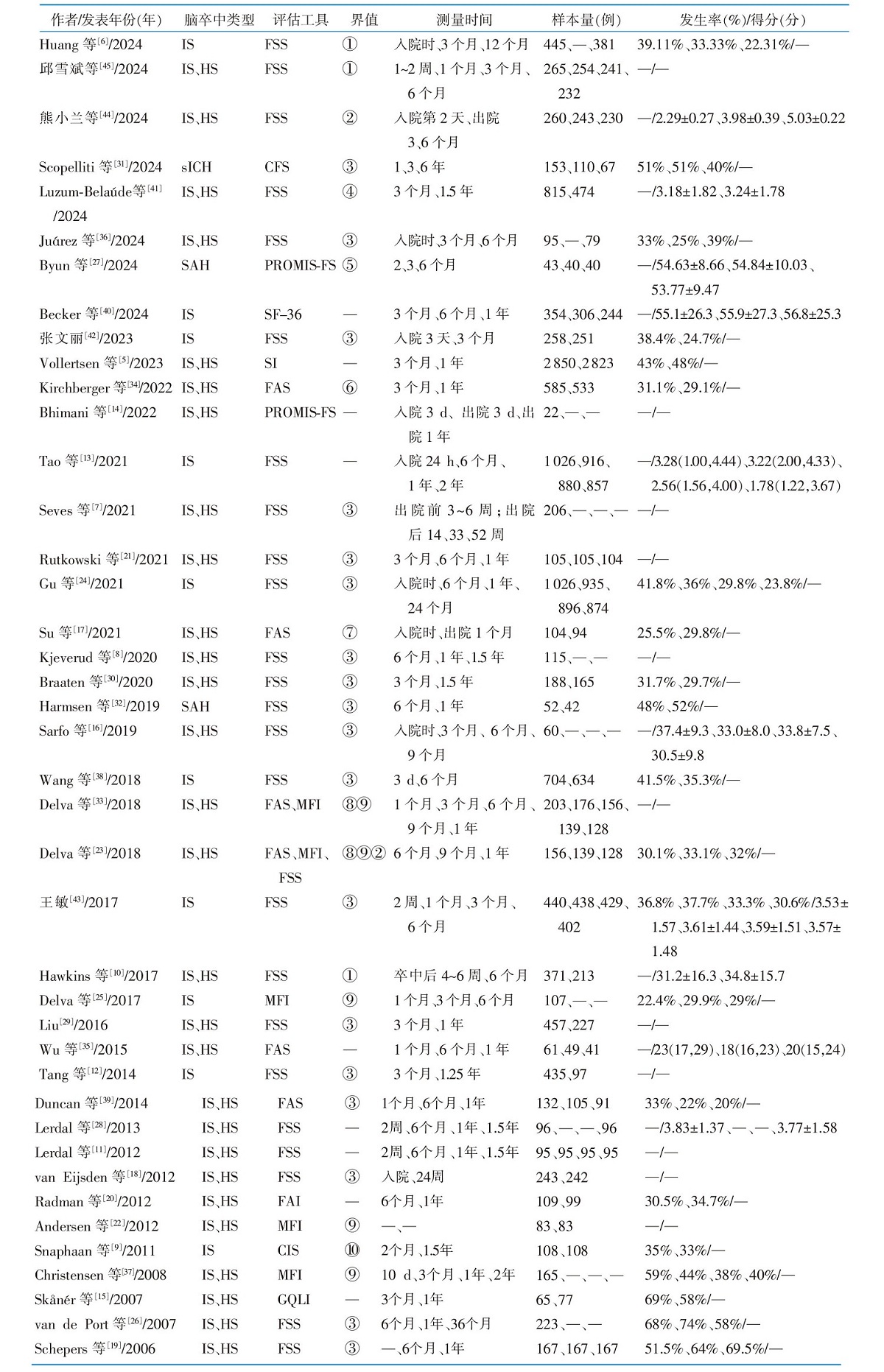 |
表1 纳入文献的基本特征(n=41)
Table 1 Characteristics of the included articles(n=41)
|
| [1] | NICE. Stroke rehabilitation in adults[EB/OL]. (2023-10-18)[2024-11-10]. https://www.nice.org.uk/search?q=Stroke+rehabilitation+in+adults. |
| [2] | Zhan J, Zhang PM, Wen H, et al. Global prevalence estimates of poststroke fatigue:a systematic review and meta-analysis[J]. Int J Stroke, 2023, 18(9):1040-1050. |
| [3] |
史慧玲, 王清, 蒋园园, 等. 脑卒中患者运动康复体验质性研究的Meta整合[J]. 中华护理杂志, 2024, 59(11):1397-1404.
DOI URL |
| Shi HL, Wang Q, Jiang YY, et al. Exercise rehabilitation experience of stroke patients:a qualitative meta-synthesis[J]. Chin J Nurs, 2024, 59(11):1397-1404. | |
| [4] |
张敏, 王清, 史慧玲, 等. 急性缺血性脑卒中患者早期活动影响因素的质性研究[J]. 中华护理杂志, 2023, 58(17):2112-2118.
DOI URL |
| Zhang M, Wang Q, Shi HL, et al. Influencing factors of early activities in patients with acute ischemic stroke:a qualitative study[J]. Chin J Nurs, 2023, 58(17):2112-2118. | |
| [5] | Vollertsen J, Björk M, Norlin AK, et al. The impact of post-stroke fatigue on work and other everyday life activities for the working age population-a registry-based cohort study[J]. Ann Med, 2023, 55(2):2269961. |
| [6] | Huang HM, Lu MX, Zhong JH, et al. Prevalence,trajectory,and predictors of post-stroke fatigue in older adults[J]. Arch Phys Med Rehabil, 2024: S0003-S9993(24)01371-6. |
| [7] | Seves BL, Hoekstra T, Hoekstra F, et al. Unravelling perceived fatigue and activity pacing in maintaining a physically active lifestyle after stroke rehabilitation:a longitudinal cohort study[J]. Disabil Rehabil, 2021, 43(24):3492-3502. |
| [8] | Kjeverud A, Østlie K, Schanke AK, et al. Trajectories of fatigue among stroke patients from the acute phase to 18 months post-injury:a latent class analysis[J]. PLoS One, 2020, 15(4):e0231709. |
| [9] |
Snaphaan L, van der Werf S, de Leeuw FE. Time course and risk factors of post-stroke fatigue:a prospective cohort study[J]. Eur J Neurol, 2011, 18(4):611-617.
DOI PMID |
| [10] |
Hawkins L, Lincoln NB, Sprigg N, et al. The Nottingham Fatigue After Stroke(NotFAST) study:results from follow-up six months after stroke[J]. Top Stroke Rehabil, 2017, 24(8):592-596.
DOI PMID |
| [11] | Lerdal A, Lee KA, Bakken LN, et al. The course of fatigue during the first 18 months after first-ever stroke:a longitudinal study[J]. Stroke Res Treat, 2012, 2012:126275. |
| [12] |
Tang WK, Chen YK, Liang HJ, et al. Subcortical white matter infarcts predict 1-year outcome of fatigue in stroke[J]. BMC Neurol, 2014, 14:234.
DOI PMID |
| [13] | Tao CR, Gu MM, Xu PF, et al. Stressful life events can predict post-stroke fatigue in patients with ischemic stroke[J]. Eur J Neurol, 2021, 28(9):3080-3088. |
| [14] |
Bhimani R, Chappuis D, Mathiason MA, et al. Spasticity,pain,and fatigue:are they associated with functional outcomes in people with stroke?[J]. Rehabil Nurs, 2022, 47(2):60-71.
DOI PMID |
| [15] |
Skånér Y, Nilsson GH, Sundquist K, et al. Self-rated health,symptoms of depression and general symptoms at 3 and 12 months after a first-ever stroke:a municipality-based study in Sweden[J]. BMC Fam Pract, 2007, 8:61.
PMID |
| [16] |
Sarfo FS, Berchie P, Singh A, et al. Prevalence,trajectory,and predictors of poststroke fatigue among ghanaians[J]. J Stroke Cerebrovasc Dis, 2019, 28(5):1353-1361.
DOI PMID |
| [17] | Su Y, Asamoto M, Yuki M, et al. Predictors and short-term outcomes of post-stroke fatigue in initial phase of transition from hospital to home:a prospective observational study[J]. J Adv Nurs, 2021, 77(4):1825-1838. |
| [18] | van Eijsden HM, van de Port IG, Visser-Meily JM, et al. Poststroke fatigue:who is at risk for an increase in fatigue?[J]. Stroke Res Treat, 2012, 2012:863978. |
| [19] | Schepers VP, Visser-Meily AM, Ketelaar M, et al. Poststroke fatigue:course and its relation to personal and stroke-related factors[J]. Arch Phys Med Rehabil, 2006, 87(2):184-188. |
| [20] | Radman N, Staub F, Aboulafia-Brakha T, et al. Poststroke fatigue following minor infarcts:a prospective study[J]. Neurology, 2012, 79(14):1422-1427. |
| [21] | Rutkowski NA, Sabri E, Yang C. Post-stroke fatigue:a factor associated with inability to return to work in patients <60 years:a 1-year follow-up[J]. PLoS One, 2021, 16(8):e0255538. |
| [22] |
Andersen G, Christensen D, Kirkevold M, et al. Post-stroke fatigue and return to work:a 2-year follow-up[J]. Acta Neurol Scand, 2012, 125(4):248-253.
DOI PMID |
| [23] | Delva MY, Delva II, Lytvynenko NV. Post-stroke fatigue and its dimensions over the second half year after stroke[J]. Wiad Lek, 2018, 71(2):314-317. |
| [24] | Gu MM, Xiao LL, Wang JJ, et al. Obesity and poststroke fatigue:a 2-year longitudinal study[J]. Neurol Ther, 2021, 10(2):955-969. |
| [25] |
Delva M, Delva I. Neuroimaging characteristics and post-stroke fatigue within the first 6 months after ischemic strokes[J]. Georgian Med News, 2017(271):91-95.
PMID |
| [26] |
van de Port IG, Kwakkel G, Schepers VP, et al. Is fatigue an independent factor associated with activities of daily living,instrumental activities of daily living and health-related quality of life in chronic stroke?[J]. Cerebrovasc Dis, 2007, 23(1):40-45.
DOI PMID |
| [27] | Byun E, McCurry SM, Kwon S, et al. Fatigue,toll-like receptor 4,and pro-inflammatory cytokines in adults with subarachnoid hemorrhage:a 6-month longitudinal study[J]. Biol Res Nurs, 2024, 26(2):192-201. |
| [28] |
Lerdal A, Gay CL. Fatigue in the acute phase after first stroke predicts poorer physical health 18 months later[J]. Neurology, 2013, 81(18):1581-1587.
DOI PMID |
| [29] | Liu XX. Fatigue and depression in Chinese stroke patients:a 1-year longitudinal study[D]. Hong kong: The Chinese University of Hong Kong, 2016. |
| [30] | Braaten RS, Askim T, Gunnes M, et al. Fatigue and activity after stroke. Secondary results from the Life After Stroke study[J]. Physiother Res Int, 2020, 25(4): e1851. |
| [31] | Scopelliti G, Rossi C, Kuchcinski G, et al. Fatigue after spontaneous intracerebral haemorrhage:prevalence and associated factors[J]. Neurol Sci, 2024, 45(5):2127-2135. |
| [32] | Harmsen WJ, Ribbers GM, Heijenbrok-Kal MH, et al. Fatigue after aneurysmal subarachnoid hemorrhage is highly prevalent in the first-year postonset and related to low physical fitness:a longitudinal study[J]. Am J Phys Med Rehabil, 2019, 98(1):7-13. |
| [33] |
Delva M, Lytvynenko N, Delva I. Factors associated with the time-based phenomenology of post-stroke fatigue over the first year after stroke occurrence[J]. Georgian Med News, 2018(279):92-97.
PMID |
| [34] | Kirchberger I, Wallner F, Linseisen J, et al. Factors associated with early and late post-stroke fatigue in patients with mild impairment results from the stroke cohort study Augsburg[J]. Front Neurol, 2022, 13:852486. |
| [35] | Wu SM, Duncan F, Anderson NH, et al. Exploratory cohort study of associations between serum C-reactive protein and fatigue after stroke[J]. PLoS One, 2015, 10(11):e0143784. |
| [36] | Juárez-Belaúnde A, Soto-León V, Dileone M, et al. Early poststroke clinically significant fatigue predicts functional independence:a prospective longitudinal study[J]. Front Neurol, 2024, 15:1364446. |
| [37] |
Christensen D, Johnsen SP, Watt T, et al. Dimensions of post-stroke fatigue:a two-year follow-up study[J]. Cerebrovasc Dis, 2008, 26(2):134-141.
DOI PMID |
| [38] | Wang JJ, Li FL, Xiao LL, et al. Depressed TSH level as a predictor of poststroke fatigue in patients with acute ischemic stroke[J]. Neurology, 2018, 91(21):e1971-e1978. |
| [39] |
Duncan F, Greig C, Lewis S, et al. Clinically significant fatigue after stroke:a longitudinal cohort study[J]. J Psychosom Res, 2014, 77(5):368-373.
DOI PMID |
| [40] | Becker CJ, Lisabeth LD, Kwicklis M, et al. Association between sleep-disordered breathing and post-stroke fatigue in patients with ischemic stroke[J]. J Stroke Cerebrovasc Dis, 2024, 33(6):107701. |
| [41] | Luzum G, Thrane G, Aam S, et al. A machine learning approach to predict post-stroke fatigue. The Nor-COAST study[J]. Arch Phys Med Rehabil, 2024, 105(5):921-929. |
| [42] | 张文丽. 缺血性卒中后疲劳的影响因素分析[D]. 广州: 南方医科大学, 2023. |
| Zhang WL. Analysis of influencing factors of fatigue after ischemic stroke[D]. Guangzhou: Southern Medical University, 2023. | |
| [43] | 王敏. 缺血性脑卒中患者疲劳发生率及其影响因素研究[D]. 郑州: 郑州大学, 2017. |
| Wang M. Study on the incidence of fatigue and its influencing factors in patients with ischemic stroke[D]. Zhengzhou: Zhengzhou University, 2017. | |
| [44] | 熊小兰, 谢健, 邓鸿元, 等. 中老年脑卒中患者疲劳发展轨迹及其影响因素的研究[J]. 实用临床医药杂志, 2024, 28(19):123-128,133. |
| Xiong XL, Xie J, Deng HY, et al. Fatigue development trajectory and its influencing factors in middle-aged and elderly patients with stroke[J]. J Clin Med Pract, 2024, 28(19):123-128,133. | |
| [45] |
邱雪斌, 繆小红, 夏敏棋, 等. 脑卒中患者疲劳轨迹的潜在类别及影响因素分析[J]. 中华护理杂志, 2024, 59(19):2375-2381.
DOI URL |
|
Qiu XB, Miao XH, Xia MQ, et al. Potential categories and influencing factors of fatigue trajectories in stroke patients[J]. Chin J Nurs, 2024, 59(19):2375-2381.
DOI URL |
|
| [46] |
臧爽, 崔赢, 倪翠萍, 等. 卒中后疲劳评估工具的范围综述[J]. 中华护理杂志, 2023, 58(1):46-54.
DOI URL |
|
Zang S, Cui Y, Ni CP, et al. A scoping review of assessment tools for post-stroke fatigue[J]. Chin J Nurs, 2023, 58(1):46-54.
DOI URL |
|
| [47] |
Wu SM, Mead G, MacLeod M, et al. Model of understanding fatigue after stroke[J]. Stroke, 2015, 46(3):893-898.
DOI PMID |
| [48] |
袁潇逸, 邢唯杰. 纵向混合研究在护理领域中的应用进展[J]. 中华护理杂志, 2024, 59(2):244-249.
DOI URL |
|
Yuan XY, Xing WJ. Longitudinal mixed methods and its application progress in nursing[J]. Chin J Nurs, 2024, 59(2):244-249.
DOI URL |
| [1] | 中华护理学会静脉输液治疗专业委员会, 北京护理学会, (执笔:李佳, 李旭英, 覃惠英, 陈利芬, 吴珍明, 胡泽吟, 罗梦娜, 范育英, 吴嘉慧, 林宇萍, 王蕾, 孙文彦, 冯毕龙, 高伟, 李亚南, 侯罗娅, 李春燕. 中心静脉通路装置拔除护理专家共识[J]. 中华护理杂志, 2026, 61(9): 1157-1162. |
| [2] | 周霞, 马艳艳, 师正坤, 于海霞, 周艳, 胡红玲, 李莜, 陈思思, 张京慧. 隧道式经股静脉PICC置入术在困难静脉通路婴幼儿中的应用研究[J]. 中华护理杂志, 2026, 61(9): 1163-1170. |
| [3] | 黄萍, 李黎, 郭骊莉, 徐莹, 叶赟, 江淑芳. 与无针输液接头相关的导管相关性血流感染风险评估工具的构建与初步应用[J]. 中华护理杂志, 2026, 61(9): 1171-1179. |
| [4] | 李佳, 张玉玲, 邢乐, 张利峰, 牛秀峰, 许莉. 早产儿经上肢置入PICC尖端继发性异位风险预测模型的建立与验证[J]. 中华护理杂志, 2026, 61(9): 1180-1186. |
| [5] | 何娟, 赵蕾蕾, 叶冠军, 余艳芬, 傅晓君, 周琴. 1例双侧无名静脉及上腔静脉人工血管置换术后患者经上肢置入PICC的护理[J]. 中华护理杂志, 2026, 61(9): 1187-1191. |
| [6] | 梁江淑渊, 曾妃, 何鹏, 谢梦珊, 江悦, 蒋宗恒, 王建茗. 静脉-静脉体外膜肺氧合患者早期活动风险等级评估系统的构建及应用研究[J]. 中华护理杂志, 2026, 61(9): 1192-1199. |
| [7] | 陈晨, 顾肖, 郭凡, 王敏, 倪兴梅, 黄琴, 程念开. 3种衰弱评估工具对急诊老年创伤患者不良结局的预测价值[J]. 中华护理杂志, 2026, 61(9): 1200-1207. |
| [8] | 郑煜琳, 刘晋宁, 张静, 郭会敏, 谷艳梅, 张莉莉. 酒精性肝病患者肝移植术后再饮酒现状及其影响因素分析[J]. 中华护理杂志, 2026, 61(9): 1208-1214. |
| [9] | 叶俊霜, 沈丽佳, 孟霞靓, 张玉姣, 蔡根莲, 邵碧云, 周亚辉, 张柳倩, 应金萍. 维持性血液透析患者对口腔衰弱认知和体验的质性研究[J]. 中华护理杂志, 2026, 61(9): 1215-1220. |
| [10] | 王芸姣, 杨玉金, 郑春艳, 彭菲津, 王淑贞, 蒋喜露, 周为民, 王薇, 张娜. 糖尿病下肢动脉硬化闭塞症患者介入术后康复护理方案的构建及应用研究[J]. 中华护理杂志, 2026, 61(9): 1221-1229. |
| [11] | 杨明霞, 安冉, 臧金凤, 李春梅. 老年慢性病共病患者及照护者老老照护能力与自我忽视的相关性分析[J]. 中华护理杂志, 2026, 61(9): 1230-1236. |
| [12] | 梁和静, 许鹊, 史云霞, 祖金美, 黄文静, 杨春旭, 郭明华, 王磊. 颈动脉内膜剥脱术围手术期护理质量评价指标的构建[J]. 中华护理杂志, 2026, 61(9): 1237-1244. |
| [13] | 韩媛媛, 石玉竹, 尚文涵, 么莉. 870所三级甲等医院老年住院患者跌倒伤害发生现状与影响因素分析[J]. 中华护理杂志, 2026, 61(9): 1245-1252. |
| [14] | 夏云芳, 王洪, 崔岱, 付真真, 朱敏. 1例弥漫性毒性甲状腺肿合并超敏反应综合征青少年患者的护理[J]. 中华护理杂志, 2026, 61(9): 1253-1256. |
| [15] | 周益飞, 王海苹, 胡益环, 应莉, 罗松娜. 1例氢氟酸中毒并发呼吸心搏骤停患者的急救护理[J]. 中华护理杂志, 2026, 61(9): 1257-1260. |
| 阅读次数 | ||||||
|
全文 |
|
|||||
|
摘要 |
|
|||||
