

中华护理杂志 ›› 2025, Vol. 60 ›› Issue (3): 281-287.DOI: 10.3761/j.issn.0254-1769.2025.03.004
郭子鑫( ), 徐慧萍(), 张艳, 刘延锦, 黄倩, 孙义芳, 王鑫
收稿日期:2024-06-26
出版日期:2025-02-10
发布日期:2025-01-22
*通讯作者:
徐慧萍,E-mail:xhuiping1030@163.com作者简介:郭子鑫:女,本科(硕士在读),E-mail:874182873@qq.com
基金资助:
GUO Zixin(), XU Huiping(), ZHANG Yan, LIU Yanjin, HUANG Qian, SUN Yifang, WANG Xin
Received:2024-06-26
Online:2025-02-10
Published:2025-01-22
摘要:
目的 调查老年住院患者口腔衰弱和肌少症共病现象的发生率,并探讨其影响因素,为口腔衰弱合并肌少症患者制订针对性的干预措施提供参考。方法 采用便利抽样法,选取2024年1月—4月在河南省郑州市3所三级甲等医院和商丘市1所二级甲等医院的515例老年住院患者作为调查对象,采用一般资料问卷、口腔衰弱指数-8、肌少症筛查问卷、微型营养评估简表、社会支持量表、医院焦虑抑郁量表进行调查。采用Logistic回归分析老年住院患者口腔衰弱和肌少症共病的影响因素。结果 回收有效问卷508份。老年住院患者中肌少症和口腔衰弱共病的发生率为22.8%,高龄、吞咽困难、合并慢性病数量、高血压病史、脑卒中病史、多重用药、抑郁、营养不良、低水平社会支持是老年住院患者口腔衰弱与肌少症共病的危险因素(P<0.05)。结论 老年住院患者口腔衰弱合并肌少症发生率较高,医护人员应根据其影响因素针对性地采取护理措施,以预防和控制口腔衰弱合并肌少症患者病情的发展。
郭子鑫, 徐慧萍, 张艳, 刘延锦, 黄倩, 孙义芳, 王鑫. 住院老年患者口腔衰弱与肌少症共病现状及影响因素研究[J]. 中华护理杂志, 2025, 60(3): 281-287.
GUO Zixin, XU Huiping, ZHANG Yan, LIU Yanjin, HUANG Qian, SUN Yifang, WANG Xin. Current situation and influencing factors of comorbidities of oral frailty and sarcopenia in elderly hospitalized patients[J]. Chinese Journal of Nursing, 2025, 60(3): 281-287.
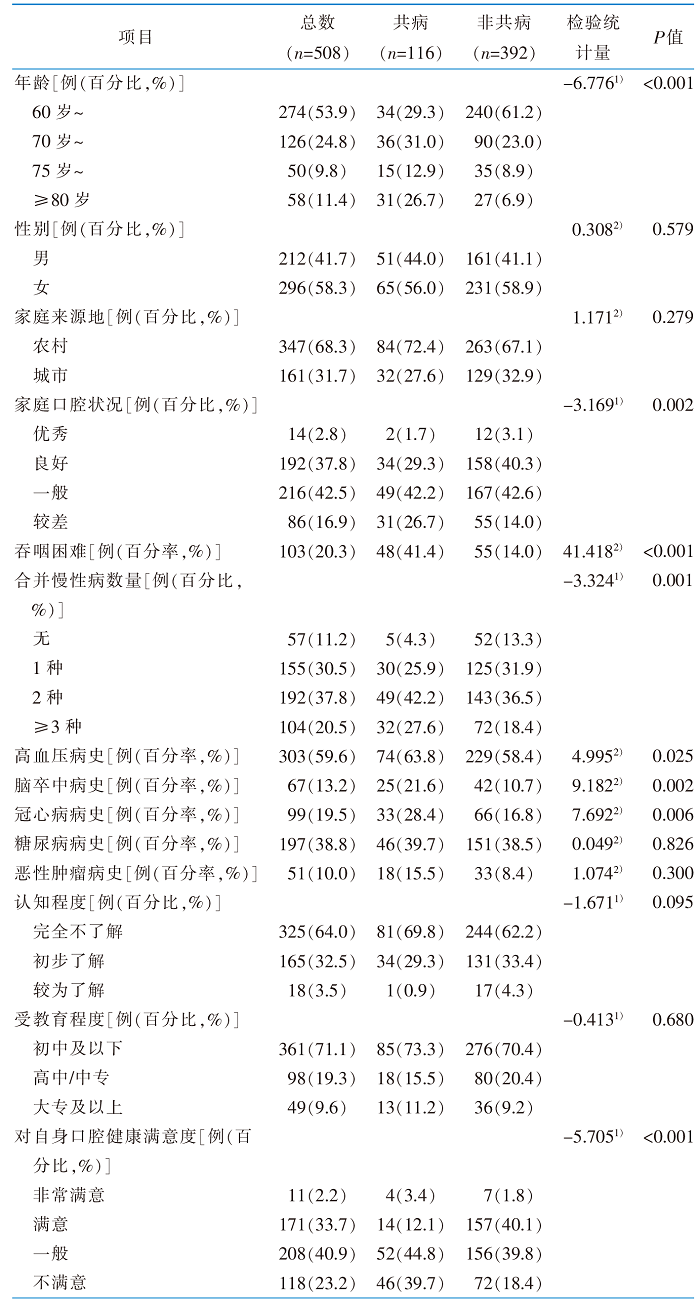 |
表1 老年住院患者一般资料及口腔衰弱与肌少症共病的单因素分析
Table 1 Single factor analysis of general data and oral frailty and sarcopenia comorbidities in elderly hospitalized patients
| |
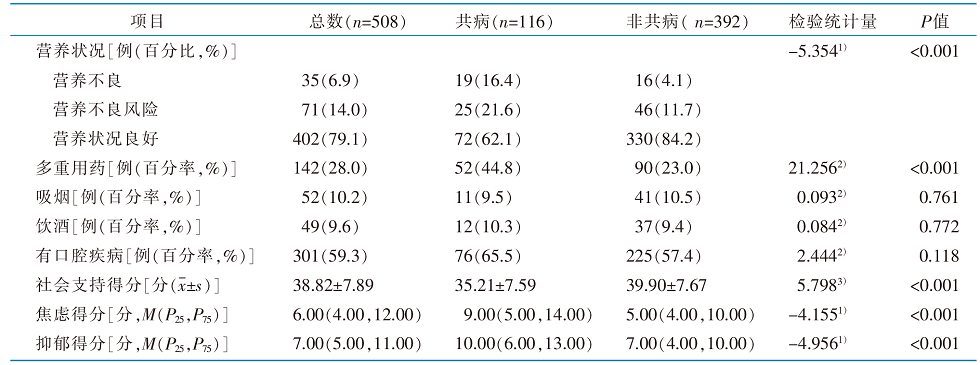 |
续表1 老年住院患者一般资料及口腔衰弱与肌少症共病的单因素分析
Table 1 (Continued) Single factor analysis of general data and oral frailty and sarcopenia comorbidities in elderly hospitalized patients
| |
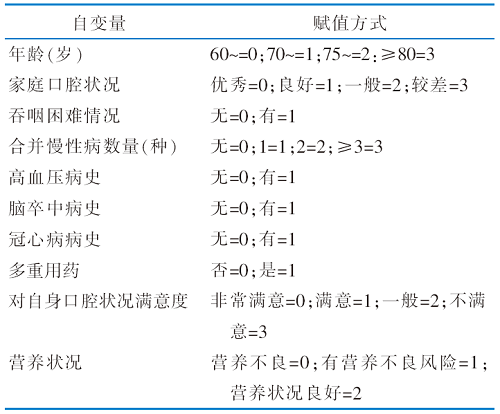 |
表2 自变量赋值方式
Table 2 Independent variable assignment
| |
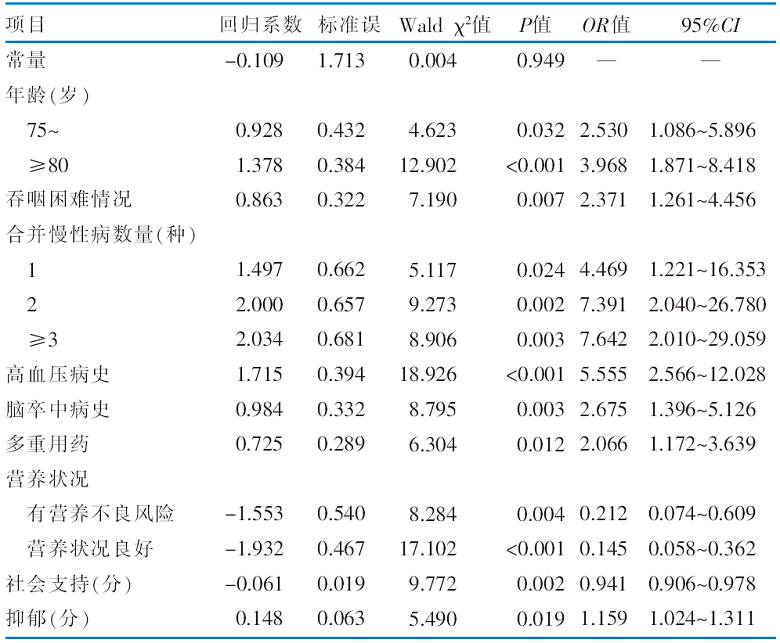 |
表3 老年住院患者口腔衰弱和肌少症共病的Logistic回归分析(n=508)
Table 3 Logistic regression analysis of oral frailty and sarcopenia comorbidities in elderly hospitalized patients(n=508)
| |
| [1] | Bonavita V, de Simone R. Towards a definition of comorbidity in the light of clinical complexity[J]. Neurol Sci, 2008, 29(Suppl 1):S99-S102. |
| [2] | Hu YD, Wang ZX, He HJ, et al. Prevalence and patterns of multimorbidity in China during 2002-2022:a systematic review and meta-analysis[J]. Ageing Res Rev, 2024, 93:102165. |
| [3] | Zhong YQ, Qin G, Xi HQ, et al. Prevalence,patterns of mul-timorbidity and associations with health care utilization among middle-aged and older people in China[J]. BMC Public Health, 2023, 23(1):537. |
| [4] | Zhao HM, Wu B, Zhou YQ, et al. Oral frailty:a concept analy-sis[J]. BMC Oral Health, 2024, 24(1):594. |
| [5] | Sayer AA, Cruz-Jentoft A. Sarcopenia definition,diagnosis and treatment:consensus is growing[J]. Age Ageing, 2022, 51(10):afac220. |
| [6] | 王昆, 曾翔, 王兆兰, 等. 60岁及以上老年住院患者中肌少症患病情况及其危险因素的Meta分析[J]. 预防医学情报杂志, 2024, 40(6):737-745,754. |
| Wang K, Zeng X, Wang ZL, et al. Meta-analysis prevalence and risk factors of sarcopenia in hospitalized elderly patients aged 60 years and above[J]. J Prev Med Inf, 2024, 40(6):737-745,754. | |
| [7] | 乔婉婉,田海萍,敬洁,等. 老年人口腔衰弱患病率的Meta分析[J]. 中国全科医学,2024, 27(30):3810-3816. |
| Qiao WW, Tian HP, Jing J, et al. Meta-analysis of the preva-lence of oral frailty in the elderly[J]. Chin Gen Pract, 2024, 27(30):3810-3816. | |
| [8] | 倪平, 陈京立, 刘娜. 护理研究中量性研究的样本量估计[J]. 中华护理杂志, 2010, 45(4):378-380. |
| Ni P, Chen JL, Liu N. The sample size estimation hi quanti-tative nursing research[J]. Chin J Nurs, 2010, 45(4):378-380. | |
| [9] | Tanaka T, Hirano H, Ohara Y, et al. Oral Frailty Index-8 in the risk assessment of new-onset oral frailty and functional disa-bility among community-dwelling older adults[J]. Arch Gerontol Geriatr, 2021, 94:104340. |
| [10] |
屠杭佳, 张书怡, 方雨慧, 等. 社区老年人口腔衰弱现状及影响因素分析[J]. 中华护理杂志, 2023, 58(11):1351-1356.
DOI URL |
| Tu HJ, Zhang SY, Fang YH, et al. Current situation and influ-encing factors of oral frailty in the community elderly[J]. Chin J Nurs, 2023, 58(11):1351-1356. | |
| [11] | 王晓英. 老年肌少症问卷的汉化及运动疗法对肌少症治疗效果的meta分析[D]. 石家庄: 河北医科大学, 2018. |
| Wang XY. Sinicization of the Sarcopenia Questionnaire for the Elderly and meta-analysis of the therapeutic effect of exercise therapy on sarcopenia[D]. Shijiazhuang: Hebei Medical University, 2018. | |
| [12] | Rubenstein LZ, Harker JO, Salvà A, et al. Screening for undernutrition in geriatric practice:developing the Short-Form Mini Nutritional Assessment(MNA-SF)[J]. J Gerontol A Biol Sci Med Sci, 2001, 56(6):M366-M372. |
| [13] | 张燕, 王利仙, 吕晓华, 等. 微型营养评估简表在老年慢性病住院患者营养筛查中的应用[J]. 中华老年多器官疾病杂志, 2019, 18(2):107-111. |
| Zhang Y, Wang LX, Lü XH, et al. Application of Mini Nutri-tional Assessment-Short Form in nutrition screening in elderly inpatients with chronic diseases[J]. Chin J Mult Organ Dis Elder, 2019, 18(2):107-111. | |
| [14] | 肖水源. 《社会支持评定量表》的理论基础与研究应用[J]. 临床精神医学杂志, 1994(2):98-100. |
| Xiao SY. Theoretical basis and research application of the Social Support Rating Scale[J]. J Clin Psychiatr, 1994(2):98-100. | |
| [15] | Zigmond AS, Snaith RP. The Hospital Anxiety and Depression Scale[J]. Acta Psychiatr Scand, 1983, 67(6):361-370. |
| [16] | Kugimiya Y, Iwasaki M, Ohara Y, et al. Association between sarcopenia and oral functions in community-dwelling older adults:a cross-sectional study[J]. J Cachexia Sarcopenia Muscle, 2023, 14(1):429-438. |
| [17] | Yuan S, Larsson SC. Epidemiology of sarcopenia:prevalence,risk factors,and consequences[J]. Metabolism, 2023, 144:155533. |
| [18] | Hihara T, Goto T, Ichikawa T. Investigating eating behaviors and symptoms of oral frailty using questionnaires[J]. Dent J,2019, 7(3):66. |
| [19] | 王琳, 鞠梅, 王婷, 等. 社区老年人口腔衰弱风险现状及影响因素分析[J]. 护理学杂志, 2023, 38(18):112-116. |
| Wang L, Ju M, Wang T, et al. Oral frailty risk and its influe-ncing factors in community-dwelling elderly population[J]. J Nurs Sci, 2023, 38(18):112-116. | |
| [20] | Tanaka T, Akishita M, Kojima T, et al. Polypharmacy with po-tentially inappropriate medications as a risk factor of new onset sarcopenia among community-dwelling Japanese older adults:a 9-year Kashiwa cohort study[J]. BMC Geriatr, 2023, 23(1):390. |
| [21] | Li YT, Yuan XJ, Zheng QT, et al. The association of periodon-tal disease and oral health with hypertension,NHANES 2009-2018[J]. BMC Public Health, 2023, 23(1):1122. |
| [22] | Quan YW, Wang C, Wang LF, et al. Geriatric sarcopenia is associated with hypertension:a systematic review and meta-analysis[J]. J Clin Hypertens, 2023, 25(9):808-816. |
| [23] | Sun WB, Huang SW, Yang XL, et al. The oral microbiome of patients with ischemic stroke predicts their severity and prognosis[J]. Front Immunol, 2023, 14:1171898. |
| [24] | 蒋微, 张剑书, 刘雪莲, 等. 老年口腔衰弱与肌少症相关性的研究进展[J]. 国际老年医学杂志, 2023, 44(3):358-361. |
| Jiang W, Zhang JS, Liu XL, et al. Research progress on the correlation between oral frailty and sarcopenia in the elderly[J]. Int J Geriatr, 2023, 44(3):358-361. | |
| [25] |
Cha S, Kim WS, Kim KW, et al. Sarcopenia is an independent risk factor for dysphagia in community-dwelling older adults[J]. Dysphagia, 2019, 34(5):692-697.
DOI PMID |
| [26] | de Sire A, Ferrillo M, Lippi L, et al. Sarcopenic dysphagia,malnutrition,and oral frailty in elderly:a comprehensive review[J]. Nutrients, 2022, 14(5):982. |
| [27] |
王婷, 侯冉, 常杲杲, 等. 头颈部肿瘤放疗患者吞咽功能训练的最佳证据总结[J]. 中华护理杂志, 2023, 58(14):1712-1718.
DOI URL |
| Wang T, Hou R, Chang GG, et al. Summary of the best evide-nce for swallowing function training in patients with head and neck cancer undergoing radiotherapy[J]. Chin J Nurs, 2023, 58(14):1712-1718. | |
| [28] | 唐吉, 唐小艳, 曾黎, 等. 贵州省农村地区老年人口腔衰弱的流行现况及影响因素分析[J]. 中国慢性病预防与控制, 2023, 31(5):327-331. |
| Tang J, Tang XY, Zeng L, et al. Prevalence and influencing factors of oral frailty in the elderly of rural areas in Guizhou Province[J]. Chin J Prev Contr Chronic Dis, 2023, 31(5):327-331. | |
| [29] | Nishi K, Kanouchi H, Tanaka A, et al. Relationship between oral hypofunction,and protein intake:a cross-sectional study in local community-dwelling adults[J]. Nutrients, 2021, 13(12):4377. |
| [30] | Cabanas-Sánchez V, Esteban-Cornejo I, Parra-Soto S, et al. Mu-scle strength and incidence of depression and anxiety:findings from the UK biobank prospective cohort study[J]. J Ca-chexia Sarcopenia Muscle, 2022, 13(4):1983-1994. |
| [1] | 中华护理学会静脉输液治疗专业委员会, 北京护理学会, (执笔:李佳, 李旭英, 覃惠英, 陈利芬, 吴珍明, 胡泽吟, 罗梦娜, 范育英, 吴嘉慧, 林宇萍, 王蕾, 孙文彦, 冯毕龙, 高伟, 李亚南, 侯罗娅, 李春燕. 中心静脉通路装置拔除护理专家共识[J]. 中华护理杂志, 2026, 61(9): 1157-1162. |
| [2] | 周霞, 马艳艳, 师正坤, 于海霞, 周艳, 胡红玲, 李莜, 陈思思, 张京慧. 隧道式经股静脉PICC置入术在困难静脉通路婴幼儿中的应用研究[J]. 中华护理杂志, 2026, 61(9): 1163-1170. |
| [3] | 黄萍, 李黎, 郭骊莉, 徐莹, 叶赟, 江淑芳. 与无针输液接头相关的导管相关性血流感染风险评估工具的构建与初步应用[J]. 中华护理杂志, 2026, 61(9): 1171-1179. |
| [4] | 李佳, 张玉玲, 邢乐, 张利峰, 牛秀峰, 许莉. 早产儿经上肢置入PICC尖端继发性异位风险预测模型的建立与验证[J]. 中华护理杂志, 2026, 61(9): 1180-1186. |
| [5] | 何娟, 赵蕾蕾, 叶冠军, 余艳芬, 傅晓君, 周琴. 1例双侧无名静脉及上腔静脉人工血管置换术后患者经上肢置入PICC的护理[J]. 中华护理杂志, 2026, 61(9): 1187-1191. |
| [6] | 梁江淑渊, 曾妃, 何鹏, 谢梦珊, 江悦, 蒋宗恒, 王建茗. 静脉-静脉体外膜肺氧合患者早期活动风险等级评估系统的构建及应用研究[J]. 中华护理杂志, 2026, 61(9): 1192-1199. |
| [7] | 陈晨, 顾肖, 郭凡, 王敏, 倪兴梅, 黄琴, 程念开. 3种衰弱评估工具对急诊老年创伤患者不良结局的预测价值[J]. 中华护理杂志, 2026, 61(9): 1200-1207. |
| [8] | 郑煜琳, 刘晋宁, 张静, 郭会敏, 谷艳梅, 张莉莉. 酒精性肝病患者肝移植术后再饮酒现状及其影响因素分析[J]. 中华护理杂志, 2026, 61(9): 1208-1214. |
| [9] | 叶俊霜, 沈丽佳, 孟霞靓, 张玉姣, 蔡根莲, 邵碧云, 周亚辉, 张柳倩, 应金萍. 维持性血液透析患者对口腔衰弱认知和体验的质性研究[J]. 中华护理杂志, 2026, 61(9): 1215-1220. |
| [10] | 王芸姣, 杨玉金, 郑春艳, 彭菲津, 王淑贞, 蒋喜露, 周为民, 王薇, 张娜. 糖尿病下肢动脉硬化闭塞症患者介入术后康复护理方案的构建及应用研究[J]. 中华护理杂志, 2026, 61(9): 1221-1229. |
| [11] | 杨明霞, 安冉, 臧金凤, 李春梅. 老年慢性病共病患者及照护者老老照护能力与自我忽视的相关性分析[J]. 中华护理杂志, 2026, 61(9): 1230-1236. |
| [12] | 梁和静, 许鹊, 史云霞, 祖金美, 黄文静, 杨春旭, 郭明华, 王磊. 颈动脉内膜剥脱术围手术期护理质量评价指标的构建[J]. 中华护理杂志, 2026, 61(9): 1237-1244. |
| [13] | 韩媛媛, 石玉竹, 尚文涵, 么莉. 870所三级甲等医院老年住院患者跌倒伤害发生现状与影响因素分析[J]. 中华护理杂志, 2026, 61(9): 1245-1252. |
| [14] | 夏云芳, 王洪, 崔岱, 付真真, 朱敏. 1例弥漫性毒性甲状腺肿合并超敏反应综合征青少年患者的护理[J]. 中华护理杂志, 2026, 61(9): 1253-1256. |
| [15] | 周益飞, 王海苹, 胡益环, 应莉, 罗松娜. 1例氢氟酸中毒并发呼吸心搏骤停患者的急救护理[J]. 中华护理杂志, 2026, 61(9): 1257-1260. |
| 阅读次数 | ||||||
|
全文 |
|
|||||
|
摘要 |
|
|||||
