

中华护理杂志 ›› 2025, Vol. 60 ›› Issue (24): 2956-2963.DOI: 10.3761/j.issn.0254-1769.2025.24.002
徐雅萍( ), 贾云洋, 易祖玲, 许蕊凤, 佟冰度, 鲁雪梅
收稿日期:2025-04-21
出版日期:2025-12-20
发布日期:2025-12-19
作者简介:徐雅萍:女,硕士,副主任护师,护士长,E-mail:yaping0535@163.com
基金资助:
XU Yaping(), JIA Yunyang, YI Zuling, XU Ruifeng, TONG Bingdu, LU Xuemei
Received:2025-04-21
Online:2025-12-20
Published:2025-12-19
摘要:
目的 探究老年髋部骨折患者出院准备度的潜在剖面并分析其影响因素,为临床实施精准化出院准备护理干预提供依据。 方法 采用便利抽样法,选取2024年9月—2025年2月北京市5所三级甲等医院收治的老年髋部骨折患者作为调查对象,通过一般资料调查表、社会支持评定量表、出院指导质量量表、出院准备度量表对其进行问卷调查。采用潜在剖面分析和多元Logistic回归分析进行数据分析。 结果 回收有效问卷215份,有效问卷回收率为93.48%。老年髋部骨折患者出院准备度得分为6.17(5.42,6.75)分,处于中等偏低水平。出院准备度可被分为3个分型:低准备-全面薄弱型(21.86%)、高准备-适应引领型(39.07%)、中准备-支持优势型(39.07%)。家庭年收入水平、出院时日常生活活动能力、社会支持水平是老年髋部骨折患者出院准备度潜在剖面的影响因素(均P<0.05)。 结论 老年髋部骨折患者出院准备度处于中等偏低水平且存在明显异质性,建议对低准备-全面薄弱型患者实施基础需求优先-系统支持强化策略,对高准备-适应引领型患者强化院内支持、优化延续护理,对中准备-支持优势型患者实施支持-效能转化干预。
徐雅萍, 贾云洋, 易祖玲, 许蕊凤, 佟冰度, 鲁雪梅. 老年髋部骨折患者出院准备度的潜在剖面分析及护理对策[J]. 中华护理杂志, 2025, 60(24): 2956-2963.
XU Yaping, JIA Yunyang, YI Zuling, XU Ruifeng, TONG Bingdu, LU Xuemei. Latent profile analysis and influencing factors of discharge readiness among older patients with hip fractures and nursing strategies[J]. Chinese Journal of Nursing, 2025, 60(24): 2956-2963.
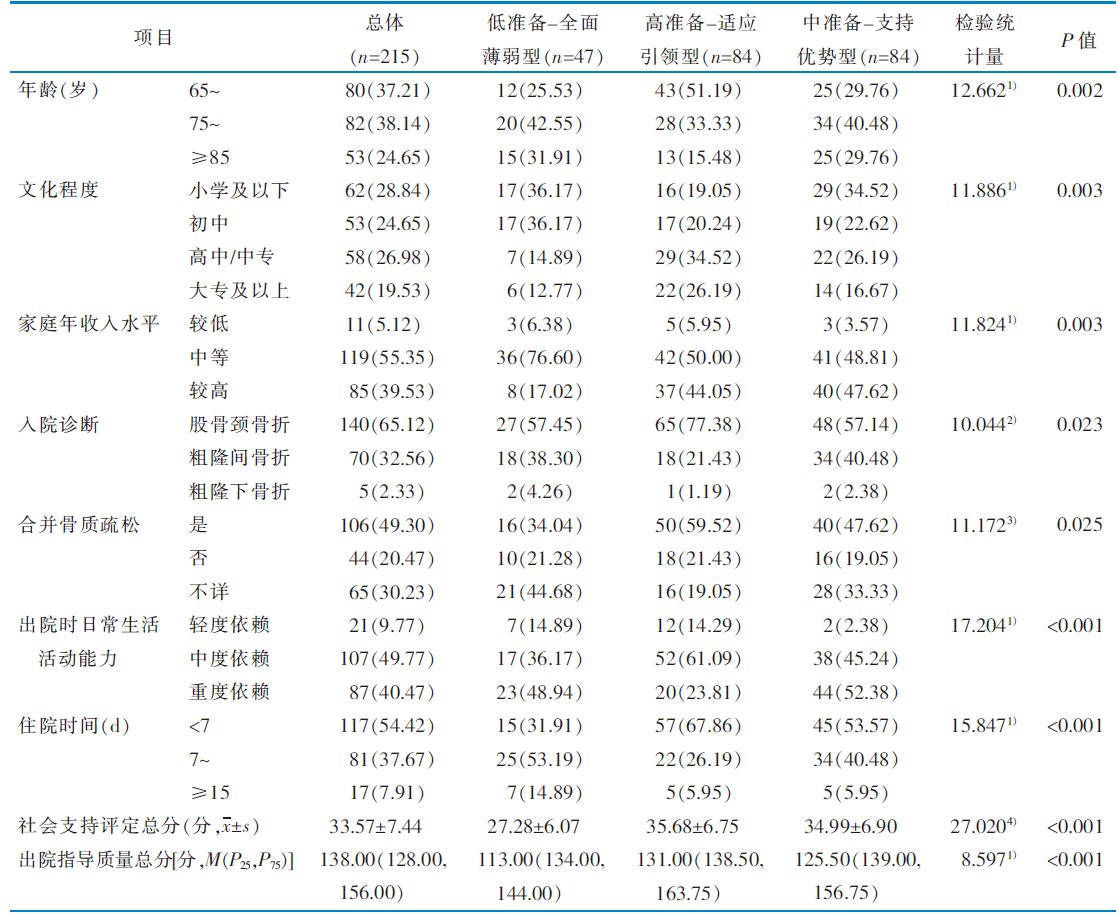 |
表1 老年髋部骨折患者的一般资料及出院准备度潜在剖面的单因素分析
Table 1 General information and univariate analysis of potential profiles of discharge readiness among older patients with hip fractures
|
 |
表2 老年髋部骨折患者出院准备度潜在剖面模型的拟合指标(n=215)
Table 2 Model fitting results of potential profile analysis model for discharge readiness among older patients with hip fractures(n=215)
|
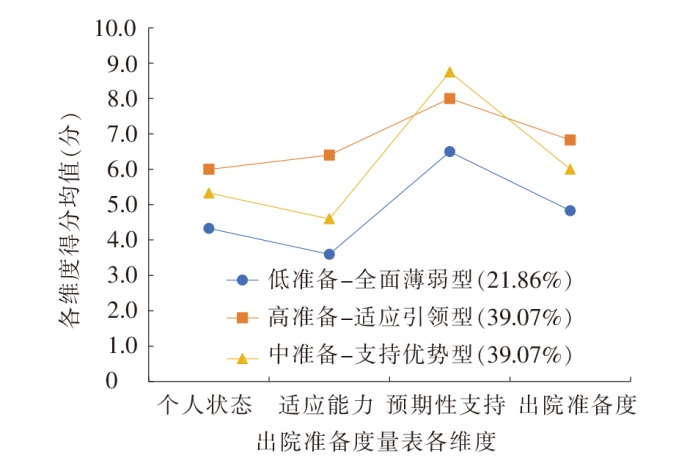
图1 老年髋部骨折患者出院准备度3个潜在剖面的特征分布
Figure 1 The characteristic distribution of 3 potential profiles of discharge readiness among older patients with hip fractures
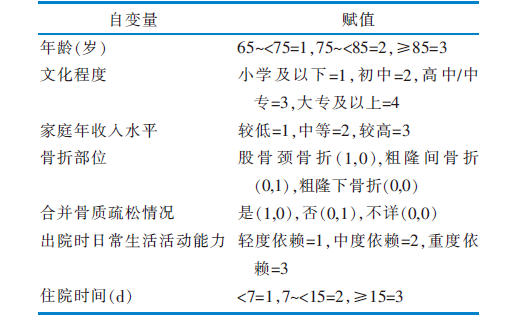 |
表3 自变量赋值
Table 3 Multiple Logistic regression analysis assignment table
|
 |
表4 老年髋部骨折患者出院准备度潜在剖面的多因素分析(n=215)
Table 4 Multifactor analysis of potential profiles of discharge readiness among older patients with hip fractures(n=215)
|
| [1] | 国家卫生健康委员会医政司. 老年髋部骨折诊疗与管理指南(2022年版)[J]. 中华创伤骨科杂志, 2023, 25(4):277-283. |
| Medical Administration Bureau of National Health Commission. Guidelines for treatment and management of hip fractures in the elderly(2022 version)[J]. Chin J Orthop Trauma, 2023, 25(4):277-283. | |
| [2] |
Veronese N, Maggi S. Epidemiology and social costs of hip fracture[J]. Injury, 2018, 49(8):1458-1460.
DOI PMID |
| [3] |
中华医学会骨质疏松和骨矿盐疾病分会. 原发性骨质疏松症诊疗指南(2022)[J]. 中国全科医学, 2023, 26(14):1671-1691.
DOI |
| Chinese Society of Osteoporosis and Bone Mineral Research. Guidelines for the diagnosis and treatment of primary osteoporosis(2022)[J]. Chin Gen Pract, 2023, 26(14):1671-1691. | |
| [4] |
Downey C, Kelly M, Quinlan JF. Changing trends in the mortality rate at 1-year post hip fracture:a systematic review[J]. World J Orthop, 2019, 10(3):166-175.
DOI PMID |
| [5] | 北京市统计局. 北京市2024年国民经济和社会发展统计公报. [EB/OL]. (2025-03-20)[2025-03-26]. https://tjj.beijing.gov.cn/tjsj_31433/tjgb_31445/ndgb_31446/202503/t20250319_4038820.html. |
| Beijing Municipal Bureau of Statistics. Beijing 2024 statistical bulletin of national economic and social development[EB/OL].(2025-03-20)[2025-03-26]. https://tjj.beijing.gov.cn/tjsj_31433/tjgb_31445/ndgb_31446/202503/t20250319_4038820.html. | |
| [6] | 刘刚, 杨明辉, 张京, 等. 北京地区老年髋部骨折的流行病学分布特点:多中心2071例患者分析[J]. 中华创伤骨科杂志, 2022, 24(9):759-765. |
| Liu G, Yang MH, Zhang J, et al. Epidemiological characteristics of geriatric hip fracture in Beijing:a multicenter analysis of 2,071 cases[J]. Chin J Orthop Trauma, 2022, 24(9):759-765. | |
| [7] | 宋宏晖, 张鹏, 徐炜, 等. 加速康复外科管理模式对高龄髋部骨折患者护理效果评价[J]. 中华创伤杂志, 2021, 37(9):825-832. |
| Song HH, Zhang P, Xu W, et al. Evaluation of nursing effect of enhanced recovery after surgery model in elderly patients with hip fracture[J]. Chin J Trauma, 2021, 37(9):825-832. | |
| [8] | 赵媛, 彭贵凌. 多学科协作下老年髋部骨折围手术期医护一体信息化护理模式的研究[J]. 中国实用护理杂志, 2021, 37(7):481-486. |
| Zhao Y, Peng GL. Study on the information-based nursing mode of the elderly patients with hip fracture in perioperative period under multidisciplinary cooperation[J]. Chin J Pract Nurs, 2021, 37(7):481-486. | |
| [9] | 张明辉, 郭丽君, 胡玉红, 等. 上海市居家康复治疗项目实施现况及影响因素[J]. 中国卫生资源, 2023, 26(2):203-213. |
| Zhang MH, Guo LJ, Hu YH, et al. Implementation status and influencing factors of home-based rehabilitation treatment project in Shanghai[J]. Chin Health Resour, 2023, 26(2):203-213. | |
| [10] | 安若轩, 陈圆圆, 刘良红, 等. 出院准备度的概念分析[J]. 护理学杂志, 2025, 40(2):104-107. |
| An RX, Chen YY, Liu LH, et al. Conceptual analysis of discharge readiness[J]. J Nurs Sci, 2025, 40(2):104-107. | |
| [11] | 何丹, 胡三莲, 周玲, 等. 老年髋部骨折患者出院准备度的现况及影响因素分析[J]. 中华现代护理杂志, 2020, 26(27):3732-3737. |
| He D, Hu SL, Zhou L, et al. Current status and influencing factors for discharge readiness in elderly patients with hip fractures[J]. Chin J Mod Nurs, 2020, 26(27):3732-3737. | |
| [12] | 王惠惠, 李娜, 魏民, 等. 老年髋部骨折术后患者出院准备度在社会支持和生活质量间的中介效应分析[J]. 中华现代护理杂志, 2022, 28(18):2431-2436. |
| Wang HH, Li N, Wei M, et al. Mediating effect of discharge readiness on social support and quality of life in elderly patients with hip fracture[J]. Chin J Mod Nurs, 2022, 28(18):2431-2436. | |
| [13] |
温忠麟, 谢晋艳, 王惠惠. 潜在类别模型的原理、步骤及程序[J]. 华东师范大学学报(教育科学版), 2023, 41(1):1-15.
DOI |
| Wen ZL, Xie JY, Wang HH. Principles,procedures and programs of latent class models[J]. J East China Norm Univ Educ Sci, 2023, 41(1):1-15. | |
| [14] |
Cohen J. A power primer[J]. Psychol Bull, 1992, 112(1):155-159.
DOI PMID |
| [15] |
梅伶俐, 陈朔晖, 胡艳, 等. 社会生态系统理论视角下短肠综合征患儿照护者负担体验的质性研究[J]. 中华护理杂志, 2022, 57(6):718-723.
DOI URL |
| Mei LL, Chen SH, Hu Y, et al. Caring experience of caregivers of children with short bowel syndrome based on the social ecological theory:a qualitative study[J]. Chin J Nurs, 2022, 57(6):718-723. | |
| [16] |
韩明华, 赵倩, 罗明月, 等. 慢性阻塞性肺疾病患者社会隔离体验的质性研究[J]. 中华护理杂志, 2025, 60(5):532-539.
DOI URL |
| Han MH, Zhao Q, Luo MY, et al. Experience of social isolation in patients with chronic obstructive pulmonary disease:a qualitative study[J]. Chin J Nurs, 2025, 60(5):532-539. | |
| [17] |
Welsh A, Hanson S, Pfeiffer K, et al. Facilitating the transition from hospital to home after hip fracture surgery:a qualitative study from the HIP HELPER trial[J]. BMC Geriatr, 2024, 24(1):948.
DOI PMID |
| [18] | 肖水源. 《社会支持评定量表》的理论基础与研究应用[J]. 临床精神医学杂志, 1994, 4(2):98-100. |
| Xiao SY. Theoretical basis and research application of Social Support Rating Scale[J]. J Clin Psychiatry, 1994, 4(2):98-100. | |
| [19] |
李莉, 申雅文, 李德龙, 等. 脆性骨折术后患者康复自我效能感的影响因素及路径分析[J]. 中华护理杂志, 2024, 59(24):3003-3008.
DOI URL |
|
Li L, Shen YW, Li DL, et al. Analysis of influencing factors and pathways of postoperative self-efficacy in patients with fragility fracture[J]. Chin J Nurs, 2024, 59(24):3003-3008.
DOI URL |
|
| [20] | 王婧怡, 孔晓倩, 王莉, 等. 失能老年人及家庭照顾者衰弱与社会支持、自我效能的主客体效应分析[J]. 中国护理管理, 2024, 24(12):1836-1841. |
| Wang JY, Kong XQ, Wang L, et al. Relationships among social support,self-efficacy,and frailty in disabled older adults and their family caregivers:the actor-partner interdependence analysis[J]. Chin Nurs Manag, 2024, 24(12):1836-1841. | |
| [21] | 李竹梅, 孙念梅. 妊娠晚期孕妇创伤后应激障碍与分娩恐惧、社会支持的相关性[J]. 护理研究, 2024, 38(16):2985-2991. |
| Li ZM, Sun NM. Correlation of post-traumatic stress disorder with fear of childbirth and social support in pregnant women in the third trimester[J]. Chin Nurs Res, 2024, 38(16):2985-2991. | |
| [22] |
Weiss ME, Piacentine LB, Lokken L, et al. Perceived readiness for hospital discharge in adult medical-surgical patients[J]. Clin Nurse Spec, 2007, 21(1):31-42.
DOI PMID |
| [23] | 王冰花, 汪晖, 杨纯子. 中文版出院指导质量量表的信效度测评[J]. 中华护理杂志, 2016, 51(6):752-755. |
| Wang BH, Wang H, Yang CZ. Reliability and validity of the Chinese version of the Quality of Discharge Teaching Scale[J]. Chin J Nurs, 2016, 51(6):752-755. | |
| [24] |
Weiss ME, Piacentine LB. Psychometric properties of the Readiness for Hospital Discharge Scale[J]. J Nurs Meas, 2006, 14(3):163-180.
DOI PMID |
| [25] | 林佑樺, 高家常, 黄阿美, 等. 中文版医院出院准备度量表之信效度检定[J]. 护理杂志, 2024, 61(4):56-65. |
| Lin YH, Gao CC, Huang AM, et al. Psychometric testing of the Chinese version of the Readiness for Hospital Discharge Scale[J]. The Journal of Nursing, 2014, 61(4):56-65. | |
| [26] |
韩琳, 闫楚楚, 单亚维, 等. 髋关节置换患者出院准备服务的循证实践[J]. 中华护理杂志, 2025, 60(10):1157-1164.
DOI URL |
|
Han L, Yan CC, Shan YW, et al. Evidence-based practice of discharge preparation services for hip replacement patients[J]. Chin J Nurs, 2025, 60(10):1157-1164.
DOI URL |
|
| [27] |
李红颐, 李雪, 范宇莹, 等. ICU患者创伤心理反应的潜在剖面及影响因素的混合研究[J]. 中华护理杂志, 2025, 60(7):842-849.
DOI URL |
|
Li HY, Li X, Fan YY, et al. A mixed study of latent profile analysis and influencing factors of psychological responses to trauma in ICU patients[J]. Chin J Nurs, 2025, 60(7):842-849.
DOI URL |
|
| [28] |
张文忠, 季红, 王宁, 等. 全膝关节置换术后患者康复治疗体验质性研究的Meta整合[J]. 中华护理杂志, 2023, 58(24):3028-3036.
DOI URL |
| Zhang WZ, Ji H, Wang N, et al. Rehabilitation experience of patients after total knee arthroplasty:a qualitative meta-synthesis[J]. Chin J Nurs, 2023, 58(24):3028-3036. | |
| [29] | 乔晓春. 对未来中国养老照护需求的估计[J]. 人口与发展, 2021, 27(1):105-116. |
| Qiao XC. Estimation of care needs of Chinese elderly in the future[J]. Popul Dev, 2021, 27(1):105-116. | |
| [30] | 汤叶丛, 庄丽丽, 李秀文, 等. 医患共同决策在临床实践中的困境及对策[J]. 医学与哲学, 2025, 46(4):19-23. |
| Tang YC, Zhuang LL, Li XW, et al. Challenges and strategies of shared decision-making in clinical practice[J]. Med Philos, 2025, 46(4):19-23. | |
| [31] |
Bandura A. Self-efficacy:toward a unifying theory of behavioral change[J]. Psychol Rev, 1977, 84(2):191-215.
DOI PMID |
| [1] | 中华护理学会静脉输液治疗专业委员会, 北京护理学会, (执笔:李佳, 李旭英, 覃惠英, 陈利芬, 吴珍明, 胡泽吟, 罗梦娜, 范育英, 吴嘉慧, 林宇萍, 王蕾, 孙文彦, 冯毕龙, 高伟, 李亚南, 侯罗娅, 李春燕. 中心静脉通路装置拔除护理专家共识[J]. 中华护理杂志, 2026, 61(9): 1157-1162. |
| [2] | 周霞, 马艳艳, 师正坤, 于海霞, 周艳, 胡红玲, 李莜, 陈思思, 张京慧. 隧道式经股静脉PICC置入术在困难静脉通路婴幼儿中的应用研究[J]. 中华护理杂志, 2026, 61(9): 1163-1170. |
| [3] | 黄萍, 李黎, 郭骊莉, 徐莹, 叶赟, 江淑芳. 与无针输液接头相关的导管相关性血流感染风险评估工具的构建与初步应用[J]. 中华护理杂志, 2026, 61(9): 1171-1179. |
| [4] | 李佳, 张玉玲, 邢乐, 张利峰, 牛秀峰, 许莉. 早产儿经上肢置入PICC尖端继发性异位风险预测模型的建立与验证[J]. 中华护理杂志, 2026, 61(9): 1180-1186. |
| [5] | 何娟, 赵蕾蕾, 叶冠军, 余艳芬, 傅晓君, 周琴. 1例双侧无名静脉及上腔静脉人工血管置换术后患者经上肢置入PICC的护理[J]. 中华护理杂志, 2026, 61(9): 1187-1191. |
| [6] | 梁江淑渊, 曾妃, 何鹏, 谢梦珊, 江悦, 蒋宗恒, 王建茗. 静脉-静脉体外膜肺氧合患者早期活动风险等级评估系统的构建及应用研究[J]. 中华护理杂志, 2026, 61(9): 1192-1199. |
| [7] | 陈晨, 顾肖, 郭凡, 王敏, 倪兴梅, 黄琴, 程念开. 3种衰弱评估工具对急诊老年创伤患者不良结局的预测价值[J]. 中华护理杂志, 2026, 61(9): 1200-1207. |
| [8] | 郑煜琳, 刘晋宁, 张静, 郭会敏, 谷艳梅, 张莉莉. 酒精性肝病患者肝移植术后再饮酒现状及其影响因素分析[J]. 中华护理杂志, 2026, 61(9): 1208-1214. |
| [9] | 叶俊霜, 沈丽佳, 孟霞靓, 张玉姣, 蔡根莲, 邵碧云, 周亚辉, 张柳倩, 应金萍. 维持性血液透析患者对口腔衰弱认知和体验的质性研究[J]. 中华护理杂志, 2026, 61(9): 1215-1220. |
| [10] | 王芸姣, 杨玉金, 郑春艳, 彭菲津, 王淑贞, 蒋喜露, 周为民, 王薇, 张娜. 糖尿病下肢动脉硬化闭塞症患者介入术后康复护理方案的构建及应用研究[J]. 中华护理杂志, 2026, 61(9): 1221-1229. |
| [11] | 杨明霞, 安冉, 臧金凤, 李春梅. 老年慢性病共病患者及照护者老老照护能力与自我忽视的相关性分析[J]. 中华护理杂志, 2026, 61(9): 1230-1236. |
| [12] | 梁和静, 许鹊, 史云霞, 祖金美, 黄文静, 杨春旭, 郭明华, 王磊. 颈动脉内膜剥脱术围手术期护理质量评价指标的构建[J]. 中华护理杂志, 2026, 61(9): 1237-1244. |
| [13] | 韩媛媛, 石玉竹, 尚文涵, 么莉. 870所三级甲等医院老年住院患者跌倒伤害发生现状与影响因素分析[J]. 中华护理杂志, 2026, 61(9): 1245-1252. |
| [14] | 夏云芳, 王洪, 崔岱, 付真真, 朱敏. 1例弥漫性毒性甲状腺肿合并超敏反应综合征青少年患者的护理[J]. 中华护理杂志, 2026, 61(9): 1253-1256. |
| [15] | 周益飞, 王海苹, 胡益环, 应莉, 罗松娜. 1例氢氟酸中毒并发呼吸心搏骤停患者的急救护理[J]. 中华护理杂志, 2026, 61(9): 1257-1260. |
| 阅读次数 | ||||||
|
全文 |
|
|||||
|
摘要 |
|
|||||
