

中华护理杂志 ›› 2026, Vol. 61 ›› Issue (19): 2731-2737.DOI: 10.3761/j.issn.0254-1769.2026.19.020
• 综述 • 上一篇
严慧娜( ), 肖爽*(), 邹依然, 廖莲梅
收稿日期:2026-04-02
出版日期:2026-10-10
发布日期:2026-09-28
*通讯作者:
肖爽,E-mail:faye-mn@163.com作者简介:严慧娜:女,硕士,护士,E-mail:1065955152@qq.com严慧娜:资料收集与分析、论文撰写;肖爽:研究指导、论文审阅与修改;邹依然:文献整理与分析;廖莲梅:资料收集、研究指导
基金资助:
YAN Huina(), XIAO Shuang*(), ZOU Yiran, LIAO Lianmei
Received:2026-04-02
Online:2026-10-10
Published:2026-09-28
* Corresponding author:
XIAO Shuang,E-mail:faye-mn@163.comFunding program:摘要:
目的 对数字健康技术在乳腺癌相关认知障碍患者中的应用进行范围综述,为开展相关研究提供参考。方法 以范围综述方法学框架为指导,系统检索中英文数据库中相关文献,检索时限为2016年1月1日—2026年5月19日,对纳入文献进行数据提取和汇总分析。结果 共纳入16篇文献,包括11篇随机对照试验、4篇类实验研究和1篇混合研究,数字健康技术载体包括为视频会议、移动应用程序、远程医疗平台、虚拟现实及游戏化程序;干预内容以认知训练为核心,同时结合健康教育、症状管理、监督提醒、体育锻炼或身心运动及心理社会支持;评价指标涵盖整体及特定认知功能、依从性、情绪、疲劳、睡眠质量及生活质量等。结论 数字健康技术在乳腺癌相关认知障碍患者中具有一定应用潜力,未来研究应立足国内患者需求,研发适配性载体,规范干预核心要素的报告标准,同时建立标准化的认知评价体系,以提升患者的康复效果和生活质量。
严慧娜, 肖爽, 邹依然, 廖莲梅. 数字健康技术在乳腺癌相关认知障碍患者中应用的范围综述[J]. 中华护理杂志, 2026, 61(19): 2731-2737.
YAN Huina, XIAO Shuang, ZOU Yiran, LIAO Lianmei. Digital health technologies in patients with cancer-related cognitive impairment of breast cancer:a scoping review[J]. Chinese Journal of Nursing, 2026, 61(19): 2731-2737.
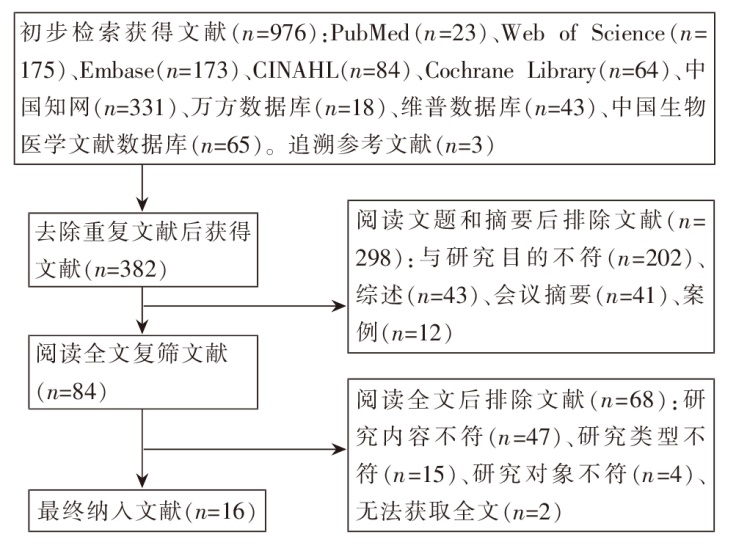
图1 文献筛选流程
Figure 1 Flow chart of literature screening
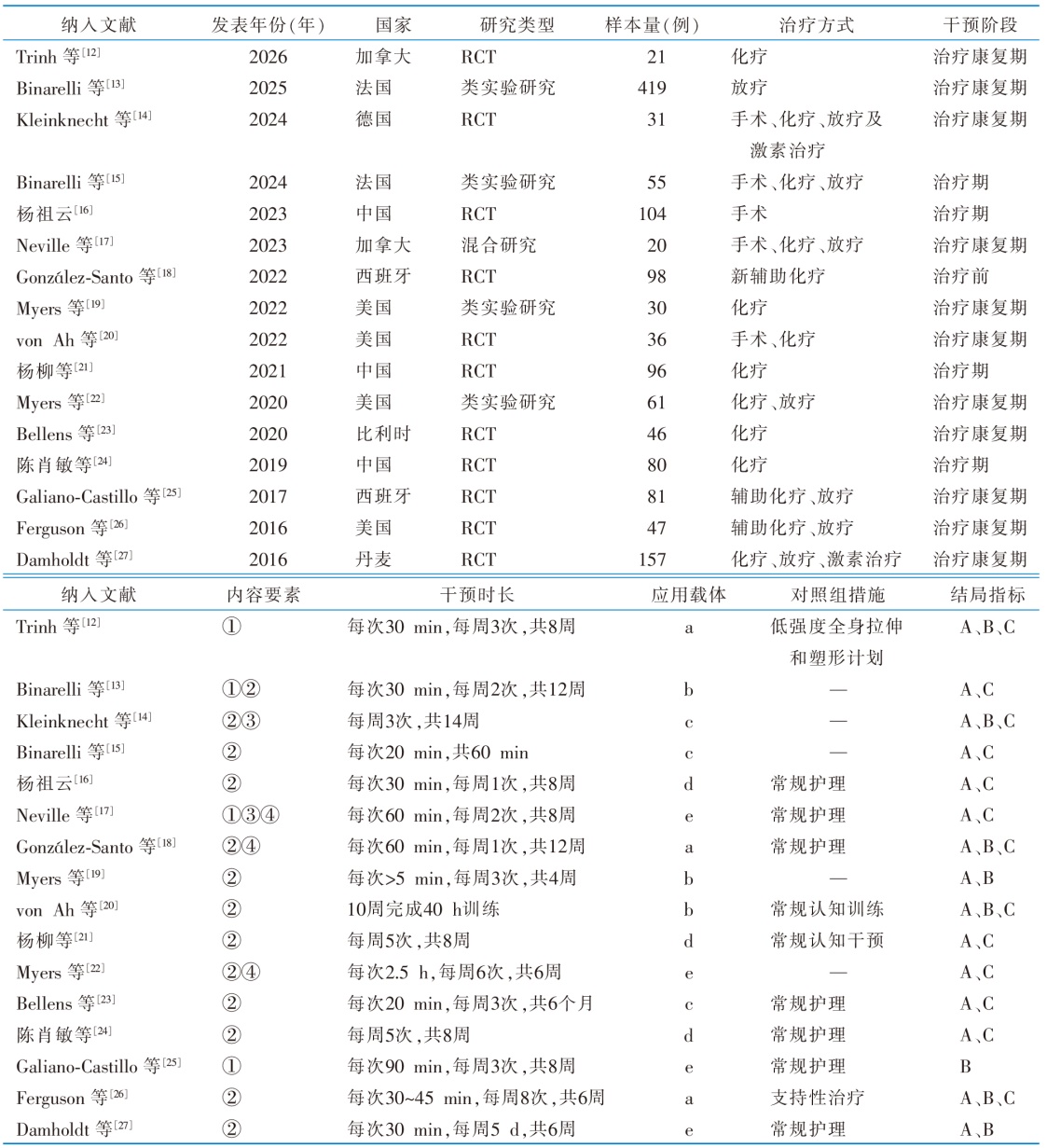 |
表1 纳入文献的基本特征(n=16)
Table 1 Basic characteristics of included studies(n=16)
| |
| [1] | Siegel RL, Kratzer TB, Giaquinto AN, et al. Cancer statistics,2025[J]. CA Cancer J Clin, 2025, 75(1):10-45. |
| [2] | Demos-Davies K, Lawrence J, Seelig D. Cancer related cognitive impairment:a downside of cancer treatment[J]. Front Oncol, 2024, 14:1387251. |
| [3] |
Mustian KM, Lin PJ, Chakrabarti A, et al. Effects of exercise on cognitive impairment in patients receiving chemotherapy:a multicenter phase Ⅲ randomized controlled trial[J]. J Natl Compr Canc Netw, 2026, 24(3):91-99.
DOI URL |
| [4] | 姚佳盈, 赵梦琴, 朱慧, 等. 癌症相关认知障碍发生率及影响因素的系统评价[J]. 中华护理教育, 2025, 22(5):623-629. |
| Yao JY, Zhao MQ, Zhu H, et al. Systematic review of preva-lence and its influencing factors in patients with cancer-related cognitive impairment[J]. Chin J Nurs Educ, 2025, 22(5):623-629. | |
| [5] | WHO. Global strategy on digital health2020-2025[EB/OL].(2021-01-30)[2026-05-24]. https://iris.who.int/bits-tream/handle/10665/344249/9789240020924-eng.pdfsequence=1. |
| [6] |
Liu SY, Ma JR, Sun MC, et al. Mapping the landscape of di-gital health intervention strategies:25-year synthesis[J]. J Med Internet Res, 2025, 27:e59027.
DOI URL |
| [7] |
Giustiniani A, Danesin L, Pezzetta R, et al. Use of telemedicine to improve cognitive functions and psychological well-being in patients with breast cancer:a systematic review of the current literature[J]. Cancers, 2023, 15(4):1353.
DOI URL |
| [8] |
Arksey H, O’Malley L. Scoping studies:towards a methodologi-cal framework[J]. Int J Soc Res Methodol, 2005, 8(1):19-32.
DOI URL |
| [9] |
王喜益, 叶志弘, 汤磊雯. 范围综述在护理领域的应用进展[J]. 中华护理杂志, 2019, 54(8):1259-1263.
DOI URL |
| Wang XY, Ye ZH, Tang LW. An integrative review of scoping review applied in nursing literature[J]. Chin J Nurs, 2019, 54(8):1259-1263. | |
| [10] | 仇如霞, 顾艳荭. 范围综述报告规范(PRISMA-ScR)的解读[J]. 中国循证医学杂志, 2022, 22(6):722-730. |
| Qiu RX, Gu YH. Interpretation of the PRISMA extension for scoping review(PRISMA-ScR)[J]. Chin J Evid Based Med, 2022, 22(6):722-730. | |
| [11] |
Lockwood C, dos Santos KB, Pap R. Practical guidance for knowledge synthesis:scoping review methods[J]. Asian Nurs Res, 2019, 13(5):287-294.
DOI PMID |
| [12] |
Trinh L, Cuda N, Sabiston CM, et al. The feasibility and accep-tability of a remotely delivered,combined exercise interven-tion on cognitive function in patients with breast cancer following chemotherapy:randomized controlled trial[J]. JMIR Cancer, 2026, 12:e73393.
DOI URL |
| [13] |
Binarelli G, Joly F, Christy F, et al. Digital multimodal inter-vention for cancer-related cognitive impairment in breast-cancer patients:Cog-Stim feasibility study[J]. BMC Psychiatry, 2025, 25(1):249.
DOI PMID |
| [14] |
Kleinknecht KR, Bierend M, Keim LM, et al. Computerized cognitive training improves cognitive function in primary breast cancer survivors[J]. NPJ Breast Cancer, 2024, 10(1):85.
DOI PMID |
| [15] | Binarelli G, Lange M, Dos Santos M, et al. Digital cognitive stimulation in elderly breast cancer patients:the Cog-Tab-Age feasibility study[J]. BMC Complementary Med Ther, 2024, 24(1):209. |
| [16] | 杨祖云. 基于虚拟现实技术的认知康复训练模式在乳腺癌CRCI病人中的应用[J]. 全科护理, 2023, 21(31):4340-4344. |
| Yang ZY. Application of cognitive rehabilitation training mode based on virtual reality technology in breast cancer patients with CRCI[J]. Chin Gen Pract Nurs, 2023, 21(31):4340-4344. | |
| [17] | Neville AR, Bernstein LJ, Sabiston CM, et al. Feasibility of a remotely-delivered yoga intervention on cognitive function in breast cancer survivors:a mixed-methods study[J]. Front Cog-nit, 2023, 2:1286844. |
| [18] |
González-Santos á, Lopez-Garzon M, Sánchez-Salado C, et al. A telehealth-based cognitive-adaptive training(e-OTCAT) to pre-vent cancer and chemotherapy-related cognitive impairment in women with breast cancer:protocol for a randomized control-led trial[J]. Int J Environ Res Public Health, 2022, 19(12):7147.
DOI URL |
| [19] | Myers J, Pathak HB, He JH, et al. Combined exercise and game-based cognitive training intervention:correlative pilot study of neurotrophic and inflammatory biomarkers for women with breast cancer[J]. Cancer Nurs, 2022, 1(10):1097. |
| [20] | von Ah D, McDonald BC, Crouch AD, et al. Randomized dou-ble-masked controlled trial of cognitive training in breast cancer survivors:a preliminary study[J]. Support Care Cancer, 2022, 30(9):7457-7467. |
| [21] | 杨柳, 王晓梅, 张伟, 等. 虚拟认知康复训练在乳腺癌化疗相关认知障碍患者中的应用[J]. 齐鲁护理杂志, 2021, 27(24):159-162. |
| Yang L, Wang XM, Zhang W, et al. Application and effect of vir-tual cognitive rehabilitation training in breast cancer patients with cognitive impairment after chemotherapy[J]. J Qilu Nurs, 2021, 27(24):159-162. | |
| [22] |
Myers JS, Cook-Wiens G, Baynes R, et al. Emerging from the haze:a multicenter,controlled pilot study of a multidimen-sional,psychoeducation-based cognitive rehabilitation interven-tion for breast cancer survivors delivered with telehealth conferencing[J]. Arch Phys Med Rehabil, 2020, 101(6):948-959.
DOI URL |
| [23] |
Bellens A, Roelant E, Sabbe B, et al. A video-game based cog-nitive training for breast cancer survivors with cognitive impair-ment:a prospective randomized pilot trial[J]. Breast, 2020, 53:23-32.
DOI PMID |
| [24] |
陈肖敏, 金艾香, 朱慧, 等. 虚拟认知康复训练在乳腺癌化疗相关认知障碍患者中的应用[J]. 中华护理杂志, 2019, 54(5):664-668.
DOI URL |
|
Chen XM, Jin AX, Zhu H, et al. Application and effect of virtual cognitive rehabilitation training in breast cancer patients with cognitive impairment after chemotherapy[J]. Chin J Nurs, 2019, 54(5):664-668.
DOI URL |
|
| [25] | Galiano-Castillo N, Arroyo-Morales M, Lozano-Lozano M, et al. Effect of an Internet-based telehealth system on functional capacity and cognition in breast cancer survivors:a secondary analysis of a randomized controlled trial[J]. Support Care Can-cer, 2017, 25(11):3551-3559. |
| [26] |
Ferguson RJ, Sigmon ST, Pritchard AJ, et al. A randomized trial of video conference-delivered cognitive behavioral therapy for survivors of breast cancer with self-reported cognitive dysfun-ction[J]. Cancer, 2016, 122(11):1782-1791.
DOI PMID |
| [27] |
Damholdt MF, Mehlsen M, O’Toole MS, et al. Web-based cog-nitive training for breast cancer survivors with cognitive complaints:a randomized controlled trial[J]. Psychooncology, 2016, 25(11):1293-1300.
DOI PMID |
| [28] |
Daneshgar-Pironneau S, Godard J, Porro B. Combining physical and cognitive training to address cancer-related cognitive impairment:advantages and methods[J]. Med Oncol, 2025, 43(1):36.
DOI |
| [29] | 郑霞, 周洁, 胡雅, 等. 老年肿瘤患者数字健康技术使用体验的质性研究[J]. 护理学杂志, 2023, 38(23):20-24,34. |
| Zheng X, Zhou J, Hu Y, et al. Experience of using digital health technology in elderly cancer patients:a qualitative study[J]. J Nurs Sci, 2023, 38(23):20-24,34. | |
| [30] |
彭燕霞, 高云飞, 雍敬敬, 等. 社区老年人对数字健康技术焦虑的现状及护理对策分析[J]. 中华护理杂志, 2023, 58(11):1345-1351.
DOI URL |
|
Peng YX, Gao YF, Yong JJ, et al. The current status and influencing factors of technophobia among the elderly from the perspective of digital health[J]. Chin J Nurs, 2023, 58(11):1345-1351.
DOI URL |
|
| [31] |
杨滕, 李雯, 卢楠, 等. 虚拟现实体感运动在老年失智症患者中应用的范围综述[J]. 中华护理杂志, 2024, 59(17):2166-2172.
DOI URL |
| Yang T, Li W, Lu N, et al. Virtual reality motor sensing exercise in the elderly patients with dementia:a scoping review[J]. Chin J Nurs, 2024, 59(17):2166-2172. | |
| [32] |
Zhou X, Zhang XY, Zhong TS, et al. Prevalence and associated factors of chemotherapy-related cognitive impairment in older breast cancer survivors[J]. J Adv Nurs, 2024, 80(2):484-499.
DOI URL |
| [1] | 李艳桃, 杨连招, 龙秀红, 陈玲, 高慧, 覃文婷, 朱芳慧, 罗雪儿. HIV感染者/AIDS患者创伤后成长体验的Meta整合[J]. 中华护理杂志, 2026, 61(9): 1261-1268. |
| [2] | 黄璇, 郭书萍, カルデナス暁東, 谢云影, 王瀚敏, 张玉美, 刘焘丽, 李莉. 银屑病患者自我报告结局评估工具测量学属性的评价及护理启示[J]. 中华护理杂志, 2026, 61(8): 1117-1124. |
| [3] | 张滢, 刘淑娟, 王婧瑞, 马千蓉. 轻度认知障碍患者对虚拟现实技术使用体验的Meta整合[J]. 中华护理杂志, 2026, 61(8): 1125-1131. |
| [4] | 李秋桦, 傅桂芬, 蒋建华, 尹丹, 左静, 刘艳群. 可穿戴设备在炎症性肠病患者动态监测与管理中应用的范围综述[J]. 中华护理杂志, 2026, 61(8): 1132-1140. |
| [5] | 熊丽莎, 袁越, 王思雪, 王云翠. 实施性研究视角下认知障碍患者干预方案保真度的研究进展[J]. 中华护理杂志, 2026, 61(8): 1141-1147. |
| [6] | 韩林, 杨丽娟, 李太东, 郑晓丽, 程敏, 郭琛, 郑培培. ICU机械通气清醒患者沟通体验的Meta整合[J]. 中华护理杂志, 2026, 61(7): 901-908. |
| [7] | 曾佳琳, 符冰, 杨泠韵, 江庆华. 头颈癌患者自我报告结局评估工具的评价及护理启示[J]. 中华护理杂志, 2026, 61(7): 986-994. |
| [8] | 王秀丽, 代春豪, 许梓婷, 李昊远, 冷敏敏, 张海博, 李晴, 杨丽娟. 运动干预在老年肌少性肥胖患者中应用的范围综述[J]. 中华护理杂志, 2026, 61(7): 995-1001. |
| [9] | 贺敬婷, 应燕萍, 陆秋芳, 赵慧函, 刘丽颖, 马含章, 张程. 多模态数据在护理领域中应用的范围综述[J]. 中华护理杂志, 2026, 61(7): 1002-1008. |
| [10] | 付海炜, 朱晓菊, 毕建静, 黎美娴, 张小迪, 王宗华. 肺癌患者癌症相关认知障碍核心症状与生活质量的相关性研究[J]. 中华护理杂志, 2026, 61(6): 783-789. |
| [11] | 武玲, 吴波, 陈红, 古晨茜, 刘洋, 张春谨, 陈梦琪, 章青. 基于机器学习算法的成人术中低体温预测模型的范围综述[J]. 中华护理杂志, 2026, 61(6): 844-851. |
| [12] | 陈静, 王君君, 魏晓琼, 何欢, 孙秋怡, 唐莹, 韩莹, 何华云. 运动干预在幼年特发性关节炎患儿中应用的范围综述[J]. 中华护理杂志, 2026, 61(6): 858-864. |
| [13] | 温佳, 郭慧芳, 郭晶晶, 田云霞, 杨玥, 刘波. 维持性血液透析患者社会疏离感的范围综述[J]. 中华护理杂志, 2026, 61(5): 605-611. |
| [14] | 旷婉, 祝敏, 胡露红. 简短的正念干预在围手术期患者中应用的范围综述[J]. 中华护理杂志, 2026, 61(5): 707-714. |
| [15] | 中华医学会骨科学分会护理学组 执笔:梅迎雪, 韩梦月, 潘韩丽, 韩冰, 杨旭. 骨科大手术患者静脉血栓栓塞症预防专家共识[J]. 中华护理杂志, 2026, 61(4): 437-441. |
| 阅读次数 | ||||||
|
全文 |
|
|||||
|
摘要 |
|
|||||
