

中华护理杂志 ›› 2025, Vol. 60 ›› Issue (23): 2864-2871.DOI: 10.3761/j.issn.0254-1769.2025.23.007
赵英楠( ), 郑鑫彤, 郑秋岗, 刘俊玲, 吴泓悦, 温晓艳, 魏肖倩, 李静, 杨川川, 李燕()
收稿日期:2025-04-02
出版日期:2025-12-10
发布日期:2025-12-15
通讯作者:
李燕,E-mail:liyan1@tjmuch.com作者简介:赵英楠:男,本科(硕士在读),护士,E-mail:18403307070@163.com
基金资助:
ZHAO Yingnan(), ZHENG Xintong, ZHENG Qiugang, LIU Junling, WU Hongyue, WEN Xiaoyan, WEI Xiaoqian, LI Jing, YANG Chuanchuan, LI Yan()
Received:2025-04-02
Online:2025-12-10
Published:2025-12-15
摘要:
目的 评价护士主导的早期肺康复策略在老年肺癌术后患者中的应用效果,为优化老年肺癌术后康复护理方案提供循证依据。方法 采用随机对照试验研究设计,按照纳入、排除标准,于2024年9月至2025年3月在天津市某三级甲等肿瘤专科医院胸外科招募患者,采用区组随机化分为试验组70例和对照组70例,试验组采用护士主导的早期肺康复策略,对照组采用常规肺康复护理。比较两组干预前后肺部感染发生率、用力肺活量、6 min步行距离、血氧饱和度、术后住院时间、疼痛评分、运动自我效能和肺漏气情况的差异。结果 最终试验组62例、对照组68例完成研究。干预后,试验组6 min步行距离为(363.76±54.42)m,高于对照组的(336.01±55.56)m;用力肺活量为(1.58±0.47)L,高于对照组的(1.28±0.33)L;运动自我效能评分为(56.9±12.2)分,高于对照组的(43.0±13.0)分。重复测量方差分析显示,两组术后血氧饱和度和疼痛评分均存在时间与组间的交互效应(P<0.05)。简单效应分析显示,试验组术后第3天疼痛评分(1.97±0.51)分,低于对照组的(2.20±0.55)分;术后第1天疼痛评分、术后第2~3天血氧饱和度高于对照组,差异均具有统计学意义(P<0.05)。两组术后肺部感染发生率、术后住院时间、肺漏气持续时间、持续性肺漏气发生率比较,差异无统计学意义(P>0.05)。结论 护士主导的早期精细化肺康复策略可促进肺癌患者术后肺功能恢复,增强活动耐力,改善氧合,提升患者后续完成肺康复训练的信念。
赵英楠, 郑鑫彤, 郑秋岗, 刘俊玲, 吴泓悦, 温晓艳, 魏肖倩, 李静, 杨川川, 李燕. 护士主导的早期肺康复策略在老年肺癌术后患者中的应用研究[J]. 中华护理杂志, 2025, 60(23): 2864-2871.
ZHAO Yingnan, ZHENG Xintong, ZHENG Qiugang, LIU Junling, WU Hongyue, WEN Xiaoyan, WEI Xiaoqian, LI Jing, YANG Chuanchuan, LI Yan. Application of nurse-led early pulmonary rehabilitation strategies in elderly postoperative lung cancer patients[J]. Chinese Journal of Nursing, 2025, 60(23): 2864-2871.
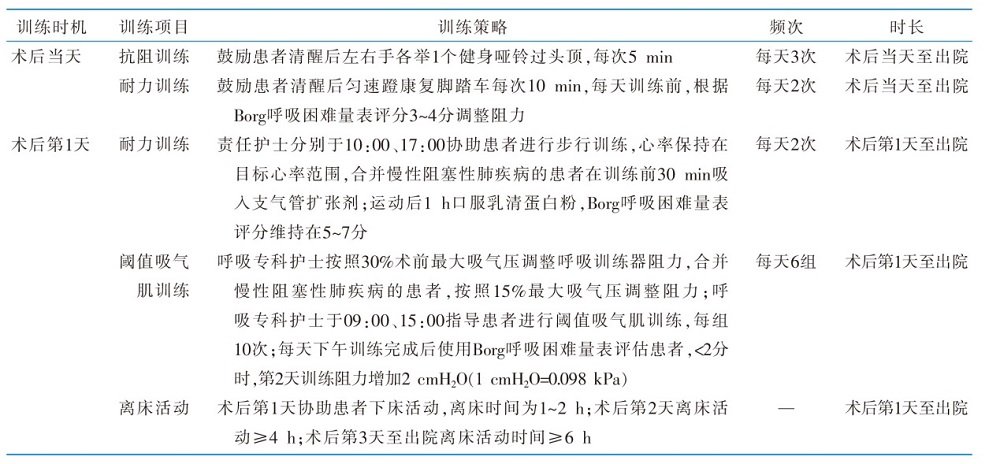 |
表1 护士主导的早期肺康复策略
Table 1 Nurse-led early pulmonary rehabilitation strategies
| |
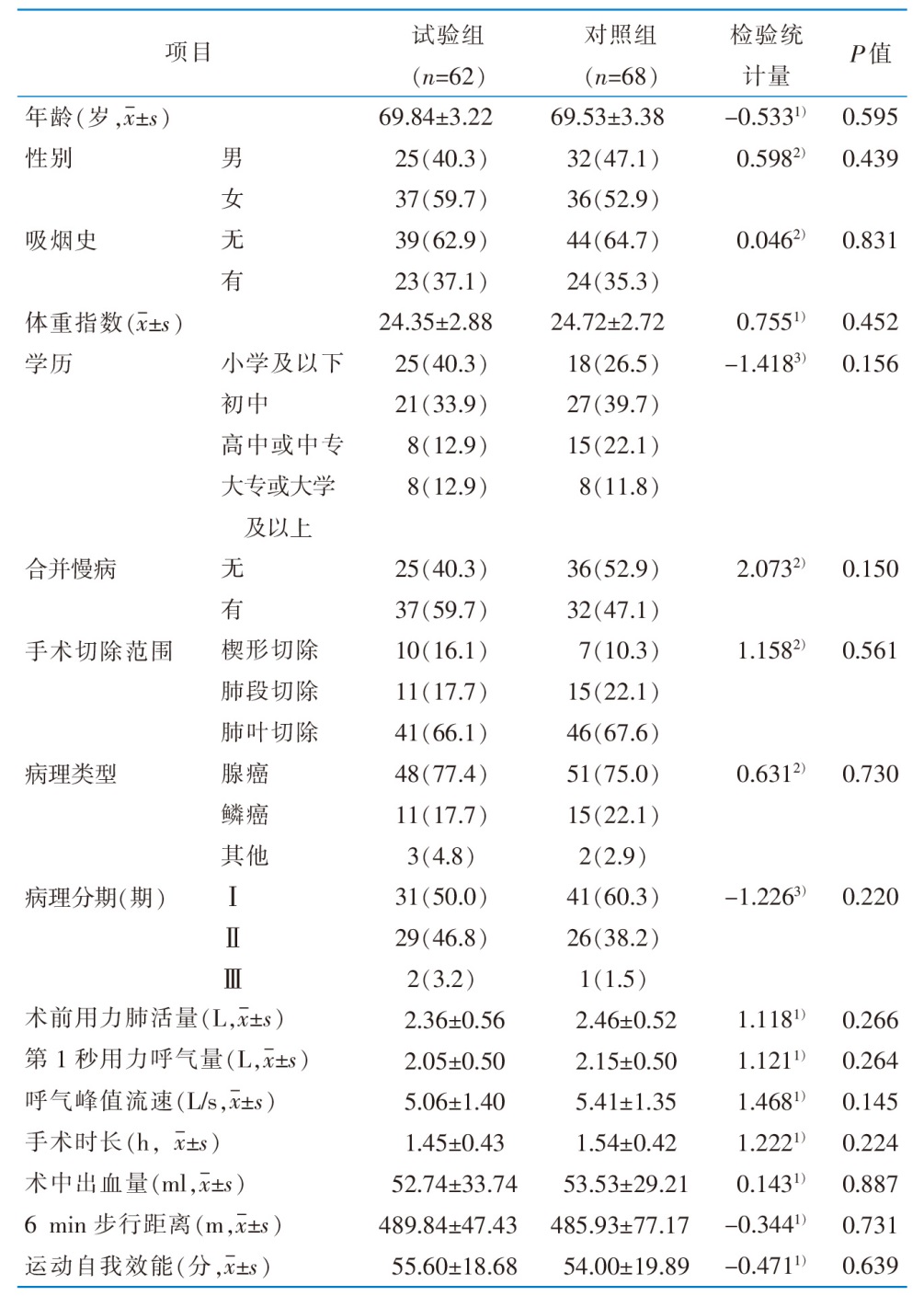 |
表2 两组一般资料的比较
Table 2 Comparison of general data between 2 groups
| |
 |
表3 两组干预后评价指标的比较
Table 3 Comparison of post-intervention evaluation indicators between 2 groups
| |
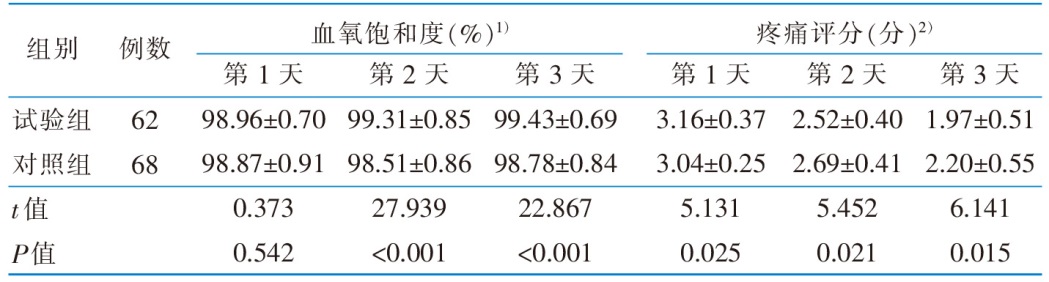 |
表4 两组干预后血氧饱和度与疼痛评分的重复测量方差分析($\bar{x}±s$)
Table 4 Repeated-measures ANOVA of blood Oxygen saturation and pain score after intervention in 2 groups($\bar{x}±s$)
| |
| [1] | Bray F, Laversanne M, Sung H, et al. Global cancer statistics 2022:GLOBOCAN estimates of incidence and mortality worldwide for 36 cancers in 185 countries[J]. CA Cancer J Clin, 2024, 74(3):229-263. |
| [2] |
韩娜菲, 贺红, 袁华娣, 等. 日间肺癌手术患者出院后症状纵向变化及护理对策研究[J]. 中华护理杂志, 2025, 60(4):432-438.
DOI |
|
Han NF, He H, Yuan HD, et al. Longitudinal changes of symptoms and nursing strategies of patients under daytime lung cancer surgery after discharge[J]. Chin J Nurs, 2025, 60(4):432-438.
DOI |
|
| [3] | 李燕, 刘丽峰, 郑秋岗, 等. 老年肺癌胸腔镜手术患者围手术期运动处方的设计与实施效果评价[J]. 中国护理管理, 2023, 23(11):1616-1622. |
| Li Y, Liu LF, Zheng QG, et al. Development and effectiveness of perioperative exercise prescription in elderly lung cancer patients undergoing thoracoscopic surgery[J]. Chin Nurs Manag, 2023, 23(11):1616-1622. | |
| [4] |
Schaller SJ, Kiselev J, Loidl V, et al. Prehabilitation of elderly frail or pre-frail patients prior to elective surgery(PRAEP-GO):study protocol for a randomized,controlled,outcome assessor-blinded trial[J]. Trials, 2022, 23(1):468.
DOI PMID |
| [5] |
朱虹宣, 庞建美, 孙盛楠, 等. 老年肺癌患者术后过渡期肺康复行为影响因素的质性研究[J]. 中华护理杂志, 2024, 59(1):15-21.
DOI |
|
Zhu HX, Pang JM, Sun SN, et al. A qualitative study of the factors of pulmonary rehabilitation behavior of elderly patients with lung cancer in the post-operative transitional period[J]. Chin J Nurs, 2024, 59(1):15-21.
DOI |
|
| [6] |
郑娉婷, 纪超娜, 王逸如, 等. 肺癌患者术后肺部感染预防护理方案的构建及验证[J]. 中华护理杂志, 2024, 59(7):820-827.
DOI |
|
Zheng PT, Ji CN, Wang YR, et al. Construction and validation of a postoperative lung infection prevention care program for lung cancer patients[J]. Chin J Nurs, 2024, 59(7):820-827.
DOI |
|
| [7] |
Bobčíková K, Macounová P, Bužgová R, et al. An assessment of quality of life,health,and disability in patients undergoing lung resection[J]. Kontakt, 2023, 25(4):307-313.
DOI URL |
| [8] |
中华医学会外科学分会, 中华医学会麻醉学分会. 加速康复外科中国专家共识及路径管理指南(2018版)[J]. 中国实用外科杂志, 2018, 38(1):1-20.
DOI |
| Chinese Society of Surgery,Chinese Society of Anesthesiology. Chinese consensus and clinical guidelines for enhanced recovery after surgery(2018 edition)[J]. Chin J Pract Surg, 2018, 38(1):1-20. | |
| [9] |
Wu X, Liang XY, Li Y, et al. Development and testing of the Knowledge-Attitudes-Practices Questionnaire for nurses on the perioperative pulmonary rehabilitation of patients with lung cancer[J]. Asia Pac J Oncol Nurs, 2024, 11(4):100387.
DOI URL |
| [10] |
李京京, 吕晓晴, 刘杉杉, 等. 围手术期肺癌患者症状群与生活质量相关性的纵向研究[J]. 中华护理杂志, 2020, 55(11):1635-1641.
DOI |
|
Li JJ, Lü XQ, Liu SS, et al. A longitudinal study on the correlations between symptom clusters and quality of life in patients with lung cancer during perioperation[J]. Chin J Nurs, 2020, 55(11):1635-1641.
DOI |
|
| [11] | Schulz KF, Altman DG, Moher D, et al. CONSORT 2010 statement:updated guidelines for reporting parallel group randomized trials[J]. Open Med, 2010, 4(1):e60-e68. |
| [12] | Celli BR. Pulmonary rehabilitation[EB/OL]. (2023-04-03)[2025-03-29]. https://www.uptodate.cn/contents/pulmonary-rehabilita-tion?search=Pulmonary%20rehabilitation&source=search_result&selectedTitle=1-94&usage_type=default&display_rank=1. |
| [13] | 杨卓婧, 李银鲜, 王菊子, 等. 肺癌患者围手术期肺康复的最佳证据总结[J]. 护士进修杂志, 2025, 40(3):327-333. |
| Yang ZJ, Li YX, Wang JZ, et al. Summary of the best evidence of pulmonary rehabilitation for lung cancer patients in the perioperative period[J]. J Nurses Train, 2025, 40(3):327-333. | |
| [14] |
韩娜菲, 冯华丽, 贺红, 等. 肺癌合并慢性阻塞性肺疾病患者术后肺康复管理的证据总结[J]. 中华护理杂志, 2024, 59(1):42-50.
DOI |
|
Han NF, Feng HL, He H, et al. Best evidence summary of postoperative pulmonary rehabilitation management in patients with lung cancer complicated with chronic obstructive pulmonary disease[J]. Chin J Nurs, 2024, 59(1):42-50.
DOI |
|
| [15] | 徐梅, 林雯雯, 刘海婷, 等. 围手术期肺癌患者呼吸功能锻炼的最佳证据总结[J]. 护理管理杂志, 2024, 24(5):430-436. |
| Xu M, Lin WW, Liu HT, et al. Summary of the best evidence for respiratory exercise in patients with perioperative lung cancer[J]. J Nurs Adm, 2024, 24(5):430-436. | |
| [16] | 刘天艺, 喻姣花, 李素云, 等. 成人围术期肺康复管理的最佳证据总结[J]. 护理学杂志, 2021, 36(2):88-92. |
| Liu TY, Yu JH, Li SY, et al. Evidence summary on perioperative pulmonary rehabilitation in adults[J]. J Nurs Sci, 2021, 36 (2):88-92. | |
| [17] | 李梅, 陈军, 杨梅, 等. 老年肺癌护理中国专家共识(2022版)[J]. 中国肺癌杂志, 2023, 26(3):177-192. |
| Li M, Chen J, Yang M, et al. Consensus of Chinese experts on nursing of lung cancer in the elderly(2022 edition)[J]. Chin J Lung Cancer, 2023, 26(3):177-192. | |
| [18] |
Bhatt NR, Sheridan G, Connolly M, et al. Postoperative exercise training is associated with reduced respiratory infection rates and early discharge:a case-control study[J]. Surgeon, 2017, 15(3):139-146.
DOI URL |
| [19] | Braga M, Wischmeyer PE, Drover J, et al. Clinical evidence for pharmaconutrition in major elective surgery[J]. JPEN J Parenter Enteral Nutr, 2013, 37(Suppl 5):66S-72S. |
| [20] | 支修益, 刘伦旭. 中国胸外科围手术期气道管理指南(2020版)[J]. 中国胸心血管外科临床杂志, 2021, 28(3):251-262. |
| Zhi XY, Liu LX. Chinese guidelines for perioperative airway management in thoracic surgery(2020 edition)[J]. Chin J Clin Thorac Cardiovasc Surg, 2021, 28(3):251-262. | |
| [21] | Berna P, Quesnel C, Assouad J, et al. Guidelines on enhanced recovery after pulmonary lobectomy[J]. Anaesth Crit Care Pain Med, 2021, 40(1):100791. |
| [22] | Coats V, Maltais F, Tremblay L, et al. Exercise-based rehabilitation for people with lung cancer[J]. J Pulm Respir Med, 2014, 4(3):1-7. |
| [23] | 李鹏飞, 赖玉田, 周坤, 等. 应用Clavien-Dindo分级系统对肺癌患者术后并发症分级及危险因素分析[J]. 中国肺癌杂志, 2017, 20(4):264-271. |
| Li PF, Lai YT, Zhou K, et al. Analysis of postoperative complications and risk factors of patients with lung cancer through Clavien-Dindo classification[J]. Chin J Lung Cancer, 2017, 20(4):264-271. | |
| [24] |
Resnick B, Jenkins LS. Testing the reliability and validity of the Self-Efficacy for Exercise Scale[J]. Nurs Res, 2000, 49(3):154-159.
DOI PMID |
| [25] |
Lee LL, Perng SJ, Ho CC, et al. A preliminary reliability and validity study of the Chinese version of the Self-Efficacy for Exercise Scale for older adults[J]. Int J Nurs Stud, 2009, 46(2):230-238.
DOI URL |
| [26] |
王新月, 张明娜, 朱晓红. 肺癌术后患者呼吸功能锻炼时间的探讨[J]. 中华护理杂志, 2019, 54(8):1194-1196.
DOI |
|
Wang XY, Zhang MN, Zhu XH. Exploration of timing of respiratory function exercise in patients after lung cancer surgery[J]. Chin J Nurs, 2019, 54(8):1194-1196.
DOI |
|
| [27] | 中国医师协会胸外科医师分会, 吴阶平医学基金会肺癌专业委员会, 中国抗癌协会肺部肿瘤整合康复专业委员会, 等. 胸部手术围术期持续性肺漏气管理策略全国专家共识(2023)[J]. 中华胸心血管外科杂志, 2024, 40(4):193-200. |
| Thoracic Surgeons Branch of Chinese Medical Doctor Association, Lung Cancer Professional Committee of Wu Jieping Medical Foundation, Professional Committee of Integrated Rehabilitation for Lung Tumors of Chinese Anti-Cancer Association, et al. Management strategies for persistent pulmonary air leak in the perioperative period of thoracic surgery:national ex-pert consensus(2023)[J]. Chin J Thorac Cardiovasc Surg, 2024, 40(4):193-200. | |
| [28] | 王翠, 张楠, 郭敏, 等. 慢性心力衰竭患者吸气肌训练效果的Meta分析[J]. 中华护理杂志, 2018, 53(8):932-938. |
| Wang C, Zhang N, Guo M, et al. Effectiveness of inspiratory muscle training in chronic heart failure patients:a meta-analysis[J]. Chin J Nurs, 2018, 53(8):932-938. | |
| [29] | 刘梦婷, 沈霞, 鲍关爱, 等. 运动干预对化疗诱导周围神经损伤影响的研究进展[J]. 中国康复医学杂志, 2023, 38(1):120-123. |
| Liu MT, Shen X, Bao GA, et al. Research progress on the effect of exercise intervention on peripheral nerve injury induced by chemotherapy[J]. Chin J Rehabil Med, 2023, 38(1):120-123. | |
| [30] | 胡银燕, 赵林芳, 贺晓映, 等. 1例食管癌术后并发重度免疫检查点抑制剂相关肺炎及吻合口瘘患者的护理[J]. 中华护理杂志, 2024, 59(14):1752-1756. |
| Hu YY, Zhao LF, He XY, et al. Nursing care of a postoperative patient with esophageal cancer complicated by severe immune checkpoint inhibitor-related pneumonia and anastomotic fistula[J]. Chin J Nurs, 2024, 59(14):1752-1756. | |
| [31] |
Liu JF, Kuo NY, Fang TP, et al. A six-week inspiratory muscle training and aerobic exercise improves respiratory muscle strength and exercise capacity in lung cancer patients after video-assisted thoracoscopic surgery:a randomized controlled trial[J]. Clin Rehabil, 2021, 35(6):840-850.
DOI URL |
| [32] |
Brocki BC, Andreasen JJ, Langer D, et al. Postoperative inspiratory muscle training in addition to breathing exercises and early mobilization improves oxygenation in high-risk patients after lung cancer surgery:a randomized controlled trial[J]. Eur J Cardiothorac Surg, 2016, 49(5):1483-1491.
DOI URL |
| [1] | 曾妃, 兰美娟, 顾培培, 梁江淑渊, 王衍蝶, 蔡凌云. 儿童双肺移植术后肺康复护理方案的构建及初步验证[J]. 中华护理杂志, 2025, 60(9): 1029-1035. |
| [2] | 阎寅至, 闻芳, 王敏, 周雪梅, 马金玲, 吴惠芳, 姚文英. 造血干细胞移植患儿运动康复分级护理方案的构建与应用研究[J]. 中华护理杂志, 2025, 60(9): 1036-1042. |
| [3] | 刘晓熠, 王红, 周智聪, 孙旭, 王意茹, 仝紫薇, 刘晓莹. 沉浸式虚拟现实技术对外周性前庭功能障碍患者康复效果的Meta分析[J]. 中华护理杂志, 2025, 60(9): 1140-1145. |
| [4] | 彭颖洁, 刘艾红, 朱文莉, 梅雨欣, 周萌, 关文静. 老年人预立医疗照护计划准备度评估工具的系统评价[J]. 中华护理杂志, 2025, 60(9): 1146-1153. |
| [5] | 严雪芹, 曹松梅, 周芳芳, 朱丽群, 陈成, 朱梦雪, 张艳红, 梁怡青, 柏素萍. 手部烧伤患者手功能早期康复管理的最佳证据总结[J]. 中华护理杂志, 2025, 60(8): 998-1004. |
| [6] | 吴丽萍, 肖丽娜, 赖菡青, 黄倩, 郭璇, 周迅. 老年类风湿关节炎患者对跌倒警觉体验的质性研究[J]. 中华护理杂志, 2025, 60(7): 836-841. |
| [7] | 何梦欣, 陈德凤, 李蓓, 董旭辉, 李佳宝, 杨扬, 徐要凯, 梁悦语. 智能化交互式认知运动干预在老年人跌倒预防中应用的范围综述[J]. 中华护理杂志, 2025, 60(7): 884-889. |
| [8] | 唐楠, 高远, 苏清清, 宋咪, 邱晨, 邵梦琪. 老年骨质疏松患者再骨折影响因素分析及护理对策[J]. 中华护理杂志, 2025, 60(6): 710-716. |
| [9] | 付琴, 张秀敏, 侯铭, 王彩虹, 李晓梅, 茆永琴, 李萍. 智能化体感运动在老年慢性阻塞性肺疾病患者居家肺康复中的效果评价[J]. 中华护理杂志, 2025, 60(5): 517-524. |
| [10] | 任建兰, 马开利, 张代英, 何雪梅, 黄敏, 熊洪, 陈燕华, 田华菊, 肖璐. 慢性阻塞性肺疾病患者肺康复健康教育游戏的开发及应用研究[J]. 中华护理杂志, 2025, 60(5): 525-531. |
| [11] | 李燕, 吴雪, 庞建美, 强万敏, 杨川川, 孙盛楠, 李静. 24个省份胸外科护士围手术期肺康复知信行的调查研究[J]. 中华护理杂志, 2025, 60(5): 569-574. |
| [12] | 韩娜菲, 贺红, 袁华娣, 兰美娟, 吴小燕, 曹俊华, 高丽燕, 辛鼎杰. 日间肺癌手术患者出院后症状纵向变化及护理对策研究[J]. 中华护理杂志, 2025, 60(4): 432-438. |
| [13] | 中华护理学会老年护理专业委员会, 北京医院 国家老年医学中心, 中国医学科学院老年医学研究院, 北京大学护理学院(执笔:刘文静 王志稳 余跃琳 任欣 琚慧 陈宏 王君鑫 陈闪闪 周佳 伊默 王文霞 张玲娟 陈思烨 杨宇帆 王小萌 孙红). 老年人内在能力评估与维护指南[J]. 中华护理杂志, 2025, 60(3): 261-265. |
| [14] | 金晓超, 施忠英, 周英凤, 黄晓燕, 黄楚贤, 顾艳虹, 苏雅, 李丽. 多组分运动联合认知训练在老年精神障碍合并肌少症患者中的应用研究[J]. 中华护理杂志, 2025, 60(3): 266-273. |
| [15] | 王敏, 杨文娟, 廖婷, 邹金梅, 廖冬霞, 张翠翠, 邓颖一, 龚喜燕, 廖常菊. 社区老年人口腔衰弱风险预测模型的构建及验证[J]. 中华护理杂志, 2025, 60(3): 274-280. |
| 阅读次数 | ||||||
|
全文 |
|
|||||
|
摘要 |
|
|||||
