
Chinese Journal of Nursing ›› 2026, Vol. 61 ›› Issue (3): 347-352.DOI: 10.3761/j.issn.0254-1769.2026.03.008
• Specialist Nursing Practice and Research • Previous Articles Next Articles
LIU Fengchun( ), MENG Qian, SONG Xiaomeng, MU Dongshuai, WANG Yan, WANG Xue, CHANG Hong*()
Received:2025-03-31
Online:2026-02-10
Published:2026-02-03
* Corresponding author:
CHANG Hong,E-mail:changhong19791111@126.comFunding program:
刘凤春(), 孟茜, 宋晓萌, 穆东帅, 王艳, 王雪, 常红*()
通讯作者:
常红,E-mail:changhong19791111@126.com作者简介:刘凤春:女,本科,副主任护师,E-mail:lycz666@126.com
基金资助:LIU Fengchun, MENG Qian, SONG Xiaomeng, MU Dongshuai, WANG Yan, WANG Xue, CHANG Hong. Effect of timely acupoint application on nocturnal polyuria in Parkinson’s disease patients[J]. Chinese Journal of Nursing, 2026, 61(3): 347-352.
刘凤春, 孟茜, 宋晓萌, 穆东帅, 王艳, 王雪, 常红. 择时穴位贴敷对帕金森病患者夜间尿频的护理效果研究[J]. 中华护理杂志, 2026, 61(3): 347-352.
Add to citation manager EndNote|Ris|BibTeX
URL: https://zh.zhhlzzs.com/EN/10.3761/j.issn.0254-1769.2026.03.008
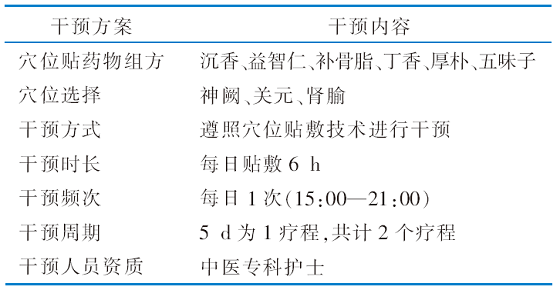 |
Table 1 Intervention program of acupoint application
| |
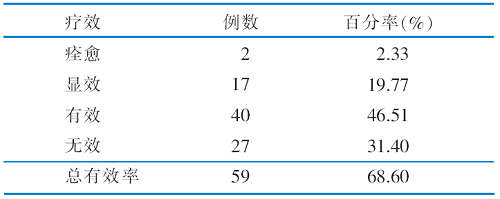 |
Table 2 Therapeutic effect of nocturnal polyuria in patients after intervention(n=86)
| |
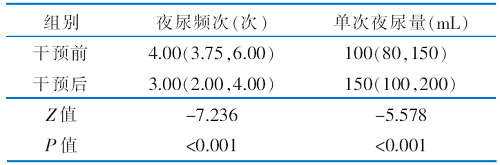 |
Table 3 Comparison of nocturnal frequency and single nocturnal volume of patients before and after treatment [n=86,M(P25,P75)]
| |
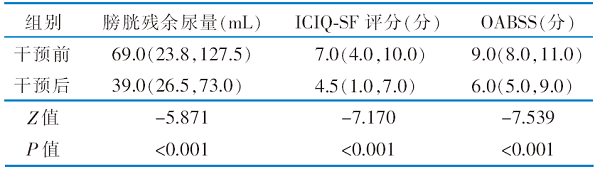 |
Table 4 Comparison of residual urine volume, overactive bladder, and urinary incontinence before and after intervention[n=86,M(P25,P75)]
| |
| [1] |
Li MM, Ye XF, Huang ZP, et al. Global burden of Parkinson’s disease from 1990 to 2021:a population-based study[J]. BMJ Open, 2025, 15(4):e095610.
DOI URL |
| [2] | Tapdia M, Kumar A, Yadav AK, et al. Clinical spectrum of non-motor symptoms in correlation with quality of life in Parkinson’s disease and atypical Parkinsonism:evidence in reaching consensus[J]. Ann Neurosci,2025:09727531251321234. |
| [3] | 麻红梅, 蒋银芬. 帕金森病患者体位性低血压的护理研究进展[J]. 中华护理杂志, 2017, 52(11):1371-1374. |
| Ma HM, Jiang YF. Research progress on nursing of Parkinson’s disease patients with orthostatic hypotension[J]. Chin J Nurs, 2017, 52(11):1371-1374. | |
| [4] | 王李润, 李建香, 陆艳, 等. 温肾养肝法治疗帕金森病夜尿增多症经验总结[J]. 环球中医药, 2019, 12(2):233-235. |
| Wang LR, Li JX, Lu Y, et al. Summary of experience in treating nocturia of Parkinson’s disease by warming kidney and nou-rishing liver[J]. Glob Tradit Chin Med, 2019, 12(2):233-235. | |
| [5] | 李二强, 张贺林, 王博, 等. 骶神经刺激装置在膀胱过度活动症治疗中的研究进展[J]. 国际泌尿系统杂志, 2023, 43(4):751-754. |
| Li EQ, Zhang HL, Wang B, et al. Advances in sacral nerve stimulation devices in the treatment of overactive bladder syndrome[J]. Int J Urology Nephr, 2023, 43(4):751-754. | |
| [6] | 陈月莹. 夜尿症的中医证型分布及其中药治疗的用药规律分析[D]. 北京: 北京中医药大学, 2024. |
| Chen YY. Distribution of TCM syndrome types of nocturia and analysis of its medication law in traditional Chinese medicine treatment[D]. Beijing: Beijing University of Chinese Medicine, 2024. | |
| [7] | 高莹, 郭兆安. 夜尿增多的中医病因病机与治疗[J]. 中国中西医结合肾病杂志, 2019, 20(12):1119-1120. |
| Gao Y, Guo ZA. Etiology,pathogenesis and treatment of nocturia in traditional Chinese medicine[J]. Chin J Integr Tradit West Nephrol, 2019, 20(12):1119-1120. | |
| [8] | 曹雯媗, 杨剑英, 罗悦, 等. 基于子午流注理论运用五音疗法治疗视疲劳的理论探析[J]. 中国中医眼科杂志, 2024, 34(12):1151-1155. |
| Cao WX, Yang JY, Luo Y, et al. Theoretical exploration of five-tone therapy based on the midnight-noon ebb-flow theory for the treatment of eyestrain[J]. China J Chin Ophthalmol, 2024, 34(12):1151-1155. | |
| [9] |
桂屏, 叶淑华, 谢玉英, 等. 子午流注择时穴位贴敷对妇科腹腔镜术后患者胃肠功能的影响[J]. 中华护理杂志, 2020, 55(9):1376-1380.
DOI URL |
|
Gui P, Ye SH, Xie YY, et al. Effects of acupoint application therapy based on midnight-noon ebb-flow for gastrointestinal function in patients undergoing gynecological laparoscopy[J]. Chin J Nurs, 2020, 55(9):1376-1380.
DOI URL |
|
| [10] | 夜尿症临床诊疗中国专家共识编写组. 夜尿症临床诊疗中国专家共识[J]. 中华泌尿外科杂志, 2018, 39(8):561-564. |
| Chinese Expert Consensus Writing Group on Clinical Diagnosis and Treatment of Nocturia. China expert consensus on clinical diagnosis and treatment of nocturia[J]. Chin J Urol, 2018, 39(8):561-564. | |
| [11] | 雒晓东, 李哲, 朱美玲, 等. 帕金森病(颤拘病)中医临床诊疗专家共识[J]. 中医杂志, 2021, 62(23):2109-2116. |
| Luo XD, Li Z, Zhu ML, et al. Traditional Chinese medicine expert consensus on diagnosis and treatment of Parkinson’s disease(tremor and spasm disease)[J]. J Tradit Chin Med, 2021, 62(23):2109-2116. | |
| [12] | 中华医学会神经病学分会帕金森病及运动障碍学组,中国医师协会神经内科医师分会帕金森病及运动障碍学组. 中国帕金森病治疗指南(第四版)[J]. 中华神经科杂志, 2020, 53(12):973-986. |
| The Parkinson’s Disease and Movement Disorders Group of the Neurology Branch of the Chinese Medical Association,the Parkinson’s Disease and Movement Disorders Group of the Neurology Branch of the Chinese Medical Association. Chinese Parkinson’s disease treatment guidelines(fourth edition)[J]. Chin J Neur, 2020, 53(12):973-986. | |
| [13] | 中华中医药学会.中医穴位贴敷基层临床应用技术操作规范:T/CACM 1355—2021[S]. 北京: 中国标准出版社, 2021. |
| Chinese Society of Chinese Medicine.Standardized manipulations for basic clinical application of acupoint paste of tra-ditional Chinese medicine:T/CACM 1355—2021[S]. Beijing: Standards Press of China, 2021. | |
| [14] | 刘金利, 谷晓玲, 王晶. 基于数据挖掘的艾灸治疗脑卒中后尿失禁的选穴规律分析[J]. 当代护士(上旬刊), 2022, 29(9):99-102. |
| Liu JL, Gu XL, Wang J. Analysis of acupoint selection law of moxibustion in the treatment of urinary incontinence after stroke based on data mining[J]. Mod Nurse, 2022, 29(9):99-102. | |
| [15] | 首都医科大学宣武医院. 一种治疗尿失禁的中药组合物、制备方法及应用:CN202311476778.5[P]. 2024-02-06. |
| Xuanwu Hospital, Capital Medical University. A traditional Chinese medicine composition for treating urinary incontinence,its preparation method,and application:CN202311476778.5[P]. 2024-02-06. | |
| [16] | 国家市场监督管理总局, 国家标准化管理委员会. 经穴名称与定位:GB/T 12346—2021[S]. 北京: 中国标准出版社, 2021. |
| State Administration for Market Regulation, Standardization Administration of the People’s Republic of China. Nomenclature and location of meridian points:GB/T 12346—2021[S]. Beijing: Standards Press of China, 2021. | |
| [17] | 尤焱南, 周涛, 赵霞. 《中医病证诊断疗效标准》修订中文献研究法探析[J]. 中医药导报, 2019, 25(21):22-25. |
| You YN, Zhou T, Zhao X. Literature research on criteria of diagnosis and therapeutic effect of diseases and syndromes in traditional Chinese medicine(revision)[J]. Guid J Tradit Chin Med Pharm, 2019, 25(21):22-25. | |
| [18] | Gong F, Chen C, Bamberger J, et al. Translation and validation of the overactive bladder symptom score(OABSS) in Chinese during the COVID-19 telehealth surge[J]. Cont Rep, 2022,4:100016. |
| [19] | 许克新, 汪磊, 王晓峰, 等. 膀胱过度活动症症状评分表对中国OAB患者结果评估的重复信度及与其他症状评分工具间相关性的研究[J]. 中华泌尿外科杂志, 2010, 31(11):727-731. |
| Xu KX, Wang L, Wang XF, et al. Test-retest reliability of the Overactive Bladder Symptom Score and its correlation with other overactive bladder symptom evaluation tools among Chinese overactive bladder symptom patients[J]. Chin J Urol, 2010(11):727-731. | |
| [20] |
丁佳蓉, 陈慧, 王雪瑞, 等. 原位新膀胱术后患者尿失禁发展轨迹及影响因素研究[J]. 中华护理杂志, 2025, 60(2):208-214.
DOI URL |
|
Ding JR, Chen H, Wang XR, et al. Study on the trajectory and influencing factors of urinary incontinence in patients after orthotopic neobladder surgery[J]. Chin J Nurs, 2025, 60(2):208-214.
DOI URL |
|
| [21] |
Kumar A, Patil S, Singh VK, et al. Assessment of non-motor symptoms of Parkinson’s disease and their impact on the quality of life:an observatiobnal study[J]. Ann Indian Acad Neurol, 2022, 25(5):909-915.
DOI URL |
| [22] |
Ragab MM, Mohammed ES. Idiopathic Parkinson’s disease patients at the urologic clinic[J]. Neurourol Urodyn, 2011, 30(7):1258-1261.
DOI URL |
| [23] | 王炎龙. 中医学“因时用药”规律的文献整理研究[D]. 北京: 北京中医药大学, 2010. |
| Wang YL. Literature collation and research on the law of “medication according to time” in traditional Chinese medicine[D]. Beijing: Beijing University of Chinese Medicine, 2010. | |
| [24] | 赵一平, 范郁山, 贺煜竣, 等. 基于数据挖掘探讨穴位疗法治疗糖尿病神经源性膀胱的选穴规律[J]. 广西医学, 2023, 45(19):2374-2378. |
| Zhao YP, Fan YS, He YJ, et al. Acupoint selection rule of acupoint therapy for the treatment of diabetic neurogenic bladder:an exploration based on data mining[J]. Guangxi Med J, 2023, 45(19):2374-2378. | |
| [25] | 国家药典委员会. 中华人民共和国药典一部:2020年版[M]. 北京: 中国医药科技出版社, 2020. |
| National Pharmacopoeia Commission. Pharmacopoeia of the People’s Republic of China:2020 edition[M]. Beijing: China Medical Science Press, 2020. | |
| [26] | Hu WJ, Zhou H, Zhu WW, et al. Combination treatment with acupoint therapy and conventional medication for non-motor symptoms in Parkinson’s disease:a systematic review and meta-analysis[J]. Front Neurol, 2025,16:1381500. |
| [27] | Smith MD, Cullen A, Portlock GE, et al. Nocturnal polyuria is common in Parkinson’s and is associated with orthostatic hypotension[J]. Clin Park Relat Disord, 2025,12:100334. |
| [28] |
Vaughan CP. Voiding dysfunction and parkinson disease in geriatric patients[J]. Clin Geriatr Med, 2025, 41(2):209-224.
DOI PMID |
| [29] |
Gubbiotti M, Ditonno F, Brahimi E, et al. Clinical features in Parkinson’s disease:characterization of urinary symptoms according to Parkinson disease subtype[J]. Int Urol Nephrol, 2025, 57(8):2495-2501.
DOI |
| [1] | YANG Ting, WEI Hui, LIU Miaomiao, WU Minhao, TONG Fangfang, JIANG Luya, YANG Hongyan. Research on the application of five-element corresponding to five-color music therapy on post-stroke subthreshold depression patients [J]. Chinese Journal of Nursing, 2025, 60(21): 2648-2653. |
| [2] | XIE Rui, ZHANG Qixiu, CHEN Lili, LI Ying, NING Li. Study on the effect of timing aromatherapy combined with balanced cupping on perimenopausal insomnia patients [J]. Chinese Journal of Nursing, 2025, 60(21): 2654-2661. |
| [3] | SHAO Xueying, PEI Xiaodan, LI Yanjuan, DONG Yuhong, CHANG Liyang, JIN Jingfen. Application of foot massage based on the brain-gut axis theory in hemodialysis and insomnia patients with spleen-kidney yang deficiency type [J]. Chinese Journal of Nursing, 2025, 60(18): 2203-2209. |
| [4] | DU Yunhong, RONG Wenli, SUN Lili, WANG Yu, WANG Shujun, WANG Li. Study on the preference for “Internet+ TCM Nursing Services” among colorectal cancer patients [J]. Chinese Journal of Nursing, 2025, 60(12): 1413-1419. |
| [5] | YAO Binlian, XU Min, MAO Xiaopei, PENG Min, ZHU Rui, ZHANG Xiaolan, YE Menghua, YANG Danhua. Study on the effect of Bian-stone-based herbal heat therapy on gastrointestinal reactions during the preconditioning period of hematopoietic stem cell transplantation patients [J]. Chinese Journal of Nursing, 2025, 60(12): 1420-1426. |
| [6] | HOU Yanli, LU Zhentao, GUO Jing, LIN Haiqing, TANG Xinyu, ZHOU Jiaomei, WANG Kun, CHEN Yang. Construction and effect of auricular acupressure in patients with cough with different syndrome types [J]. Chinese Journal of Nursing, 2025, 60(12): 1427-1433. |
| [7] | AI Lijuan, LU Shushu, SHI Jianjian, SHI Jifen, YE Jing. Application study of auricular Gua Sha in patients with chronic renal failure accompanied by nausea and vomiting [J]. Chinese Journal of Nursing, 2025, 60(12): 1434-1439. |
| [8] | WANG Xuan, HU Jingxian, HAN Shuyu, WANG Ying, WU Xuan, ZHAO Yanchao, LIU Xuejiao. Research on the application of Traditional Chinese Medicine’s five-element music therapy in patients with autoimmune liver disease of liver depression and spleen deficiency type [J]. Chinese Journal of Nursing, 2024, 59(7): 789-795. |
| [9] | WANG Chenglong, JIN Ningning, PEI Lisong, TIAN Yuan, WANG Liwei, ZHANG Yi, LI Qingping, ZHANG Cuiqing, WANG Caihong, HAN Yang, GUO Julan, LIU Xiangdi. Current situation and strategies for improving Traditional Chinese Medicine health education among hemodialysis patients in 7 tertiary TCM hospitals [J]. Chinese Journal of Nursing, 2024, 59(7): 796-801. |
| [10] | ZHANG Yuanyuan, LONG Xiuhong, LÜ Chan, LI Xian, WANG Yi, HUANG Lanying, TU Huiqiong, QIN Huijuan. Integrative nursing experience of a case with chronic refractory wound formation caused by drug extravasation [J]. Chinese Journal of Nursing, 2024, 59(7): 808-811. |
| [11] | HUANG Yimin, HUANG Lijun, WENG Danting, ZHUANG Ping, TAN Yibing. Evidence summary of Traditional Chinese Medicine rehabilitation nursing during recovery in patients with stroke limb dysfunction [J]. Chinese Journal of Nursing, 2024, 59(7): 812-819. |
| [12] | ZHANG Jing, ZHANG Chen, JIANG Mengyuan, GE Yan, ZHANG Xinyue, XU Jiahua. Study on the effect of moxibustion in improving hypercoagulable state of tumor patients [J]. Chinese Journal of Nursing, 2024, 59(23): 2873-2877. |
| [13] | WEI Jiajia, RAN Zhenrong, SHI Aoli, CHEN Conglin, YANG Xue, YANG Guangjing, LI Feili, YANG Chanjuan. Construction and verification of evaluation indicators for the construction of key specialties in traditional Chinese medicine nursing at the provincial and municipal levels [J]. Chinese Journal of Nursing, 2024, 59(23): 2878-2886. |
| [14] | ZOU Yanling, LI Yi, ZHANG Ziyan, LI Xun, YANG Lihua, WANG Xiaoqing, GAO Juan, GUAN Huiyun, DUAN Peibei. Examining core symptoms and influencing factors of patients with gastric cancer undergoing chemotherapy:the role of Traditional Chinese Medicine constitutional traits [J]. Chinese Journal of Nursing, 2024, 59(18): 2238-2243. |
| [15] | SHAO Yashuang, SU Qian, WU Bainü, KAN Yanan, BAO Yunchun, YE Fuying. Construction of a quality evaluation system for the implementation of TCM nursing program [J]. Chinese Journal of Nursing, 2024, 59(18): 2244-2250. |
| Viewed | ||||||
|
Full text |
|
|||||
|
Abstract |
|
|||||
