

Chinese Journal of Nursing ›› 2026, Vol. 61 ›› Issue (22): 3134-3141.DOI: 10.3761/j.issn.0254-1769.2026.22.016
• Review • Previous Articles Next Articles
CAO Lili( ), CHEN Danqi, LI Zhiru, WANG Huafen*()
Received:2026-06-17
Online:2026-11-20
Published:2026-11-16
* Corresponding author:
WANG Huafen,E-mail:2185015@zju.edu.cn
曹利利(), 陈丹琦, 李志茹, 王华芬*()
通讯作者:
王华芬,E-mail:2185015@zju.edu.cn作者简介:曹利利:女,本科(硕士在读),主管护师,E-mail:982379568@qq.com曹利利:选题设计、文献检索、论文撰写;陈丹琦:文献整理及分析、论文审阅和修改;李志茹:核心概念确定、论文审阅和修改;王华芬:研究指导、论文审阅和修改
CAO Lili, CHEN Danqi, LI Zhiru, WANG Huafen. Application of digital health interventions in continuing care for patients with traumatic brain injury:a scoping review[J]. Chinese Journal of Nursing, 2026, 61(22): 3134-3141.
曹利利, 陈丹琦, 李志茹, 王华芬. 数字健康干预在创伤性颅脑损伤患者延续性护理中应用的范围综述[J]. 中华护理杂志, 2026, 61(22): 3134-3141.
Add to citation manager EndNote|Ris|BibTeX
URL: https://zh.zhhlzzs.com/EN/10.3761/j.issn.0254-1769.2026.22.016
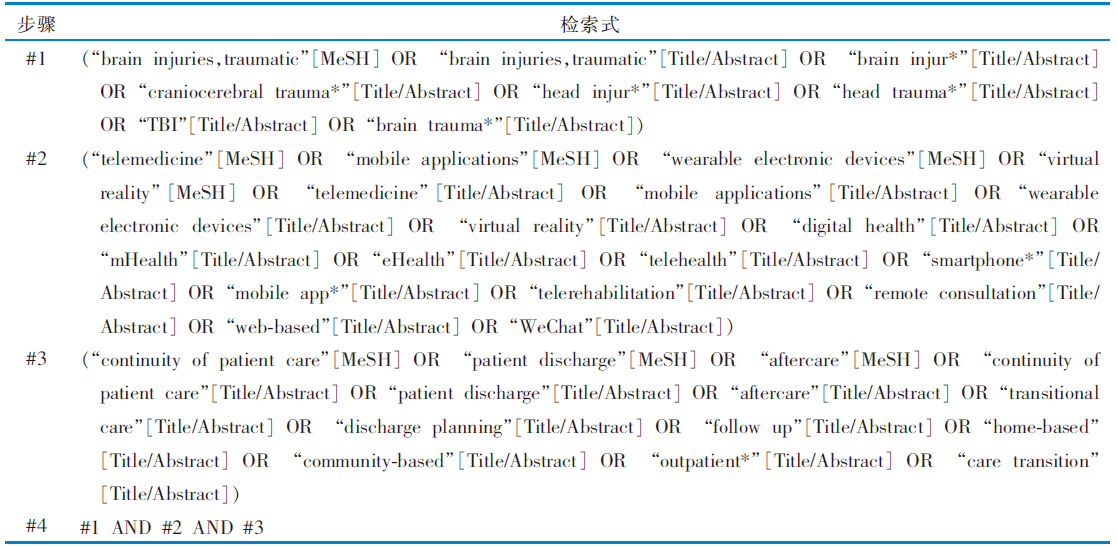 |
Table 1 Retrieval strategies of PubMed
| |
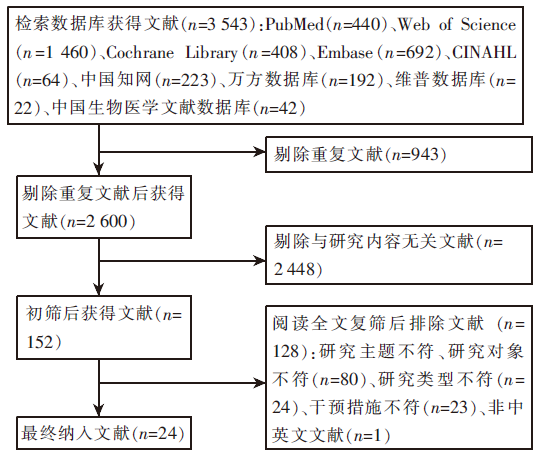
Figure 1 Literature inclusion and screening process
 |
Table 2 (Continued) Basic characteristics of included literature(n=24)
| |
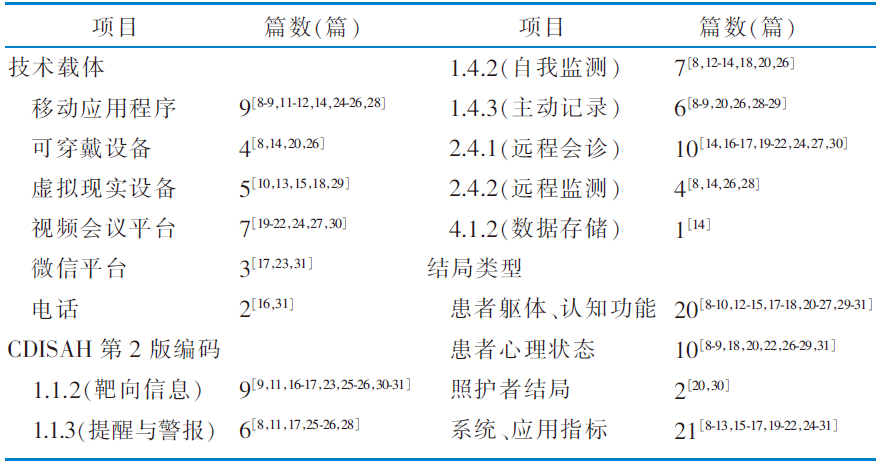 |
Table 3 Summary table of the characteristics of digital interventions and the frequency distribution across outcome domains in the included literature(n=24)
| |
| [1] |
Jiang JY, Gao GY, Feng JF, et al. Traumatic brain injury in China[J]. Lancet Neurol, 2019, 18(3):286-295.
DOI PMID |
| [2] |
王阳阳, 杨旻斐, 黄科儿, 等. 老年创伤性脑损伤合并衰弱患者早期运动康复照护促进与阻碍因素的质性研究[J]. 中华护理杂志, 2026, 61(7):939-946.
DOI |
| Wang YY, Yang MF, Huang KE, et al. Facilitating and hinder-ing factors for early exercise rehabilitation care of elderly patients with traumatic brain injury and frailty:a qualitative study[J]. Chin J Nurs, 2026, 61(7):939-946. | |
| [3] |
冯洁惠, 殷钰, 吴一女, 等. 专科护士主导的跨学科协作照护模式的构建与实践研究[J]. 中华护理杂志, 2025, 60(23):2821-2828.
DOI |
| Feng JH, Yin Y, Wu YN, et al. Development and implementa-tion of an interdisciplinary collaborative care model led by specialty nurses[J]. Chin J Nurs, 2025, 60(23):2821-2828. | |
| [4] |
毛文平, 骆金铠, 王力华, 等. 智能交互出院随访平台的构建与应用研究[J]. 中华护理杂志, 2024, 59(15):1812-1817.
DOI |
|
Mao WP, Luo JK, Wang LH, et al. Construction and application of an intelligent interactive discharge follow-up platform[J]. Chin J Nurs, 2024, 59(15):1812-1817.
DOI |
|
| [5] | World Health Organization. WHO classification of digital inter-ventions,services and applications in health:version 2[M]. Ge-neva: World Health Organization, 2023. |
| [6] |
Tricco AC, Lillie E, Zarin W, et al. PRISMA extension for scop-ing reviews(PRISMA-ScR):checklist and explanation[J]. Ann Intern Med, 2018, 169(7):467-473.
DOI URL |
| [7] | Peters MDJ, Godfrey C, McInerney P, et al. Chapter 11:scoping reviews(2020 version)[M/OL]//Aromataris E,Munn Z,editors. JBI manual for evidence synthesis. Adelaide: JBI,2020[2026-05-24]. https://synthesismanual.jbi.global. |
| [8] |
Tzeng HY, Chang CC, Chen SJ, et al. Impact of a digitally mo-nitored walking program on functional and psychological outcomes in individuals with mild traumatic brain injury:a randomized controlled trial[J]. Arch Phys Med Rehabil, 2026, 107(1):1-10.
DOI URL |
| [9] |
Gartell R, Morris J, Wallace T. Feasibility of using a mobile app supported executive function intervention in military service members and veterans with mTBI and co-occurring psy-chological conditions[J]. Int J Environ Res Public Health, 2023, 20(3):2457.
DOI URL |
| [10] |
Shen JB, Lundine JP, Koterba C, et al. VR-based cognitive re-habilitation for children with traumatic brain injuries:feasi-bility and safety[J]. Rehabil Psychol, 2022, 67(4):474-483.
DOI URL |
| [11] |
Juengst SB, McShan E, Conley M, et al. Feasibility and pilot testing of mobile health apps to supplement 2 healthy lifestyle interventions in chronic traumatic brain injury[J]. J Head Trauma Rehabil, 2022, 37(3):162-170.
DOI PMID |
| [12] |
Campbell KR, Peterka RJ, Fino PC, et al. The effects of aug-menting traditional rehabilitation with audio biofeedback in people with persistent imbalance following mild traumatic brain injury[J]. Front Neurol, 2022, 13:926691.
DOI URL |
| [13] |
Tefertiller C, Ketchum JM, Bartelt P, et al. Feasibility of vir-tual reality and treadmill training in traumatic brain injury:a randomized controlled pilot trial[J]. Brain Inj, 2022, 36(7):898-908.
DOI PMID |
| [14] | Raso MG, Arcuri F, Liperoti S, et al. Telemonitoring of patients with chronic traumatic brain injury:a pilot study[J]. Front Neu-rol, 2021, 12:598777. |
| [15] |
Tefertiller C, Hays K, Natale A, et al. Results from a randomi-zed controlled trial to address balance deficits after traumatic brain injury[J]. Arch Phys Med Rehabil, 2019, 100(8):1409-1416.
DOI URL |
| [16] |
Shahrokhi A, Azimian J, Amouzegar A, et al. The effect of telenursing on referral rates of patients with head trauma and their family’s satisfaction after discharge[J]. J Trauma Nurs, 2018, 25(4):248-253.
DOI PMID |
| [17] | 丁莉, 徐松侠, 郭锋. 微信公众平台在中重度颅脑损伤患者随访管理中的运用效果分析[J]. 中国实用护理杂志, 2016, 32(7):514-517. |
| Ding L, Xu SX, Guo F. Analysis on application effect of the WeChat public platform in follow-up management of patients with moderate or severe craniocerebral injury[J]. Chin J Pract Nurs, 2016, 32(7):514-517. | |
| [18] | Johansen T, Matre M, Tornås S, et al. Experiences with virtual reality-based cognitive training in persons with TBI:a quali-tative study[J]. Disabil Rehabil Assist Technol, 2025, 20(1):2490218. |
| [19] |
Kornblith E, Schweizer S, Abrams G, et al. Telehealth delivery of group-format cognitive rehabilitation to older veterans with TBI:a mixed-methods pilot study[J]. Appl Neuropsychol Adult, 2025, 32(3):615-627.
DOI URL |
| [20] |
O’Neil J, Egan M, Marshall S, et al. The impact of two telere-habilitation supervision schedules on physical activity,mobi-lity,and balance among people with moderate to severe trau-matic brain injury:a mixed-method single-subject design[J]. Physiother Can, 2023, 75(2):118-131.
DOI URL |
| [21] |
Demirtakan T, Işık S, Usta T, et al. Challenges and effective-ness of remote neurological follow-up of children with concus-sion following TBI using telemedicine[J]. Ir J Med Sci, 2025, 194(2):707-715.
DOI |
| [22] |
Conklin JP, McCauley KL, Breitenstein J, et al. Implementation of telehealth and hybrid service delivery of interdisciplinary rehabilitation for military populations with traumatic brain injury[J]. NeuroRehabilitation, 2023, 53(4):535-545.
DOI URL |
| [23] | 周林玲, 嵇慧, 俞岚, 等. 基于微信平台的延续性护理对重型颅脑损伤病人术后康复效果的影响[J]. 中国临床神经外科杂志, 2020, 25(7):481-483. |
| Zhou LL, Ji H, Yu L, et al. Effect of continuous nursing based on WeChat platform on postoperative rehabilitation of patients with severe traumatic brain injury[J]. Chin J Clin Neurosurg, 2020, 25(7):481-483. | |
| [24] | Bertolucci F, Fossati L, Agostini B, et al. Tele-rehabilitation for cognitive home-based treatment in young traumatic brain injury:a pilot study[J]. Eur J Phys Rehabil Med, 2024, 60(3):420-422. |
| [25] |
Ertas-Spantgar F, Korabova S, Gabel A, et al. Guiding patients with traumatic brain injury through the instrumental activities of daily living with the RehaGoal App:a feasibility study[J]. Disabil Rehabil Assist Technol, 2024, 19(2):254-265.
DOI URL |
| [26] |
Ding K, Juengst SB, Neaves S, et al. Usability of a two-way personalized mobile trainer system in a community-based exercise program for adults with chronic traumatic brain injury[J]. Brain Inj, 2022, 36(3):359-367.
DOI URL |
| [27] | Campbell KR, Wilhelm JL, Pettigrew NC, et al. Implementation and adoption of telerehabilitation for treating mild traumatic brain injury[J]. J Neurol Phys Ther, 2022, 46(4):E1-E10. |
| [28] |
Usmani S, Balcer L, Galetta S, et al. Feasibility of smartphone-delivered progressive muscle relaxation in persistent post-traumatic headache patients[J]. J Neurotrauma, 2021, 38(1):94-101.
DOI URL |
| [29] |
Moraes TM, Zaninotto AL, Neville IS, et al. Immersive virtual reality in patients with moderate and severe traumatic brain injury:a feasibility study[J]. Health Technol, 2021, 11(5):1035-1044.
DOI |
| [30] |
Rietdijk R, Power E, Attard M, et al. Improved conversation out-comes after social communication skills training for people with traumatic brain injury and their communication partners:a clinical trial investigating in-person and telehealth delivery[J]. J Speech Lang Hear Res, 2020, 63(2):615-632.
DOI URL |
| [31] | 吴海燕, 张和妹, 邢增娜, 等. 延续护理对重型颅脑损伤患者影响的研究[J]. 护理管理杂志, 2019, 19(12):898-901. |
| Wu HY, Zhang HM, Xing ZN, et al. Effect of continuous nurs-ing on patients with severe craniocerebral injury[J]. Chin J Nurs Manag, 2019, 19(12):898-901. |
| [1] | LI Qiuhua, FU Guifen, JIANG Jianhua, YIN Dan, ZUO Jing, LIU Yanqun. The application of wearable devices in dynamic monitoring and management of patients with inflammatory bowel disease:a scoping review [J]. Chinese Journal of Nursing, 2026, 61(8): 1132-1140. |
| [2] | WANG Yangyang, YANG Minfei, HUANG Keer, YAO Xiaoyue, ZHAO Yanxiang, LI Jiaqi, YIN Na, HUANG Ling, ZHANG Ju. Facilitating and hindering factors for early exercise rehabilitation care of elderly patients with traumatic brain injury and frail:a qualitative study [J]. Chinese Journal of Nursing, 2026, 61(7): 939-946. |
| [3] | WANG Xiuli, DAI Chunhao, XU Ziting, LI Haoyuan, LENG Minmin, ZHANG Haibo, LI Qing, YANG Lijuan. A scoping review on the application of exercise interventions in elderly patients with sarcopenic obesity [J]. Chinese Journal of Nursing, 2026, 61(7): 995-1001. |
| [4] | HE Jingting, YING Yanping, LU Qiufang, ZHAO Huihan, LIU Liying, MA Hanzhang, ZHANG Cheng. Scoping review on the application of multimodal data in the nursing field [J]. Chinese Journal of Nursing, 2026, 61(7): 1002-1008. |
| [5] | WU Ling, WU Bo, CHEN Hong, GU Chenxi, LIU Yang, ZHANG Chunjin, CHEN Mengqi, ZHANG Qing. Machine learning-based prediction models for intraoperative hypothermia risk in adults:a scoping review [J]. Chinese Journal of Nursing, 2026, 61(6): 844-851. |
| [6] | CHEN Jing, WANG Junjun, WEI Xiaoqiong, HE Huan, SUN Qiuyi, TANG Ying, HAN Ying, HE Huayun. Exercise intervention in children with juvenile idiopathic arthritis:a scoping review [J]. Chinese Journal of Nursing, 2026, 61(6): 858-864. |
| [7] | WEN Jia, GUO Huifang, GUO Jingjing, TIAN Yunxia, YANG Yue, LIU Bo. Social isolation in maintenance hemodialysis patients:a scoping review [J]. Chinese Journal of Nursing, 2026, 61(5): 605-611. |
| [8] | KUANG Wan, ZHU Min, HU Luhong. Brief mindfulness-based interventions in perioperative surgical patients:a scoping review [J]. Chinese Journal of Nursing, 2026, 61(5): 707-714. |
| [9] | CHEN Danlu, CHEN Ru, SHAN Yawei, SHI Chunxiang, SHEN Zhongming. Telemedicine in exercise rehabilitation for patients after total knee arthroplasty:a scoping review [J]. Chinese Journal of Nursing, 2026, 61(4): 467-474. |
| [10] | ZHOU Xinying, XU Yihong, ZHOU Liping, GONG Xiaoyan, YE Huan, LIU Xiaona, ZHUANG Yiyu. A scoping review on the relationship between gender differences and health related quality of life among stroke patients [J]. Chinese Journal of Nursing, 2026, 61(4): 571-577. |
| [11] | NAN Xue, KONG Jiaqi, LI Genyu, QI Qingqing, LIU Ziqi, WU Yani, YIN Min. A scoping review of research on theory evaluation criteria in nursing [J]. Chinese Journal of Nursing, 2026, 61(3): 412-418. |
| [12] | FAN Jingyu, YIN Tingting, YANG Bingqing, YAN Jingjing, SONG Yulei, YIN Haiyan, BAI Yamei. Application of olfactory training in the intervention in cognitive function of elderly adults:a scoping review [J]. Chinese Journal of Nursing, 2026, 61(22): 3142-3148. |
| [13] | ZHU Junyu, JIANG Ling. A scoping review and nursing implications of factors influencing the clinical application of donor human milk [J]. Chinese Journal of Nursing, 2026, 61(22): 3149-3156. |
| [14] | LIU Zhiping, HOU Zimei, YUAN Yuan, HAN Qianqian, FENG Qian. Digital exclusion in remote follow-up for patients with enterostomy:a scoping review [J]. Chinese Journal of Nursing, 2026, 61(22): 3157-3162. |
| [15] | CHEN Sijia, XU Mengna, ZHANG Yifan, CHEN Mengran, JIA Sansan, WU Junlong, WANG Jing, XU Xiaoxia. Interventions for fear of cancer recurrence in patients with colorectal cancer:a scoping review [J]. Chinese Journal of Nursing, 2026, 61(21): 3011-3017. |
| Viewed | ||||||
|
Full text |
|
|||||
|
Abstract |
|
|||||
