

Chinese Journal of Nursing ›› 2026, Vol. 61 ›› Issue (20): 2847-2854.DOI: 10.3761/j.issn.0254-1769.2026.20.016
• Evidence Synthesis Research • Previous Articles Next Articles
YU Qunfei1( ), MA Yaojing1, LIANG Xiaoying1, YUE Lan1, WANG Manman1, YE Qun1, YU Chengfei1, SHENG Shaoying1, REN Ying2,*()
Received:2026-05-08
Online:2026-10-20
Published:2026-10-12
* Corresponding author:
REN Ying,E-mail:ry0900@zju.edu.cnFunding program:
余群飞1(), 马姚静1, 梁晓英1, 岳岚1, 王曼曼1, 叶群1, 余城飞1, 盛少英1, 任英2,*()
通讯作者:
任英,E-mail:ry0900@zju.edu.cn作者简介:余群飞:女,硕士,副主任护师,E-mail:2515211@zju.edu.cn余群飞、梁晓英:文献检索、质量评价、论文撰写;马姚静、岳岚、王曼曼、叶群:文献筛选、数据提取、质量评价;余城飞、盛少英:文献筛选、数据核查、资料整理;任英:数据分析、结果解释、论文修改
基金资助:YU Qunfei, MA Yaojing, LIANG Xiaoying, YUE Lan, WANG Manman, YE Qun, YU Chengfei, SHENG Shaoying, REN Ying. A systematic review of risk prediction models for venous thromboembolism patients after spinal surgery[J]. Chinese Journal of Nursing, 2026, 61(20): 2847-2854.
余群飞, 马姚静, 梁晓英, 岳岚, 王曼曼, 叶群, 余城飞, 盛少英, 任英. 脊柱术后患者静脉血栓栓塞风险预测模型的系统评价[J]. 中华护理杂志, 2026, 61(20): 2847-2854.
Add to citation manager EndNote|Ris|BibTeX
URL: https://zh.zhhlzzs.com/EN/10.3761/j.issn.0254-1769.2026.20.016
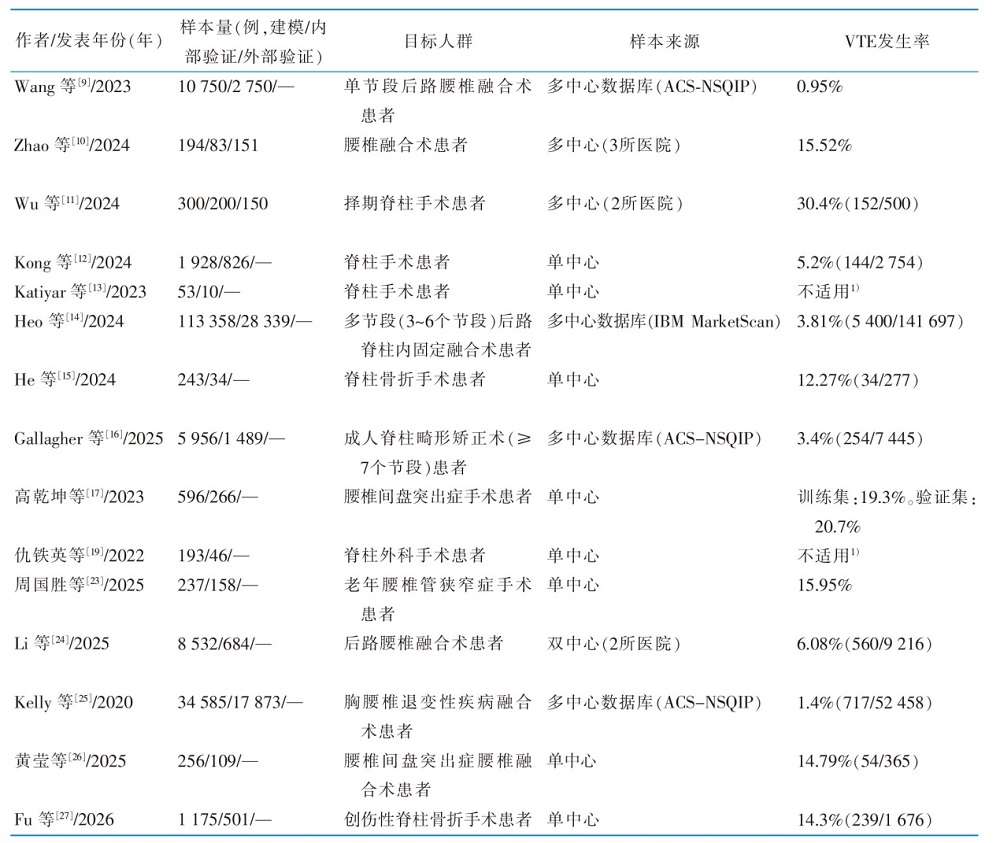 |
Table 1 Characteristics of the included studies(n=15)
| |
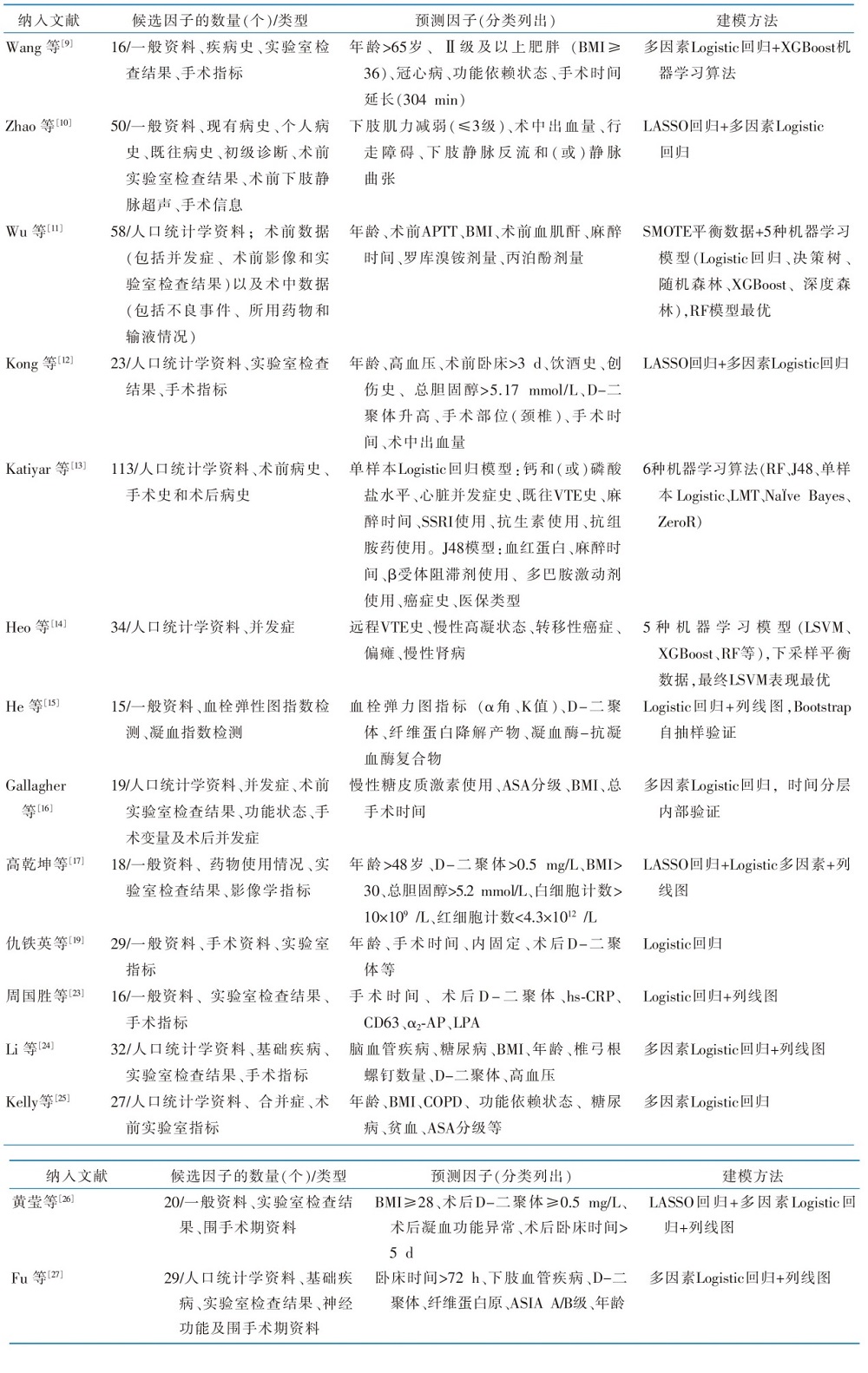 |
Table 2 Characteristics and performance of the included studies(n=15)
| |
| [1] |
McClendon J, Smith TR, O’Shaughnessy BA, et al. Time to event analysis for the development of venous thromboembolism after spinal fusion≥5 levels[J]. World Neurosurg, 2015, 84(3):826-833.
DOI PMID |
| [2] |
Yang SD, Liu H, Sun YP, et al. Prevalence and risk factors of deep vein thrombosis in patients after spine surgery:a retros-pective case-cohort study[J]. Sci Rep, 2015, 5:11834.
DOI |
| [3] |
Rockson HB, DiPaola CP, Connolly PJ, et al. Venous thromboem-bolism prophylaxis for patients having elective spine surgery:when,why,and how much[J]. J Bone Joint Surg Am, 2019, 101(13):1220-1229.
DOI URL |
| [4] |
鲁乔丹, 王磊, 邓海波, 等. 深静脉血栓形成患者健康相关生活质量评估工具的研究进展[J]. 中华护理杂志, 2022, 57(22):2791-2795.
DOI |
|
Lu QD, Wang L, Deng HB, et al. Research progress of health-related quality of life assessment tools for patients with deep vein thrombosis[J]. Chin J Nurs, 2022, 57(22):2791-2795.
DOI |
|
| [5] |
Massaro AM, Frier S, Strot SM, et al. Revisiting anticoagulation in spine surgery:balancing venous thromboembolic events and epidural hematoma[J]. Global Spine J, 2025, 15(2):363-369.
DOI URL |
| [6] | Cloney MB, Dhillon E, Hopkins B, et al. Chemoprophylactic an-ticoagulation after spine surgery does not increase epidural hematoma risk:a propensity-matched analysis[J]. Clin Spine Surg, 2024, 37(2):E97-E105. |
| [7] |
Moons KGM, de Groot JAH, Bouwmeester W, et al. Critical ap-praisal and data extraction for systematic reviews of predic-tion modelling studies:the CHARMS checklist[J]. PLoS Med, 2014, 11(10):e1001744.
DOI URL |
| [8] |
Moons KGM, Wolff RF, Riley RD, et al. PROBAST:a tool to assess risk of bias and applicability of prediction model studies:explanation and elaboration[J]. Ann Intern Med, 2019, 170(1):W1-W33.
DOI URL |
| [9] |
Wang KY, Ikwuezunma I, Puvanesarajah V, et al. Using predic-tive modeling and supervised machine learning to identify patients at risk for venous thromboembolism following posterior lumbar fusion[J]. Global Spine J, 2023, 13(4):1097-1103.
DOI URL |
| [10] |
Zhao YX, Kong XZ, Song KL, et al. Analysis of risk factors and establishment of prediction model for lower extremity deep vein thrombosis after lumbar fusion surgery[J]. BMC Surg, 2024, 24(1):392.
DOI PMID |
| [11] |
Wu XY, Wang Z, Zheng LL, et al. Construction and verifica-tion of a machine learning-based prediction model of deep vein thrombosis formation after spinal surgery[J]. Int J Med Inform, 2024, 192:105609.
DOI URL |
| [12] |
Kong WQ, Shao C, Du YK, et al. Nomogram for predicting venous thromboembolism after spinal surgery[J]. Eur Spine J, 2024, 33(3):1098-1108.
DOI |
| [13] | Katiyar P, Chase H, Lenke LG, et al. Using machine learning(ML) models to predict risk of venous thromboembolism(VTE) following spine surgery[J]. Clin Spine Surg, 2023, 36(10):E453-E456. |
| [14] |
Heo KY, Rajan PV, Khawaja S, et al. Machine learning approach to predict venous thromboembolism among patients undergo-ing multi-level spinal posterior instrumented fusion[J]. J Spine Surg, 2024, 10(2):214-223.
DOI URL |
| [15] |
He YT, Wang Z, Zheng X, et al. Construction of nomogram model for risk of venous thromboembolism after spine surgery based on thromboelastography and coagulation indices[J]. Front Med, 2024, 11:1486190.
DOI URL |
| [16] |
Gallagher DO, Bondar K, Hirase T, et al. Risk factors for and prediction of early thromboembolic disease following adult spinal deformity surgery:an analysis of >7,400 patients with spinal deformity[J]. J Bone Joint Surg Am, 2025, 107(11):1219-1226.
DOI URL |
| [17] | 高乾坤, 张文明, 曹向阳, 等. 腰椎间盘突出症患者发生下肢深静脉血栓的危险因素及列线图术前预测模型构建[J]. 中华实用诊断与治疗杂志, 2023, 37(9):896-902. |
| Gao QK, Zhang WM, Cao XY, et al. Risk factors of lower extremity deep vein thrombosis in patients with lumbar disc herniation and construction of preoperative predictive nomo-gram model[J]. J Chin Pract Diagn Ther, 2023, 37(9):896-902. | |
| [18] | 陈浏阳. 脊柱手术术后静脉血栓形成的相关因素分析及预测模型构建[D]. 扬州: 扬州大学, 2025. |
| Chen LY. Analysis of related factors of venous thrombosis after spinal surgery and construction of prediction model[D]. Yangzhou: Yangzhou University, 2025. | |
| [19] | 仇铁英, 高素园, 王卫星, 等. 脊柱外科患者术后静脉血栓危险因素分析及预测模型构建[J]. 中华现代护理杂志, 2022, 28(20):2694-2700. |
| Qiu TY, Gao SY, Wang WX, et al. Risk factors for postope-rative venous thromboembolism in patients in department of spinal surgery and construction of a predictive model[J]. Chin J Mod Nurs, 2022, 28(20):2694-2700. | |
| [20] | 谷光辉. 后入路腰椎融合术后下肢深静脉血栓形成风险预测模型的构建[D]. 济南: 山东大学, 2022. |
| Gu GH. Construction of a risk prediction model of deep vein thrombosis in patients after posterior lumbar fusion[D]. Jinan: Shandong University, 2022. | |
| [21] | 邵成. 脊柱术后并发静脉血栓栓塞症的危险因素分析及预测模型构建[D]. 青岛: 青岛大学, 2022. |
| Shao C. Risk factors analysis and prediction model construc-tion of venous thromboembolism after spinal surgery[D]. Qing-dao: Qingdao University, 2022. | |
| [22] | 赵一祥. 脊柱外科术后下肢深静脉血栓形成的危险因素分析及预测模型建立[D]. 济南: 山东大学, 2023. |
| Zhao YX. Risk factors of lower extremity deep venous throm-bosis after spinal surgery and development of a predictive model[D]. Jinan: Shandong University, 2023. | |
| [23] | 周国胜, 徐昆, 郭晓燕, 等. 基于围术期指标及CD63、α_2-AP、LPA建立的老年腰椎管狭窄症患者术后下肢深静脉血栓预警模型及验证[J]. 医学研究与战创伤救治, 2025, 38(6):614-619. |
| Zhou GS, Xu K, Guo XY, et al. An early warning model and validation of postoperative lower extremity deep vein throm-bosis in elderly patients with lumbar spinal stenosis based on perioperative indicators and CD63,α2-AP,and LPA[J]. J Med Res Combat Trauma Care, 2025, 38(6):614-619. | |
| [24] |
Li X, Ma JL, Xue L, et al. Nomogram to assess the risk of deep venous thrombosis after posterior lumbar fusion:a retro-spective study[J]. Global Spine J, 2025, 15(4):2169-2175.
DOI URL |
| [25] |
Kelly M, Speciale A, Patton C, et al. A predictive model of preoperative risk factors for venous thromboembolism after fusion for degenerative conditions of the thoracolumbar spine[J]. J Orthop, 2020, 22:598-601.
DOI URL |
| [26] | 黄莹, 孙玛骥, 祝明秋, 等. 腰椎间盘突出症患者腰椎融合术后下肢深静脉血栓发生的风险预测模型[J]. 徐州医科大学学报, 2025, 45(12):905-910. |
| Huang Y, Sun MJ, Zhu MQ, et al. Risk prediction model for deep venous thrombosis in the lower limbs after lumbar interbody fusion in patients with lumbar disc herniation[J]. Acta Acad Med Xuzhou, 2025, 45(12):905-910. | |
| [27] |
Fu GX, Wang Y, Tan DW, et al. Development and validation of a nomogram for predicting postoperative lower extremity deep vein thrombosis in patients with traumatic spinal fractures:a retrospective study[J]. Peer J, 2026, 14:e21184.
DOI URL |
| [28] |
范志英, 焦文仓, 王亚红, 等. 间歇充气加压装置不同使用时长对预防腰椎融合术中患者静脉血栓的效果评价[J]. 中华护理杂志, 2022, 57(4):449-454.
DOI |
| Fan ZY, Jiao WC, Wang YH, et al. Intervention study of app-lying intermittent pneumatic compression devices with diffe-rent duration in lumbar fusion surgery[J]. Chin J Nurs, 2022, 57(4):449-454. | |
| [29] |
Afshari A, Ageno W, Ahmed A, et al. European guidelines on perioperative venous thromboembolism prophylaxis:executive summary[J]. Eur J Anaesthesiol, 2018, 35(2):77-83.
DOI PMID |
| [30] |
米元元, 陈婷, 周英凤, 等. 脊柱外科术后患者深静脉血栓预防及管理的最佳证据总结[J]. 中华护理杂志, 2019, 54(2):288-294.
DOI |
| Mi YY, Chen T, Zhou YF, et al. Evidence summary for preven-tion and management of deep venous thrombosis after spinal surgery[J]. Chin J Nurs, 2019, 54(2):288-294. |
| [1] | LI Jia, ZHANG Yuling, XING Le, ZHANG Lifeng, NIU Xiufeng, XU Li. Construction and validation of a risk prediction model for secondary peripherally inserted central catheter tip malposition in the upper extremity of preterm infants [J]. Chinese Journal of Nursing, 2026, 61(9): 1180-1186. |
| [2] | LI Yantao, YANG Lianzhao, LONG Xiuhong, CHEN Ling, GAO Hui, QIN Wenting, ZHU Fanghui, LUO Xueer. Meta-synthesis of post-traumatic growth experiences in people living with HIV/AIDS [J]. Chinese Journal of Nursing, 2026, 61(9): 1261-1268. |
| [3] | LI Tiantian, QU Nan, CUI Liping, WEI Ling, ZHANG Lifeng, CHENG Yiwei, SUN Shuang. Risk prediction models for thrombosis in autologous arteriovenous fistulas in hemodialysis patients:a Meta-analysis [J]. Chinese Journal of Nursing, 2026, 61(9): 1269-1276. |
| [4] | HUANG Xuan, GUO Shuping, Caldenas Xiaodong, XIE Yunying, WANG Hanmin, ZHANG Yumei, LIU Taoli, LI Li. Systematic review of measurement properties of psoriasis patient specific self-reported outcome assessment tools and nursing implications [J]. Chinese Journal of Nursing, 2026, 61(8): 1117-1124. |
| [5] | ZHANG Ying, LIU Shujuan, WANG Jingrui, MA Qianrong. User experiences with virtual reality in patients with mild cognitive impairment:a Meta-synthesis [J]. Chinese Journal of Nursing, 2026, 61(8): 1125-1131. |
| [6] | WANG Jing, SHI Huan, LI Yunmeng. Construction and validation of a prediction model for the risk of aspiration in ICU patients receiving enteral nutrition support [J]. Chinese Journal of Nursing, 2026, 61(7): 877-883. |
| [7] | HAN Lin, YANG Lijuan, LI Taidong, ZHENG Xiaoli, CHENG Min, GUO Chen, ZHENG Peipei. Meta integration of communication experience of conscious patients with mechanical ventilation in ICU [J]. Chinese Journal of Nursing, 2026, 61(7): 901-908. |
| [8] | ZENG Jialin, FU Bing, YANG Lingyun, JIANG Qinghua. Evaluation of patient-reported outcome assessment tools for head and neck cancer patients and nursing implications [J]. Chinese Journal of Nursing, 2026, 61(7): 986-994. |
| [9] | WANG Xiuli, DAI Chunhao, XU Ziting, LI Haoyuan, LENG Minmin, ZHANG Haibo, LI Qing, YANG Lijuan. A scoping review on the application of exercise interventions in elderly patients with sarcopenic obesity [J]. Chinese Journal of Nursing, 2026, 61(7): 995-1001. |
| [10] | ZHENG Yan, ZENG Yongke, CHEN Jing, LUO Xiaoqin, XIA Liangxiang, ZHENG Silin. Application research of postoperative cardiac delirium patients risk prediction models [J]. Chinese Journal of Nursing, 2026, 61(6): 768-774. |
| [11] | WU Ling, WU Bo, CHEN Hong, GU Chenxi, LIU Yang, ZHANG Chunjin, CHEN Mengqi, ZHANG Qing. Machine learning-based prediction models for intraoperative hypothermia risk in adults:a scoping review [J]. Chinese Journal of Nursing, 2026, 61(6): 844-851. |
| [12] | WANG Fan, ZHAO Wenjuan, CAO Jiawei, LU Zhenqi. Construction and validation of a predictive model for puncture site bleeding complications in liver cancer patients after interventional therapy [J]. Chinese Journal of Nursing, 2026, 61(5): 689-696. |
| [13] | Nursing Committee of Orthopaedic Branch,Chinese Medical Association Writing:MEI Yingxue, HAN Mengyue, PAN Hanli, HAN Bing, YANG Xu. Expert consensus on the prevention of venous thromboembolism in major orthopaedic surgery [J]. Chinese Journal of Nursing, 2026, 61(4): 437-441. |
| [14] | JING Feng, JIANG Lingyun, CAO Yuling, TIAN Maoting, QIU Jiajia, TANG Lichen, HU Yan. Development and preliminary validation of a risk prediction model for musculoskeletal symptoms among breast cancer patients with endocrine therapy [J]. Chinese Journal of Nursing, 2026, 61(4): 498-505. |
| [15] | ZHENG Meihua, ZHU Rui, XIE Baoyuan, CHEN Feiyan, HUANG Guiyun, WANG Luzhen, LIU Yating, XU Chunhao, YANG Ruixiang. Evidence-based practice for enteral nutrition-related abdominal distension and diarrhea in postoperative digestive system tumor patients [J]. Chinese Journal of Nursing, 2026, 61(20): 2787-2794. |
| Viewed | ||||||
|
Full text |
|
|||||
|
Abstract |
|
|||||
