

Chinese Journal of Nursing ›› 2025, Vol. 60 ›› Issue (15): 1811-1817.DOI: 10.3761/j.issn.0254-1769.2025.15.003
• Special Planning——Elderly Chronic Disease Management & Health Promotion • Previous Articles Next Articles
LIU Yuhua( ), HAN Mengya, XU Yan, LUO Yuhong, XIN Chen, LIU Guixin, HAN Binru()
Received:2025-03-26
Online:2025-08-10
Published:2025-08-05
Contact:
HAN Binru
刘雨骅(), 韩梦雅, 徐琰, 罗玉红, 辛晨, 刘桂欣, 韩斌如()
通讯作者:
韩斌如
作者简介:刘雨骅:女,本科(硕士在读),护士,E-mail:Raingel_liu@163.com
基金资助:LIU Yuhua, HAN Mengya, XU Yan, LUO Yuhong, XIN Chen, LIU Guixin, HAN Binru. Construction and validation of a nomogram model for predicting cognitive frailty in hospitalized older adults[J]. Chinese Journal of Nursing, 2025, 60(15): 1811-1817.
刘雨骅, 韩梦雅, 徐琰, 罗玉红, 辛晨, 刘桂欣, 韩斌如. 住院老年患者认知衰弱列线图模型的构建与验证[J]. 中华护理杂志, 2025, 60(15): 1811-1817.
Add to citation manager EndNote|Ris|BibTeX
URL: https://zh.zhhlzzs.com/EN/10.3761/j.issn.0254-1769.2025.15.003
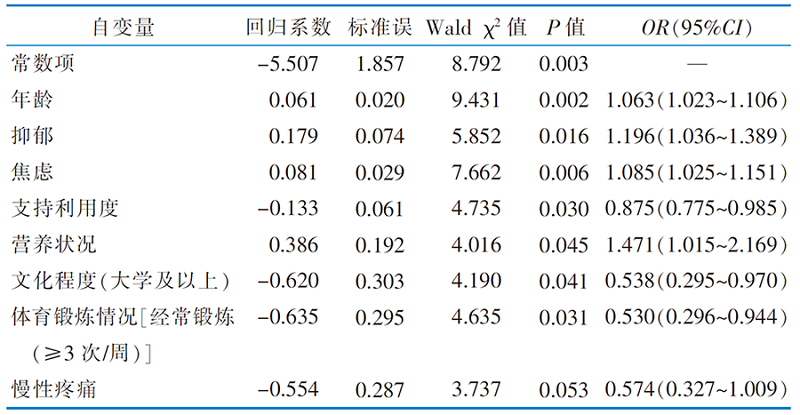 |
Table 1 Multifactorial Logistic regression analysis of cognitive frailty in hospitalized older patients(n=322)
| |
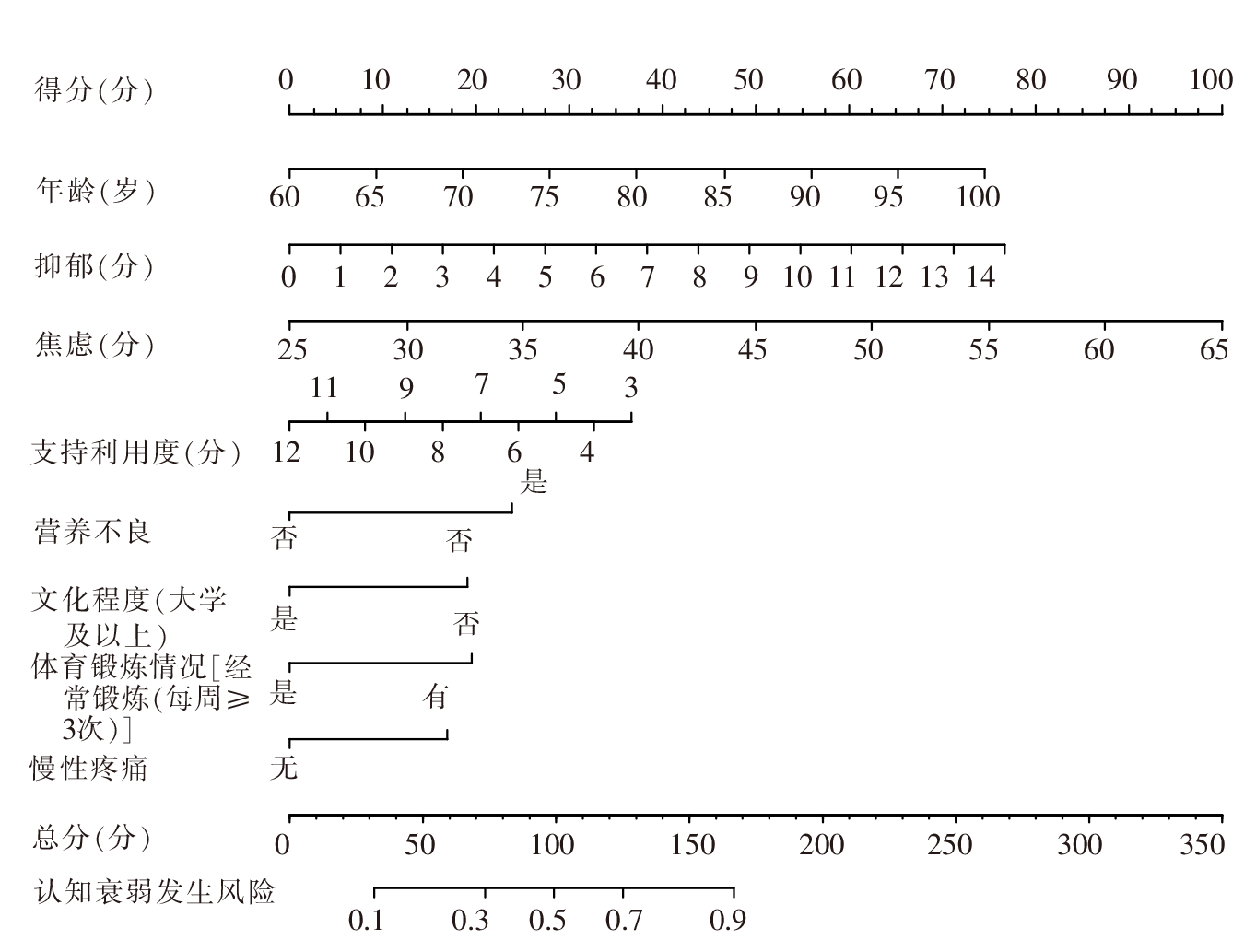
Figure 1 Nomogram of predicted risk of cognitive frailty in hospitalized older adults
| [1] |
Kelaiditi E, Cesari M, Canevelli M, et al. Cognitive frailty:ratio-nal and definition from an(I.A.N.A./I.A.G.G.) international con-sensus group[J]. J Nutr Health Aging, 2013, 17(9):726-734.
DOI PMID |
| [2] | Ruan QW, Yu ZW, Chen M, et al. Cognitive frailty,a novel target for the prevention of elderly dependency[J]. Ageing Res Rev, 2015,20:1-10. |
| [3] | Liu J, Xu SJ, Wang JR, et al. Prevalence of cognitive frailty among older adults in China:a systematic review and meta-analysis[J]. BMJ Open, 2023, 13(4):e066630. |
| [4] | Rivan NFM, Singh DKA, Shahar S, et al. Cognitive frailty is a robust predictor of falls,injuries,and disability among com-munity-dwelling older adults[J]. BMC Geriatr, 2021, 21(1):593. |
| [5] | Zheng LF, Li GC, Gao DW, et al. Cognitive frailty as a pre-dictor of dementia among older adults:a systematic review and meta-analysis[J]. Arch Gerontol Geriatr, 2020,87:103997. |
| [6] |
Diniz BS, Lima-Costa MF, Peixoto SV, et al. Cognitive frailty is associated with elevated proinflammatory markers and a higher risk of mortality[J]. Am J Geriatr Psychiatry, 2022, 30(7):825-833.
DOI PMID |
| [7] |
陈颖勇, 张正敏, 左倩倩, 等. 社区老年人认知衰弱风险预测模型的构建及验证[J]. 中华护理杂志, 2022, 57(2):197-203.
DOI |
| Chen YY, Zhang ZM, Zuo QQ, et al. Construction and valida-tion of a prediction model for the risk of cognitive frailty among the elderly in a community[J]. Chin J Nurs, 2022, 57(2):197-203. | |
| [8] | 周闯, 金学勤, 郭正丽, 等. 不同机器学习算法的社区老年人认知衰弱风险预测模型比较[J]. 护理学杂志, 2023, 38(19):1-5,11. |
| Zhou C, Jin XQ, Guo ZL, et al. Comparison of cognitive frailty risk prediction models for community older adults based on machine learning algorithms[J]. J Nurs Sci, 2023, 38(19):1-5,11. | |
| [9] | 杜瑾, 张迪, 陈玉荣, 等. 社区老年2型糖尿病患者认知衰弱风险列线图预测模型的建立与验证[J]. 中华行为医学与脑科学杂志, 2024(4):310-316. |
| Du J, Zhang D, Chen YR, et al. Establishment and validation of a nomogram prediction model for cognitive frailty in com-munity-dwelling elderly patients with type 2 diabetes mellitus[J]. Chin J Behav Med Brain Sci, 2024(4):310-316. | |
| [10] | Rubenstein LZ, Harker JO, Salvà A, et al. Screening for under-nutrition in geriatric practice:developing the Short-Form Mini-Nutritional Assessment(MNA-SF)[J]. J Gerontol A Biol Sci Med Sci, 2001, 56(6):M366-M372. |
| [11] |
Soldatos CR, Dikeos DG, Paparrigopoulos TJ. Athens Insomnia Scale:validation of an instrument based on ICD-10 criteria[J]. J Psychosom Res, 2000, 48(6):555-560.
DOI PMID |
| [12] | 简文佳, 时晶, 倪敬年, 等. 日常生活能力量表鉴别痴呆与轻度认知损害[J]. 中国老年学杂志, 2014, 34(4):865-868. |
| Jian WJ, Shi J, Ni JN, et al. Activities of Daily Living Rating for differentiating mild cognitive impairment and dementia[J]. Chin J Gerontol, 2014, 34(4):865-868. | |
| [13] | 巫嘉陵, 安中平, 王世民, 等. 脑卒中患者日常生活活动能力量表的信度与效度研究[J]. 中国现代神经疾病杂志, 2009, 9(5):464-468. |
| Wu JL, An ZP, Wang SM, et al. Study on reliability and validity of ADL Scale in patients with stroke[J]. Chin J Con-temp Neurol Neurosurg, 2009, 9(5):464-468. | |
| [14] |
Zung WW. A rating instrument for anxiety disorders[J]. Psychosomatics, 1971, 12(6):371-379.
DOI PMID |
| [15] | Du QY, Liu HW, Yang CJ, et al. The development of a short Chinese version of the State-Trait Anxiety Inventory[J]. Front Psychiatry, 2022,13:854547. |
| [16] |
Zhang H, Wang SM, Wang LJ, et al. Comparison of the Geria-tric Depression Scale-15 and the Patient Health Question-naire-9 for screening depression in older adults[J]. Geriatr Gerontol Int, 2020, 20(2):138-143.
DOI PMID |
| [17] | 肖水源. 《社会支持评定量表》的理论基础与研究应用[J]. 临床精神医学杂志, 1994, 4(2):98-100. |
| Xiao SY. Theoretical basis and research application of Social Support Rating Scale[J]. J Clin Psychiatry, 1994, 4(2):98-100. | |
| [18] | Fried LP, Tangen CM, Walston J, et al. Frailty in older adults:evidence for a phenotype[J]. J Gerontol A Biol Sci Med Sci, 2001, 56(3):M146-M156. |
| [19] |
郝立晓, 胡笑晨, 韩璎, 等. 英文版主观认知下降问卷的汉化及信效度分析[J]. 中国全科医学, 2019, 22(26):3238-3245.
DOI |
| Hao LX, Hu XC, Han Y, et al. Localization of Subjective Cognitive Decline Questionnaire and its reliability and validity test[J]. Chin Gen Pract, 2019, 22(26):3238-3245. | |
| [20] |
Folstein MF, Folstein SE, McHugh PR. “Mini-mental state”. A practical method for grading the cognitive state of patients for the clinician[J]. J Psychiatr Res, 1975, 12(3):189-198.
DOI PMID |
| [21] | 张振馨, 洪霞, 李辉, 等. 北京城乡55岁或以上居民简易智能状态检查测试结果的分布特征[J]. 中华神经科杂志, 1999, 32(3):149-153. |
| Zhang ZX, Hong X, Li H, et al. The minimental state exami-nation in the Chinese residents population aged 55 years and over in the urban and rural areas of Beijing[J]. Chin J Neurol, 1999, 32(3):149-153. | |
| [22] | 中国老年医学学会认知障碍分会. 临床痴呆评定量表简体中文版[J]. 中华老年医学杂志, 2018(4):367-371. |
| Academy of Cognitive Disorder of China. The clinical demen-tia rating(simplified Chinese)[J]. Chin J Geriatr, 2018(4):367-371. | |
| [23] | Tang HY, Zhu H, Sun QQ, et al. Transitions in the cognitive frailty states in community-living older adults:a 6-year pros-pective cohort study[J]. Front Aging Neurosci, 2021,13:774268. |
| [24] |
宋歌, 王颖, 高欢玲, 等. 老年慢性阻塞性肺疾病患者认知衰弱风险筛查模型的构建及验证[J]. 中华护理杂志, 2022, 57(15):1859-1867.
DOI |
|
Song G, Wang Y, Gao HL, et al. Construction and validation of a risk screening model for cognitive frailty in elderly patients with chronic obstructive pulmonary disease[J]. Chin J Nurs, 2022, 57(15):1859-1867.
DOI |
|
| [25] | Han KM, Ham BJ. How inflammation affects the brain in depression:a review of functional and structural MRI studies[J]. J Clin Neurol, 2021, 17(4):503-515. |
| [26] | Rathor P, Ch R. The impacts of dietary intervention on brain metabolism and neurological disorders:a narrative review[J]. Dietetics, 2024, 3(3):289-307. |
| [27] | Schock S, Hakim A. The physiological and molecular links between physical activity and brain health:a review[J]. Neurosci Insights, 2023,18:26331055231191523. |
| [28] | Tam ACY, Chan AWY, Cheung DSK, et al. The effects of inter-ventions to enhance cognitive and physical functions in older people with cognitive frailty:a systematic review and meta- analysis[J]. Eur Rev Aging Phys Act, 2022, 19(1):19. |
| [1] | PENG Yingjie, LIU Aihong, ZHU Wenli, MEI Yuxin, ZHOU Meng, GUAN Wenjing. Systematic review of readiness assessment tools for advance care planning in older adults [J]. Chinese Journal of Nursing, 2025, 60(9): 1146-1153. |
| [2] | TAN Yuting, ZHANG Zhixia, XU Mengli, GUO Peiran, XIAO Qin, QIAO Linru, SONG Feiyun, YU Qiaojun. Relationship between autonomous rehabilitation behavior and related symptoms of middle-aged stroke patients [J]. Chinese Journal of Nursing, 2025, 60(7): 773-778. |
| [3] | WU Liping, XIAO Lina, LAI Hanqing, HUANG Qian, GUO Xuan, ZHOU Xun. Qualitative study on the experience of fall alertness in elderly patients with rheumatoid arthritis [J]. Chinese Journal of Nursing, 2025, 60(7): 836-841. |
| [4] | HE Mengxin, CHEN Defeng, LI Bei, DONG Xuhui, LI Jiabao, YANG Yang, XU Yaokai, LIANG Yueyu. Intelligent interactive cognitive-motor training for fall prevention in older adults:a scoping review [J]. Chinese Journal of Nursing, 2025, 60(7): 884-889. |
| [5] | TANG Nan, GAO Yuan, SU Qingqing, SONG Mi, QIU Chen, SHAO Mengqi. An analysis influencing factors of subsequent fracture among elderly osteoporotic patients and nursing countermeasures [J]. Chinese Journal of Nursing, 2025, 60(6): 710-716. |
| [6] | FU Qin, ZHANG Xiumin, HOU Ming, WANG Caihong, LI Xiaomei, MAO Yongqin, LI Ping. Effect of somatosensory exercise based on artificial intelligence technology in home pulmonary rehabilitation of elderly patients with COPD [J]. Chinese Journal of Nursing, 2025, 60(5): 517-524. |
| [7] | Chinese Nursing Association Geriatric Nursing Committee, Beijing Hospital, National Center of Gerontology, Institute of Geriatric Medicine, Chinese Academy of Medical Sciences, School of Nursing, Peking University(Writing Committee:LIU Wenjing, WANG Zhiwen, YU Yuelin, REN Xin, JU Hui, CHEN Hong WANG Junxin, CHEN Shanshan, ZHOU Jia, YI Mo, WANG Wenxia, ZHANG Lingjuan, CHEN Siye, YANG Yufan, WANG Xiaomeng, SUN Hong). Guideline for assessment and maintenance of intrinsic capacity in older adults [J]. Chinese Journal of Nursing, 2025, 60(3): 261-265. |
| [8] | JIN Xiaochao, SHI Zhongying, ZHOU Yingfeng, HUANG Xiaoyan, HUANG Chuxian, GU Yanhong, SU Ya, LI Li. Application of a multicomponent exercise and cognitive stimulation program in elderly patients with mental disorders and sarcopenia [J]. Chinese Journal of Nursing, 2025, 60(3): 266-273. |
| [9] | WANG Min, YANG Wenjuan, LIAO Ting, ZOU Jinmei, LIAO Dongxia, ZHANG Cuicui, DENG Yingyi, GONG Xiyan, LIAO Changju. Construction and validation of a risk prediction model for oral frailty in the elderly community population [J]. Chinese Journal of Nursing, 2025, 60(3): 274-280. |
| [10] | DUAN Yu, GUO Zhanghui, ZHANG Jie, JIAO Meng, QU Jianni, LIU Guiying, ZHAO Dan, CHEN Yingyu, GUO Hong. Facilitators and barriers to the implementation of exercise for elderly patients with frailty:a qualitative Meta-synthesis [J]. Chinese Journal of Nursing, 2025, 60(3): 288-296. |
| [11] | ZHANG Xue, CAI Yan, WANG Cong, JIANG Yan. Research progress on cognitive-motor dual-task training for preventing falls in older adults [J]. Chinese Journal of Nursing, 2025, 60(3): 297-302. |
| [12] | QIU Chen, GAO Yuan, SHAO Mengqi, SU Xiaojing, WANG Qingmei, SONG Mi, HU Xingxing. An analysis of the present situation and barriers to home care for elderly patients with postoperative osteoporotic fractures [J]. Chinese Journal of Nursing, 2025, 60(2): 201-207. |
| [13] | SHI Yanhong, YAN Yuanjiao, LIN Rong, HUANG Chenshan, LI Hong. The application of user profiles in the health management of elderly patients with chronic diseases:a scoping review [J]. Chinese Journal of Nursing, 2025, 60(2): 244-250. |
| [14] | HAO Yuqing, HU Huixiu, ZHAO Yajie, GAO Jie, LUO Huanhuan, SUN Chao. Research progress and nursing inspiration on the relationship between social activities and cognitive function in older adults [J]. Chinese Journal of Nursing, 2025, 60(2): 251-256. |
| [15] | FAN Yingying, LÜ Pengpeng, CHEN Xueang, ZHANG Junmei, ZHAO Rui, ZHANG Shibian. Application of fragmented resistance exercise in exercise rehabilitation of elderly patients with chronic obstructive pulmonary disease [J]. Chinese Journal of Nursing, 2025, 60(15): 1797-1803. |
| Viewed | ||||||
|
Full text |
|
|||||
|
Abstract |
|
|||||
