

中华护理杂志 ›› 2026, Vol. 61 ›› Issue (18): 2486-2494.DOI: 10.3761/j.issn.0254-1769.2026.18.005
袁华娣1( ), 韩娜菲1, 高丽燕1, 贺红1, 吴小燕1, 吴竖光2, 严敏2,*()
收稿日期:2026-03-10
出版日期:2026-09-20
发布日期:2026-09-23
*通讯作者:
*严敏,E-mail:zryanmin@zju.edu.cn作者简介:袁华娣:女,本科,副主任护师,护士长,E-mail:yhd751024@zju.edu.cn袁华娣:研究设计、专家函询、论文撰写;韩娜菲:实施研究、论文撰写及修改;高丽燕:数据分析、论文撰写及修改;贺红:专家函询、论文修改;吴小燕:实施研究、论文修改;吴竖光:数据收集、论文修改;严敏:论文审阅、技术支持
YUAN Huadi1(), HAN Nafei1, GAO Liyan1, HE Hong1, WU Xiaoyan1, WU Shuguang2, YAN Min2,*()
Received:2026-03-10
Online:2026-09-20
Published:2026-09-23
* Corresponding author:
*YAN Min,E-mail:zryanmin@zju.edu.cn摘要:
目的 构建成人哮喘史患者围手术期气道管理方案并探究其应用效果,为围手术期哮喘预防与管理提供参考依据。 方法 2025年9月,通过文献研究、专家函询等形成该方案。采用便利抽样法,选取浙江省某三级甲等医院的165例哮喘史患者作为研究对象,其中2025年10—12月纳入的80例患者为试验组,2024年10—12月纳入的85例患者为对照组,试验组实施构建的气道管理方案,对照组实施常规气道管理。比较两组干预前后血管活性药物使用率、气道痉挛发生率、哮喘急性发作发生率、气管拔管时间、麻醉后监护病房停留时间、院前等待时间、术前等待时间、患者住院时间的差异。 结果 最终试验组纳入80例,对照组纳入83例。试验组气道痉挛发生率为15.00%,低于对照组的32.53%;哮喘急性发作发生率为11.25%,低于对照组的22.89%,差异均具有统计学意义(P=0.009、0.049);试验组术前等待时间为1.0(1.0,2.0)d,低于对照组的2.0(1.0,3.0)d,差异具有统计学意义(P=0.010)。两组其他指标的比较,差异无统计学意义(P>0.05)。 结论 构建的气道管理方案具有科学性,可满足成人哮喘史患者围手术期护理需求,实施该方案能降低患者气道痉挛和哮喘急性发作的风险,缩短术前等待时间,改善围手术期预后。
袁华娣, 韩娜菲, 高丽燕, 贺红, 吴小燕, 吴竖光, 严敏. 成人哮喘史患者围手术期气道管理方案的构建及应用研究[J]. 中华护理杂志, 2026, 61(18): 2486-2494.
YUAN Huadi, HAN Nafei, GAO Liyan, HE Hong, WU Xiaoyan, WU Shuguang, YAN Min. Construction and application of a perioperative airway management protocol for adult patients with a history of asthma[J]. Chinese Journal of Nursing, 2026, 61(18): 2486-2494.
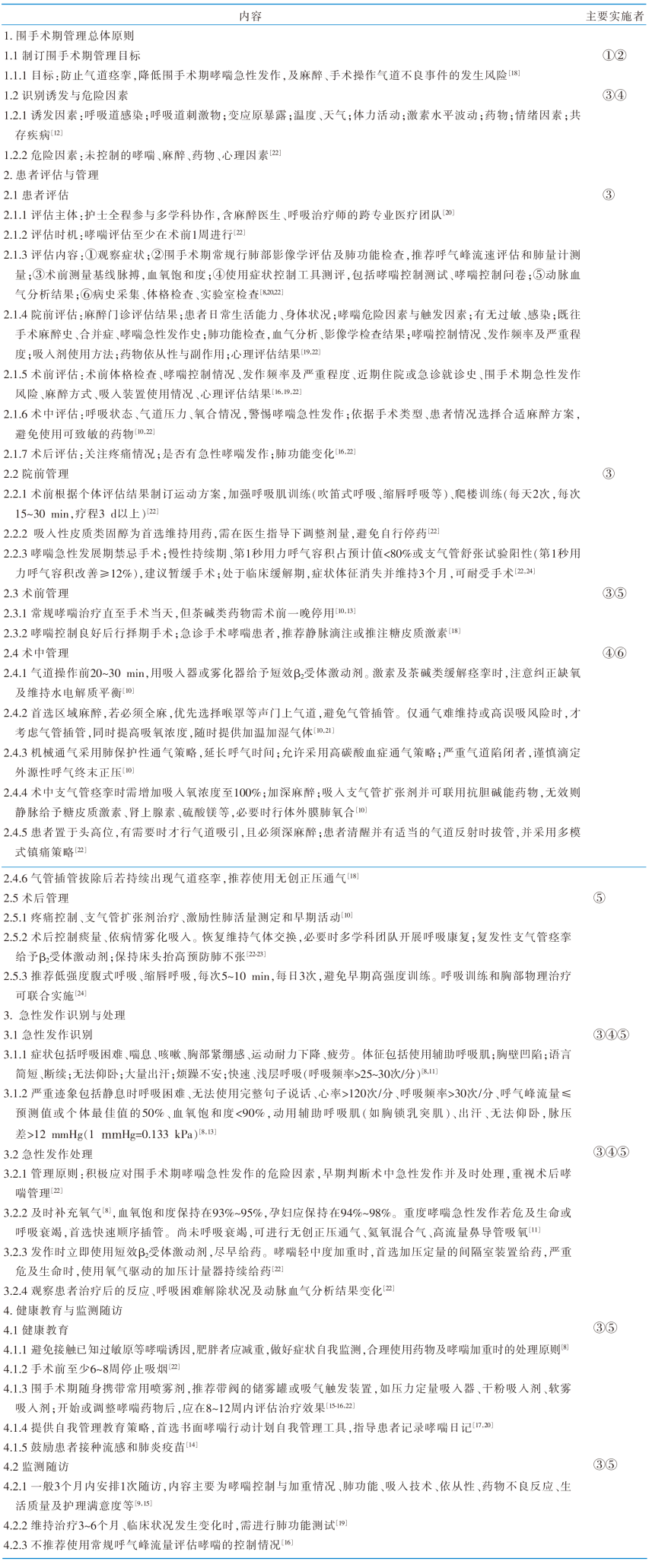 |
表1 成人哮喘患者围手术期气道管理方案
Table 1 The perioperative airway management in adult patients with asthma
| |
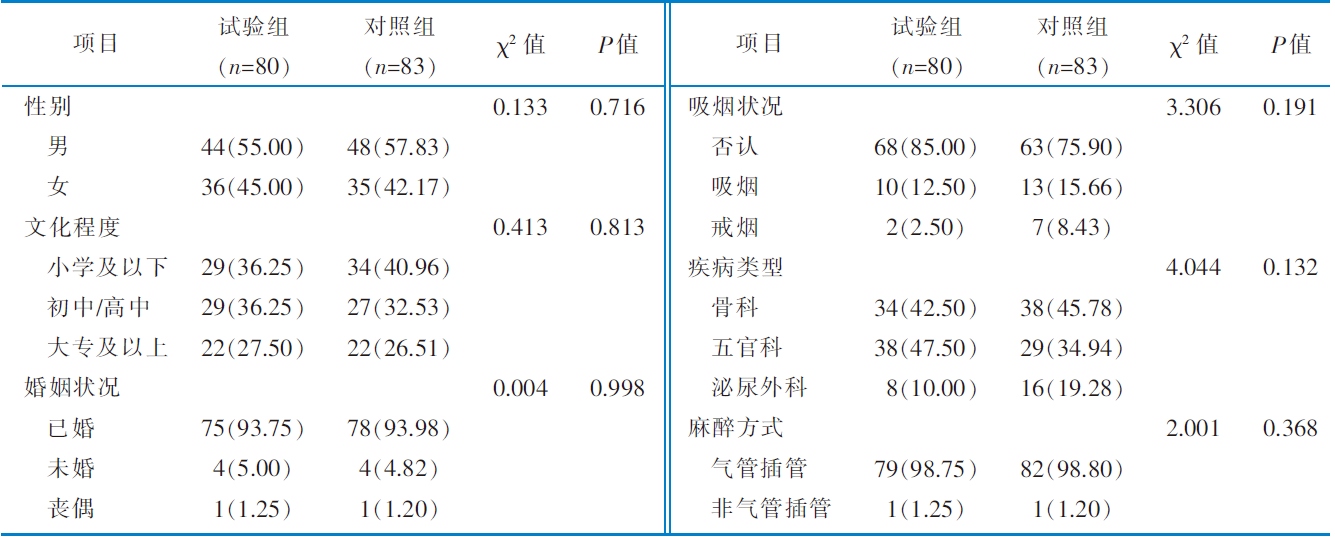 |
表2 两组一般资料的比较[例(百分比,%)]
Table 2 Comparison of general data between the 2 groups[case(percentage,%)]
| |
 |
表3 两组主要结局指标的比较
Table 3 Comparison of primary indicators between the 2 groups of patients
| |
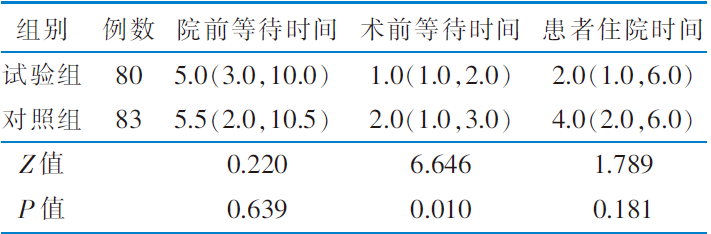 |
表4 两组次要结局指标的比较[d,M(P25,P75)]
Table 4 Comparison of secondary indicators between the 2 groups of patients[d,M(P25,P75)]
| |
| [1] |
Jayasooriya SM, Devereux G, Soriano JB, et al. Asthma:epidemiology,risk factors,and opportunities for prevention and treatment[J]. Lancet Respir Med, 2025, 13(8):725-738.
DOI PMID |
| [2] |
Yu JR, Xu L, Han AZ, et al. The epidemiology of asthma in Mainland China:a systematic review and meta-analysis[J]. BMC Public Health, 2024, 24(1):2888.
DOI |
| [3] |
Liang HR, Che GW, Cui F, et al. Multidisciplinary international expert consensus on perioperative airway management[J]. Transl Lung Cancer Res, 2025, 14(4):1042-1060.
DOI URL |
| [4] |
Numata T, Nakayama K, Fujii S, et al. Risk factors of postoperative pulmonary complications in patients with asthma and COPD[J]. BMC Pulm Med, 2018, 18(1):4.
DOI PMID |
| [5] |
Junaidi B, Hawrylak A, Kaw R. Evaluation and management of perioperative pulmonary complications[J]. Med Clin N Am, 2024, 108(6):1087-1100.
DOI URL |
| [6] |
Mohamed-Hussein AAR, Sayed SS, Eldien HMS, et al. Beta 2 adrenergic receptor geneticpolymorphisms in bronchial asthma:relationship to disease risk,severity,and treatment response[J]. Lung, 2018, 196(6):673-680.
DOI PMID |
| [7] |
Tamaoki J, Nagase H, Sano H, et al. Practical guidelines for asthma management(PGAM):digest edition[J]. Respir Investig, 2025, 63(3):405-421.
DOI PMID |
| [8] | Katherine NC. Acute exacerbations of asthma in adults Home and office management[EB/OL]. (2024-10-01)[2025-12-01]. http://112.2.34.14:9095/contents/zh-Hans/acute-exacerbations-of-asthma-in-adults-home-and-office-management?search=-%20Acute%20exacerbations%20of%20asthma%20in%20adults_%20Home%20and%20office%20management%20-%20UpToDate&source=search_result&selectedTitle=1-150&usage_type=default&display_rank=1. |
| [9] | Anne ED, Tara FC. Ongoing monitoring and titration of asthma therapies in adolescentsand adults[EB/OL]. (2025-09-26)[2025-12-01]. http://112.2.34.14:9095/contents/zh-Hans/ongoing-monitoring-and-titration-of-asthma-therapies-in-adolescents-and-adults?search=Ongoing%20monitoring%20and%20titration%20of%20asthma%20therapies%20in%20adolescents%20and%20adults%20&source=search_result&selectedTitle=1-150&usage_type=default&display_rank=1. |
| [10] | Zyad JC. Anesthesia for adult patients with asthma[EB/OL].(2024-01-08)[2025-12-01]. http://112.2.34.14:9095/contents/zh-Hans/anesthesia-for-adult-patients-with-asthma?search=Anesthesia%20for%20adult%20patients%20with%20asthma&source=search_result&selectedTitle=1-150&usage_type=default&display_rank=1. |
| [11] | Andy J, Rachel S. Airway management in acute severe asthma for emergency medicineand critical care[EB/OL]. (2024-01-08)[2025-12-01]. http://112.2.34.14:9095/contents/zh-Hans/airway-management-in-acute-severe-asthma-for-emergency-medicine-and-critical-care?search=Airway%20management%20in%20acute%20severe%20asthma%20for%20emergency%20medicine%20and%20critical%20&source=search_result&selectedTitle=1-150&usage_type=default&display_rank=1. |
| [12] | Rachel LM. Trigger control to enhance asthma management[EB/OL]. (2025-07-20)[2025-12-01]. http://112.2.34.14:9095/contents/zh-Hans/trigger-control-to-enhance-asthma-management?search=Trigger%20control%20to%20enhance%20asthma%20management%20-%20UpToDate.pdf%3E%20%5BJ%5D.%20&source=search_result&selectedTitle=1-150&usage_type=default&display_rank=1. |
| [13] | Katherine NC. Acute exacerbations of asthma in adults emergency department and inpatient management[EB/OL]. (2025-09-26)[2025-12-01]. http://112.2.34.14:9095/contents/zh-Hans/acute-exacerbations-of-asthma-in-adults-emergency-department-and-inpatient-management?search=-%20Acute%20exacerbations%20of%20asthma%20in%20adults_%20Emergency%20department%20and%20inpatient%20management%20&source=search_result&selectedTitle=1-150&usage_type=default&dis-play_rank=1. |
| [14] | Priya JP. Asthma education and self-management[EB/OL].(2025-07-14)[2025-12-01]. http://112.2.34.14:9095/contents/zh-Hans/asthma-education-and-self-management?search=Asthma%20 education%20and%20self-management&source=search_result& selectedTitle=1-150&usage_type=default&display_rank=1. |
| [15] | Tina H, Leonard BB. An overview of asthma management in children and adults[EB/OL]. (2025-08-08)[2025-12-01]. http://112.2.34.14:9095/contents/zh-Hans/an-overview-of-asthma-management-in-children-and-adults?search=An%20overview%20of%20asthma%20management%20in%20children%20and%20adults%20&source=search_result&selectedTitle=1-150&usage_type=default&display_rank=1. |
| [16] | National Institute for Health and Care Excellence(NICE). Asthma: diagnosis,monitoringand chronic asthma management[EB/OL].(2017-11-29)[2025-12-01]. https://www.nice.org.uk/guidance/ng80. |
| [17] | Yang CL, Hicks EA, Mitchell P, et al. Canadian Thoracic Society 2021 guideline update:diagnosis and management of asthma in preschoolers,children and adults[J]. Paediatr Child Health, 2021, 5(6):348-361. |
| [18] | 中华医学会呼吸病学分会. 支气管哮喘防治指南(2024年版)[J]. 中华结核和呼吸杂志, 2025, 48(3):208-248. |
| Chinese Thoracic Society, Chinese Medical Association. Guidelines for the prevention and management of bronchial asthma(2024 edition)[J]. Chin J Tuberc Respir Dis, 2025, 48(3):208-248. | |
| [19] | Global Initiative for AsthmaGINA. Global strategy for asthma management and prevention[EB/OL]. (2025-05-06)[2025-12-01]. https://ginasthma.org/2025-gina-summary-guide. |
| [20] | Registered Nurses Association of Ontario(RNAO). Adult asthma care: promoting control of asthma,second edition[EB/OL]. (2017-05-02)[2025-12-01]. https://rnao.ca/bpg/guidelines/adult-asthma-care. |
| [21] | 中华医学会呼吸病学分会, 哮喘学组中国哮喘联盟. 支气管哮喘急性发作评估及处理中国专家共识[J]. 中华内科杂志, 2018, 57(1):4-14. |
| Asthma Group of Chinese Thoracic Society,China Asthma Alliance. The Chinese experts’ consensus on the evaluation and management of asthma exacerbation[J]. Chin J Intern Med, 2018, 57(1):4-14. | |
| [22] | 王晴, 张转运, 张偌翠, 等. 围术期患者哮喘评估与干预的最佳证据总结[J]. 实用临床医药杂志, 2023, 27(7):56-61. |
| Wang Q, Zhang ZY, Zhang RC, et al. Summary of the best evidence for perioperative asthma assessment and intervention[J]. J Clin Med Pract, 2023, 27(7):56-61. | |
| [23] |
Bayable SD, Melesse DY, Lema GF, et al. Perioperative management of patients with asthma during elective surgery:a systematic review[J]. Ann Med Surg, 2021, 70:102874.
DOI URL |
| [24] | Santino TA, Chaves GS, Freitas DA, et al. Breathing exercises for adults with asthma[J]. Cochrane Database Syst Rev, 2020, 3(3):CD001277. |
| [25] |
应春钗, 李雅岑, 刘宁宁, 等. “互联网+产后母婴居家护理”护士核心能力指标的构建及验证[J]. 中华护理杂志, 2025, 60(12):1486-1492.
DOI |
| Ying CC, Li YC, Liu NN, et al. Construction and verification of a core competency index system of nurses in “internet+postpartum maternal and infant home care”[J]. Chin J Nurs, 2025, 60(12):1486-1492. | |
| [26] |
巩晓珊, 林安琪, 秦玉, 等. 术前虚拟现实场景模拟训练对老年肺癌患者术后谵妄的干预效果研究[J]. 中华护理杂志, 2026, 61(3):332-339.
DOI |
|
Gong XS, Lin AQ, Qin Y, et al. Study on the intervention effect of preoperative virtual reality scene simulation training on postoperative delirium in elderly lung cancer patients[J]. Chin J Nurs, 2026, 61(3):332-339.
DOI |
|
| [27] |
袁芳, 冯勤, 钱援芳, 等. 基于有限时间理论的日间手术全流程护理清单的构建与应用[J]. 中华护理杂志, 2024, 59(10):1226-1232.
DOI |
|
Yuan F, Feng Q, Qian YF, et al. Construction and application of a nursing list for whole process of day surgery based on the theory of limited time[J]. Chin J Nurs, 2024, 59(10):1226-1232.
DOI |
|
| [28] | 郭俊, 周纯. 肾上腺素对重症支气管哮喘急性发作患者肺功能及呼吸动力学的影响[J]. 中华急诊医学杂志, 2020, 29(2):268-271. |
| Guo J, Zhou C. Effect of epinephrine on pulmonary function and respiratory dynamics in patients with acute attack of severe bronchial asthma[J]. Chin J Emerg Med, 2020, 29(2):268-271. | |
| [29] | Christian B, Daniel C, Hong L. A contemporary approach to the treatment of perioperative bronchospasm[J]. Transl Perioper & Pain Med, 2020, 7(2):190-198. |
| [30] | Woods BD, Sladen RN. Perioperative considerations for the patient with asthma and bronchospasm[J]. Br J Anaesth, 2009, 103(S1):i57-i65. |
| [31] | Jordan RR. Preoperative optimization of the asthmatic patient[J]. Anesth eJournal, 2022, 10(4):1-2. |
| [32] |
Budiarto A, Tsang KCH, Wilson AM, et al. Machine learning-based asthma attack prediction models from routinely collected electronic health records:systematic scoping review[J]. JMIR AI, 2023, 2:e46717.
DOI URL |
| [1] | 中华护理学会静脉输液治疗专业委员会, 北京护理学会, (执笔:李佳, 李旭英, 覃惠英, 陈利芬, 吴珍明, 胡泽吟, 罗梦娜, 范育英, 吴嘉慧, 林宇萍, 王蕾, 孙文彦, 冯毕龙, 高伟, 李亚南, 侯罗娅, 李春燕. 中心静脉通路装置拔除护理专家共识[J]. 中华护理杂志, 2026, 61(9): 1157-1162. |
| [2] | 周霞, 马艳艳, 师正坤, 于海霞, 周艳, 胡红玲, 李莜, 陈思思, 张京慧. 隧道式经股静脉PICC置入术在困难静脉通路婴幼儿中的应用研究[J]. 中华护理杂志, 2026, 61(9): 1163-1170. |
| [3] | 黄萍, 李黎, 郭骊莉, 徐莹, 叶赟, 江淑芳. 与无针输液接头相关的导管相关性血流感染风险评估工具的构建与初步应用[J]. 中华护理杂志, 2026, 61(9): 1171-1179. |
| [4] | 李佳, 张玉玲, 邢乐, 张利峰, 牛秀峰, 许莉. 早产儿经上肢置入PICC尖端继发性异位风险预测模型的建立与验证[J]. 中华护理杂志, 2026, 61(9): 1180-1186. |
| [5] | 何娟, 赵蕾蕾, 叶冠军, 余艳芬, 傅晓君, 周琴. 1例双侧无名静脉及上腔静脉人工血管置换术后患者经上肢置入PICC的护理[J]. 中华护理杂志, 2026, 61(9): 1187-1191. |
| [6] | 梁江淑渊, 曾妃, 何鹏, 谢梦珊, 江悦, 蒋宗恒, 王建茗. 静脉-静脉体外膜肺氧合患者早期活动风险等级评估系统的构建及应用研究[J]. 中华护理杂志, 2026, 61(9): 1192-1199. |
| [7] | 陈晨, 顾肖, 郭凡, 王敏, 倪兴梅, 黄琴, 程念开. 3种衰弱评估工具对急诊老年创伤患者不良结局的预测价值[J]. 中华护理杂志, 2026, 61(9): 1200-1207. |
| [8] | 郑煜琳, 刘晋宁, 张静, 郭会敏, 谷艳梅, 张莉莉. 酒精性肝病患者肝移植术后再饮酒现状及其影响因素分析[J]. 中华护理杂志, 2026, 61(9): 1208-1214. |
| [9] | 叶俊霜, 沈丽佳, 孟霞靓, 张玉姣, 蔡根莲, 邵碧云, 周亚辉, 张柳倩, 应金萍. 维持性血液透析患者对口腔衰弱认知和体验的质性研究[J]. 中华护理杂志, 2026, 61(9): 1215-1220. |
| [10] | 王芸姣, 杨玉金, 郑春艳, 彭菲津, 王淑贞, 蒋喜露, 周为民, 王薇, 张娜. 糖尿病下肢动脉硬化闭塞症患者介入术后康复护理方案的构建及应用研究[J]. 中华护理杂志, 2026, 61(9): 1221-1229. |
| [11] | 杨明霞, 安冉, 臧金凤, 李春梅. 老年慢性病共病患者及照护者老老照护能力与自我忽视的相关性分析[J]. 中华护理杂志, 2026, 61(9): 1230-1236. |
| [12] | 梁和静, 许鹊, 史云霞, 祖金美, 黄文静, 杨春旭, 郭明华, 王磊. 颈动脉内膜剥脱术围手术期护理质量评价指标的构建[J]. 中华护理杂志, 2026, 61(9): 1237-1244. |
| [13] | 韩媛媛, 石玉竹, 尚文涵, 么莉. 870所三级甲等医院老年住院患者跌倒伤害发生现状与影响因素分析[J]. 中华护理杂志, 2026, 61(9): 1245-1252. |
| [14] | 夏云芳, 王洪, 崔岱, 付真真, 朱敏. 1例弥漫性毒性甲状腺肿合并超敏反应综合征青少年患者的护理[J]. 中华护理杂志, 2026, 61(9): 1253-1256. |
| [15] | 周益飞, 王海苹, 胡益环, 应莉, 罗松娜. 1例氢氟酸中毒并发呼吸心搏骤停患者的急救护理[J]. 中华护理杂志, 2026, 61(9): 1257-1260. |
| 阅读次数 | ||||||
|
全文 |
|
|||||
|
摘要 |
|
|||||
